
This is the free version of Porter Stansberry’s Complete Investor, which provides market analysis and investor insights. Paid subscribers get access to the full issue, including investment recommendations with buy-up-to prices, a real-time list of holdings, and more. Click here for details.
The AI Power Provider The Market Way Underappreciates
When the chambermaid found Nikola Tesla’s body in Room 3327 in The New Yorker Hotel, the great inventor was wearing nothing but a pair of socks.
The plans for his Death Ray were missing, too.
All that was left in the hotel room where Tesla died was a half-empty safe with a few medals and personal effects. As a swarm of government spooks discovered when they descended on the New Yorker that day in 1943, the blueprint for the mysterious superweapon he’d been designing for the past few years was gone.
By the time of his death, the genius creator of alternating current and wireless transmission had become a wild-eyed old man shuffling to a different hotel after he ran up too large of a bill at the current one. In his yearly press conference – an event eagerly awaited by the public – he’d pitched ideas for radio-operated warfare drones and lightning-bolt-shooting towers.
Lately, though, he’d been talking about a Death Ray... and he insisted that this invention was real.
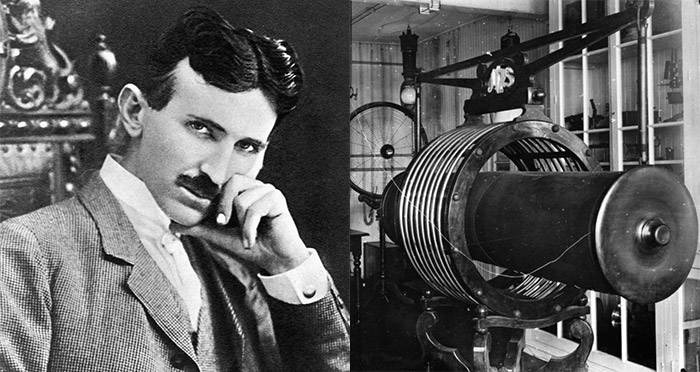
No one was quite sure how the Death Ray worked. As Tesla (above) described it to The New York Times, it was a “particle beam” that would pack 100 billion watts of power into a fraction of a centimeter, and could shoot down an airplane from hundreds of miles away. Sensational news reports of the time described it as the “hammer of Thor” or more euphemistically, the “peace ray.”
What did seem certain was that it was something to do with particle physics – a real field of study that was heating up during the 1930s just as the world was preparing for international war...
In an era when the boundary between science and science fiction was still somewhat malleable, the idea of a Death Ray wasn’t as far-fetched as it might sound today.
As World War II progressed, both the Germans and the Japanese had put in some serious work on weapons of mass destruction – although the Japanese model was unfortunately only strong enough to kill “a rabbit after five minutes at a distance of a thousand yards.” And the Nazis’ “heliobeam,” a contraption designed to reflect the sun from space and burn enemies to a crisp, flopped – for obvious reasons.
But particle science seemed to point a viable way forward. Ever since the late 1800s, when Cambridge University physics professor J.J. Thomson discovered that atoms were made of even tinier particles, scientists had been obsessed with speeding up atoms to the point that they crashed and broke.
This atom-smashing also produced bursts of concentrated energy, which – conceivably – could be channeled into something like Tesla’s “bolt of Thor.”
It also required significant amounts of energy, initially provided by small generators, and then, as particle machines became more advanced, by generators sufficient to power large houses, then small cities.
Throughout the early part of the 20th century, physicists introduced a parade of progressively stronger atom-speeders and atom-smashers, like the Cockcroft-Walton machine, which accelerated particles in a straight line, and the Cyclotron, which sent them around and around in a circle. By 1940, they were up to the Betatron, “the world’s most powerful accelerator,” a four-ton behemoth that improved on the Cyclotron by adding a 30-kilowatt electromagnet.
The technology was there, and Nikola Tesla – or so he claimed – had figured out how to kill people with it. Then he died in his socks in The New Yorker Hotel.
The only person to touch Tesla’s personal effects had been his Serbian nephew, Sava Kosanovic, who – classified memos later revealed – was a spy with ties to Hitler’s Germany. Kosanovic scribbled down plans to sell his uncle’s papers to the Nazis, and then conveniently disappeared.
The papers – whatever they were – vanished too.
What we do know is that in 1943 – the year Tesla died – the Nazis suddenly had a full-fledged plan to create a particle beam death ray... and they’d kidnapped the world’s two top particle scientists to build it for them...
A Device For Mass Destruction
When the particle scientists got nabbed, Austrian-born Bruno Touschek and Norwegian Rolf Wideroe were studying how to collide particles into each other rather than firing them at a stationary target – thus, the Germans imagined, unleashing even more potent levels of destruction.
Neither scientist wanted to help the Nazis build the Death Ray.
But the Germans had leverage: Touschek was broke, and Wideroe’s brother was languishing in the Grini concentration camp. In 1943, the Reich Ministry of Aviation sequestered the pair in a basement lab in Hamburg to tinker with a Betatron and turn it into a working Death Ray.
Wideroe played along: he parlayed his research skills into better living conditions for his brother, who was moved to an easier work post and ultimately freed in 1945.
But half-Jewish Touschek dragged his feet on the project, which by doing so he said “signed his own death warrant.” Every time the Nazis thought he wasn’t working fast enough, they’d come in and threaten to drag him off to a concentration camp, which they eventually did.
Over the years, Touschek told varied tall tales about how he got away... some involving a high fever and being left for dead on the side of the road, some involving gunfire. Biographers speculate that he was embarrassed about helping the Nazis – even under duress – and had to invent a little extra heroism for himself.
What’s certain is that by 1950, both he and Wideroe were safely in Switzerland, helping to launch the newly-formed international particle research lab, CERN (the French acronym for European Council for Nuclear Research). CERN was stern about its peacetime-only mission statement and refused to have anything to do with X-ray guns, “peace rays,” or any sort of exotic particle weapon.
That was effectively the end of the Death Ray. So far, no one has ever built one. The Nazi Betatron project was seized as Allied war booty and eventually disappeared. And – as far as we know – Tesla’s mysterious blueprint remains missing.
Energy-Hungry Particle Splitters
What we did get was the nuclear bomb – the Manhattan Project used Cyclotrons to split uranium atoms – and a host of useful peacetime projects like radiation therapy, food sterilization, and ion implantation for semiconductor chips. (Less useful: a bucketload of conspiracy theories about time travel and parallel dimensions connected with CERN.)
We also got a bottomless pit of energy hunger.
From Tesla’s Death Ray onwards, particle research has always demanded larger amounts of electricity to break atoms into smaller and smaller and smaller bits.
After mastering the Cyclotron and the Betatron, particle scientists Touschek and Wideroe dug in at CERN to build the next level of particle accelerator: the super-powerful 1950s Synchrotron, capable of speeding up particles to billions of electrovolts. A Who’s Who of international eggheads soon joined them.
By the 1970s, CERN boasted a bewildering lineup of particle reactors – including a Synchro-Cyclotron, Intersecting Storage Rings, and a Super Proton Synchrotron – had upped the energy needs of those machines by 1,000-fold, and had commandeered a string of power stations to run its ever more complex atom smashers.
At that point, one of CERN’s research physicists got fed up with this increasing energy inefficiency in the particle-science field. He decided to invent a method of power conversion that would take tiny amounts of power and turn them into large amounts, so he took a step back from CERN and started his own electronics company.
Which brings us to this month’s recommendation...
In a twist that would make Nikola Tesla proud, this former particle physicist has now become a key player in our biggest modern-day arms race: he’s built a weapon of mass production for the artificial intelligence (“AI”) industry.
The Quiet Lineage Behind Modern Computing
Every era of computing rests on the shoulders of a small number of people most investors have never heard of. You won’t hear their names on CNBC or trending on X. Their faces don't appear on magazine covers. But without them, the chips that power your phone, your car, your computer, and the AI revolution simply would not exist.
Consider three of them.
Robert Noyce co-invented the integrated circuit in 1959. He then co-founded Intel (INTC) in 1968, ran it as its first CEO, and shaped the entire culture of Silicon Valley – the flat hierarchies, the merit-based promotion, the stock options for engineers. The reason Silicon Valley looks the way it does is largely because Bob Noyce decided it should.
Bob Widlar designed the first commercially successful operational amplifier in 1964. Then he designed dozens more analog circuits that became industry standards. Every analog engineer in the world today still uses circuits with his name attached to them – the Widlar current source, the Widlar bandgap reference. He produced more foundational analog intellectual property (“IP”) from one mind than entire engineering teams have produced since.
Bob Pease worked alongside Widlar at National Semiconductor, designing precision analog integrated circuits (“IC”) that ran in everything from medical devices to spacecraft. But his more lasting contribution was philosophical. For two decades he wrote Pease Porridge, the column that taught a generation of engineers that analog design is physics-first, intuition-driven work that cannot be replaced by simulation software or committee.
These three men share a pattern that we believe is the most underappreciated wealth-creation pattern in technology investing.
-
They didn't just discover something – they built the companies that turned the discovery into core infrastructure
-
They were personally the named inventors on the foundational IP, rather than the CEOs who hired the inventors – the patents have their names on them
-
Their work compounded for decades, in a field that the broader investing public ignored, until it became impossible to ignore
When the world finally caught up to what Noyce, Widlar, and Pease had built, it was already too late to compete with them. The IP estate had been laid down and the companies had been built. The moat was 20 or 30 years deep before anyone outside the industry noticed.
We believe there is one more name that belongs in this lineage. He is alive, he is still working, and his life's work is on the verge of becoming the most critical infrastructure layer of the AI era.
He is still the founder, CEO, chairman, and largest shareholder of the company we will be recommending this month.
Subscribe to Porter Stansberry’s Complete Investor to unlock the rest of this issue and more.
Become a Complete Investor subscriber today to get instant access to the rest of this issue and other valuable subscriber-only content.
A Complete Investor subscription gets you:
-
Monthly Issues – a detailed analysis on a new recommendation plus ongoing updates on the existing list of recommendations
-
Special Reports – deep-dive analyses covering every major market-moving trend, such as artificial intelligence and other breakthrough technologies. Plus, why property & casualty insurance stocks are a must-own, the best ways to invest in energy and commodities.
-
Buy / Sell Alerts – instant notifications when any stock in our recommended list makes a major move worthy of your attention.
-
Monthly Roundtable – listen in to this exclusive podcast as Porter and his editorial team discuss the markets, the open recommendations, and the strategies subscribers can use to maximize their returns
-
Custom Investment Indexes - such as the Better Than Berkshire Index, a systematic approach to building your own Berkshire Hathaway holdings using superior companies, and The Lindy Index, the top-40 companies that have been compounding returns for at least 50 years, to name just two
-
Porter’s Permanent Portfolio – a fully balanced portfolio with 25% allocated to bond-like investments, 25% in the world’s best businesses, 25% in hard assets, and 25% in cash-like investments. Despite having half the risk of the market, this portfolio has consistently outperformed the S&P since inception
-
And more…
Click here to lock in our lowest available rate --> a savings of $575 off the usual annual rate.
This content is only available for paid members. If you are interested in joining Porter & Co. either click the button below now or call our Customer Care team at 888-610-8895.