Issue #113, Volume #3


To Fix Healthcare In America, Put The Patient Back In Charge
Inside today's Daily Journal…
|
Obama should have driven a Trabant.
You might not recognize the car brand. The Trabant had a two-cylinder, two-stroke engine that made 26 horsepower – the exact motor you would normally find in a chainsaw. To make it lighter, its body panels were not steel but Duroplast – a plastic pressed out of recycled cotton waste and phenol resin. There were no working gauges. You checked the fuel tank with a dipstick. And because you mixed the oil into the gasoline by hand at every fill-up, the engine belched roughly nine times the hydrocarbons of an ordinary Western car. The design didn’t evolve for 30 years. And in East Germany, where the car was made, it cost more than a full year's wages for the average worker.
It was automotive abortion… and yet people waited a third of their working lives to buy one.
The Trabant was a car built by politics. It was not designed to move people efficiently or safely. It was built to empower the ruling class. But because there was no other car available, people still waited more than a decade to buy a chainsaw on wheels.
The same is true about Obamacare. President Barack Obama’s Affordable Care Act isn’t a healthcare system. It is a redistribution scheme designed to empower the State.
It forced insurers to accept every applicant regardless of health (known as “guaranteed issue”) and to charge the sick roughly the same price as the healthy (known as “community rating”).
When the architects of Obamacare bolted the same two rules onto the entire nation, they knew what would happen. Insurance only works when it can be intelligently underwritten. If the very sick are allowed to buy insurance at the same price as the very healthy, then the price of insurance will soar. The healthy will stop buying it. And premiums climb.
Actuaries have a name for this. It’s called the premium death spiral.
The politicians’ fix was the individual mandate: a tax to force the healthy to pay and subsidize the sick. Because it was a broad-based, flat tax (it wasn’t only the rich who had to pay) it didn’t last long. Congress eliminated it in 2017. And so… now what must happen?
-
In 2026, the average premium payment jumped 58%
-
Deductibles rose 37% to a record $3,786
-
Enrollment collapsed from about 22.3 million to an estimated 17.5 million – the sharpest single-year drop ever recorded
The people who left Obamacare were disproportionately young and healthy – of course. This is a premium death spiral. The 2027 rate filings – a 28% request in Washington on top of last year's 35% – are simply insurers pricing the sicker pool as the healthy leave.
None of this is a surprise.
In the mid-1990s, eight states imposed guaranteed issue and community rating on their individual markets: Kentucky, Maine, Massachusetts, New Hampshire, New Jersey, New York, Vermont, and Washington. Every one of them saw premiums surge and healthy buyers flee.
Kentucky repealed its law. New Hampshire repealed its law. Washington let insurers turn away the sickest applicants just to keep the market breathing.
But New York? There is no reforming the most corrupt state government in the country. New York mandated guaranteed issue and pure community rating in 1993 and proceeded to hold the title of the most expensive individual market in America for two decades. Its individual market did not shrink. It vanished – falling 96%. The Supreme Court itself, in King v. Burwell, cited this history. New York's reforms had "effectively eliminated the commercial individual indemnity market."
This isn’t a bug – it’s a feature to the political class. Obamacare was never engineered to deliver cheap medicine. It was engineered to deliver a fully dependent political constituency. On that measure, it has worked flawlessly.
This is a program that produces a visible victim every fall when the premium subsidies are re-evaluated. The policy is manufactured to concentrate benefits on organized groups and disperse the costs across everyone else. The insurers get a guaranteed customer base. The hospitals get patients who can pay. The drug makers get enormously subsidized demand and prices. And the taxpayer gets the bill.
When political schemes like this break – as they surely will – the fix is never "remove the market distortion." It is "add another subsidy," which wins another election cycle and deepens the dependency.
Every system that abolishes price (rational insurance underwriting) ends up rationing with time. This is exactly what’s next for America.
Britain now has 7.29 million people on its treatment waiting list. Canada, which bans most private payment for covered services, has watched its median wait from a family doctor's referral to actual treatment grow to 30 weeks in 2024, up from 9.3 weeks in 1993.
Suppressing a price does not repeal the underlying cost. It only hides who is paying it and how. When you make care "free," you do not make it abundant. You simply move the scarcity from the price tag to the queue. And the queue is paid in suffering that never shows up in a budget line.
Contrast Singapore. It spends about 4.5% of its GDP on health. The United States spends 18%. We’re spending nearly one dollar in every five on Trabants!
Singapore's outcomes are among the best on Earth. Its secret is not magic: it is ownership. Money flows through individual medical savings accounts, so patients spend their own dollars and shop accordingly. Catastrophic insurance covers the genuinely ruinous events, which is what insurance is actually for. The government subsidizes the poor directly rather than laundering the subsidy through a mandate that corrupts prices for everyone. Singapore did not conquer price – it uses it to direct scarce resources where they’re needed most.
To fix health care in America, all we need to do is put the patient back in charge and give them the information they need (price) to make wise decisions.
Three Ways To Fix Healthcare Humanely
First, sever routine care from insurance entirely and fund it through mandatory, portable health savings accounts (“HSA”) seeded for the poor. When a patient pays cash for an office visit, a price appears, and where prices appear, prices fall.
The Surgery Center of Oklahoma posts a flat, all-inclusive price for every procedure on its website and takes no insurance at all. A breast biopsy there runs $3,500. Mercy Hospital across town billed $16,244 for the same thing. A gallbladder removal is $5,865 against OU Medical Center's $21,556. A whole-knee replacement, airfare and physical therapy included, cost one patient $19,000, roughly half what his local hospital expected to charge. Independent imaging centers post cash MRIs for $400 to $650 while hospitals bill $4,000 and up for the identical scan read by the identical radiologist.
A posted price invites discipline, while political allocation guarantees waste.
Second, legalize honest underwriting again, and quarantine the genuinely uninsurable in a transparently funded high-risk pool paid for out of general taxation. Instead of hiding the cost of the sick inside everyone's premium – which drives the healthy out and destroys the market for both – budget the cost and fund it openly.
Third, and most importantly, publish the prices! You cannot have a market without prices, and American medicine is the last major sector where the customer is forbidden from knowing the cost before agreeing to pay. End that and competition will magically fix costs.
Obamacare failed because it was built on a lie about arithmetic – the belief that you can order a price to be lower than a cost and make the gap vanish by decree. You cannot. The gap always reappears, as a premium, a deductible, a queue, or a vanished market.
The only real reform is to stop lying about the price and let people see it.
Tell me what you think of today’s Daily Journal: porterstansberrydirect@gmail.com
Good investing,
F. Porter Stansberry
Stevenson, Maryland
3 Things To Know Before We Go…
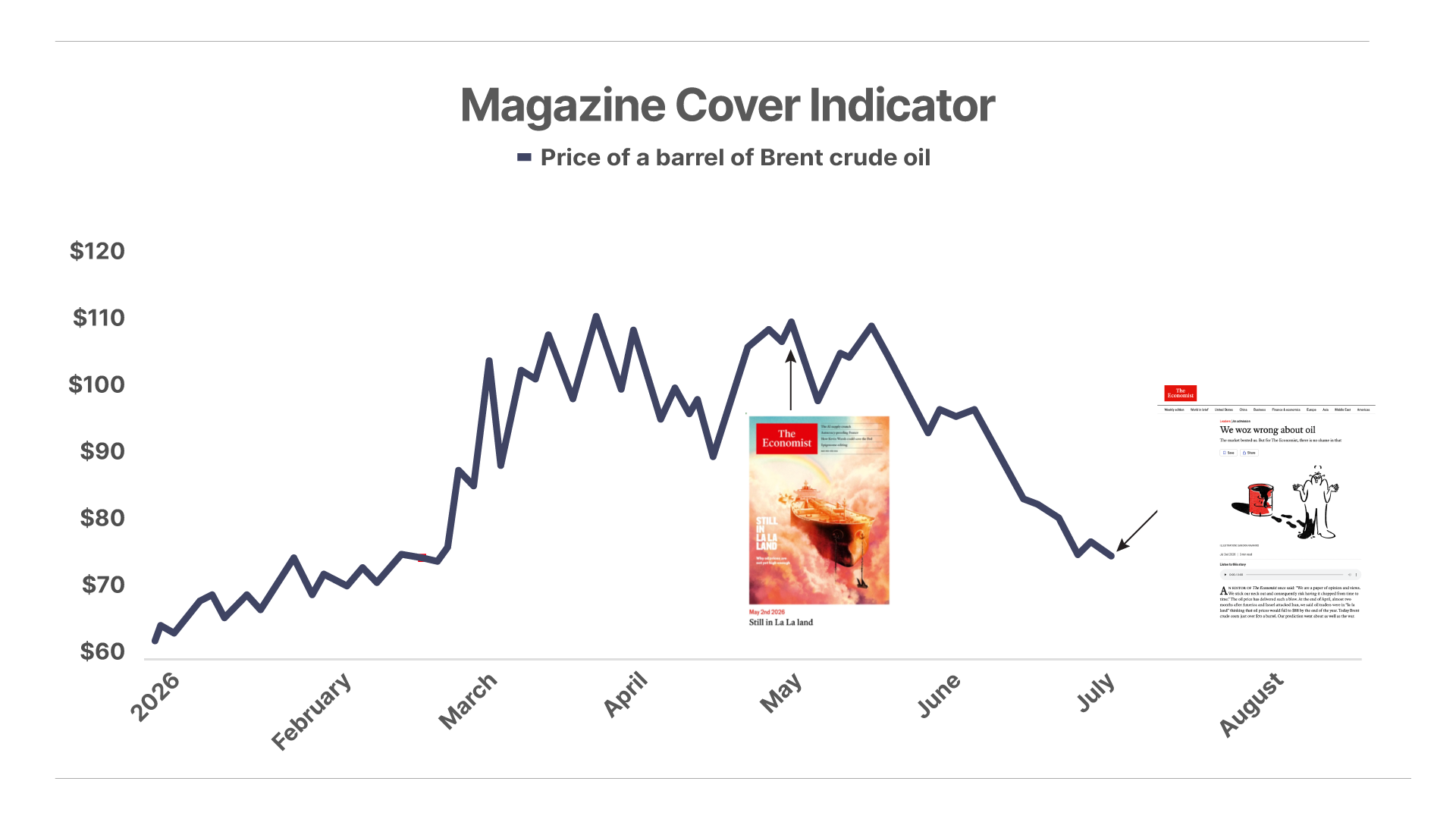
1. The Economist may have called the bottom in oil… the same way it called the top. On May 2, with Brent crude oil trading north of $110 a barrel, the cover of the global affairs publication insisted prices were "not yet high enough." Prices peaked that same day. Last week, on July 2, with Brent near $70, it published a mea culpa: "We woz wrong about oil." Oil, again, reversed that same day and has since rallied nearly 15% to near $80 per barrel. The “magazine-cover indicator” – one of Wall Street's favorite contrarian tells – appears to have struck again.
2. Amazon.com (AMZN) is now the AI boom's biggest borrower. Its bond issuance over the past year has reached roughly $107 billion – more than any other big tech company. But Tuesday's latest $25 billion offering drew a cooler reception than previous issues: final orders totaled around $41 billion, or 1.6 times the deal size, against the four-times average for high-grade issues this year. The e-commerce and cloud-computing giant paid wider concessions to clear it. Global AI-linked debt has topped $335 billion in 2026 – more than double 2025's levels – and it appears investor fatigue may be setting in.
3. Housing’s demand sinkhole. Half of American adults under 30 now live with a parent – up 12 points from 2019 – and roughly 55% say it's a financial necessity. Today's median home price exceeds $400,000, about 5x the average wage versus 2x a generation ago. Every 20-something parked in a childhood bedroom is a future first-time buyer… we just need more supply to make their dream affordable.
Chart Of The Day… AMC Entertainment (AMC)
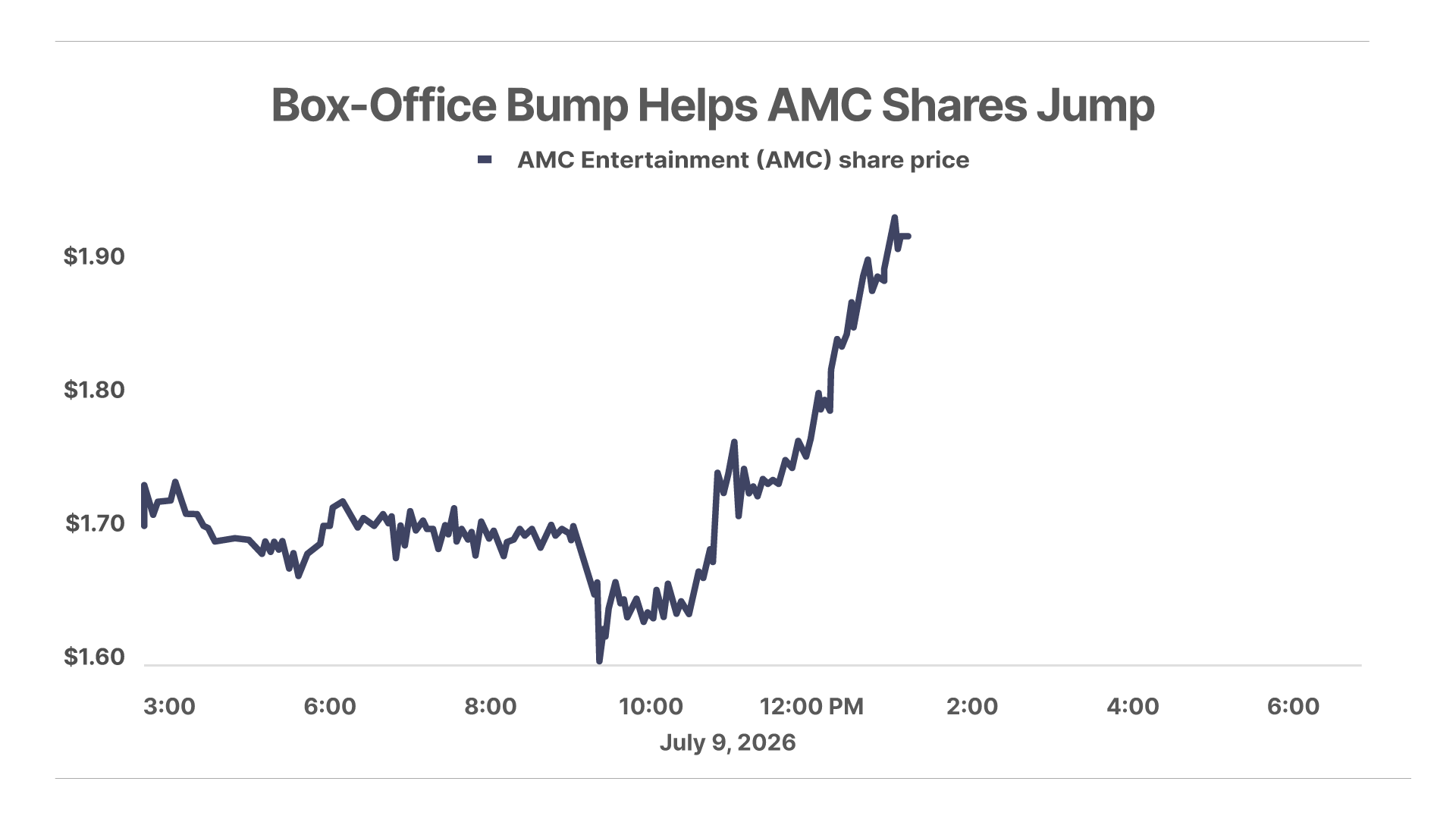
AMC Entertainment (AMC) CEO Adam Aron took to X to highlight AMC’s Q2 figures, expressing optimism about the U.S. box office – which generated $2.974 billion in the quarter, marking the industry's best Q2 performance since 2019 and ranking among the five highest-grossing quarters in the past 50 years. Shares rose 10% following Aron’s post.
Distressed Investing recommended AMC to its readers last year. On Saturday, editor Marty Fridson will recommend another distressed equity – one that it feels is ripe for a buyout, sending shares higher as a result. If you are not a Distressed Investing subscriber and would like to access this new report, click here.
Mailbag
“Disparaging Your Readers”
Joshua L writes:
On March 13 (Issue #34, Volume #3), while disparaging your readers who happened to support Donald Trump, you mentioned to short oil and buy stock to learn our lesson. I did both and I’m up big! Thanks for the advice.
Porter Comment: Just to be clear, I didn't disparage anyone for supporting Donald Trump. I correctly pointed out that Iran is not and could never realistically become a threat to our sovereignty. And I predicted that our bombing would only make their regime stronger. Alas, that seems to have come to pass. At the very beginning of this crisis I warned everyone not to believe anything the media or the government tells you about this conflict. Both institutions have a 50+ plus history of only lying about our military. That will continue. Iran is the most fanatical adversary that we have faced since Vietnam. And despite the president’s repeated claims to the contrary, we are not winning this war.
Porter & Co. Market Snapshot
| Price | Yesterday's Return | Year-to-Date Return | |
|---|---|---|---|
| S&P 500 Index | $7,503.85 | -0.45% | 10.3% |
| Gold per ounce | $4,145.30 | -1.44% | -6.2% |
| Bitcoin | $63,297.39 | -0.19% | -29.2% |
| Oil (West Texas Intermediate) per barrel | $70.44 | 2.71% | 29.3% |
| Berkshire Hathaway (BRK) | $756,000.00 | -0.13% | 0.2% |
| Porter's Permanent Portfolio | - | 0.28% | 1.8% |
| The Better Than Berkshire Index | - | 0.29% | 10.2% |
| Total Return | Annual Return | ||
| Porter & Co's Top Ranked* | 36.8% | 17.3% | |
| Yield | Yesterday's Change | Change Year-to-Date |
|
| U.S Treasury 30-Year Yield | 5.04% | 7 bps | 21 bps |
*A Complete Investor risk rating of 1 is defined as a "low risk, high allocation" security, while positions rated closer to a 5 are higher risk. Porter & Co.'s top-ranked positions include those rated either 1 or 2 in Complete Investor portfolio.
Porter & Co. Top Positions
| Publication | Ticker | Description | Total Return |
|---|---|---|---|
| Tech Frontiers | QURE | uniQure | 237% |
| Complete Investor | BWXT | BWX Technologies | 226% |
| Tech Frontiers | TGTX | TG Therapeutics | 163% |
| Tech Frontiers | ROIV | Roivant Sciences | 161% |
| Complete Investor | SKWD | Skyward Specialty Insurance | 153% |
| Tech Frontiers | SGMT | Sagimet Biosciences | 143% |
| Complete Investor | BTC/USD | Bitcoin | 135% |
| Complete Investor | PM | Philip Morris | 134% |
| Tech Frontiers | QURE | uniQure | 131% |
| Tech Frontiers | NUVB | Nuvation Bio | 123% |
Prices as of 4:00 pm ET July 7, 2026
Please note: The investments in our “Porter & Co. Top Positions” should not be considered current recommendations. These positions are the best performers across our publications – and the securities listed may (or may not) be above the current buy-up-to price. To learn more, visit the current recommendations page of the relevant service, here. To gain access or to learn more about our current recommendations, call our Customer Care team at 888-610-8895 or internationally at +1 443-815-4447.