Issue #119, Volume #3


Changing Its Playbook Totally Changed Its Game… Our Investors Won
Inside Today’s Issue
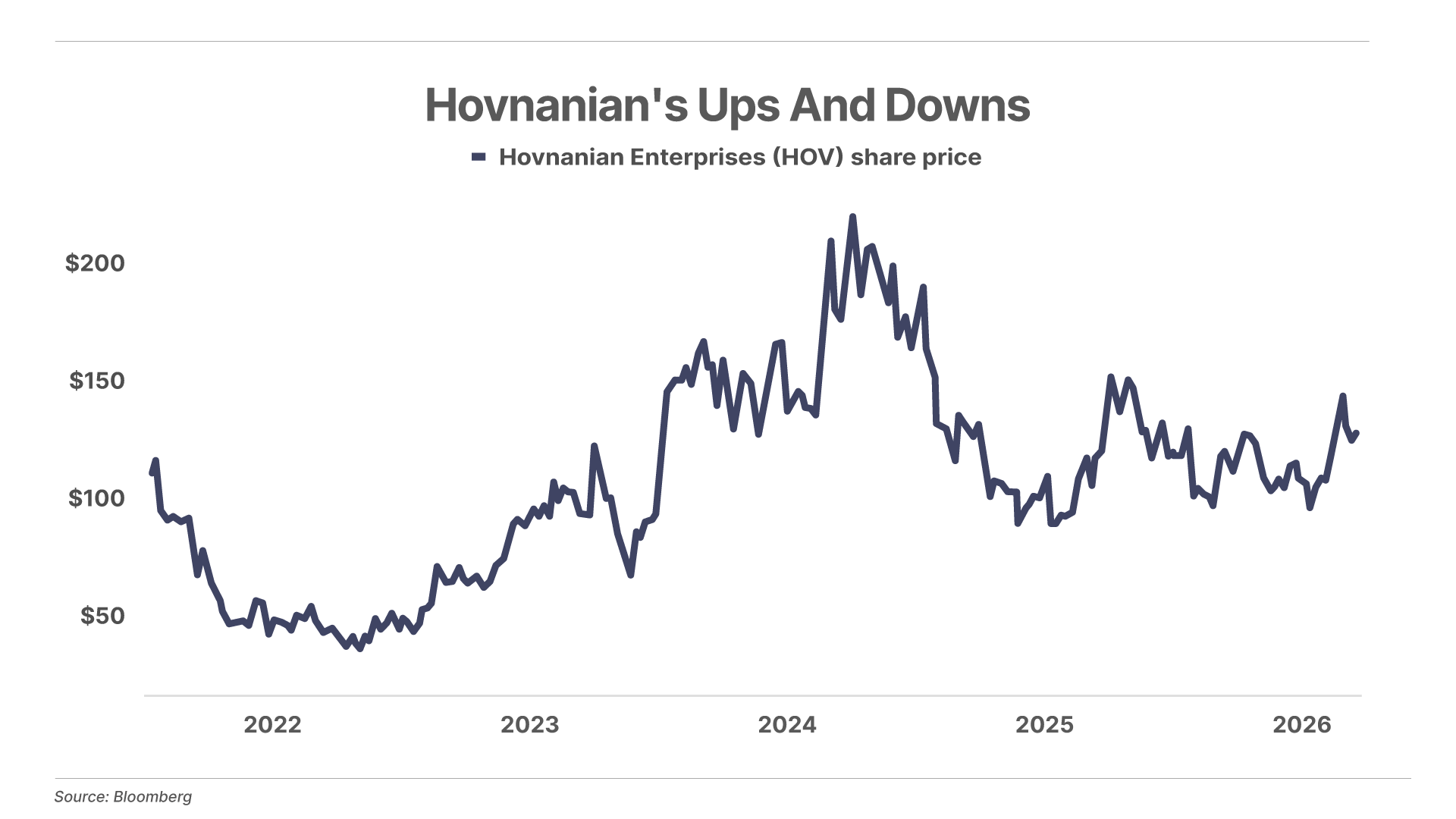
Sixteen months ago, in the Daily Journal, Porter made the case that Hovnanian Enterprises (HOV) had quietly become a far better business than almost anyone on Wall Street understood – and that it was on its way to becoming a genuine long-term compounder.
Since that March 12, 2025, issue, HOV is up 31%. And since we recommended Hovnanian in Complete Investor, subscribers are sitting on a 50% gain. The stock trades around $134 this week.
We share those numbers not to take a victory lap. We are sharing them because the last time we owned Hovnanian, we made a mistake we have no intention of repeating. We added it to the Complete Investor recommendations list at $42.79, watched the transformation unfold almost exactly as we predicted, and then sold at the first whiff of higher interest rates. We left a fortune on the table – a 211% gain to be exact. This time, we are holding as the evidence has only strengthened our thesis.
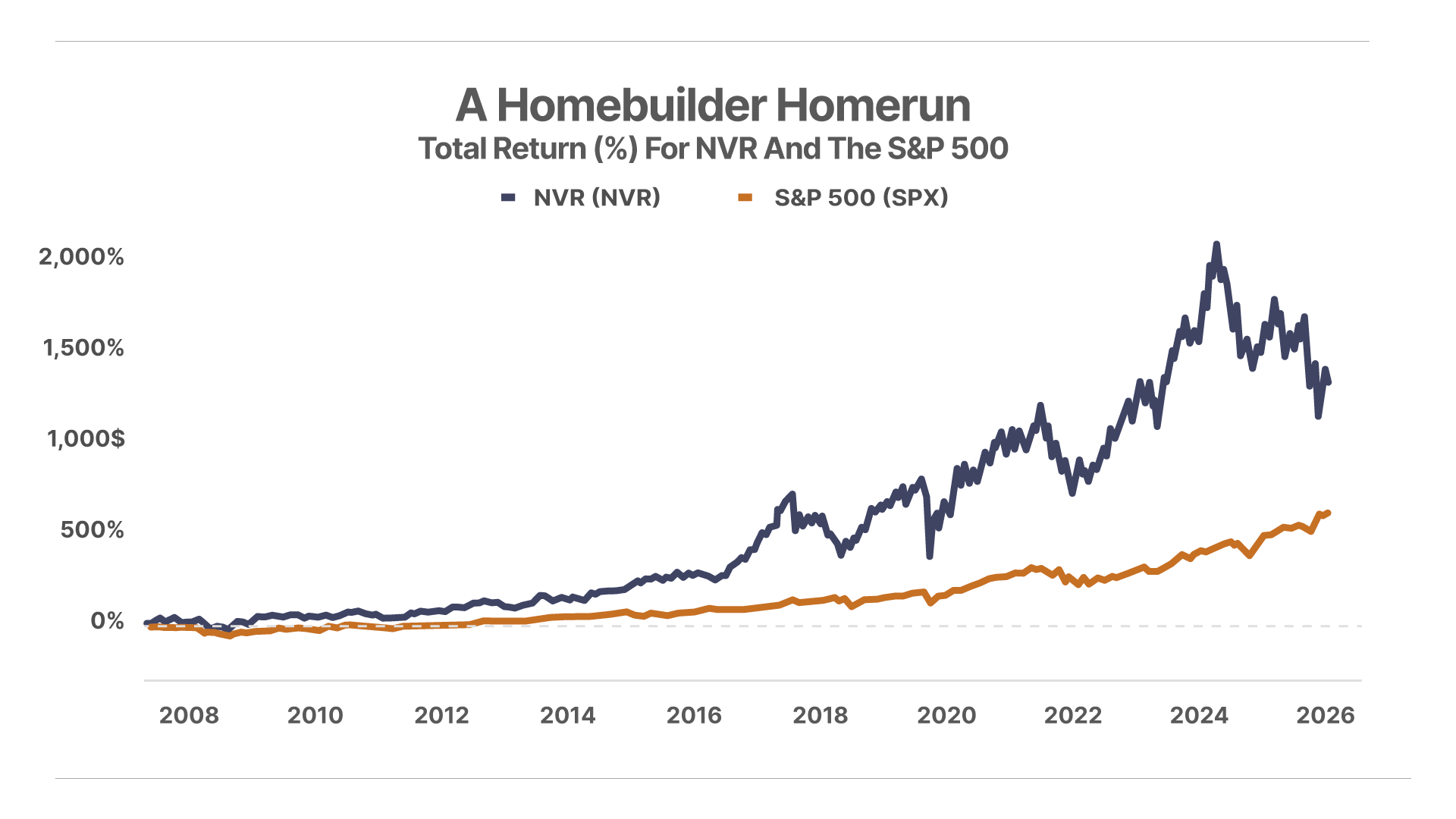
Hovnanian used to be a “debt dog” – so buried in land and leverage that its earnings never reached shareholders, because they all went to pay the interest on its debt. Beginning around 2019, management copied the single best business model in homebuilding, the one NVR (NVR) pioneered in the late 1990s: stop buying and developing land with borrowed money, and instead buy options on finished lots you intend to build on in the near term. The land sits on someone else’s balance sheet until a homebuyer shows up. That one change turns a brutally cyclical, capital-hungry business into an asset-light, high-return machine. NVR proved it by sailing through the worst housing collapse in American history with minimal write-offs and 20%-plus returns on equity across the entire cycle.
Porter’s long-time subscribers will likely remember – his recommendation of NVR in the midst of the housing crisis has gone on to be a homerun – a 15.5% annualized return good for a 1,378% total return in 19 years.
And now Hovnanian is running the same playbook.
Hovnanian builds roughly 6,000 homes a year across 13 states, for about $3 billion in revenue. What changed – and what most investors still don’t understand – is how it finances them. You can watch the company run that exact NVR playbook in its own numbers. Optioned lots have climbed to roughly 86% of the pipeline, up from a third a decade ago, while owned lots have fallen from 67% of sales to 14%. As that land came off the balance sheet, debt and interest went with it – annual interest expense has been cut from $192 million in 2015 to roughly $45 million.
The result is that a debt-heavy business became a capital efficient one. Even back in 2021, the made-over Hovnanian threw off 21% gross margins, a 29% return on assets (“ROA”), and a 53% return on invested capital (“ROIC”) – elite figures for any business, let alone a homebuilder – while the shares still changed hands at under 4x earnings. And this is no fly-by-night operation: Hovnanian was founded in 1959 and has traded publicly since 1983, so it has plenty of Lindy DNA.
The real test, though, was the last 16 months. High mortgage rates and a cautious consumer defined the entire industry – Hovnanian’s fiscal Q2 revenue slipped 3% on 12% fewer deliveries, and the company posted a small diluted loss of $0.46 per share, half of the $0.88 loss Wall Street feared. But look at how the asset-light model carried it through a genuine downturn:
Write-offs stayed small. Inventory impairments and land-option write-offs over the trailing 12 months totaled just $46.6 million – against $254.5 million of adjusted operating earnings over the same stretch. This is the NVR lesson in miniature: when you don’t own the land, a soft market does not blow a hole in your equity.
The balance sheet got stronger. In late 2025, Hovnanian completed a $900 million unsecured refinancing, pushing its maturities out to 2031 and 2033. It ended April with $442 million in total liquidity – nearly double the top of its own $170 million to $245 million target range.
It kept earning real returns at the trough. Its trailing-12-month adjusted return on investment was 15.9%, which management believes is the highest among its nine midsized public homebuilding peers. Most builders post their worst numbers at the bottom of the cycle. This one stayed near the top of its class.
It bought back stock below book value. Last quarter, Hovnanian repurchased 90,507 shares – about 1.8% of its Class A stock – at an average of $104.60, against a book value of roughly $118 per share. That is management buying $1 of book for 89 cents.
Demand is turning. Total domestic contracts rose 2% year over year, adjusted gross margin ticked up to 14.3% from 13.4% the prior quarter, and management is guiding to 14% to 15% for the current quarter.
Here is how CEO Ara Hovnanian summed up the quarter in May:
Overall, our performance reflects the resilience of our operating model and our team’s ability to execute in an unsettled market.
There is also a free option attached. Hovnanian’s Middle East affiliate – recently rebranded HOV Global – just deepened its investment in Saudi Arabia, with roughly 2,400 homes delivered there since 2013 and about 3,000 more underway. We are paying nothing for it in our valuation, which is exactly how we like optionality.
Despite a transformed balance sheet, a superior business model, and a real runway of growth, Hovnanian still trades at less than 3x operating cash flows – versus NVR’s 14x. The market has decided one of these companies is world-class and the other is a leftover from the last cycle, even though they are running the identical playbook.
You can lead a horse to water, but you can’t make it drink. Porter led you to the water in the Daily Journal in March – in public, for free. The readers who drank – who took the official recommendation in Complete Investor – are sitting on a 50% gain.
Now we’ll let the Hovnanian position compound and stay out of its way – as long as it continues to deliver.
Tell us what you think of today’s Journal: porterstansberrydirect@gmail.com
Good investing,
Jared Simons
Miami Beach, Florida

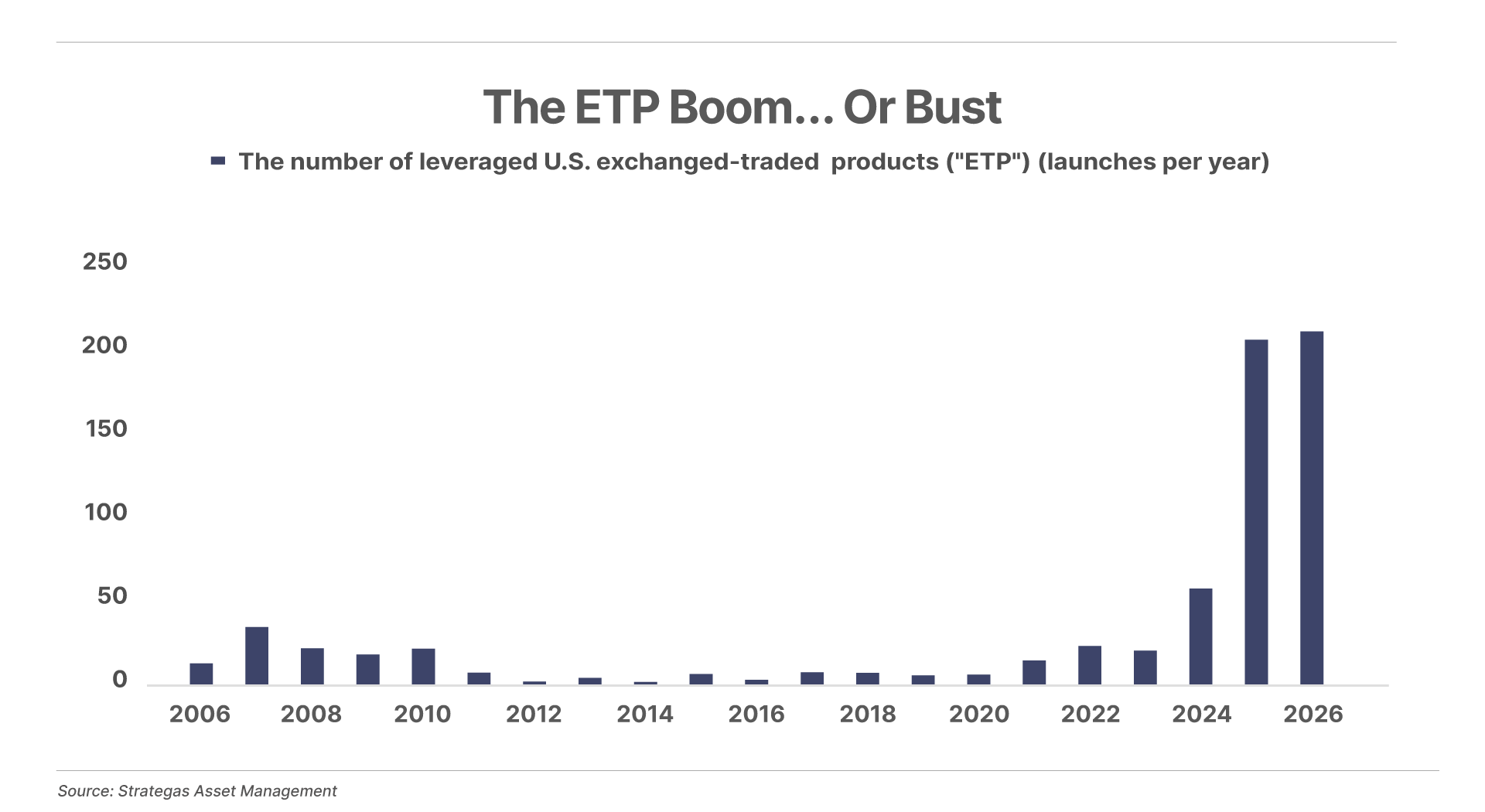
1. Leveraged ETP growth is exploding. The U.S. now lists nearly 700 leveraged exchange-traded products (“ETPs”) – more than double the count at the end of 2024. A leveraged ETF uses borrowing and derivatives to deliver 2x or 3x a stock’s or index’s daily move, magnifying gains and losses. The growth in these products is startling: when SpaceX (SPCX) went public on June 12, issuers rolled out 11 leveraged funds tied to it within days. Investors reaching for amplified, short-term bets is one of the strongest signs of a speculative bubble we see anywhere in this market.
2. Chinese oil imports plunge. The latest Chinese customs data revealed that the country’s crude-oil imports dropped by a record 41% in June. The 7 million barrel per day decline in demand from the world’s largest energy importer helped balance supply disruptions from the closure of the Strait of Hormuz. But this is merely a temporary balancing act as China draws down its strategic petroleum reserves, setting up a rebound in global demand when Chinese imports come back into the market.
3. Memory-chip stocks have fallen into a bear market. Micron Technology (MU) has dropped more than 12% over two days and now trades 30% below its June 25 record high. Western Digital (WDC) and Sandisk (SNDK) are each down more than 35% from their June highs, with South Korea’s SK Hynix (SKHY) and Samsung sliding alongside them. Three catalysts have stacked up: a Korean regulator’s June warning on risky chip ETFs, a below-consensus profit estimate from SK Hynix last week, and, today, Taiwan Semiconductor’s (TSMC) move to raise its 2026 capital-spending plan to as much as $64 billion – a combination some analysts read as AI spending outrunning the returns it’s producing. Still, despite the recent correction, each of these stocks is up between 300% and 3,000% in the past year.
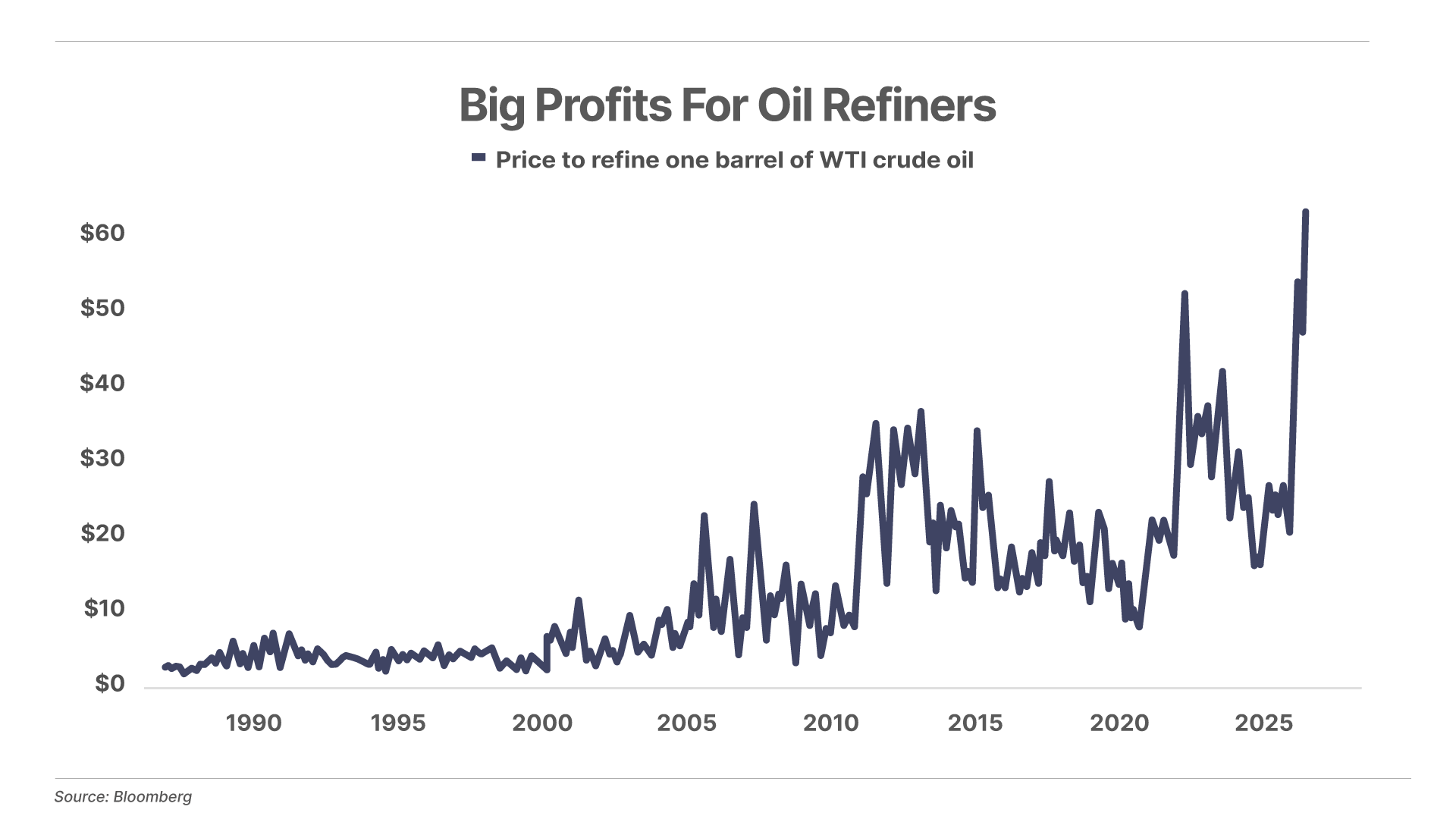
The 3-2-1 refining margin, or “crack spread” – the gap between what refiners pay for crude and what they sell the gasoline and diesel for, the standard gauge of refining profit – hit an all-time high near $64 a barrel, as Ukraine’s drone strikes on Russian refineries and Iran’s disruption of the Strait of Hormuz keep fuel prices high even as crude itself has slipped. Refiners are earning their best margins on record.
“Biotech Is So Different”
Eric K. writes:
I don’t remember exactly where, but sometime probably in the last year I remember you saying that now since you’ve spent so much time analyzing capital efficient, quality business you couldn’t picture recommending anything else. Biotech is so very different than this, so do you think you’ll really be able to enjoy this market and develop a passion for it?
I’ll look forward to hearing more in the first issue.
Porter Comment: I took $36,000 and turned it into $3 billion in 20 years. With zero additional capital. I did this by learning how to invest in multiple asset classes and run a great business, putting customers first.
I can’t promise you what will happen in regards to biotech. But I can promise you there isn’t anyone who is going to work harder at it.
That’s always worked for me before.
In my personal account last year, I was up something like 168% on an eight-figure account. One of my biggest gains was Prime Medicine (PRME) – which I gave to our former biotech editor Erez Kalir. Another was Circle Internet (CRCL), an ultra-high-risk IPO.
But most of the gains came from The Hershey Company (HSY), Philip Morris International (PM), and Franco-Nevada (FNV). I think the most valuable thing I can teach people is how to make a lot of money without risking any.
But that’s far from the only thing I know. There’s a reason guys like Dave Lashmet and Erez Kalir worked for me.
Like I said, I hope you’ll read my first issue.
I am certain you won’t be disappointed.
Porter & Co. Market Snapshot
Porter & Co. Top Positions
Please note: The investments in our “Porter & Co. Top Positions” should not be considered current recommendations. These positions are the best performers across our publications – and the securities listed may (or may not) be above the current buy-up-to price. To learn more, visit the current recommendations page of the relevant service, here. To gain access or to learn more about our current recommendations, call our Customer Care team at 888-610-8895 or internationally at +1 443-815-4447.