| Below, you’ll find the latest market update and portfolio review from Porter & Co.’s Director of Distressed Investing, Martin Fridson. We release a full report with a new recommendation on the second Thursday of each month, and an update like this one two weeks later. Marty also provides the “Top 3 Best Buys” – a regular feature that highlights what he views as the three most attractive positions to focus on in the portfolio, to help those who are new to distressed investing get started. As always, please call Lance James, our Director of Customer Care, with any questions. You can reach him and his team at 888-610-8895, or internationally at +1 443-815-4447. |
Our distressed-debt recommendations have worked out well, producing an aggregate return of 24.5% through February 25.
We’ve managed to find attractive opportunities despite a relatively small supply of beaten-down bonds. The Distress Ratio (see chart below), defined as the percentage of bonds in the ICE BofA U.S. High Yield Index yielding 10 percentage points or more above default-risk-free U.S. Treasury rates, is well below the 12.7% historical average. The January 31 reading of 3.7% was the lowest month-end level in about two years.
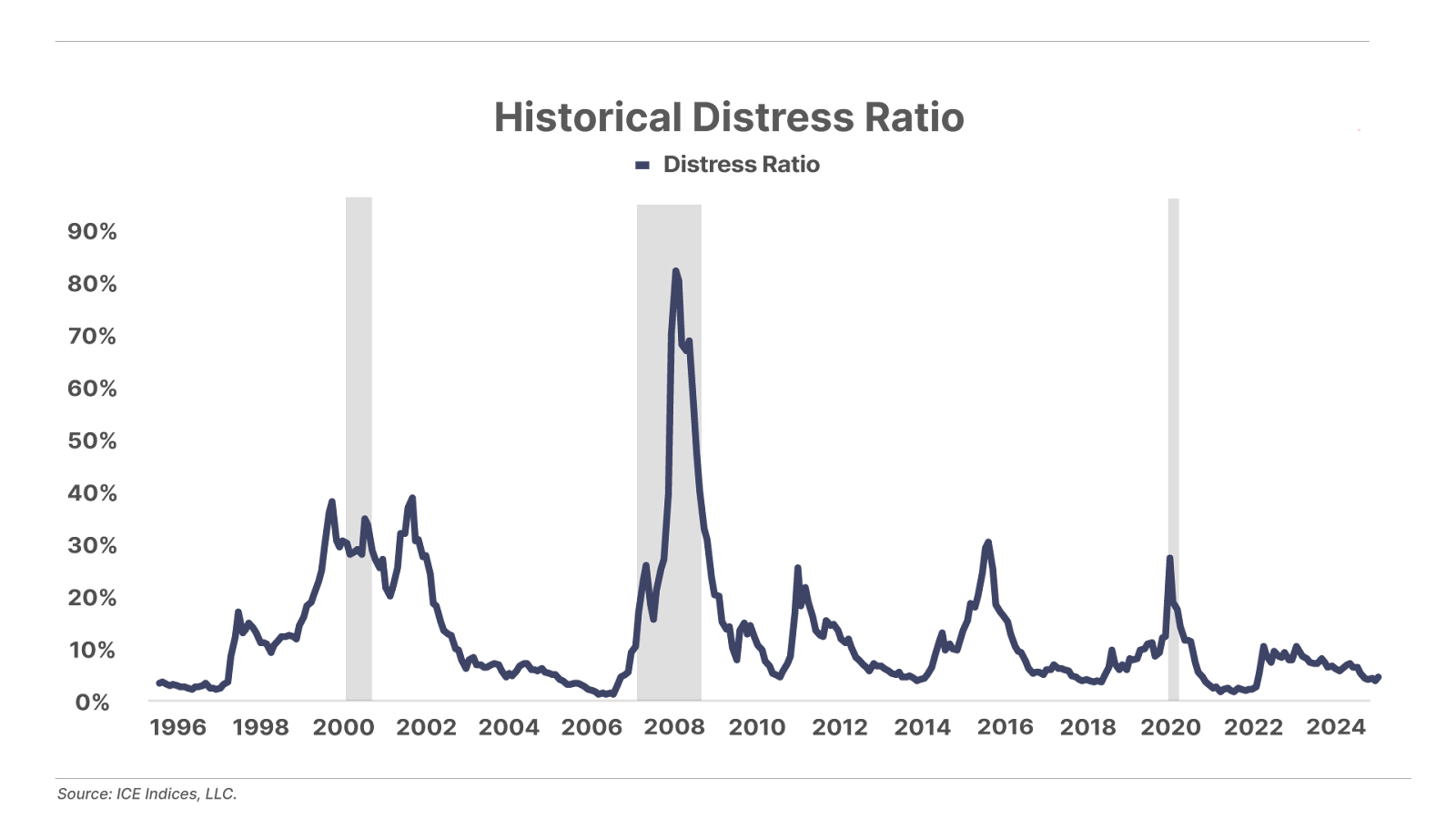
But there’s some good news for supply-thirsty distressed-debt investors. The trend has begun to reverse. By February 25, the Distress Ratio was up to 4.1%. And the percentage is likely to continue heading higher.
Here’s why. Each quarter the Federal Reserve surveys senior bank loan officers about credit market conditions. One question put to the lenders is whether they’re currently tightening or easing their standards for medium- and large-sized companies to qualify for loans. We subtract the percentage of banks that are easing from the percentage that are tightening. A positive number means that, on balance, credit is getting tighter.
This measure, called Credit Tightness, is highly correlated (68%) with the Distress Ratio. For example, both hit their all-time highs of over 80% during the Global Financial Crisis in November 2008. And at the latest peak in the Distress Ratio – 10.4% in March 2023 – Credit Tightness stood at 44.8%. As Credit Tightness declined to zero in the third quarter of 2024, the Distress Ratio also headed downward, eventually reaching the above-mentioned low in December 2024 of 3.7%.
But in the fourth quarter of 2024, banks started to get tougher on loan approvals and Credit Tightness rose to 6.2%. We’re already seeing an effect on the Distress Ratio. By mid-February, as we said before, it had climbed to 4.5%.
Admittedly, Credit Tightness isn’t the only factor driving the Distress Ratio’s rise and fall. But it’s a powerful one that’s likely to keep making it harder for struggling companies to refinance their maturing debt in coming months.
Putting ourselves in the lending officers’ shoes, we’d figure it’s possible that higher tariffs won’t depress trade and reduce economic activity – but then again, it might. Better to wait and see how that all turns out and be cautious for the time being about lending to businesses that may be of dubious quality.
It all adds up to a likelihood that distressed-debt investors will have a significantly wider array of bonds to choose from before very long.
This content is only available for paid members.
If you are interested in joining Porter & Co. either click the button below now or call our Customer Care team at 888-610-8895.