Issue#133, Volume#3


Fixing America’s Broken Healthcare System
Inside Today's Issue
Editor’s note: Today, Porter turns the Journal over to Trading Club lead analyst Ross Hendricks, who outlines an opportunity recently recommended to Trading Club members… capitalizing on the U.S.’s broken healthcare system.
By any measure of price, the U.S. healthcare system is the most expensive on Earth.
Americans spent an average of $14,885 per person on healthcare in 2024, nearly 50% more than the next-highest-spending country Switzerland at $9,963 per person. And as a share of the economy, the gap is just as stark: healthcare spending makes up 17% of the U.S. GDP compared to an 11.0% average among comparable countries.
Despite all this spending, Americans don’t live as long. The average U.S. life expectancy at birth is just 79.0 years, or nearly four years less than the 82.7-year average among peer countries.
And on the two most basic tests of a health system – can it keep mothers alive, can it keep their babies alive – America comes in dead last with the highest infant and maternal mortality rates of any high-income country.
This is the paradox at the center of America's healthcare system: we’re not dealing with a lack of capital.
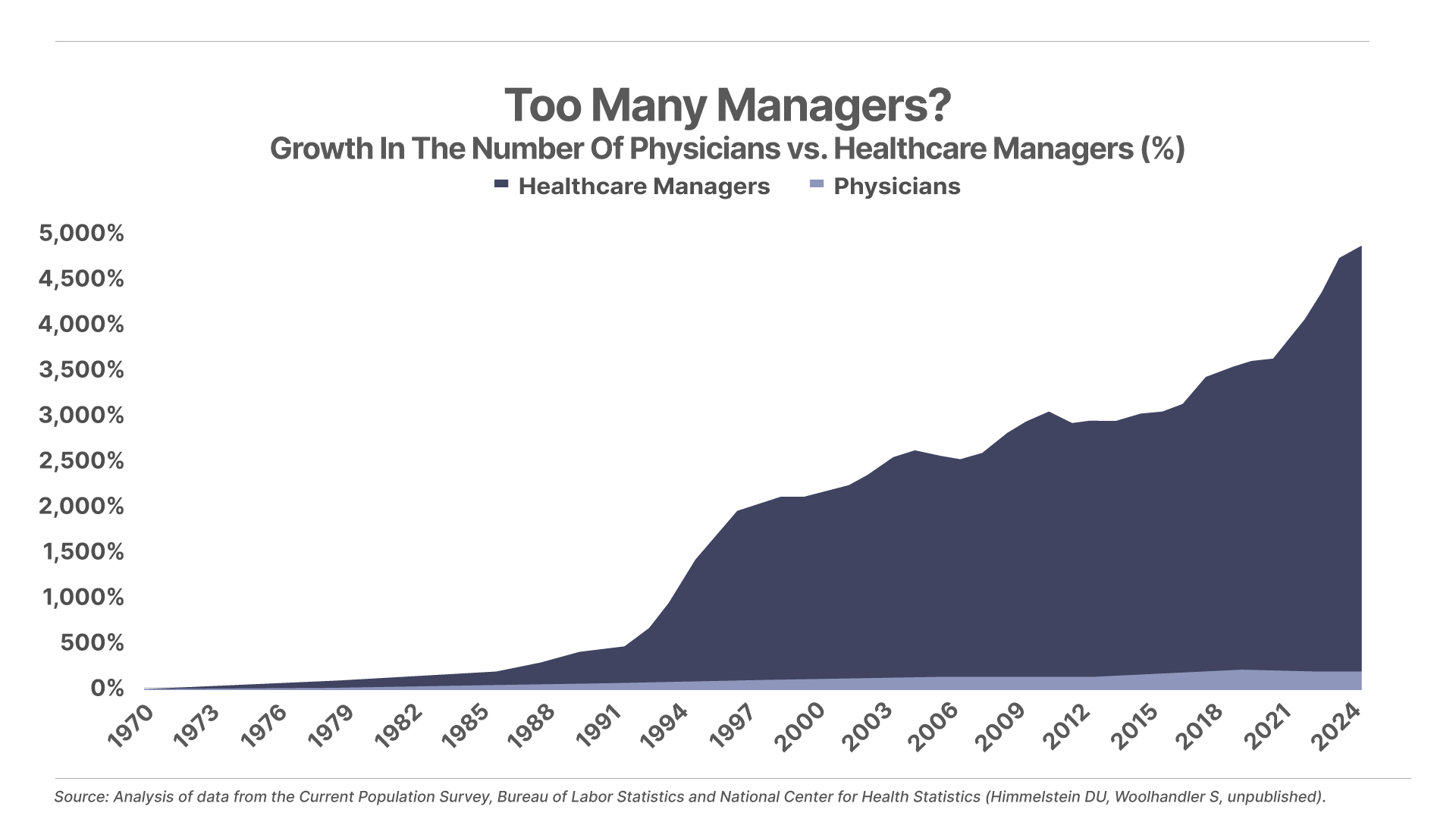
So where does all the extra money go, if not toward better outcomes? All evidence points to bureaucratic bloat rather than more care. The U.S. spends $925 per person on health administration, compared to $245 in comparable countries. It’s led to charts like the one shown below, where an increasing share of employment and costs go toward “managers” of the U.S. system rather than the physicians providing actual care:
To understand how it all works, consider a simple thought experiment where we overlay U.S. healthcare billing practices to something more mundane, like an oil change.
Imagine that car insurance providers were forced to begin covering basic maintenance – where every 5,000 miles, consumers go to a "network-approved" mechanic for a routine oil change, handing over a co-pay, and never see the actual bill. Now consider the sequence of events this kicks off…
- The mechanics stop competing on price. Why would they? Consumers don't shop around when their out-of-pocket expense is a flat $20 co-pay, regardless of whether the actual bill is $40 or $200.
- The mechanics start negotiating with insurers instead of customers. Their sales effort shifts entirely toward getting on network panels and maximizing reimbursement rates instead of competing with other mechanics to offer customers the best price.
- A middleman emerges. Let’s call it a parts benefits manager (“PBM”), which sits between the mechanic and the insurer to negotiate rebates, collect a spread, and decide which oil brands are "preferred" based on reimbursement schemes.
- Prices inflate invisibly. The list price for an oil change creeps up to $200 because everyone in the chain – mechanic, PBM, insurer – has every incentive to inflate the sticker price and negotiate rebates from the inflated starting point. Customers never see this inflation directly, because they only have to cover the co-pay.
- The market loses the one thing that keeps the ecosystem honest: the pricing signal. Customers have no incentive to determine if $200 is a fair price for an oil change because they’re never exposed to that $200 number. And as a result, the mechanism of price competition – the free market force that ensures mechanics offer customers the lowest price – disappears.
The fundamental problem here comes from turning the concept of insurance on its head. Insurance exists to pool risk against low-probability, high-severity events like totaling your car, not to cover a regularly scheduled oil change. This is obviously an absurd arrangement for routine car maintenance. And yet the U.S. healthcare system is built upon this same flawed architecture.
Thus it’s no surprise why America’s healthcare system has become the most inefficient in the world, where consumers pay the highest medical costs of wealthy counties, while ranking among the worst in health outcomes.
But the flip side of every market inefficiency is opportunity. And we’ve identified one company that’s perfectly positioned to disrupt the bloated costs and needless middlemen in the $1 trillion market for routine health care.
The Disruptor Taking On The $1 Trillion Status Quo
Hims & Hers Health (HIMS) operates one of America’s largest direct-to-consumer telehealth platforms, with 2.6 million subscribers generating $2.4 billion in revenue last year. The business was launched by serial entrepreneur Andrew Dudum in 2017, with a founding vision of bringing down U.S. healthcare costs by cutting out the middlemen and connecting patients directly with doctors and pharmacists.
The platform was built to bypass the two key agents driving up routine healthcare costs: the insurance industry and pharmacy benefits managers (“PBM”). It charges a flat subscription fee for customers to access licensed clinicians for consultations across a wide swath of routine care. Customers pay Hims & Hers directly, at prices set on the platform rather than prices negotiated by intermediaries like insurers. And it bypasses PBMs by using its own affiliated pharmacies to fulfill and ship prescriptions directly to the patient.
By allowing patients to shop directly for care and prescriptions at transparent, cash-only prices, the platform is bringing free market forces back to healthcare. And it makes the entire process seamless, with Amazon-like efficiency that results in faster care and lower prices.
Instead of waiting weeks to see a general practitioner, patients can meet virtually with a doctor within 48 hours of requesting one and have their medication arrive at their doorstep within a week. And by eliminating the multiple layers of traditional healthcare bureaucracy, Hims & Hers can offer rock-bottom prices for routine healthcare and prescription drugs.
That’s how the platform has grown from a standing start in 2017 to a $2.4 billion juggernaut in the span of a decade, serving millions of customers each year. And the beauty of this business model is that the total addressable market is massive, with over $1 trillion in annual spending on non-emergency, routine physician care and services in the U.S. alone.
The business began with a focus on men's health, including treatments for erectile dysfunction and hair loss. In 2018, it launched the Hers side of the platform for women's wellness, providing access to prescription birth-control pills, hair regrowth medication, and skincare products. In 2024, it introduced GLP-1 weight-loss treatments, which have become its best-selling products that now generate over $1 billion in annual sales (more on this below).
With this growing array of offerings, Hims & Hers is pursuing a classic land-and-expand strategy: acquire a subscriber through one treatment and then cross-sell them into additional offerings across the platform. And while the business is not yet consistently profitable, the key metric we monitor for an indication of future profitability is the successful monetization of its subscriber base, through revenue per subscriber. The chart below shows Hims & Hers’ masterful execution on this front, with revenue per subscriber doubling in the last four years alone:
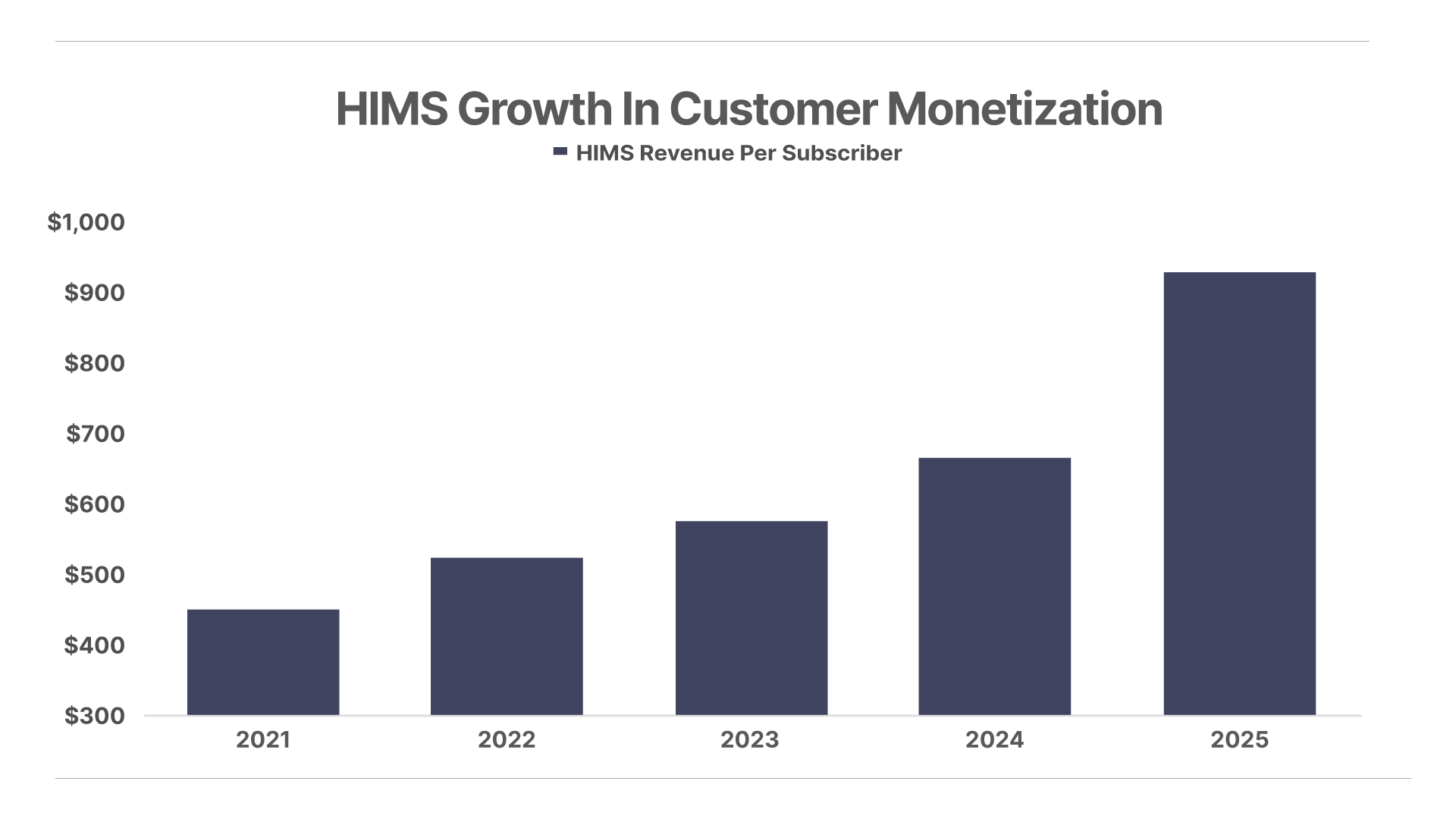
This monetization metric is a key indicator for measuring the ultimate health of any subscription business: lifetime value. The more effectively a subscription business can retain and upsell its subscriber base, the more lifetime value those customers will represent. And as lifetime value grows, it allows the business to invest more aggressively into new customer acquisition, which sets the stage for greater profitability down the road.
For now, growth is the key metric to monitor, as that sets the stage for future profitability. And the company has several upcoming catalysts for driving higher growth both in the short and medium term.
Upcoming Catalysts For HIMS
The biggest near-term source of upside for Hims & Hers will come from the successful resolution of a major legal battle with pharmaceutical giant Novo Nordisk (NVO) over the sale of GLP-1 weight-loss drugs.
In 2024, Novo Nordisk’s semaglutide-based Ozempic and Wegovy weight-loss drugs went onto the Food And Drug Administration’s (“FDA”) shortage list, which meant pharmacies could offer generic versions without paying patent-licensing fees.
This provided a legal opening for Hims & Hers to begin offering generic compounded versions of semaglutide to its subscribers. However, once the shortage passed and the legal greenlight for mass compounding of these weight-loss drugs was supposed to end, Hims & Hers continued offering generic versions by relying on legal loopholes that go beyond the scope of this discussion.
In February, Hims & Hers announced plans to mass-produce a cheaper version of Novo's new Wegovy oral pill, priced at $49 per month versus Novo's monthly pricing of $299. Novo sued Hims & Hers for patent infringement.
Around the same time, the FDA signaled it would move to restrict compounding pharmacies' access to bulk semaglutide now that the shortage was over, and referred Hims & Hers to the U.S. Department Of Justice for potential violations. HIMS shares collapsed by 50% to $14 on the news.
But everything changed in March, when Novo dropped the lawsuit in exchange for HIMS agreeing to stop mass-marketing compounded semaglutide. As part of the agreement, Hims & Hers became an authorized distribution channel for branded Ozempic and Wegovy (both injectables and oral pills), at price parity with other telehealth platforms.
The FDA publicly welcomed the resolution, since it aligned with the agency's own push to wind down non-shortage compounding. Thus, in one fell swoop, the settlement converted an existential legal risk into a durable new distribution relationship for Hims & Hers. And all signs indicate business is booming under this new partnership.
Within six weeks of rolling out Novo Nordisk’s branded Wegovy on its platform, Hims & Hers reported on its Q1 earnings call on May 12 that it fulfilled more than 125,000 shipments. And based on the strong sales momentum, management forecasted bringing an additional 100,000 new weight-loss subscribers per month onto its platform through the end of the year. This led to the company raising its 2026 revenue outlook to $2.9 billion, representing growth of 21% over last year, and the second boost to its revenue forecast so far this year.
Since then, the outlook of this partnership has brightened further by the recent success of the new Wegovy pill from Novo. Recent data shows the Wegovy pill registering over 120,000 prescriptions per week, and outselling Eli Lilly’s Foundayo (orforglipron) 9-to-1. If this trend continues – which we expect, given the increased weight-loss efficacy of Wegovy over Foundayo – then that should translate into more subscriber growth and sales through the Hims & Hers platform versus the guidance management provided on the Q1 earnings call.
The Coming Peptide Boom
Next up, another major catalyst for Hims & Hers could come in the form of peptide sales. Peptides are short chains of amino acids that have become part of a growing class of unregulated chemicals used for various “bio-hacking” applications including anti-aging, athletic performance, and accelerated recovery of damaged tendons and muscles.
Under a 2023 FDA rule, 17 popular peptides were classified as Category 2 drugs, meaning compounding pharmacies were banned from producing and distributing these drugs for human use. This inspired a booming gray market (not clearly regulated) for peptides that are sold as “research chemicals, not for human consumption.” A recent Bloomberg report estimates more than 20 million doses of gray-market peptides have been distributed in the last eight years.
But recently U.S. health authorities have begun exploring the reclassification of these drugs to move them off the gray market and into regulated channels. This movement has been promoted by Health And Human Services Secretary Robert F. Kennedy Jr. who has openly championed therapeutic peptides, citing his own personal use of the drugs for injury recovery.
In late July, the FDA’s Pharmacy Compounding Advisory Committee (“PCAC”) voted in favor of placing six popular peptide treatments on the FDA’s Section 503A Bulks List. In effect, this would allow licensed compounding pharmacies to legally synthesize and distribute these peptides.
For HIMS investors, this marks a promising first step toward legitimizing a whole new class of drugs that Hims & Hers is perfectly positioned to capitalize on. In March 2025, Hims & Hers acquired a peptide-manufacturing facility based in California. It’s been quietly building a 1 million square foot lab and testing facility to synthesize a wide range of peptide treatments from start to finish.
While this is a speculative longer-term opportunity that will require clearing a number of legal and operational hurdles, the upside potential is promising. The peptide gray market in the U.S. is estimated at approximately $2 billion to $3 billion. Should the FDA greenlight these treatments for legal compounding, that number could grow into the tens of billions. And we believe Hims & Hers could capture a significant chunk of this market.
Longer-term, Hims & Hers management sees a clear path for the business to reach $6.5 billion in sales by 2030, with EBITDA (earnings before interest, tax, depreciation and amortization) of at least $1.3 billion. Management first issued this guidance in May 2025 and has reiterated it every quarter since. We’ll hear more about the growth pipeline and future outlook when the company reports earnings on August 10.
We believe the company has a credible pathway to achieving its long-term financial targets. The opportunity set created by the bloated bureaucracy of America’s healthcare system is an addressable market of over $1 trillion. Hims & Hers has already demonstrated a decade-long track record of tapping into this opportunity by delivering easier, lower-cost routine care for millions of consumers.
In the bull case where the company achieves its long-term guidance, we see shares trading at a 15x to 20x multiple of management’s $1.3 billion EBITDA target by 2030. That translates into a market capitalization of $20 billion to $26 billion, or a share price of $80 to $105.
However, we must also point out the significant risks involved. The business operates in one of the most complex regulatory environments in all of American industry. And it hasn’t yet reached sufficient scale to generate sustainable profits. This means the shares are prone to significant volatility and downside risks. However, we also believe the upside potential is worth the risk.
We’ve taken a small, speculative position in the Porter & Co Trading Club portfolio, and we believe this is an opportunity worth putting on your radar.
Tell us what you think of today’s Journal: porterstansberrydirect@gmail.com
Ross Hendricks
Houston, Texas

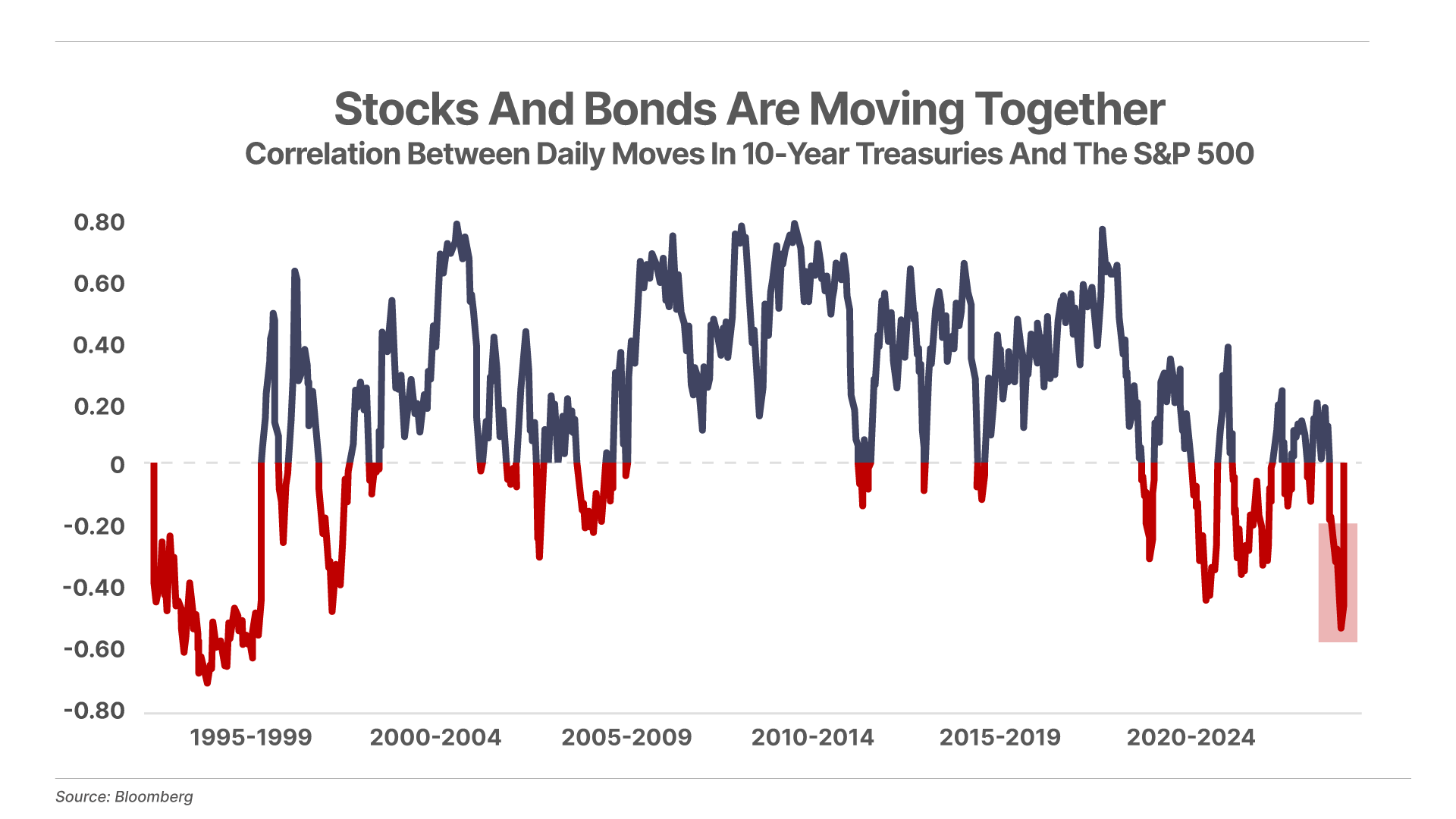
1. The 60/40 portfolio concept is dead. The correlation between daily moves in the 10-year Treasury yield and the S&P 500 has fallen to roughly -0.5, the most negative since 1999 – meaning rising yields are associated with weaker stock market performance, while falling yields are supporting equities. Bond prices move inversely to yields, so if higher yields push stocks down, bond prices and stocks are falling together. Through the decade before COVID, stocks and long-dated Treasuries reliably moved opposite each other, which is what made bonds a hedge. That relationship has now flipped: stocks and bonds are moving together. The shock absorber in a traditional 60/40 portfolio – 60% stocks, 40% bonds – is gone.
2. Solid earnings fail to lift SpaceX shares. In reporting earnings yesterday, SpaceX (SPCX) beat on nearly every segment – revenue up 92% to $7.81 billion, EBITDA up 191%, losses cut nearly in half – but the stock is down 9%. Tomorrow, 911.5 million insider shares become eligible to trade. That number of outstanding shares could keep a lid on prices, and is one of the reasons we caution against buying into IPOs – the market often provides a better entry point once the initial hype dies down, as we’re now seeing in SpaceX.
3. Leopold Aschenbrenner's collapse did the market a favor. Situational Awareness went from $45 billion in assets and a 439% first-half return to selling its assets at a steep discount to Ken Griffin's Citadel. Retail investors cleaned house as well… selling more tech stocks last week than in any week since January 2019, exceeding the prior record by 80%. Forced deleveraging and retail capitulation clears nervous investors out and re-establishes prices of overvalued shares.
Shares of Complete Investor recommendation Domino's Pizza (DPZ) are up more than 20% since we added the stock to our Best Buys publication in late June.
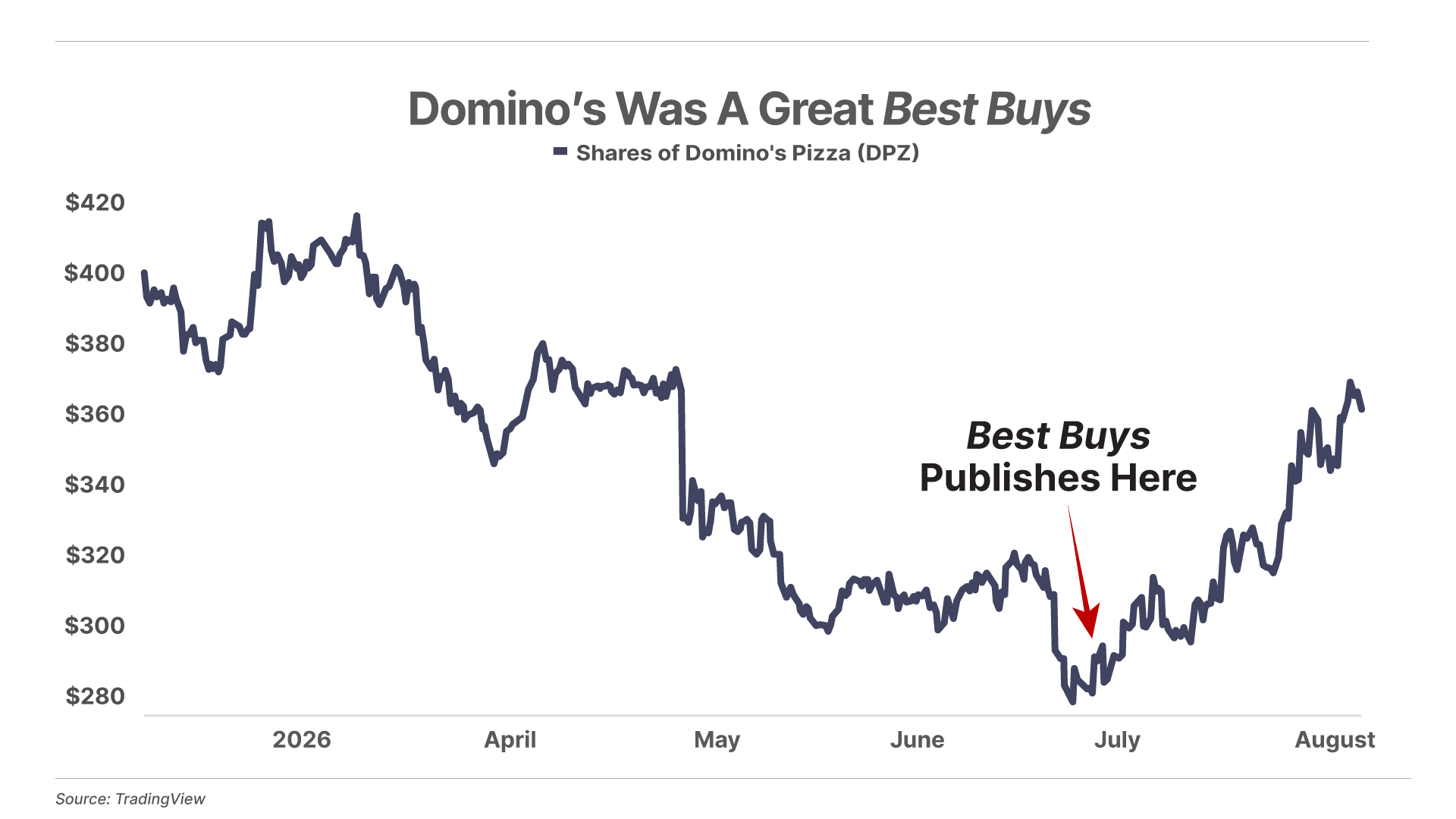
We release the next batch of Best Buys on August 22 – selecting what our analysts think represent the best buying opportunities of all Porter & Co. recommendations. To see what we pick, click here now.
In yesterday’s Daily Journal, analyst Jared Simons shared research by University of Florida’s Jay Ritter about IPO euphorias.
“One Word: Rational”
Bruce H. writes:
Thanks to Mr. Ritter's research, it's generally accepted that buying into IPOs has been a losing proposition for the investing public. Yet the awareness has only taken root in the last few years. Given the new understanding, will IPOs continue to perform according to Mr. Ritter's laws? A rational person would think not. The answer lies in the operative word: rational.
Thank you for sharing Mr. Ritter's insightful research. I'll continue to follow IPOs for their entertainment value.
“Perfect Advice”
Barry D. writes:
Perfect advice.
I will wait on SpaceX until December, letting shares find a level worth investing in. I wish I had this advice 40 years ago. My thinker is on right now.
Robert R. writes:
More people need to read this!!!!
Porter & Co. Market Snapshot
| Price | Yesterday's Return | Year-to-Date Return | |
| S&P 500 Index | $7,736.52 | 1.79% | 13.8% |
| Gold per ounce | $4,077.99 | 058% | -3.1% |
| Bitcoin | $64,297 | 0.87% | -26.9% |
| Oil (West Texas Intermediate) per barrel | $75.77 | -5.4% | 32.7% |
| Berkshire Hathaway (BRK) | $774,300.00 | 0.79% | 2.6% |
| Porter's Permanent Portfolio | - | 0.47% | 1.6% |
| The Better Than Berkshire Index | - | 0.85% | 9.7% |
| Total Return | Annual Return | ||
| Porter & Co's Top Ranked* |
35.4% |
16.8% | |
| Yield | Yesterday's Change | Change Year-to-Date |
|
| U.S Treasury 30-Year Yield | 5.17% | -5 bps | 33 bps |
| Prices as of 4:00 pm ET August 4, 2026 | bps = basis points (or 0.01%) | |||
| *A Complete Investor risk rating of 1 is defined as a "low risk, high allocation" security, while positions rated closer to a 5 are higher risk. Porter & Co.'s top-ranked positions include those rated either 1 or 2 in Complete Investor portfolio. | |||
Porter & Co. Top Positions
| Publication | Ticker | Description | Total Return |
| Biotechnology | QURE | uniQure | 237% |
| Complete Investor | BWXT | BWX Technologies | 203% |
| Biotechnology | NUVB | Nuvation Bio | 154% |
| Biotechnology | ROIV | Roivant Sciences | 153% |
| Complete Investor | SKWD | Skyward Specialty Insurance | 150% |
| Biotechnology | SGMT | Sagimet Biosciences | 148% |
| Biotechnology | TGTX | TG Therapeutics | 138% |
| Complete Investor | BTC/USD | Bitcoin | 137% |
| Complete Investor | PM | Philip Morris | 133% |
| Biotechnology | QURE | uniQure | 131% |
| Prices as of 4:00 pm ET August 4, 2026 | |||
Please note: The investments in our “Porter & Co. Top Positions” should not be considered current recommendations. These positions are the best performers across our publications – and the securities listed may (or may not) be above the current buy-up-to price. To learn more, visit the current recommendations page of the relevant service, here| New Window. To gain access or to learn more about our current recommendations, call our Customer Care team at 888-610-8895 or internationally at +1 443-815-4447.