The Threat From AI Is Politics, Not Technology
Inside Today’s Issue
Every great leap forward in productivity arrives as a catastrophe to some people.
That’s a big part of what’s driving the entire angst over artificial intelligence (“AI”). All the nerds are saying that humans will never have a job again.
Nonsense.
Yes, millions of jobs will vanish. Yes, whole trades will die. Yes, prices for things like legal work, accounting, and medical diagnosis will collapse. And yes, the capital invested in the old way of doing those things will get wiped out. People aren’t going to use Google’s web search anymore. But that doesn’t mean that Alphabet (GOOG) is going to go out of business.
Why not? Because creative destruction isn’t a flaw of capitalism – it’s the main feature.
Joseph Schumpeter, the Austrian economist, first explained all of this formally in 1942. But you still won’t see this taught in government schools. While Marx invented the term “creative destruction,” Schumpeter correctly explained it for the first time as a process that “incessantly revolutionizes the economic structure from within, incessantly destroying the old one, incessantly creating a new one.” He wrote:
“This process of Creative Destruction is the essential fact about capitalism,” and he described capitalism itself as “the perennial gale of creative destruction.”
The logic is simple. A new machine lets fewer people produce more, so prices fall. The workers and the capital that the old method no longer needs are set free, and prices tell them where they are needed next. The market allows them to go on to build new industries that nobody could have planned.
That’s why the AI nerds believe there won’t be any new jobs: they haven’t been created yet. Ironically, the AI that the nerds do understand is what will empower the human creativity and ingenuity that will build these entire new industries – if the government doesn’t get in the way.
Capitalism is the best way to organize a society and allocate its scarce resources for exactly this reason: it encourages creative destruction instead of preventing it. On the other hand, systems that protect incumbents stagnate. They don’t grow. They restrain human ingenuity. Poverty is the result.
We are living through a new huge “gale” of creative destruction today with AI. The temptation to stop it politically will be immense. And whether or not we – as a society – thrive or are destroyed by AI will depend on Americans continuing to choose freedom and capitalism over statism and poverty.
Given our changing demographics and the rise of communism in America, I’m honestly not optimistic. (And by the way, much of the blame for that rests with the Republicans who continue to pursue statist, big-government policies.)
So I want to do my part and explain what happens when Americans choose the government over the free market. I hope you’ll share what I’ve written below with everyone who is afraid of AI.
You Shouldn’t Fear Creative Destruction – You Should Embrace It
John Deere was a blacksmith. In 1837, in Grand Detour, Illinois, he cut the teeth off a broken steel saw blade and shaped it into a plow that would scour itself clean in sticky prairie soil. For the next 80 years, his company sold horse-drawn implements.
Then Nicolaus Otto built the first working four-stroke internal combustion engine in Germany in 1876.
And then… everything about farming changed forever. An Iowa inventor named John Froelich built the first practical gasoline tractor in 1892. Froelich left the business, but the firm, renamed the Waterloo Gasoline Engine Company, went on to build the Waterloo Boy: a two-cylinder kerosene tractor.
As he’d done with cars, Henry Ford perfected the tractor. Ford’s tractor debuted in October 1917 at $750, or roughly $137,000 today. Tractors were expensive, at first. High prices for tractors told entrepreneurs what the economy needed more of – tractors.
In March 1918, John Deere (eventually Deere & Co.: DE) bought the Waterloo Gasoline Engine Company for $2.35 million – or around $400 million in today’s terms. The John Deere Model D arrived in 1923, stayed in production for 30 years, and sold 160,000 units.
Anticipating the competition, in February 1922, Ford cut the price of his tractor to $395. The industry called what followed the “tractor wars.” In 1923 alone, Ford built more than 100,000 tractors.
The resulting creative destruction was massive. The vast increase to farming productivity in the 1920s was probably the single biggest, most important fundamental economic change in human history to that point.
In 1830, growing 100 bushels of wheat took 250 to 300 hours of human labor with a walking plow, a sickle, and a flail. By 1930, with a tractor, a gang plow, and a combine, the same 100 bushels took 15 to 20 hours, a 95% reduction.
In 1920, American farms owned 246,083 tractors and 25.2 million horses and mules. By 1950, they owned 3.25 million tractors and only 7.6 million horses and mules. A mature farm horse needed about three acres of cropland for feed every year. At “peak horse” in 1915, roughly 93 million acres of American cropland grew food for horses and mules rather than for people.
The economic historians Alan Olmstead and Paul Rhode calculated that the tractor replaced 23 million draft animals between 1910 and 1960. That added 79 million acres to the effective cropland base, an area equal to two-thirds of all the cropland harvested across the Louisiana Purchase.
By 1960, the tractor cut the labor needed to grow America’s crops by about 1.7 million workers.
So who lost? The horse breeders lost, and so did the oat growers who fed the horses. The harness makers, the livery stables, and the farm blacksmiths lost too. And, of course, millions of farmers who didn’t take advantage of the new machinery and vastly expand their acreage also lost.
But… who won? America won. All of us.
In 1900, 41% of America’s workforce worked in agriculture. By 1930, the share was 21.5%, and by 2000, it was only 1.9%.
It was this fundamental change to farming productivity that created our cities. The 1920 census was the first in our history to count more Americans in towns and cities than in the countryside: 51.2%. During the 1920s, for the first time in our history, the total rural population actually fell.
So… what happened to the farmers? They followed prices (wages) to build what the economy needed. It didn’t need farmers anymore, thanks to tractors. The new economy needed cars and radios, city offices, stores, and hospitals. While they went on to build these things (and invent many others), the food they no longer had to grow kept arriving from fewer farms, at lower prices.
But hang on, didn’t the advent of the tractor and the changes to farming cause the Great Depression? Remember the “Okies”? Remember John Steinbeck’s The Grapes of Wrath?
For the farmers who couldn’t compete in the new world of tractor farming, politics held out the siren song of getting something for nothing. And getting disaffected farmers’ votes was a winning political strategy for decades. When Herbert Hoover became the U.S. president in March 1929, he called Congress into special session to deliver “farm relief through limited changes in the tariff.”
Much like President Trump today, Hoover believed tariffs were taxes that Americans wouldn’t have to pay. Those revenues could be used to give money to farmers. Congress took Hoover’s farm bill and loaded it with protection for thousands of other businesses.
More than 1,000 American economists signed a petition begging Hoover to veto the bill. They warned “the vast majority of farmers would also lose.” Henry Ford, the man selling tractors to those farmers, spent an evening at the White House calling the bill “an economic stupidity.” But Hoover signed it anyway, on June 17, 1930.
The Smoot-Hawley Tariff did exactly what the economists predicted. Canada retaliated before the bill was even signed, and Europe followed. Our exports fell from $5.24 billion in 1929 to $1.67 billion in 1933: a 68% collapse.
From 1926 through 1929, trade accounted for 15% to 17% of American farm income. It went to zero. Farm-state banks failed by the thousands. Between December 1930 and March 1933, about half of all American banks either closed or merged.
But the tractor didn’t cause the Great Depression.
The productivity – the enormous wealth – it delivered was real. What turned that productivity into misery was government: a tariff wall that kept American farmers from selling their incredible abundance to the world.
Now look at today’s gale.
The tractor of the AI age is the Nvidia (NVDA) accelerator chip: the machine that lets a small number of people do work that once took armies of them. I expect the creative destruction it unleashes to be every bit as violent as the tractor’s. And Washington has decided that the best way for us to manage it is to keep the machine at home.
The United States began restricting Nvidia’s advanced chips to China in 2022, and it still bans the export of Nvidia’s newest Blackwell and Rubin chips there. In December 2025, the White House allowed sales of the older H200 chips to approved Chinese buyers on one condition: the chips had to be routed through the United States, where the government collected a 25% tariff on the way out.
The barriers keep spreading. On Monday, the Commerce Department issued a rule requiring an export license to ship advanced chips to Indonesia, Malaysia, Singapore, Thailand, and Brazil, and requiring data centers abroad that serve Chinese customers to identify who those customers are.
Yesterday, Nvidia told investors it sold $2.4 billion of licensed chips to China last quarter and has stopped shipping them.
Beijing has spent this year steering its own companies away from the H200 and toward Chinese-made chips. Reuters reports that roughly 600,000 H200s are sitting in Hong Kong, waiting for import approval that probably won’t come.
You don’t need to fear AI. You need to embrace it.
You do need to fear the political response to AI. It will almost surely cause an enormous global depression.
Tell me what you think of today’s Journal: porterstansberrydirect@gmail.com
Good investing,
F. Porter Stansberry
Stevenson, Maryland
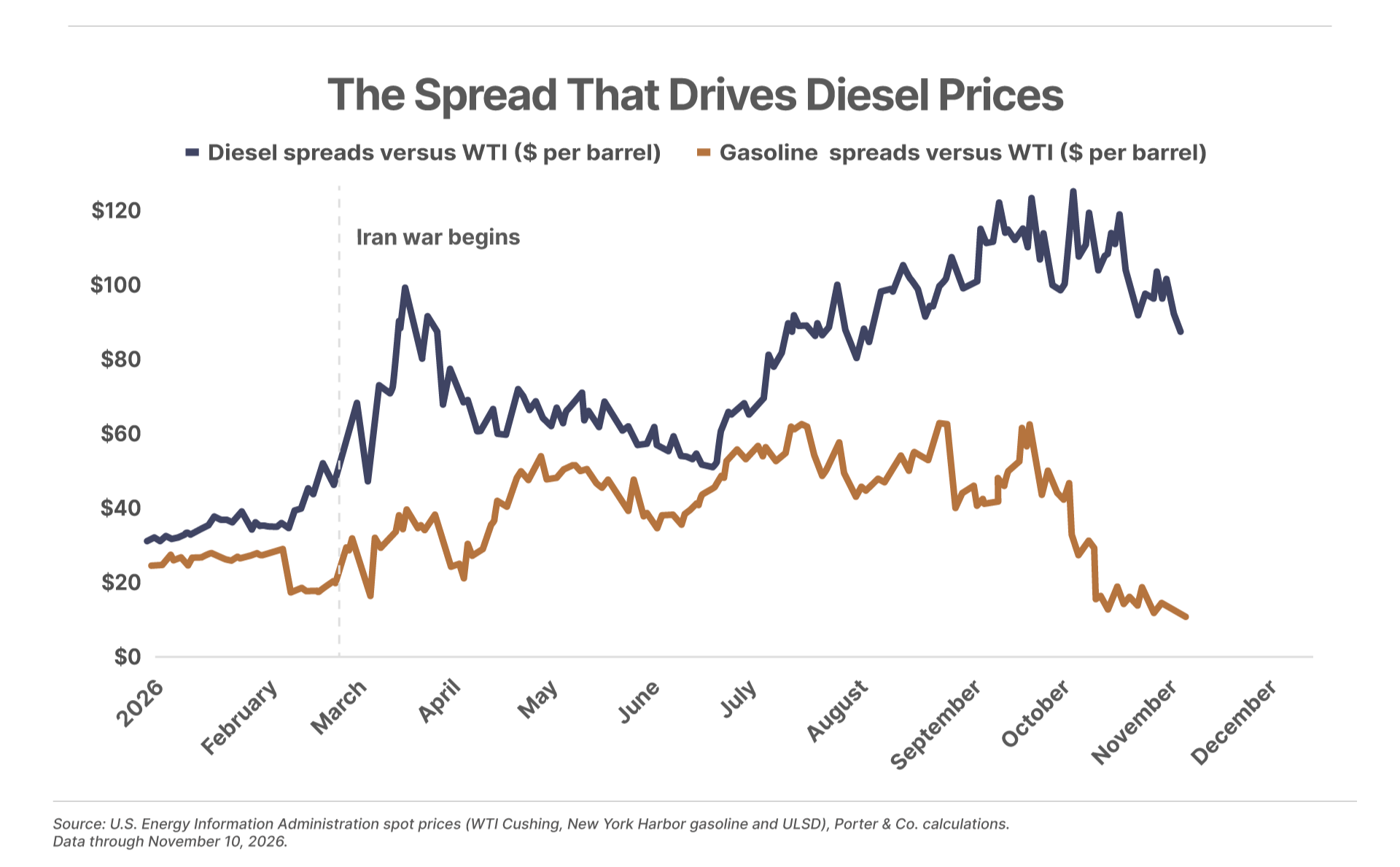
1. Gasoline accounts for most of the drop in refining margins. The 3-2-1 crack spread – the profit from turning three barrels of crude oil into two barrels of gasoline and one of diesel – has fallen more than 40% from its September record to $41.90 a barrel on Tuesday, an eight-month low. The gasoline margin has dropped from $61 in late September to $12. The diesel margin is still high – $87 compared with $46 before the Iran War began. With supply still low – U.S. diesel inventories are 8% below their five-year average – prices will remain high.
2. A Fed governor is calling for bigger rate hikes. On CNBC this morning, Christopher Waller said inflation is “headed in the wrong direction, and it’s spreading out.” Prices have risen at nearly 3.5% annually over the past three months, versus the Fed’s 2% target. About 70% of items in core services – such as car insurance and medical care – are rising faster than 3%, which Waller said has nothing to do with the price of oil. He wants a half-point hike in December, undoing all three of the Fed’s 2025 cuts.
3. Positive earnings fail to boost Nvidia shares. Nvidia (NVDA) reported excellent Q3 earnings yesterday, including a 103% year-on-year (“YOY”) increase in revenue to $116 billion and a 111% YOY jump in earnings per share to $2.68 – handily exceeding analyst estimates. Interim CEO Colette Kress provided positive commentary about the strength of the company’s demand outlook during the conference call while forecasting a 75% increase in next year’s revenue growth, up from 70% previously. Shares rallied by as much as 5% in after-hours trading before trading lower this morning. Superb earnings weren’t enough to assuage investor concerns about the long-term leadership of the business following the abrupt exit of founder Jensen Huang.
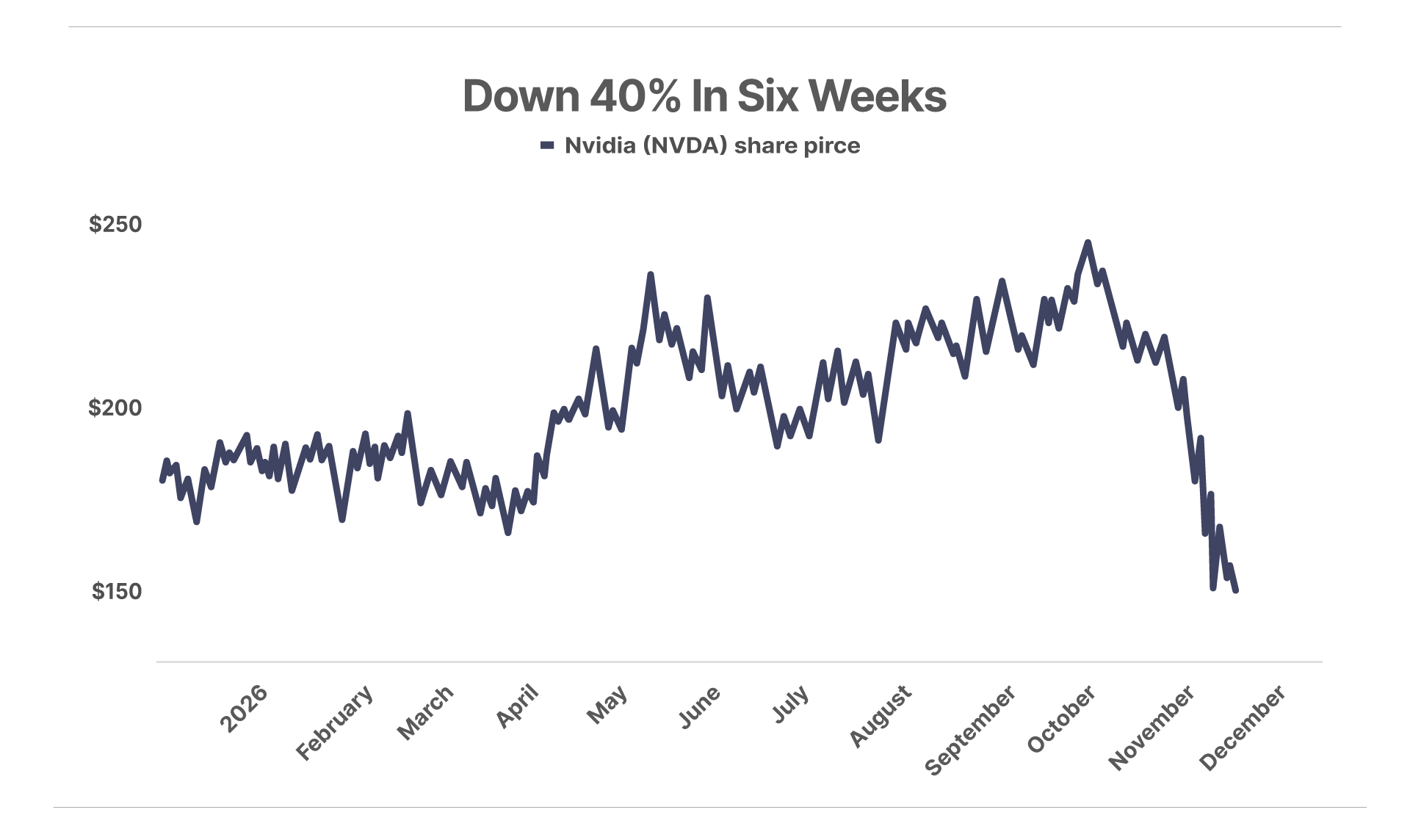
A Complete Investor recommendation, Nvidia (NVDA) shares have dropped 40% in the last six weeks, driven by two factors: 1) concerns of a peak in AI spending and 2) founder Jensen Huang’s extramarital affairs and alleged illegal chip sales to China.
“You Changed My Family’s Life”
Brett M. writes:
Hello Porter,
I have been a subscriber since the early 2000s. First time sending you an email. Forever grateful to you for changing my family’s life.
I hope you will continue by working with Tuttle Capital Management to complete the trifecta and create a Honeycomb Portfolio ETF. I proudly own PCPP and PCPC and have them in my Forever Portfolio. Keep up the great work!
Thanks again.
“Shorting The Nasdaq-100”
In yesterday’s Daily Journal, Porter explained why, although he says that the AI bubble is going to burst, he has no plans to short the major companies in it – partly because it’s so difficult to make money shorting stocks.
Richard A. writes:
So I bought SQQQ and will ride it into the recession. No carry charges.
Kevin L. writes:
Porter,
A great article on the AI trade on Monday, but, as you know, the timing on these bubbles is the hardest thing to get right. I like the way you went about it with the 366-day lockup expiration for SpaceX, but maybe it could happen earlier than June 12, as the market anticipates the possible sale. Or maybe Elon Musk vows not to sell any meaningful amount of shares, and that lets the bubble go on for longer.
Porter Comment: I’ve got two balls, but neither of them is crystal!
I think the bigger issue will be the $500 billion in credit funding the industry is projected to need. That’s going to wreck some credit ratings… And some equity prices.
Porter & Co. Market Snapshot |
Through Tuesday, November 17, 2026 close |
| Markets |
| Index or asset | Last | 1-Day | YTD | 1-Year |
|---|---|---|---|---|
|
S&P 500
Total return
|
732.44 | −1.01% | +8.2% | +11.2% |
|
Gold
Front-month futures
|
$3,864.20 | +0.29% | −11.0% | −5.2% |
|
Bitcoin
4 pm ET print
|
$63,915.00 | −1.69% | −27.0% | −30.4% |
|
Crude oil
WTI, per barrel
|
$86.01 | +0.34% | +49.8% | +43.6% |
|
Berkshire Hathaway
NYSE: BRK-A
|
$878,512.00 | −1.02% | +16.4% | +16.3% |
| U.S. Treasury yields |
| Maturity | Yield | 1-Day | YTD | 1-Year |
|---|---|---|---|---|
|
2-Year
|
4.80% | −3 bps | +133 bps | +120 bps |
|
10-Year
|
5.10% | −2 bps | +92 bps | +97 bps |
|
30-Year
|
5.46% | 0 bps | +62 bps | +73 bps |
| Porter & Co. strategies |
| Strategy | 1-Day | YTD | Since start | Per year |
|---|---|---|---|---|
|
Porter’s Permanent Portfolio
Since September 25, 2024
|
−0.51% | +5.2% | +32.6% | +14.1% |
|
Better Than Berkshire Index
Since May 16, 2025
|
−0.99% | +3.5% | +3.8% | +2.5% |
|
Porter & Co. Top Ranked*
Since July 14, 2022
|
−0.13% | +4.6% | +27.4% | +9.4% |
Porter & Co. Top Positions |
Through Tuesday, November 17, 2026 close |
| # | Position | Total return |
|---|---|---|
| 1 |
Roivant Sciences ROIV
Biotechnology
|
+238% |
| 2 |
Roivant Sciences ROIV
Complete Investor
|
+235% |
| 3 |
TG Therapeutics TGTX
Biotechnology
|
+234% |
| 4 |
APA Corporation APA
Porter & Co. Asymmetry
|
+162% |
| 5 |
Skyward Specialty Insurance SKWD
Complete Investor
|
+158% |
| 6 |
Philip Morris PM
Complete Investor
|
+143% |
| 7 |
Bitcoin BTC/USD
Complete Investor
|
+140% |
| 8 |
W.R. Berkley WRB
Complete Investor
|
+127% |
| 9 |
BWX Technologies BWXT
Complete Investor
|
+111% |
| 10 |
Chubb CB
Complete Investor
|
+103% |