Issue#134, Volume#3


Over The Long Term, Productivity Increases Lead To Lower Prices
Inside Today’s Issue
Editor’s note: Today, Distressed Investing analyst Andrew Lipman shares his insight on how, over the long term, the infusion of AI into all aspects of the economy will lead to great productivity and lower inflation.
Here’s Andy now…
AI can do many things – and it might even end high inflation…
But first we will see an increase in inflation, then as productivity increases with the expansion of artificial intelligence (“AI”) throughout the economy, inflation will fall over the longer term.
Three economic points underlay this theme:
- If the supply of something is constant, increasing demand for it leads to higher prices (price inflation) and declining demand leads to lower prices (price deflation)
- If the demand for something is constant, rising supply of it leads to lower prices (deflation) and reducing its supply leads to higher prices (inflation)
- Productivity means getting more output from the same amount of input – which for any product or service is a particular mix of labor and investment capital
The investment bank Goldman Sachs estimates that between $5.5 trillion and $7.6 trillion will be invested in AI infrastructure between 2026 and 2030. Such large expenditures will no doubt lead to a period of “demand pull” inflation – when demand for goods and services required to complete the buildout outpaces supply.
First, There Will Be Short-Term Inflation
According to McKinsey & Co., it takes three to five years to add a new semiconductor production facility. Which means the current phase of the AI investment boom – building data centers fitted out with computing, storage, and cooling systems – is projected to last through 2030. Spending $1 trillion per year will increase demand for these build-out products faster than supply – the chipmakers and power providers cannot deliver what’s needed as fast as it is needed.
This mismatch of demand and supply is leading to price inflation, particularly due to demand for memory and flash-storage semiconductors. The demand has outstripped supply and caused prices to ratchet higher. It has given rise to a new word: memflation.
Higher semiconductor prices, in turn, lead to higher prices for consumer electronics. Virtually every new appliance has processing and memory chips embedded – affecting even the simplest things like pre-programmed settings on a microwave oven or a dishwasher and therefore the everyday consumer.
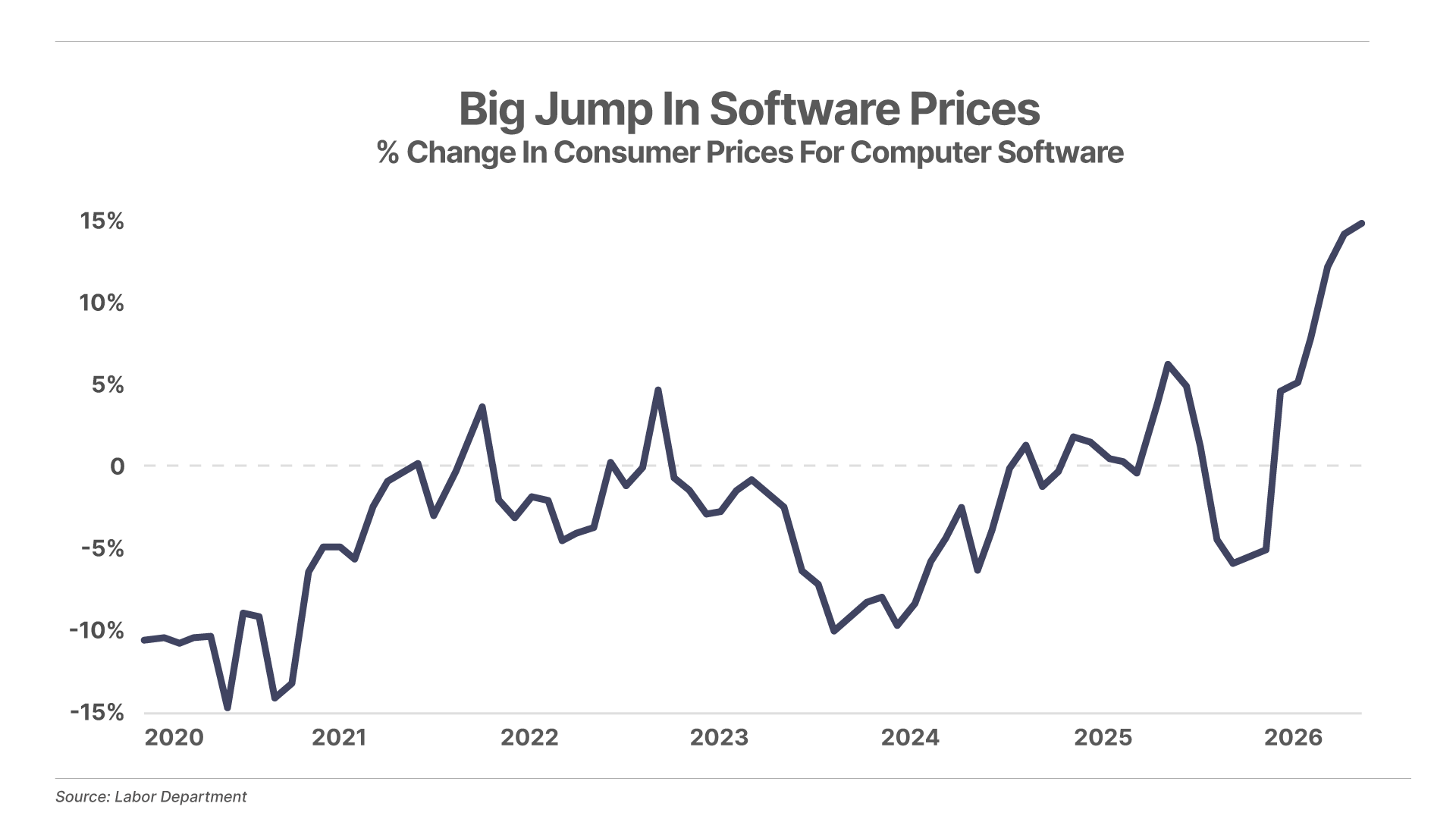
Software prices have also been surging. This is partly attributable to semiconductor chip prices, as well as the indirect cost of adapting programs to incorporate AI.
By 2030, it’s estimated that AI systems could use 12% of U.S. electricity – up from about 5% today. This incremental demand for generating capacity and extending local power grids is leading to higher power prices.
Productivity Is The Other Half Of The Story
Between 2000 and 2024, the inflation rate for the period was 83%, a compound increase of 2.55% per year. This headline statistic misses the nuance that over that time, prices of some goods and services rose and others fell.
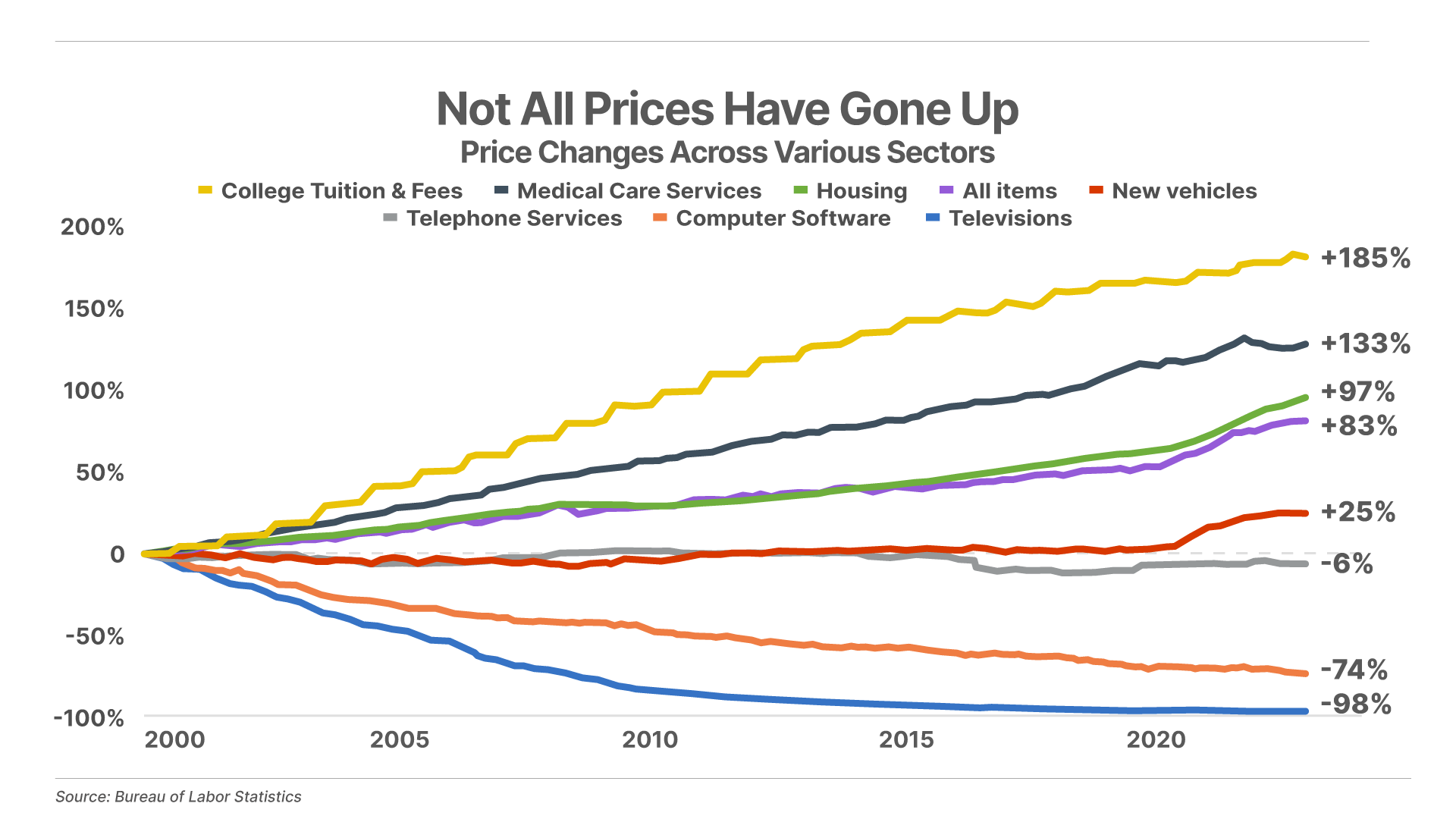
Prices rose fastest in the areas of housing (97%), medical care (133%), and education (185%). Car prices rose only 25% between 2000 and 2024. And the price of telephone services declined 6%, computer software fell 74%, and televisions dropped by a staggering 98%.
The difference maker is productivity gains – or how much more a business can get from its same input mix of labor and capital – often called labor productivity. Speaking generally, the higher the capital investment relative to labor, the greater the level of productivity gains.
- Productivity gains were least pronounced in labor-intensive housing, medical care, and education. Wage increases outstripped productivity gains significantly for these industries.
- The results were better in the automobile industry, where the mix of labor and capital mix is more balanced.
- Prices fell in capital-intensive telephone services, software, and consumer electronics, where advances in technology and productivity gains were most pronounced.
In effect, the value of a dollar rose against a basket of tech-related products and services. Given the capital intensity of AI, we expect it will have the same type of deflationary effect.
Excluding inflation, productivity gains cause wages to rise and standards of living to increase. While there is a recent debate about the share of gains going into wages, labor productivity and wage gains are closely linked.
Anthropic estimates that as AI becomes more adopted over the next 10 years (starting in 2025), annual productivity growth should rise from 1.4% (the 2021-2025 average) to 3.2% for the next 10 years.
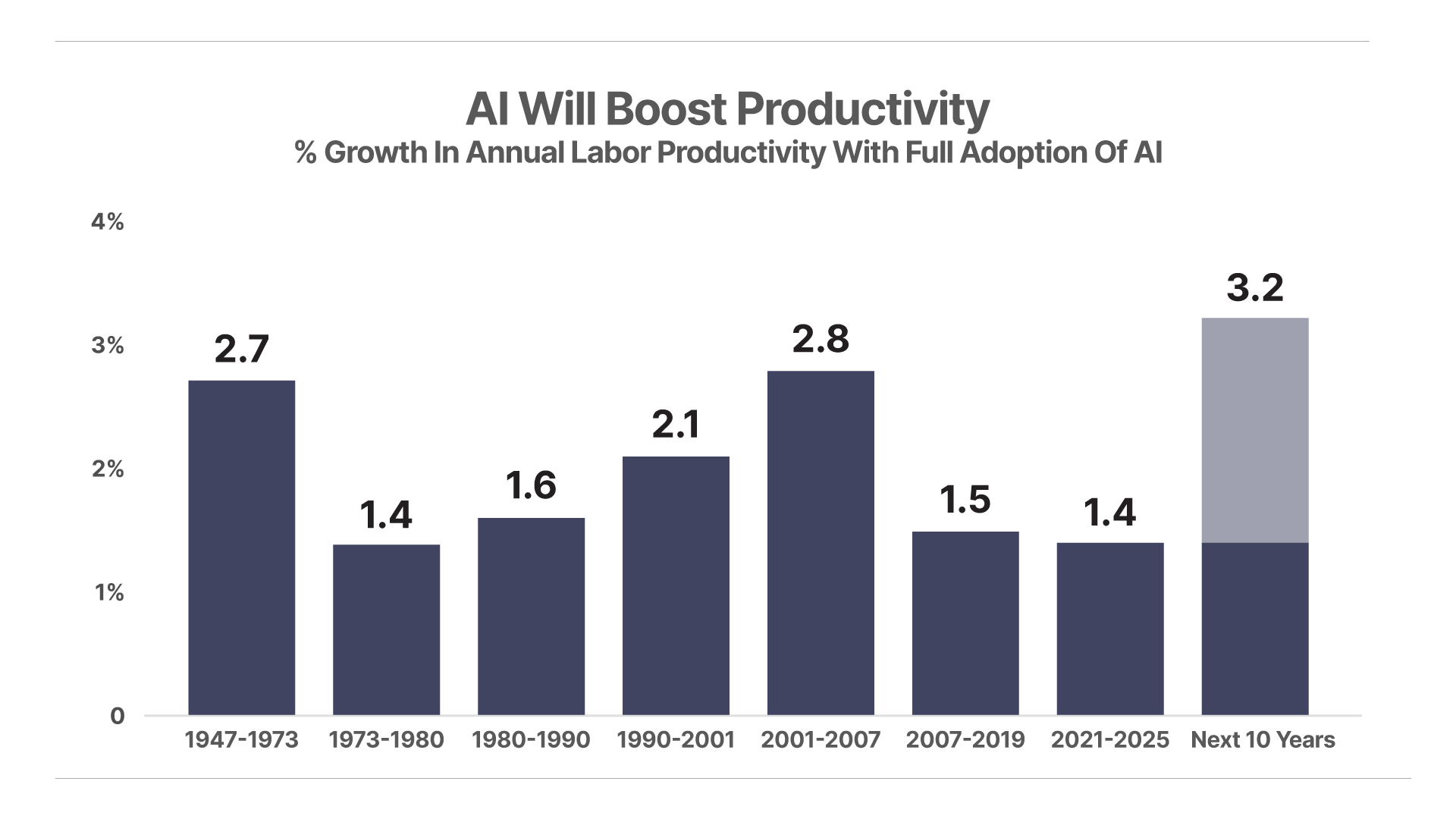
Anthropic based its estimates on its own Claude AI Chatbot, and it has financial incentives to present Claude’s projected benefits favorably. Even so, we consider its projections to be directionally correct.
Past technological advances support this idea that tech innovation leads to productivity growth. A study by the Federal Reserve Bank of San Francisco found the expansion of the internet between 1996 and 2000 caused productivity to rise to 2.75% annually, nearly double its 1.5% average between 1973 and 1996. We would expect AI’s effect – which we date back to Microsoft’s 2018 investment of $1 billion in OpenAI – to be at least as great and for a longer period.
There are signs that AI is already boosting productivity growth, which bottomed out at 1.3% in 2020 and grew to 1.7% in 2025. We note that these figures are rolling 10-year averages – the 1.7% in 2025 represents the average 2016-2025. The productivity growth rate in 2025 was likely well above 1.7%.
As the AI buildout rolls on for the next few years – causing a major supply-demand imbalance – AI should increase the rate of inflation. But once it fully takes hold in business and becomes infused in the overall economy after that, AI will likely increase productivity and lead to lower inflation over the longer term.
Tell us what you think of today’s Journal: porterstansberrydirect@gmail.com
Andrew Lipman
Southampton, New York

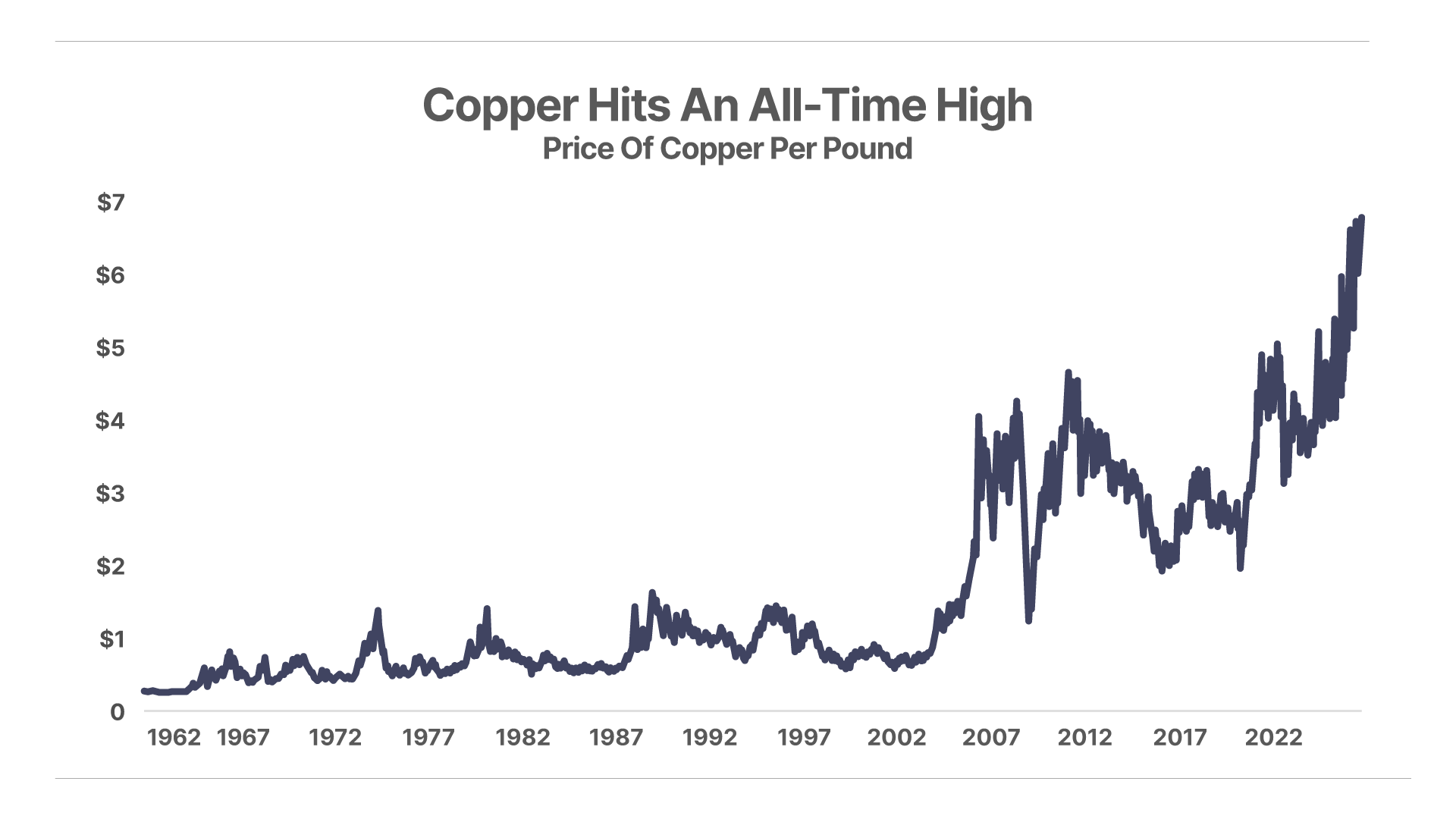
1. The copper train is taking off. Copper touched a fresh all-time high of $6.72 per pound on Wednesday. A tariff ruling sequestered more than 200,000 tonnes of the base metal into U.S. ports in July – a record inflow – starving the rest of the world. Five months of Hormuz closure gutted the sulphuric acid that global copper production depends on, and that demand wave is now arriving – copper is a key finishing component in AI data centers. New highs on broken supply before the demand even lands is a repricing, not a blip.
2. Dollar defender turns skeptic. UCal Berkeley economist and currency expert Barry Eichengreen has long argued that the dollar keeps its role as the world’s reserve currency because it’s been the least-bad option available: the “cleanest dirty shirt in the pile.” Writing in the Financial Times on Wednesday, he said last week’s joint U.S.-Japan yen rescue may have changed that. Japan agreed to borrow dollars from the Fed against its Treasury holdings rather than sell those bonds – a move designed to avoid pushing more Treasuries onto an already strained market. Eichengreen’s point: if central banks can’t easily spend their Treasury reserves when they need to, they will likely hold far fewer of them going forward.
3. A little-known economic gauge just turned bullish. Market research firm SentimenTrader noted this week that its proprietary JK Economic Barometer – a monthly measure blending the Conference Board’s index of leading economic indicators with an 11-part model of housing, labor, and market data – just jumped from one of its weakest readings on record to one of its strongest. In the 10 prior cases of the barometer rising since 1969, the S&P 500 was higher one year later 90% of the time, with an average gain of 16.3%.
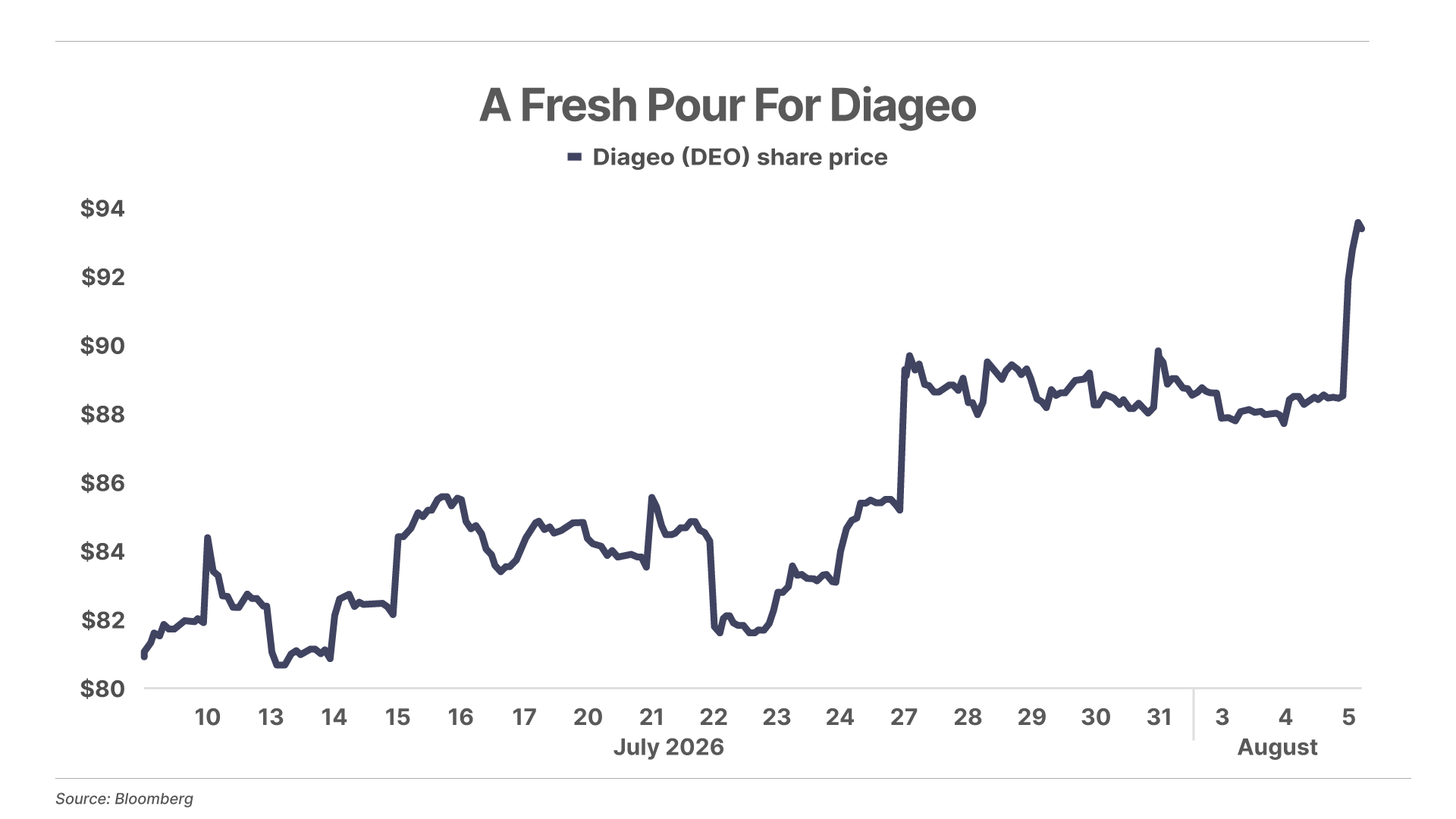
Shares of alcoholic-beverage maker Diageo (DEO) jumped 6% today, extending a 15.6% run since early July, after CEO Dave Lewis used the company’s Capital Markets Day to unveil a $1 billion, three-year cost savings plan and an $8 billion cumulative free cash flow target through fiscal 2029.
“Amazing News!”
Robert H. writes:
Amazing news that Porter is taking over the Biotechnology newsletter.
Will there be a separate fee for the Biotechnology portfolio or will it be included in the Partner Pass membership?
Porter & Co. Comment: Partner Pass members receive everything Porter & Co. publishes as part of their partnership. Among other benefits, Partners receive Biotechnology on the first Saturday of the month, Distressed Investing on the second Saturday, Complete Investor on the third Saturday, Best Buys on the fourth Saturday… plus, Asymmetry, High Conviction, Porter’s Permanent Portfolio, and Partners are first in line to purchase tickets to the Porter & Co. Annual Conference, which takes place at Porter’s farm every September. If you would like to learn about becoming a Partner, call our Customer Care team at 888-610-8895.
Porter & Co. Market Snapshot
| Price | Yesterday’s Return | Year-to-Date Return | |
| S&P 500 Index | $7,723.55 | -0.17% | 13.6% |
| Gold per ounce | $4,246.82 | 4.14% | -1.3% |
| Bitcoin | $64,786 | 0.76% | -26.5% |
| Oil (West Texas Intermediate) per barrel | $75.22 | 0.07% | 32.3% |
| Berkshire Hathaway (BRK) | $777,696.03 | 0.44% | 3.0% |
| Porter’s Permanent Portfolio | – | 1.04% | 2.6% |
| The Better Than Berkshire Index | – | 0.22% | 10.0% |
| Total Return | Annual Return | ||
| Porter & Co’s Top Ranked* | 35.6% | 16.8% | |
| Yield | Yesterday’s Change | Change Year-to-Date |
|
| U.S Treasury 30-Year Yield | 5.16% | -1 bps | 32 bps |
| Prices as of 4:00 pm ET August 5, 2026 | bps = basis points (or 0.01%) | |||
| *A Complete Investor risk rating of 1 is defined as a “low risk, high allocation” security, while positions rated closer to a 5 are higher risk. Porter & Co.’s top-ranked positions include those rated either 1 or 2 in Complete Investor portfolio. | |||
Porter & Co. Top Positions
| Publication | Ticker | Description | Total Return |
| Biotechnology | QURE | uniQure | 237% |
| Complete Investor | BWXT | BWX Technologies | 196% |
| Biotechnology | SGMT | Sagimet Biosciences | 160% |
| Complete Investor | SKWD | Skyward Specialty Insurance | 156% |
| Biotechnology | ROIV | Roivant Sciences | 153% |
| Biotechnology | NUVB | Nuvation Bio | 151% |
| Biotechnology | TGTX | TG Therapeutics | 141% |
| Complete Investor | BTC/USD | Bitcoin | 139% |
| Complete Investor | PM | Philip Morris | 135% |
| Biotechnology | QURE | uniQure | 131% |
| Prices as of 4:00 pm ET August 5, 2026 | |||
Please note: The investments in our “Porter & Co. Top Positions” should not be considered current recommendations. These positions are the best performers across our publications – and the securities listed may (or may not) be above the current buy-up-to price. To learn more, visit the current recommendations page of the relevant service, here| New Window. To gain access or to learn more about our current recommendations, call our Customer Care team at 888-610-8895 or internationally at +1 443-815-4447.