Issue#128, Volume#3

Introducing Porter & Co. Biotechnology – Part One Of Three
Inside Today's Issue
Editor’s note: This is the first in a three-part series that Porter is delivering on Porter & Co. Biotechnology – a new advisory launching this Saturday, August 1. To get access to that first issue and all ongoing recommendations and portfolio updates, click here.
You think you know what it means – but you don’t.
You know there’s a new railroad being built. It’s on the news every day. It’s been driving the stock market higher and higher. Hundreds of billions of dollars a year are going into data centers – computers the size of cathedrals, drawing electricity measured in gigawatts, rising out of farmland in Ohio and Wyoming and Texas.
This is the largest infrastructure build-out in America since the railroad boom of 1865-1873.
You know this will change your life and the lives of all Americans, in many ways. You know fortunes will be made, fortunes measured in trillions of dollars. But what you don’t know is: most investors are about to lose everything.
There’s a huge paradox at the heart of every technological revolution. Tech innovations destroy as much as they create. And it is this creative destruction that lies at the heart of capitalism’s ability to dynamically create vastly more wealth.
The most important thing for investors today isn’t to know what artificial intelligence (“AI”) will build. The most important thing is to understand what it cannot destroy.
Let me start by explaining the key economic driver of these changes: an increase in computer efficiency that’s hard to even imagine, increases that are driving the price of compute down to virtually zero.
Nvidia (NVDA) built GPU chips that perform thousands of small calculations simultaneously rather than a few large ones in sequence. Broadcom's (AVGO) switching silicon and Nvidia's own chip-to-chip links made it possible to move data between processors fast enough that 10 thousand separate chips behave like a single machine. High-bandwidth memory from SK Hynix (SKHY) and Micron Technology (MU) places memory directly against the processor, so the chip stops waiting for the information it needs.
Parallel processing gave us the horsepower. Bandwidth lets us harness thousands of engines to one plow. Memory stopped the engines’ idling. Together, they collapsed the cost of computation.
It is very hard to understand how important this change will be to the world. To help you understand it, imagine if, in a single year, planes could suddenly carry 10,000x more passengers in a single aircraft, while, at the same time, they became 10,000x faster… while ticket prices fell 90%. That is the kind of efficiency gain we’ve seen in computing over the last three years.
These changes will remake American life. Cars that drive themselves. Aircraft that carry one person across a city. Robots shaped like people. And, most profoundly, vastly more effective medicines.
But there is one part of this story that nobody has told you.
These enormous investments will drive the price of everything they touch toward zero. That is what a railroad does: it destroys almost all of the forms of transportation that came before it.
You can already see it. Software stocks have come under heavy pressure, and the reason is simple: if computing is nearly free, why would a corporation keep buying application software when it can build its own?
The last time America laid a new railroad, it was fiber-optic cable. Through the late 1990s, WorldCom and Global Crossing buried millions of miles of glass across the country and under the oceans. Both companies went bankrupt – WorldCom's collapse in 2002 was the largest bankruptcy in American history at the time.
But the cable stayed in the ground. And that cable, bought for pennies on the dollar by the people who came next, made Amazon (AMZN), Netflix (NFLX), Google (GOOG), Apple (AAPL), and Facebook (META) possible. The builders were destroyed. But the businesses that were enabled by the massive decrease in data transportation costs created the greatest businesses in history.
So the question today is not who is building the data centers. The question is: which industry can absorb almost unlimited computing power and still defend its prices when computing becomes free?
The answer is biotechnology.
Biology is the largest computational problem we know of. The number of possible drug-like molecules exceeds the number of atoms in the observable universe. No amount of computing power exhausts that search. Every additional data center makes the search better.
And medicine is the only industry where the government hands you a legal monopoly – in the form of a patent – for two decades and then enforces it for you.
Software has no such protection.
Over the next 20 years, biotechnology will be the best-performing sector of the stock market. It will be the next Magnificent 7. Not because the science is thrilling, though it is, but because it is the only place where limitless computation meets a durable moat.
On August 1, Porter & Co. is relaunching our biotech coverage as Porter & Co. Biotechnology. How important is this? Important enough that I am taking over as lead analyst personally.
As always, when I build a new product, I’m driven to find a way to make it the best in class. So I’ve built a system that can monitor the entire sector every day…
- Every clinical trial
- Every action by the Food And Drug Administration (“FDA”): approval letters, decision dates, advisory committee calendars, rejection letters, and label changes
- Every filing made to the Securities And Exchange Commission, including reports that reveal which stocks the leading biotech specialist funds are accumulating
- All of the peer-reviewed literature, and the late-breaking abstracts released at medical conferences hours before they move a stock
- Medicare and Medicaid coverage decisions and the prices they pay
- The European and Japanese regulators
- Prescription and dispensing data
- Federal court dockets, for the patent fights
- The publicly available manufacturing inspection records, because a plant that fails inspection can sink a drug that works
And, on August 1 – this coming Saturday – I’ll put all of this work into a 20-stock portfolio for subscribers. And along with the portfolio, I’ll include specific asset allocation suggestions and, of course, risk ratings on every position. By building a whole-industry model, I believe we can produce outstanding returns in a relatively low volatility portfolio.
Biotech isn’t easy. A new drug takes 10 to 15 years and more than $1 billion to make. Roughly nine out of 10 drugs that enter human testing never reach a pharmacy. The testing runs in three phases: a small study to see whether the drug is safe, a larger one to see whether it does anything, and a final study large enough to prove it beyond argument.
And here’s the part that’s even worse: the patent clock starts before any of that. A company files its patent when it discovers the molecule, then spends a decade in trials. Twenty years of protection can leave only 10 or 12 years by the time the drug reaches patients.
Then the cliff arrives. Novartis (NVS) sold $7.7 billion of its heart-failure drug Entresto in 2025. Generic copies launched. Entresto sold $1.18 billion in the June quarter – down 51%.
How will we prosper in the face of these enormous hurdles? We started by isolating and focusing on only the most valuable potential new drugs. I call these areas of medicine the “11 Kingdoms.”
The 11 Kingdoms
I organized the industry by science rather than by ticker. And by the size of the potential market. Here are the 11 Kingdoms…
- Obesity – this will be the largest drug market in history, and it is still in its first act
- Immunology and inflammation – turning down an immune system attacking its owner
- Oncology – cancer, and the growing arsenal of drugs that deliver poison only to cancer cells
- Gene silencing – switching off a disease-causing gene before the body ever builds the protein (this is the subject of tomorrow's letter)
- Gene editing and gene therapy – repairing or replacing the defective gene itself
- Cell therapy – removing a patient's own immune cells, reprogramming them to hunt cancer, and returning them
- Neurology and neurodegeneration – the hardest kingdom, and the one where the first genuine wins are now appearing
- Vaccines and infectious disease – the platforms that compressed vaccine development from a decade to a year
- Radiopharmaceuticals – attaching radiation to a molecule that seeks out a tumor and delivers the dose from inside
- Complement and rare disease – shutting down an ancient arm of the immune system that destroys blood cells and kidneys
- Targeted small molecules and protein degraders – pills that shut down a specific cancer mutation, and a new class that does not block a harmful protein but marks it for destruction.
Tomorrow I am going to take you inside the Fourth Kingdom – gene silencing – and show you a new drug that will be the largest cardio drug in history. It treats a disease that afflicts one in five people that no approved drug treats. It is the clearest example I can give you of how large these markets become when computation finally cracks something biology has hidden forever.
Please don’t miss tomorrow’s Journal. And if you want to earn the largest gains of the compute revolution, subscribe to Porter & Co. Biotechnology.
Tell me what you think of today’s Journal: porterstansberrydirect@gmail.com
Good investing,
F. Porter Stansberry
Stevenson, Maryland

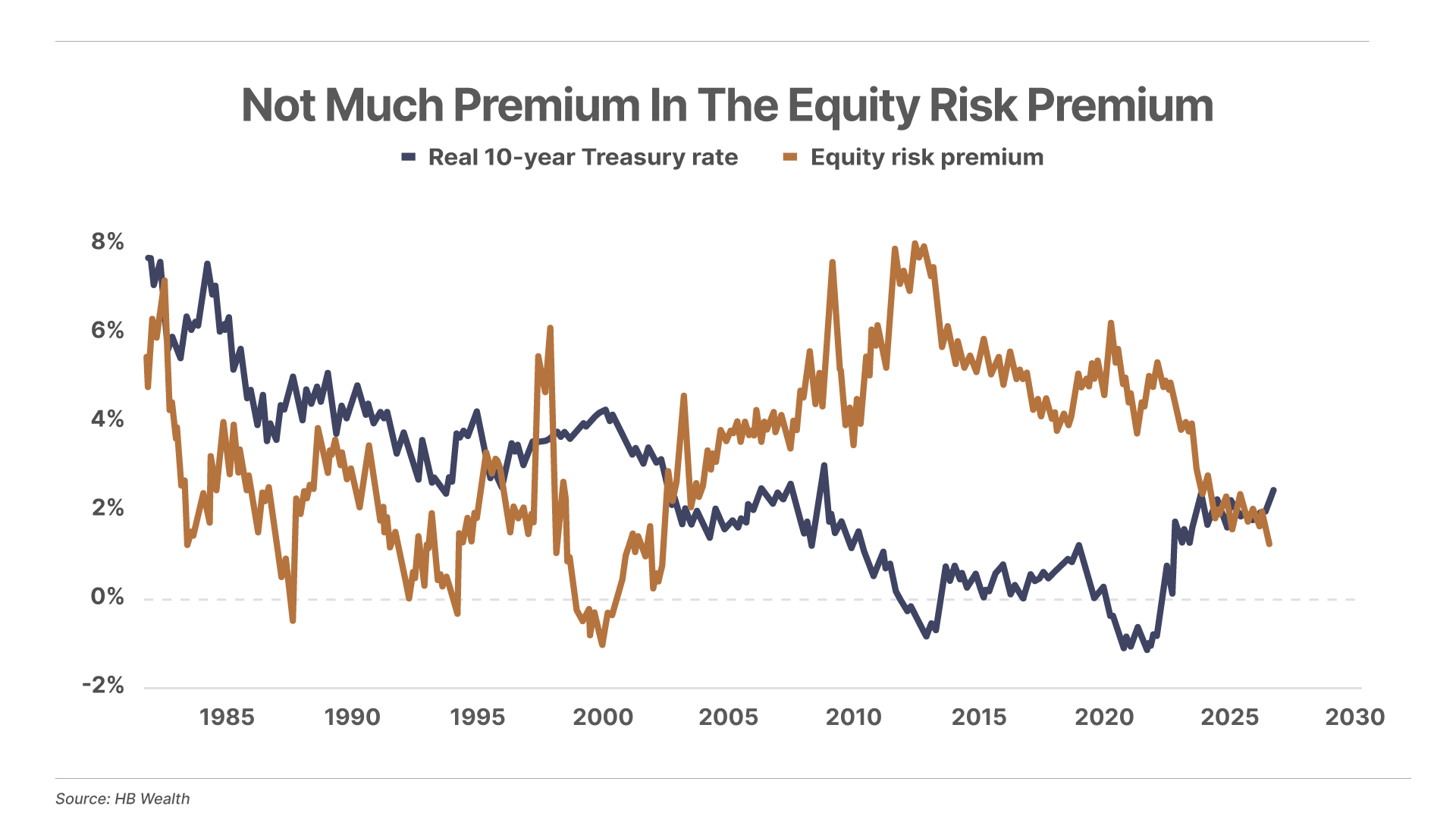
1. The bond market is weakening the case for stocks. The 10-year real yield – the Treasury yield above inflation – reached 2.44% this week, the highest since October 2023. Meanwhile, the S&P 500's earnings yield, which is corporate profits divided by share price, sits at 3.67%. That leaves a gap of just 1.23 percentage points – the thinnest since the tech bubble – as payment for owning stocks instead of government bonds. Going back to 1980, when the equity risk premium was as narrow as it is now, the S&P 500 generated below-average returns over the next six and 12 months.
2. Unwind of leverage in Korea continues. The Direxon 3x leveraged exchange-traded fund tracking South Korea’s Kospi Index (KORU) has collapsed 80% in less than two months. The country’s stock market became the epicenter of leveraged speculation on the artificial intelligence (“AI”) trade, with millions of trading accounts suffering forced liquidations from the recent decline in AI-related stocks. The ripple effects have spread around the globe, coinciding with significant losses in U.S. technology and semiconductor stocks.
3. The FOMC held rates steady, but three officials dissented. The Federal Open Market Committee (“FOMC”) left its benchmark short-term rate at 3.50%–3.75% for a fifth straight meeting on a 9-3 vote. The three dissenters each wanted a quarter-point increase – the most votes against a hold in favor of higher rates since September 2016. Chair Kevin Warsh, who has stopped telling markets where rates are headed in advance, welcomed the split: "I asked for a good family fight, and I got one." He also warned that five years of above-target inflation "cannot be cured in nine weeks," and rejected the idea that the Fed's 2% inflation goal has quietly loosened: "There is no soft implicit target, not on this committee's watch."
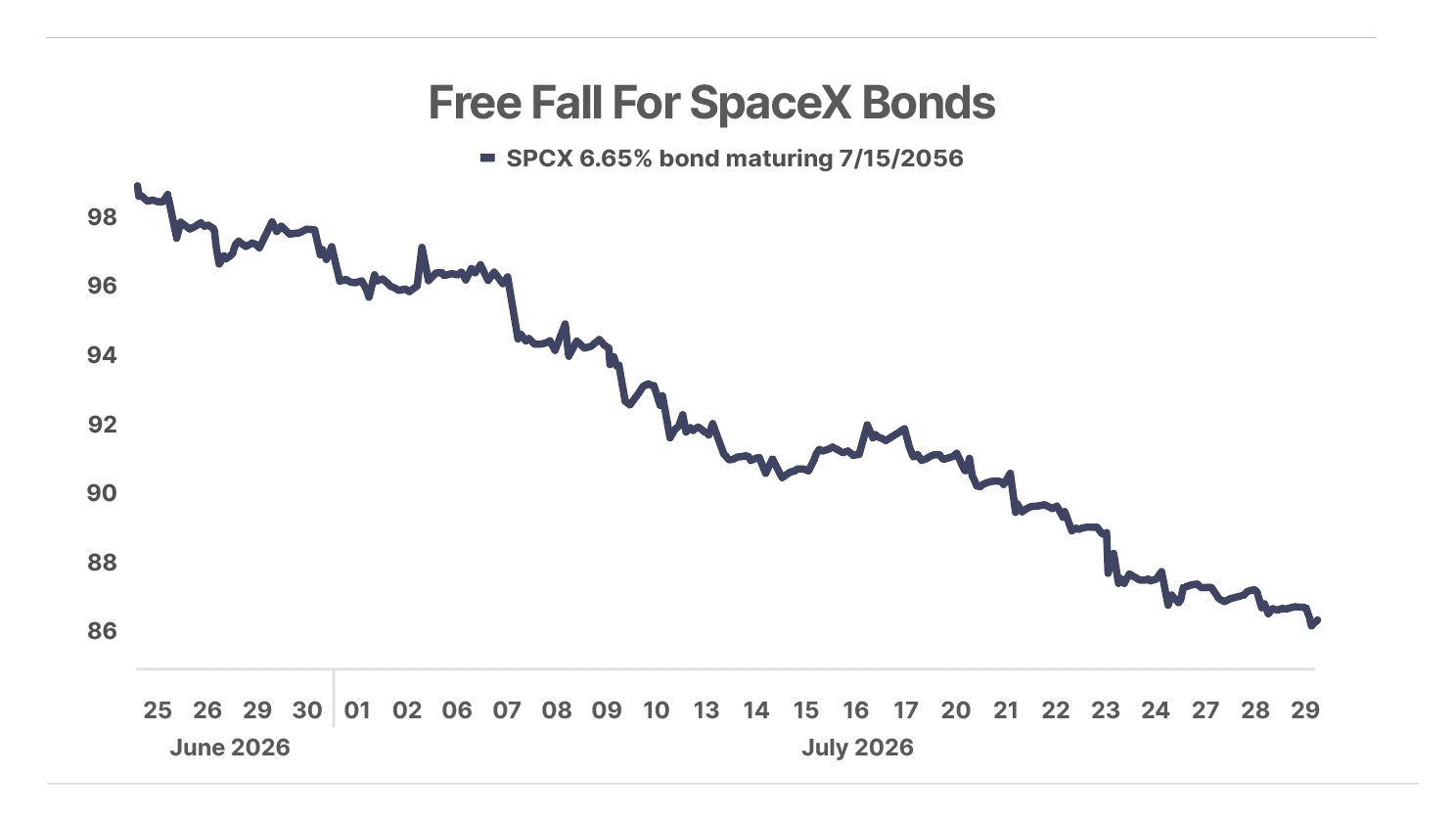
SpaceX (SPCX) 6.65% bonds due in 2056 have dropped from par to 86 cents on the dollar in just over a month after their issuance. This is a significant decline in a newly issued bond, which now trades firmly in “junk” territory yielding just under 8%. The drop in bond price mirrors the weakness in SPCX shares, trading 15% below the $135 IPO price at around $115 per share – and about 50% below their June 16 high of $225.
Poll Results… Rate Hike?
In yesterday’s Daily Journal, we asked readers what they thought the Fed would do in today’s FOMC meeting: increase interest rates, decrease interest rates, or leave them unchanged… an overwhelming 90% of survey takers believe the Fed will “hold rates where they are,” while 6% expected an increase and 3% anticipated a cut in rate.
"Best Mailbag Ever"
Kathy D. writes:
The absolute BEST mailbag ever! A special thanks for including Steve B’s uncensored thoughts on Ford (as well as GM), and your response. I certainly don’t wonder how he really feels about Ford.
"First On Race Day"
Gayle H. writes:
Damn, the pacifists and Marxists are running Ford into the ground!
I bet no one responsible for directing Ford down the path of electric-powered vehicles
and its double-figure billions in losses has ever been held accountable, with losses in
their salaries, dividends, and/or retirement accounts.
There needs to be a shareholder revolt against the leadership as well as any media
who were bought off and/or bought into this boondoggle of false hyperinflated value
of product!
Perhaps, the real problem stems from the current leadership abandoning Ford's creed
of old that was "First On Race Day" leads to sales on Monday.
"Diworsification"
Craig P. writes:
Loved your take. It reminded me of Peter Lynch’s take on diversification when it came to individual companies that decided to branch out from their core competency and it didn’t work. He called it diworsification.
Porter & Co. Market Snapshot
| Price | Yesterday's Return | Year-to-Date Return | |
| S&P 500 Index | $7,428.78 | 0.21% | 9.2% |
| Gold per ounce | $4,036.30 | -1.14% | -7.3% |
| Bitcoin | $63,871.36 | -1.64% | -26.9% |
| Oil (West Texas Intermediate) per barrel | $79.26 | -3.34% | 48.4% |
| Berkshire Hathaway (BRK) | $768,010.01 | 2.97% | 1.8% |
| Porter's Permanent Portfolio | - | 0.55% | 3.1% |
| The Better Than Berkshire Index | - | 1.11% | 10.3% |
| Total Return | Annual Return | ||
| Porter & Co's Top Ranked* | 37.4% | 16.8% | |
| Yield | Yesterday's Change | Change Year-to-Date |
|
| U.S Treasury 30-Year Yield | 5.09% | -5 bps | 24 bps |
| Prices as of 4:00 pm ET July 28, 2026 | bps = basis points (or 0.01%) | |||
| *A Complete Investor risk rating of 1 is defined as a "low risk, high allocation" security, while positions rated closer to a 5 are higher risk. Porter & Co.'s top-ranked positions include those rated either 1 or 2 in Complete Investor portfolio. | |||
Porter & Co. Top Positions
| Publication | Ticker | Description | Total Return |
| Tech Frontiers | QURE | uniQure | 237% |
| Complete Investor | BWXT | BWX Technologies | 198% |
| Tech Frontiers | NUVB | Nuvation Bio | 163% |
| Tech Frontiers | TGTX | TG Therapeutics | 155% |
| Complete Investor | SKWD | Skyward Specialty Insurance | 155% |
| Tech Frontiers | ROIV | Roivant Sciences | 150% |
| Complete Investor | PM | Philip Morris | 147% |
| Complete Investor | BTC/USD | Bitcoin | 136% |
| Tech Frontiers | SGMT | Sagimet Biosciences | 135% |
| Tech Frontiers | QURE | uniQure | 131% |
| Prices as of 4:00 pm ET July 28, 2026 | |||
Please note: The investments in our “Porter & Co. Top Positions” should not be considered current recommendations. These positions are the best performers across our publications – and the securities listed may (or may not) be above the current buy-up-to price. To learn more, visit the current recommendations page of the relevant service, here| New Window. To gain access or to learn more about our current recommendations, call our Customer Care team at 888-610-8895 or internationally at +1 443-815-4447.