Issue #106, Volume #3


What The Railroads Teach Us About The AI Buildout
Inside today's Daily Journal…
|
Today’s Daily Journal is about Bitcoin.
In this month’s Complete Investor, I gave readers my Bitcoin pricing model and explained how it works. As I said to subscribers: because of Bitcoin’s halving cycle, we’re at a low price right now. Bitcoin is, more or less, as cheap as it will ever be in this cycle. And, there’s a good chance that it will move up 10x from here in the next cycle.
But to understand why we believe that’s inevitable, you need to know what happened the last time our country financed an infrastructure project as big as the expected build out of artificial intelligence (“AI”).
The post-Civil War railroad buildout was the largest private-capital infrastructure buildout, by share of GDP, in U.S. history. In the years immediately after the Civil War (between 1865 and 1873) total railroad mileage doubled. In the peak construction years (1871 and 1872), roughly 4% of America’s entire GDP was spent on railroad construction.
The railroads were financed, almost entirely, by debt. At its peak, cumulative outstanding railroad debt equaled a third of America’s economy. Expressed in today’s dollars, railroads issued about $10 trillion in bonds.
The AI data-center buildout is now at 1.9% of GDP for the hyperscalers alone – Microsoft (MSFT), Alphabet (GOOG), Amazon (AMZN), and Meta (META). AI infrastructure spending is projected to reach $5 trillion cumulative by 2030, per consulting firm McKinsey & Co. By the time it’s completed, it will likely become as large as the railroad buildout – or even bigger because there’s one very important difference between the two types of infrastructure.
Railroads are primarily physical infrastructure – tracks, land, and trains – that are durable, long-lasting assets with a utility that changes slowly over time. Once laid, a railroad remains productive for decades or even a century with minimal technological upgrades.
In contrast, data centers are high-tech, capital-intensive facilities defined by rapid technological obsolescence. Their value is derived from the computing hardware – chips, servers, and cooling systems – that lose relevance as processing power improves and energy requirements shift. Consequently, while a railroad’s value lies in its physical geography, a data center’s value is tied to technology that inevitably demands replacement every 10 to 20 years – greatly increasing the capital commitment.
The Significance Of The Civil War
But we need to start with the Civil War, because without the massive inflation that occurred during the conflict between the North and South, the massive railroad buildout and the corresponding financial bubble would never have happened.
The Civil War was such an enormous disaster… it’s hard for people today to imagine. One in 10 white men of military age in America died in the war. One in five in the South. That’s 750,000 men. More than every other American war – combined.
The war destroyed the South. In 1860, the per-capita wealth of white Southerners was nearly double that of Northern whites. Then cotton exports collapsed by 95%, and two-thirds of the South’s railroads were destroyed. By the end of the war, the richest 10% of Southerners had lost 90% of their personal property. By 1900, per-capita income in the South was half what it was in 1860. It would not fully recover until 1950, 90 years later.
But for the North, the Civil War was good business.
The value of the stocks on the New York Stock Exchange rose 40% annually during the war. The surging value of NYSE securities led to an explosion in listings. The number rose 10x – from 30 to over 300. Railroads were the leading industry. Shares of Erie Railroad went from $8 to $122 during the war and many of America’s great fortunes – like JP Morgan’s and the Vanderbilts’ – were made during the war.
What they don’t teach in schools was how all of this wealth was formed: with paper money.

In 1861, at the start of the Civil War, the United States Treasury was on the gold standard. One dollar was a claim on a fixed weight of gold – 23.22 grains, or about half of a 1/10th-ounce American Eagle. Anyone holding a Treasury bond could redeem the interest in gold coins. Anyone holding a national banknote could walk into the issuing bank and demand gold across the counter.
Gold is hard to “print” – you need huge tractors digging in very deep mines. And war is expensive. The Union was spending $1.5 million per day. So to finance the war, the Union needed to create a fiat system.
On December 30, 1861, the New York banks suspended specie payments – meaning they would no longer hand gold across the counter. The Treasury followed two days later. Eight weeks after that, on February 25, 1862, U.S. President Abraham Lincoln signed the Legal Tender Act. And with that, the greenback – the paper dollar – was born. Congress declared it legal tender for all debts, public and private. By the end of the war, the Treasury had issued $433 million in greenbacks.
Was any of this constitutional? No.
Article I, Section 8, of the U.S. Constitution grants Congress the power to coin Money, regulate the Value thereof. Article I, Section 10, forbids the states from making anything but gold and silver coins a tender for debts. Nothing in the Constitution authorizes the federal government to issue paper as legal tender for private debts.
Salmon P. Chase, Lincoln's Treasury Secretary, backed the Legal Tender Act in February 1862. After the war, Chase was appointed Chief Justice of the United States. In Hepburn v. Griswold, which the Supreme Court decided on February 7, 1870, Chase wrote the majority opinion declaring his own Legal Tender Act unconstitutional as applied to debts contracted before its passage. President Ulysses Grant immediately nominated two new justices to the Supreme Court – William Strong and Joseph Bradley. The Court reheard the question. On May 1, 1871, the Legal Tender Cases reversed Hepburn by a 5-4 majority. The Constitution was rewritten by court-packing.
But the paper money alone wasn’t enough. The Union needed a banking system (like today’s Federal Reserve) that could absorb the bonds it was issuing in massive quantities. The answer was the National Banking Acts of 1863 and 1864.
The Acts created a federal banking charter. To get a charter, a bank had to buy U.S. Treasury bonds and deposit them with the Comptroller of the Currency. In exchange, the bank could issue national banknotes – uniform, federally regulated paper currency – up to 90% of the value of the bonds it held.
Sounds familiar, doesn’t it? A banking system with government debt as its reserves and fiat currency as its means of exchange. Our current monetary system was first implemented by the Union to finance the Civil War.
And after the war? Well, once you start printing money, it’s awfully hard to stop.
Treasury Secretary Hugh McCulloch had opposed the National Banking Acts. He believed paper money was a wartime emergency measure that had to be ended. His first annual report after the war called for the immediate retirement of greenbacks. Specie payments – the redemption of paper for gold across the counter – had to be restored. Secretary McCulloch began retiring greenbacks. The monetary base contracted 20% between 1865 and 1867.
And, as you would expect, prices fell. Wholesale prices dropped 2.5% in 1866 and almost 7% in 1867. A recession began. Heavily leveraged farmers were squeezed. Guess what? Democracies don’t like diets. Retiring all the greenbacks became politically intolerable.
On February 4, 1868, Congress passed an act suspending all further retirement of greenbacks. The Civil War paper that was supposed to be temporary became permanent. And since a federal bank charter was a license to print money, thousands of national banks were founded. The number of national banks went from one in June 1863 to 1,968 by June 1873.
In 1869, the monetary base was 70.1% larger than it had been in 1860. U.S. Notes and National Bank Notes – pure fiat paper – made up 81.9% of it. And bank credit exploded. National bank loans grew from $686 million in 1869 to $926 million in 1873 – a 35% increase in four years.
What did all of that new credit buy? Railroad bonds. Railroad bonds outstanding grew from $416 million in 1867 to $2.23 billion in 1874 – more than a fivefold expansion.
Building Railroads To Nowhere
There are many signs of a financial bubble… Rapidly growing monetary and credit aggregates, hugely extended valuations of financial assets. And the result: huge capital projects that have no basis in financial reality – railroads to nowhere.
The largest railroad to nowhere was the Texas & Pacific Railway. It was supposed to run from East Texas to San Diego, California – 1,600 miles across territory where almost no one lived. San Diego, at the western terminus, was already served by Collis Huntington's Southern Pacific, coming the other direction from California.
The business case was a fantasy, but the project was led by the Elon Musk of the period, Thomas A. Scott. Scott was president of the Pennsylvania Railroad – the largest publicly traded corporation in the world. He had been assistant secretary of war under Lincoln. And his chief engineer was Grenville Dodge, the man who had just built the Union Pacific railroad.
Eventually, a railroad to nowhere runs out of money. The Texas & Pacific ran out of money in July 1873 with only 8% (125 miles of track) of the total route laid.
The bond market broke in 1873 – far too many rail miles were built, far too quickly. There wasn’t nearly enough demand to utilize all of the tracks at a profit. Eighty-nine railroads went bankrupt in 1873, and 100 banks failed. The New York Stock Exchange closed for 10 days, its first such closing, ever. Within three years, 36% of the par value of the entire U.S. corporate bond market had defaulted – the highest default rate in 150 years of American bond history.
When Thomas Scott couldn’t sell any more Texas & Pacific bonds, he begged Washington for capital. And it almost worked! Scott's lobbying became entangled with the disputed Hayes-Tilden presidential election of 1876. The Compromise of 1877 included a promise of federal support for the Texas & Pacific. But Hayes' administration never delivered. The railroad failed. Its assets, over 3 million acres of land, were distributed to bondholders via shares in the Texas & Pacific Land Trust. (That name might ring a bell to Complete Investor subscribers: We’ve made a lot of money – about 30% – with that investment since we recommended Texas Pacific Land (TPL) in September 2024.)
It’s not hard to find today’s railroads to nowhere – SpaceX's mission is to build a self-sustaining city on Mars… that red planet 140 million miles from Earth.
Musk says the cost of that mission will be over $1,000 trillion at current technology. He plans to innovate to reduce that cost 1,000x, bringing the figure down to $1 trillion over 40 years. But, as SpaceX’s (SPCX) initial public offering (“IPO”) approached, Musk publicly postponed Mars as the company's first priority in favor of a Moon city intermediate step.
There is nothing to ship to Mars. There is no one to ship it for. The destination has no economy.
The business case is a fantasy.
But like the Texas & Pacific, it is an A-list project, run by A-list people, backed by the United States government.
Federal contracts have provided 84% of SpaceX's annual revenue. NASA has invested $15 billion in SpaceX. Space Force awarded $6.45 billion in contracts in the weeks before the SpaceX IPO.
What SpaceX has built – Starlink, an internet satellite constellation that generated $11.4 billion in revenue in 2025 – is a real business. The rest of the $2.5 trillion is a bet on Mars – a railroad to nowhere.
The 1873-1879 financial collapse was the world’s first Great Depression. And it was global.
A virtually identical inflation and speculative frenzy occurred in Europe. There, Germany had printed millions of marks to pay for the Franco-Prussian War. Newly unified under Bismarck, Germany demanded and received 5 billion gold francs as reparations for the war, driving even more liquidity into Germany’s nascent banking system. This was an enormous amount of gold – 5 billion gold francs was roughly 25% of French GDP… twice the entire German federal budget for the previous three years combined. It was the largest transfer of wealth between two states in European history.
The new German Reich had no central bank, no single national currency, and a financial system fragmented across the old German states. There was a huge financial mania.
Roughly 900 new joint-stock companies were chartered in Germany between 1871 and 1873. Most of them were in real estate. Mortgage banks issued bonds against speculative property values. In Vienna, a brick manufacturer named Heinrich Drasche became the richest man in Germany by selling bricks to all of the new construction companies. In Vienna, the Ringstrasse became the world's largest urban redevelopment project. Five kilometers of new boulevards lined with apartment buildings, office blocks, opera houses, and parliaments – all of it financed by mortgage banks issuing paper.
In May 1873, everything collapsed. Over 100 banks and brokerage houses failed. The Habsburg Treasury suspended stock and bond trading. The mortgage banks failed first. Then the joint-stock banks that held mortgage-bank bonds. Then the brokerages. By 1875, half of the 900 new joint-stock companies were bankrupt. Construction on the Ringstrasse stopped. Apartment buildings stood half-finished for years.
And here’s the part of the story that matters: Two months after Vienna's collapse, on July 9, 1873, the new German Reich melted down what was left of the French gold and minted the new Gold Mark. Germany adopted the gold standard, putting an end to paper-money-driven speculation.
In America, the government didn’t do that until 1879. And so the depression went even longer. The economy contracted from October 1873 to March 1879 – 65 months. The 1929-1933 Great Depression lasted 43 months. The 1873 depression was the longest economic contraction in American history.
We’ve never seen anything like it:
-
8,000 American businesses went bankrupt between 1873 and 1875, with over $1 billion in defaulted debt
-
By 1875, half the railroad mileage in the United States was in receivership
-
New rail construction collapsed: 7,500 miles laid in 1872 → 1,600 miles in 1875: 79% collapse in the largest non-agricultural employer in the country
-
Bank reserves in New York City fell from $50 million to $17 million between September and October 1873 – a 66% liquidity drain in 30 days
In Washington, there was enormous political pressure to bailout the railroads. And in April 1874, Congress passed an Inflation Bill that would have raised the greenback ceiling from $356 million to $400 million. President Grant vetoed it – possibly his single most important act as president. He wasn’t an economist, but he could see that without a sound currency, the economy couldn’t be set right.
On January 14, 1875, Grant signed the Specie Payment Resumption Act.
The Act, drafted primarily by Senator John Sherman of Ohio (chairman of the Senate Finance Committee), did three things:
-
It set January 1, 1879, as the date the Treasury would resume redeeming greenbacks in gold at par – 100 cents on the dollar
-
It reduced the maximum greenback circulation from $382 million to $300 million (in a forced retirement of $82 million)
-
It authorized the Secretary of the Treasury to sell bonds to accumulate the gold reserve needed to honor redemption
The execution fell to Sen. Sherman himself. Grant’s successor, President Rutherford Hayes, appointed Sherman Treasury Secretary in March 1877. January 2, 1879, was the redemption day. He had less than two years to accumulate the gold. The Treasury had expected long lines of greenback holders demanding gold. Sherman had $141.9 million in gold to pay them.
But the opposite happened! The Treasury's net gold position increased on the first day of resumption. The lines were of gold holders depositing gold to receive greenbacks. The greenback was now redeemable for gold at any moment, and paper was easier to carry.
After the Civil War, it took 17 years to return to gold. It took the largest economic contraction in American history to clear the malinvestment that all that paper financed. But the dollar was sound for the next 54 years.
Why Now Looks Like Then
When the AI bubble bursts, and investors sell the stocks and the bonds of the major hyperscalers, that liquidity will have to flow somewhere.
In the last major bubble, the Global Financial Crisis, that value flowed into U.S. Treasury bonds – at first. But by November 2008, when it became clear how much money the government was going to print to bail out the banks, it flowed into specie – into gold.
Now, when the next bubble bursts – AI – there will be a new form of specie that's even “harder" than gold, whose price is driven by liquidity flows.
This may be hard for you to imagine today, but the AI bubble will be the biggest bubble America has ever seen. I have written a book (order it here: 2029: The End of America) that describes how this bubble and America's enormous federal deficits (over $100 trillion, including unfunded Social Security) are likely to lead to a financial "Fourth Turning" – a complete, global monetary reset.
The world's governments have long controlled the monetary base (since 1971). They will be loath to lose that power. What will happen first is a kind of financial crisis that no living American has ever experienced.
In the most recent Compete Investor, we explain why we believe Bitcoin will play a leading role in the financial order that emerges after that crisis.
For non-subscribers who would like to get access to that Bitcoin report – and all past recommendations in Complete Investor, plus learn about my recklessly generous offer to become a subscriber – click here.
Tell me what you think of today’s Journal: porterstansberrydirect@gmail.com
Good investing,
F. Porter Stansberry
Stevenson, Maryland

3 Things To Know Before We Go…
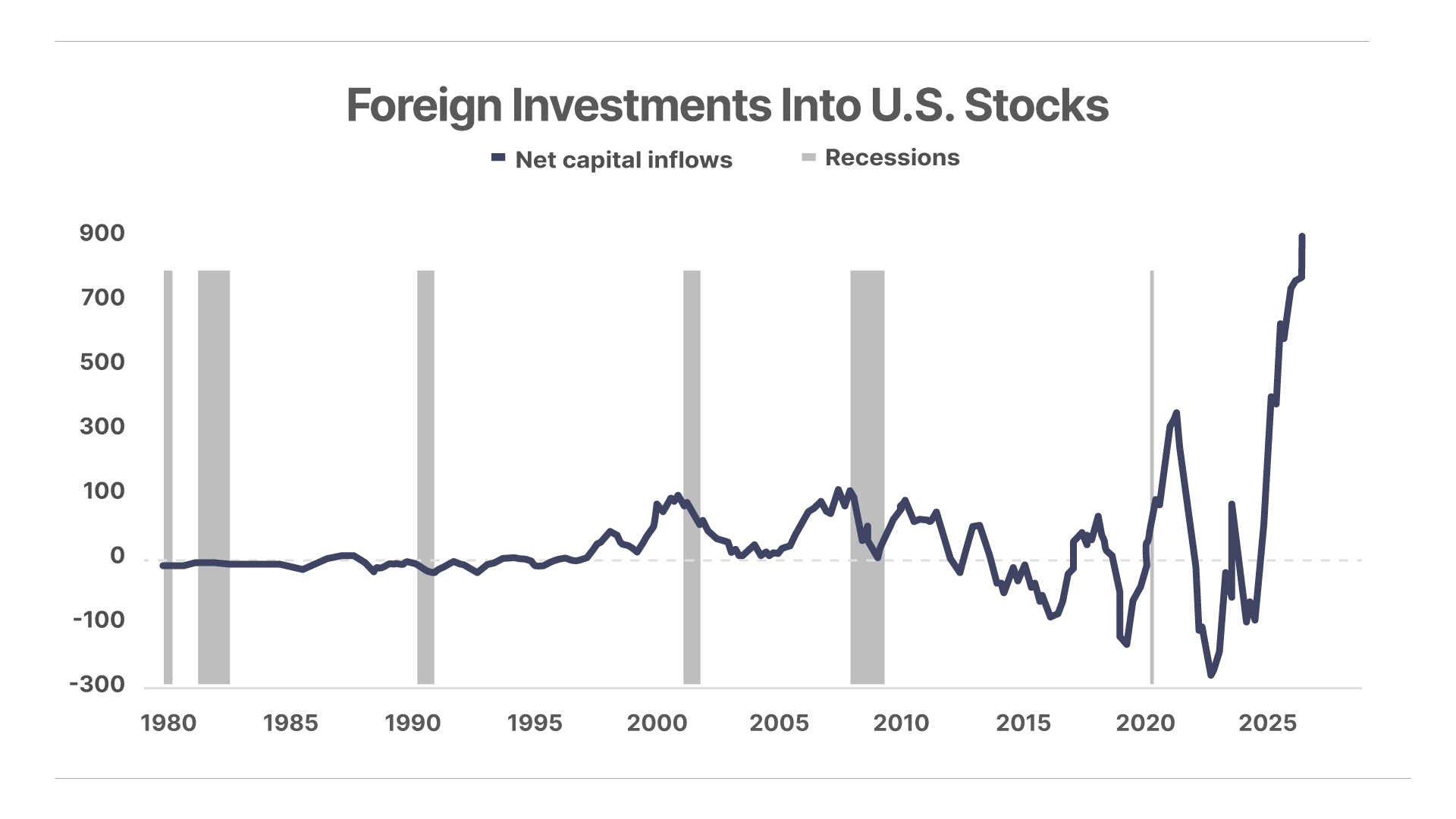
1. Foreign money is pouring into U.S stocks. Net foreign purchases of U.S. equities – private investors plus official institutions – hit an all-time high of $884 billion over the 12 months ending April 2026 – more than double the prior (2021) peak of $400 billion. Earlier foreign-buying peaks (2000, 2007, 2021) all clustered near market tops.
2. U.S. savings rate plummets. The average savings rate among Americans has dropped to 3%, down from 4.9% last year, and nearing the lowest levels in 15 years. High inflation and stagnant wages have resulted in declining real incomes, forcing Americans to forego savings just to keep up with the cost of living. This consumer squeeze is dragging down consumer discretionary stocks across the board.
3. AI is becoming a new inflation driver. Apple (AAPL) CEO Tim Cook told The Wall Street Journal that the cost surge in memory chips is unlike anything he’s seen "in any area in over 40 years," and Elon Musk echoed it on X yesterday, noting it’s the “biggest price jump in anything I've ever seen." Meanwhile, Goldman Sachs expects data centers to drive nearly half the growth in U.S. electricity demand through 2030, lifting consumer bills by about 6% a year. And unlike one-time price shocks like tariffs or oil disruptions, this surge could keep inflation higher for years before AI's promised productivity gains arrive.
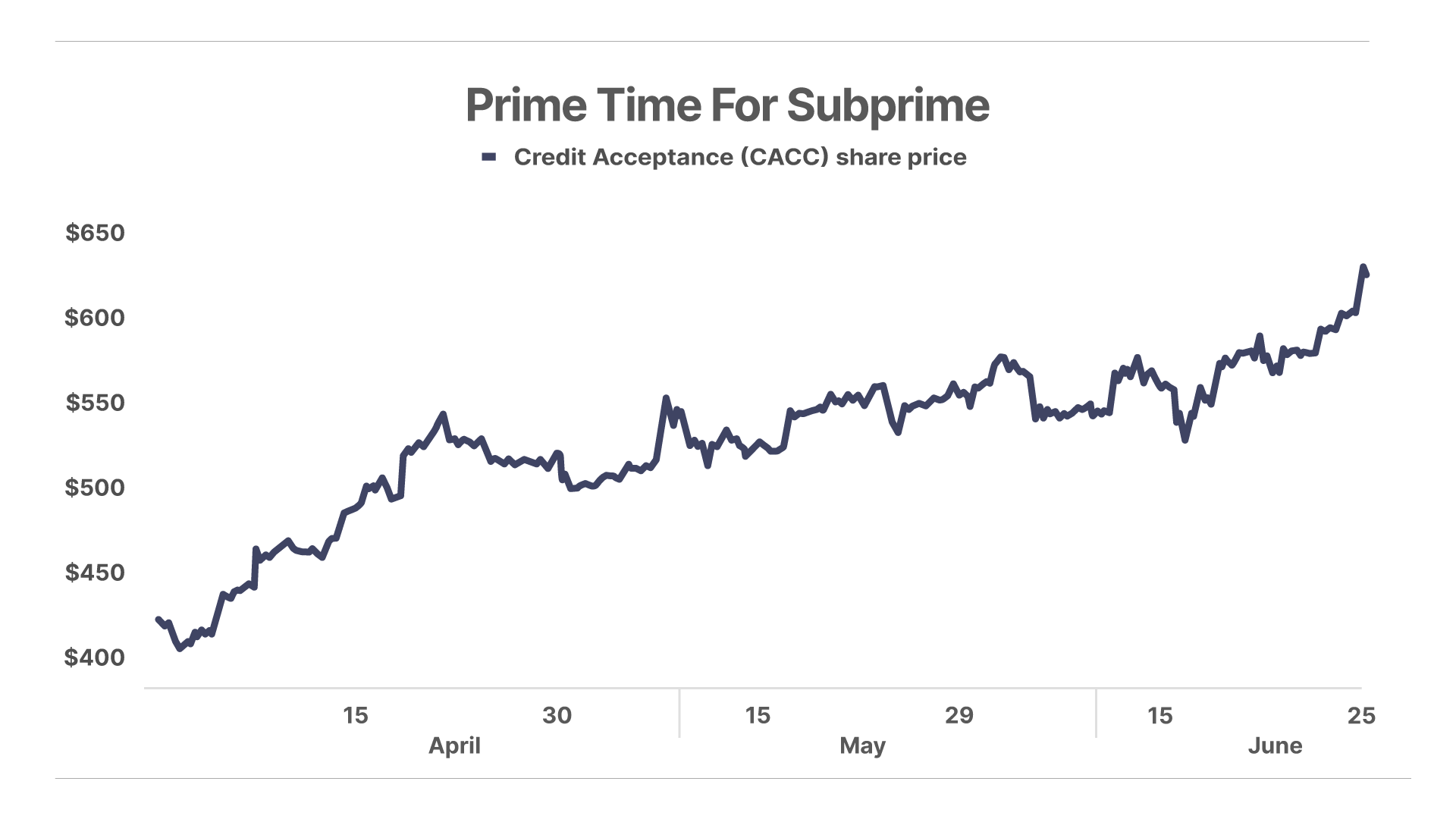
Chart Of The Day… Credit Acceptance (CACC)
Following the release of its Q1 earnings, subprime auto lender Credit Acceptance (CACC) – a Complete Investor recommendation – saw shares rise 9% for the week and 40% year to date.
Today’s Poll… The Price Of Oil
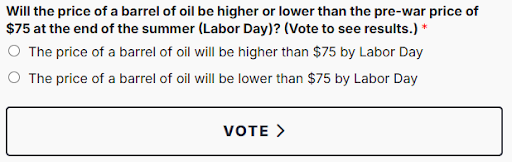
With on-and-off peace agreements in the Middle East, there is little certainty on energy pricing. With news of peace, the price of oil falls. With bombings in and around the Strait of Hormuz – as happened yesterday – the price of oil rises. So we ask readers today…
Mailbag
“Hold Cash Or Not?”
Kathy D. writes:
So which is it – hold cash or not? Headline states, and guest writer Tom Dyson says, holding cash is risky, but then at the end he says he is holding "a large cash position to protect us from crashing markets." Porter has suggested holding ultra-short-term Treasuries or money market funds paying interest. Is this what I should assume the reference means by holding a large cash position?
Thank you for your take on this.
“How Do You Hold Cash?”
Adrian I writes:
Hello,
I also subscribe to Bonner Private Research as well, and my question is: cash. It sounds like you don’t want U.S. dollars or Treasury bonds. So, how do you hold cash? I have 30% of my cash in 90-day T-bills. Sounds like you are afraid of U.S. Treasuries, so where do I go with that cash – another currency or corporate bonds?
Thank you, Porter and Bill and Tom for all you write and I read every word and follow as best I can.
Porter & Co. Market Snapshot
| Price | Yesterday's Return | Year-to-Date Return | |
|---|---|---|---|
| S&P 500 Index | $7,357.49 | -0.01% | 8.1% |
| Gold per ounce | $4,030.50 | 0.68% | -6.4% |
| Bitcoin | $59,721.68 | -2.49% | -31.9% |
| Oil (West Texas Intermediate) per barrel | $71.92 | 2.82% | 20.5% |
| Berkshire Hathaway (BRK) | $733,399.99 | -1.28% | -2.8% |
| Porter's Permanent Portfolio | - | -0.03% | -2.0% |
| The Better Than Berkshire Index | - | 0.15% | 4.7% |
| Total Return | Annual Return | ||
| Porter & Co's Top Ranked* | 34% | 14% | |
| Yield | Yesterday's Change | Change Year-to-Date |
|
| U.S Treasury 30-Year Yield | 4.86% | 2 bps | 2 bps |
*A Complete Investor risk rating of 1 is defined as a "low risk, high allocation" security, while positions rated closer to a 5 are higher risk. Porter & Co.'s top-ranked positions include those rated either 1 or 2 in Complete Investor portfolio.
Porter & Co. Top Positions
| Publication | Ticker | Description | Total Return |
|---|---|---|---|
| Complete Investor | BWXT | BWX Technologies | 259% |
| Tech Frontiers | QURE | uniQure | 237% |
| Complete Investor | ARM | ARM Holdings | 151% |
| Tech Frontiers | TGTX | TG Therapeutics | 151% |
| Tech Frontiers | ROIV | Roivant Sciences | 151% |
| Tech Frontiers | QURE | uniQure | 131% |
| Tech Frontiers | NUVB | Nuvation Bio | 129% |
| Tech Frontiers | SGMT | Sagimet Biosciences | 127% |
| Complete Investor | PM | Philip Morris | 124% |
| Complete Investor | BTC/USD | Bitcoin | 121% |
Prices as of 4:00 pm ET June 25, 2026
Please note: The investments in our “Porter & Co. Top Positions” should not be considered current recommendations. These positions are the best performers across our publications – and the securities listed may (or may not) be above the current buy-up-to price. To learn more, visit the current recommendations page of the relevant service, here. To gain access or to learn more about our current recommendations, call our Customer Care team at 888-610-8895 or internationally at +1 443-815-4447.