Anthropic Rents Compute – Here’s Why That Matters
Inside Today's Issue
Editor’s Note: A Nobel Prize winner warns that a divisive policy backed by both parties “will make a few people much richer and most people poorer.”
Porter agrees – and he believes the split could accelerate the moment the votes are counted on November 3.
This Thursday, in his emergency election broadcast, he’ll show you his #1 money move to make before election day.
Remember Jeff Bezos’ teleportation machine?
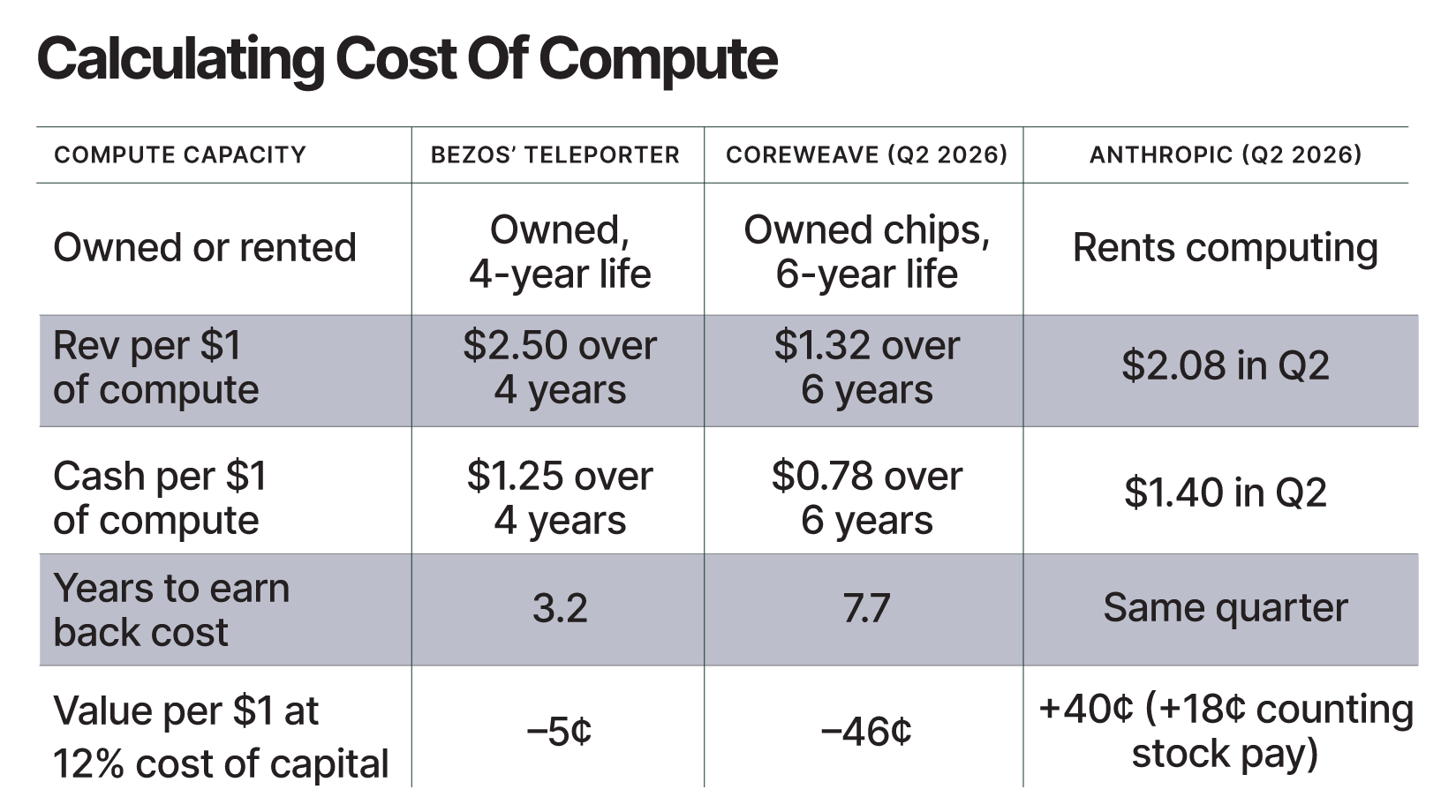
In his 2004 letter to Amazon (AMZN) shareholders (published in the spring of 2005), Bezos asked readers to imagine a teleportation machine that moves people instantly from place to place. As you’d imagine, demand for the machine was virtually endless. But the machines were expensive to build – they cost $160 million each. And they only lasted four years. Even so, revenue poured in. Each trip cost $1,000 and each machine could handle 100,000 trips a year, producing $100 million of revenue! After energy, materials, and labor, each machine produced $50 million of cash a year.
The accounting looked fine: a 10% profit margin after depreciation. The machine will earn back its cost in 3.2 years. But it wears out in four.
Over its life, each dollar of machine returned $1.25 of cash, most of it near the end. Discounted at a 12% cost of capital, each dollar invested loses five cents. Bezos' verdict:
There is no growth rate at which it makes sense to invest initial or subsequent capital to operate the business.
In other words, when you’re evaluating rapidly growing technology businesses that require huge capital investments, investors must focus on the cost of capital and the depreciation charges. Lately, because of inflation, the cost of capital has been increasing. The benchmark U.S. interest rate (the 10-year U.S. Treasury bond yield) has moved from around 2% five years ago to around 5% today.
As we showed you recently, these factors – massive depreciation costs and rising capital costs – have us questioning CoreWeave’s (CRWV) business model. CoreWeave is building data centers full of brand-new Nvidia (NVDA) chips. It rents them to artificial-intelligence (“AI”) companies. Currently, it owns $46.7 billion of equipment and brought in revenue at a rate of $10.3 billion annually in Q2: 22 cents of revenue per dollar of equipment. After operating costs, that's 13 cents of cash a year. CoreWeave needs 7.7 years to earn back its cost, but it depreciates its chips in only six years. Each dollar of equipment destroys 46 cents of value at a 12% cost of capital, based on its current results.
Anthropic, which makes the Claude AI models, filed to go public yesterday. It filed its S-1 (an annual report for a new listing) with the Securities And Exchange Commission (“SEC”), which gave investors the first complete look at its books.
My first question: is this a teleport machine business? Answer: No.
Today, Anthropic owns almost nothing. It only has $1.2 billion of property and equipment on its balance sheet. Instead of owning its computer facilities, it rents computing from Amazon, Google (GOOGL), Microsoft (MSFT), Broadcom (AVGO), and SpaceX (SPCX).
In Q2, Anthropic collected $11.6 billion of revenue and spent $5.6 billion on rent. After paying staff, sales partners, and overhead, it kept $1.40 of cash per dollar of rent paid. That's 40 cents of gross profit per dollar of rent paid, or 18 cents of gross profit if we count stock compensation as a cost.
The risk investors are taking with Anthropic isn’t the capital costs, because it’s renting its compute. The risks investors are taking with Anthropic are the contracts it’s signed to rent enough compute to power its growth.
On June 30, Anthropic owed $587 billion of minimum leases that had not yet started, with most large contracts running five to 10 years.
Spread over their terms, the named contracts cost about $115 billion a year at full delivery, which is 5x the annual rate of last quarter's rent. If you leave out Anthropic’s SpaceX contracts, which can be cancelled on 90 days' notice, it's $77 billion a year in compute rent that’s coming due.
How much revenue does that require? If other cash costs stay at 33% of revenue, Anthropic needs $1.48 of revenue per dollar of rent to break even. By our estimate, on 2028's committed compute of about $110 billion, that's $166 billion of revenue. Press reports put Anthropic's Q3 revenue at a $67 billion annual rate. So the company will require revenue growth of around 150% over the next year to breakeven.
The contracts are fixed, but the revenue is not. That’s the risk.
But I suspect the demand for Anthropic’s AI products will grow far faster than its compute contracts. In fact, I think Anthropic has a good chance to become the AI “express” company.
Watching the build-out of all of these massive data centers reminds me of the only comparable event in American history: the doubling of railroad capacity in the six years between 1867 and 1873. Most of these railroads had economics very similar to Bezos’ teleportation machine or to CoreWeave. Even though demand was endless, the capital costs of these businesses made them all fail. Virtually all of the railroads went bankrupt in the Depression of 1873, which led to a 20-year period of depression-like economic conditions.
(If you’re a history buff, like me, you’d probably enjoy reading: 1873: The Rothschilds, The First Great Depression, And The Making Of The Modern World, by Liaquat Ahamed.)
But just because the businesses that built the railroads went bust doesn’t mean the railroads disappeared. It just meant the value they created ended up being captured by others. The most successful business at capturing the value created by the rails were the express companies. These firms rented space on trains and helped their customers ship freight all over the country.
The most successful was the Adams Express Company. Even though it never laid a single mile of track, by 1910 it ended up owning most of the Pennsylvania Railroad, which was the largest industrial enterprise in the world.
From the very beginning, Adams Express simply rented space on trains. In 1840 Alvin Adams bought a season pass on the first train between New York and Boston. He rode it every day, carrying parcels and envelopes for customers. Demand for services like his exploded as the railroads created a national economy for the first time. By the Civil War, Adams Express ran throughout the North and the South, and the company paid soldiers on both sides. When Adams died in 1877, the company was worth $27 million and employed 15,000 people.
Adams paid for the trains with a share of what it collected for its freight forwarding service. One surviving contract with the Pennsylvania Railroad shows Adams paying 48% of its gross receipts from that line. By 1905, contracts across the industry ran from 40% to 60%, with a guaranteed minimum. But because Adams never had to pay for the construction, the locomotives, or the depreciation on the railroad’s enormous physical infrastructure, it didn’t have any real capital costs... and as a result... virtually all of the value of the railroad ended up accruing on its balance sheet.
Adams paid an $8 dividend on every share every year from 1870 through the depression after 1873, which put a fifth of American rail mileage into receivership, and throughout the entire period, including the panic of 1893. Adams made so much money that it began to invest the earnings it didn't pay out in dividends into stock in the railroads. By 1910, Adams was the second-largest shareholder of the Pennsylvania Railroad and the third-largest of the New York, New Haven, and Hartford Railroad.
In 1929, at the top of the market, the railroads bought their stock back. And Adams became an investment fund with $73.3 million of assets. It still trades on the New York Stock Exchange as Adams Diversified Equity Fund (ADX). It has paid a dividend every year since 1854 except 1867, 1869, and 1932 to 1935. It’s currently yielding 7.42%.
Like Adams Express, Anthropic sells what customers want from the machines: finished work. And like Adams Express, it doesn’t own the machines. It rents them.
I’m certain that building the machines (Nvidia) and renting the machines (Anthropic) will both prove to be much better businesses than owning the machines (CoreWeave).
Tell me what you think of today’s Daily Journal: porterstansberrydirect@gmail.com
Good investing,
F. Porter Stansberry
Stevenson, Maryland

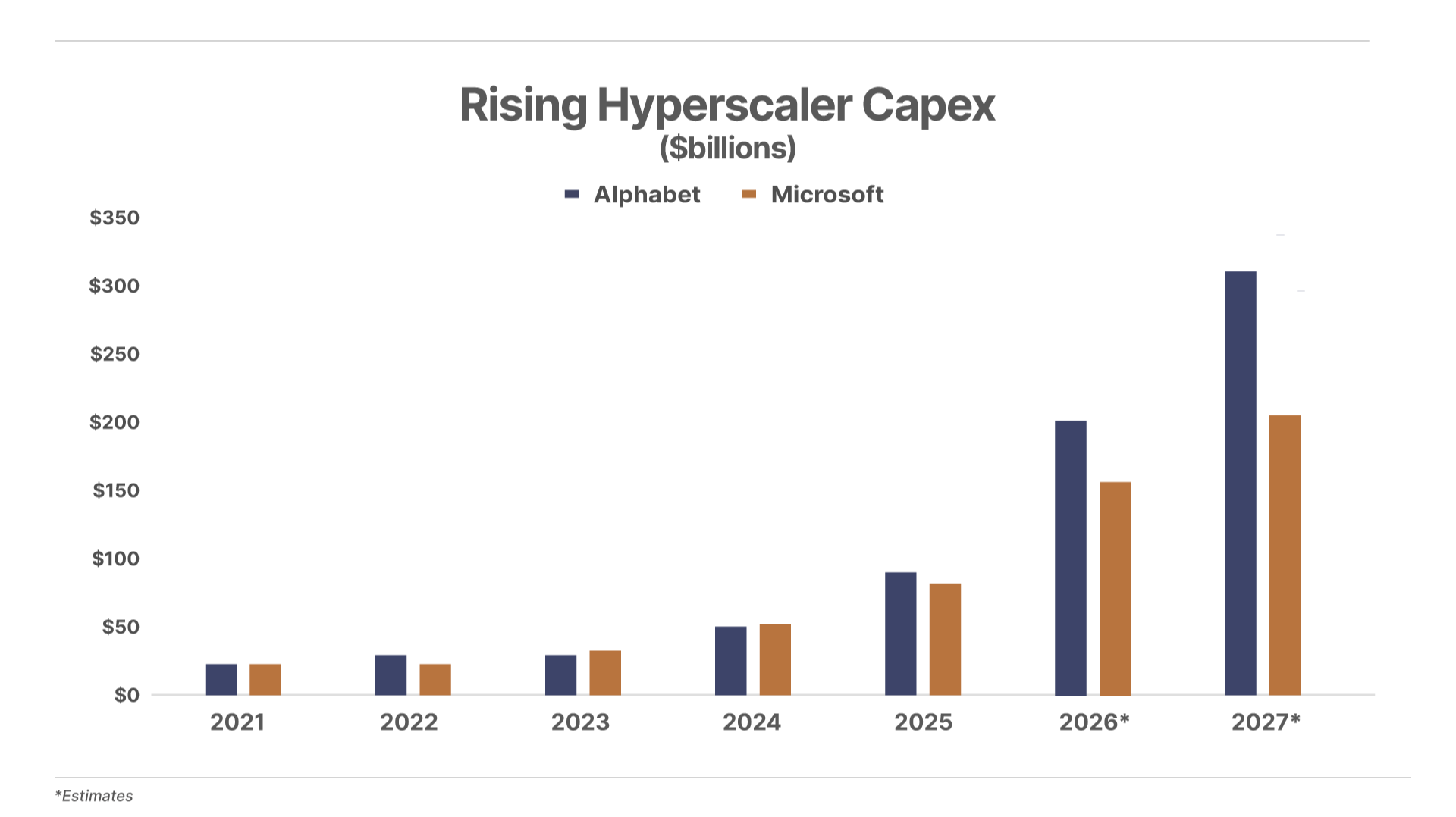
1. Big tech earnings on deck. Hyperscalers Microsoft (MSFT) and Alphabet (GOOG) kick off big tech earnings tomorrow. Both companies are expected to report double-digit earnings growth, fueled by their fast-growing cloud segments that are capturing booming compute demand from the major AI labs like OpenAI and Anthropic. We’ll be paying close attention to the capex forecasts, which have continuously exceeded analyst estimates in recent quarters. Any big changes in hyperscaler capex plans could have significant implications for the entire data-center supply chain, from semiconductors and memory chip suppliers to power solution providers.
2. Complete Investor recommendation EQT (EQT) is buying Range Resources (RRC) to become the largest U.S. natural gas producer. Range shareholders will receive 0.987 EQT shares apiece, worth $54.91, a 20.6% premium to Friday’s close. The combined company will produce more than 9 billion cubic feet of gas equivalent per day – 7% of U.S. output. EQT says it would cover its capital spending even if gas falls below $2 per million British thermal units, versus a 2025 average of $3.52. The bet is that data centers and liquefied natural gas (“LNG”) export terminals will absorb Appalachian gas, which has long sold at a discount because the region lacks pipelines.
3. Microsoft wants 60,000 people to leave. On Monday, Microsoft (MSFT) offered a buyout to a quarter of its workforce – two days before it reports earnings. The company calls it a Voluntary Exit Offer. Xbox, Windows, Copilot, and finance staff can take the offer, but data center, sales, cybersecurity, and quantum staff cannot. That tells you where the money is going. Microsoft plans to spend $175 billion on capex this year, and it needs the people who build and sell the compute more than the people who write the software. Microsoft is not alone. Amazon (AMZN) has cut 30,000 corporate jobs in the past year, American Express (AXP) is cutting 5% of its staff, and Netflix (NFLX) just cut 1,000.
Tobacco stocks have outperformed the tech-heavy Nasdaq index during one of the greatest technological revolutions of all time. This includes Complete Investor recommendations Philip Morris (PM), which has returned 21.4% annually, and British American Tobacco (BTI), which has returned 19.5% annually, versus a 14.1% annual gain in the Nasdaq. The secret to their success lies in their boring, but high-margin and incredibly capital efficient business models.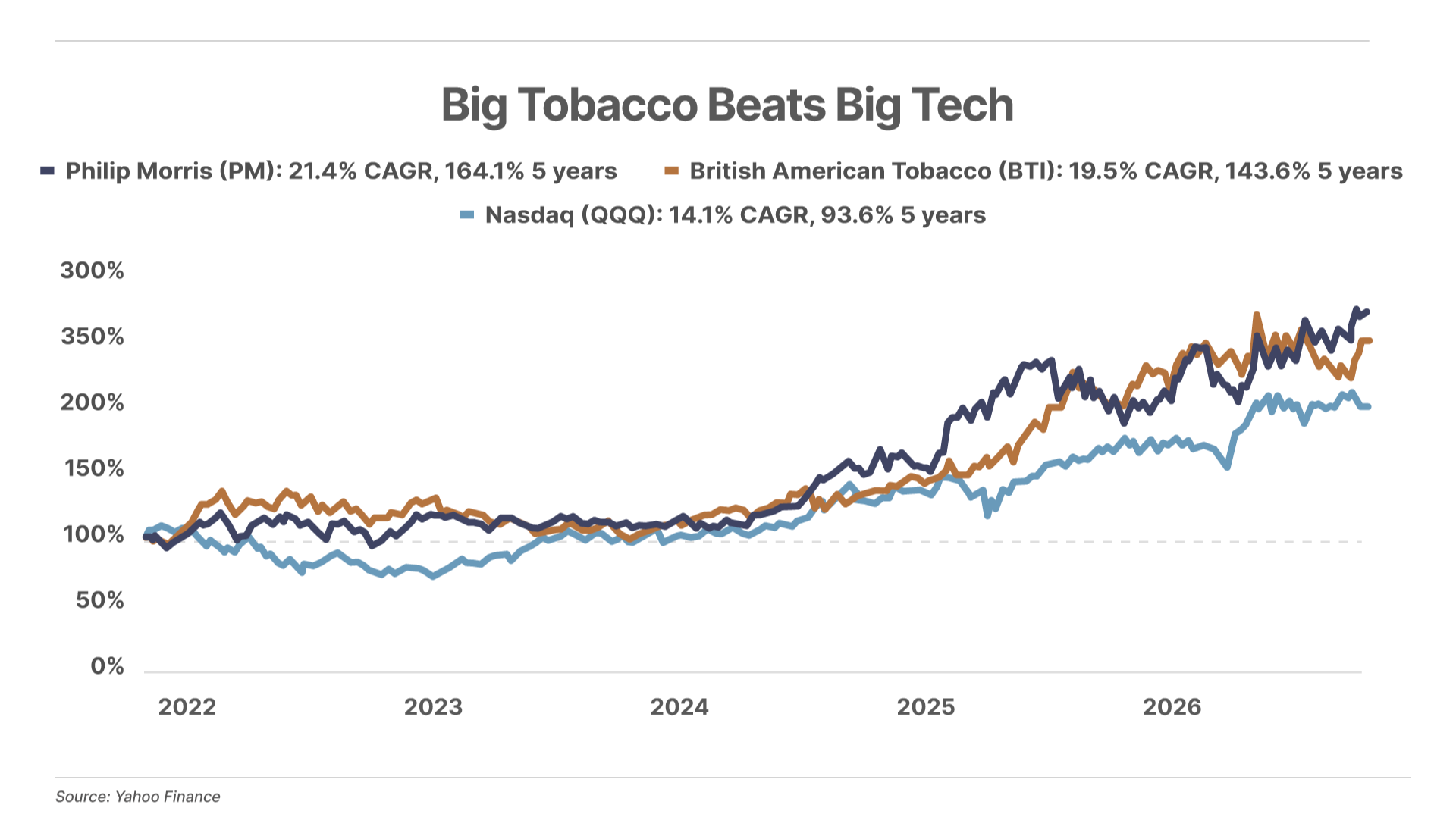
“Entire Tech Industry Is About To Be Musked”
Mike M. writes:
Very insightful article. However, I look at long-term cycles. Bottom line, this next capital-markets crash is going to be very significant! We are currently in an everything bubble, and the world is drowning in debt that is not going to be paid back appropriately. Student debt, auto debt, consumer debt, corporate debt, and most importantly sovereign debt is through the roof due in part to central bank money printing that has allowed for historically low interest rates that have caused misallocation of capital. We are seeing this most prominently with the AI bubble that you just discussed indirectly with SpaceX.
Don't even get me going about the demographics disaster that is a slow moving train wreck for the USA and many parts of the world.
I have called the 1999 and 2008 corrections to a tee. This current manic environment reminds me of the dot.bomb mania of the late 1990s. Just take out the internet, replace with AI, take out Nortel, Lucent (AT&T Technologies), Cisco Systems, and replace with Nvidia, OpenAI, CoreWeave, and repeat the same circular leveraged debt financing games with SPV, private credit, off-balance-sheet shenanigans etc. etc., and we are staring down the barrel of a major correction. Why? Because if you study human behavior, especially financial behavior, nothing, and I mean nothing, has changed!
Again, don't underestimate the demographic aspects of this upcoming problem… Latest report, first-time home buyers are approaching 40, yes, 40 years old! No marriages, no kids, plenty of abortions, tons of debt and misallocation of capital. Just watch what is going to happen.
“2029: No Law And Order”
Anthony S. writes:
Long-time member (since Stansberry) and just read the new book 2029: The End Of America. Wow. I was astounded and humbled by some of the things I did not know. I live in St. Louis and our law firm had our offices on the 17th floor of the BOA Bldg downtown across from Busch Stadium for two decades. We experienced the issues in your book and had six office windows shattered by bullets as a result of the breakdown of law and order for the reasons you listed. We had to move from downtown St. Louis as a result. I am buying a copy of your book for each of our five children and my nine brothers and sisters! Thank you for boldly speaking the truth.
Porter Comment: Thanks so much for your note.
St. Louis, like Baltimore, has been almost completely destroyed by America’s version of Marxism.
I hope it doesn’t overwhelm our entire nation.
Porter
Porter & Co. Market Snapshot |
Through Monday, October 26, 2026 close |
| Markets |
| Index or asset | Last | 1-Day | YTD | 1-Year |
|---|---|---|---|---|
|
S&P 500
Total return
|
765.37 | +0.71% | +13.1% | +14.2% |
|
Gold
Front-month futures
|
$4,038.40 | +0.76% | −7.0% | −2.4% |
|
Bitcoin
4 pm ET print
|
$79,881.00 | −1.58% | −8.7% | −27.8% |
|
Crude oil
WTI, per barrel
|
$101.76 | −1.46% | +77.2% | +65.5% |
|
Berkshire Hathaway
NYSE: BRK-A
|
$821,931.00 | +1.02% | +8.9% | +11.3% |
| U.S. Treasury yields |
| Maturity | Yield | 1-Day | YTD | 1-Year |
|---|---|---|---|---|
|
2-Year
|
4.68% | −1 bps | +121 bps | +120 bps |
|
10-Year
|
5.00% | 0 bps | +82 bps | +98 bps |
|
30-Year
|
5.31% | −2 bps | +47 bps | +72 bps |
| Porter & Co. strategies |
| Strategy | 1-Day | YTD | Since start | Per year |
|---|---|---|---|---|
|
Porter's Permanent Portfolio
Since September 25, 2024
|
+0.07% | +5.9% | +33.6% | +14.9% |
|
Better Than Berkshire Index
Since May 16, 2025
|
+0.08% | +3.2% | +3.6% | +2.5% |
|
Porter & Co. Top Ranked*
Since July 14, 2022
|
+0.07% | +5.5% | +29.7% | +10.1% |
Porter & Co. Top Positions |
Through Monday, October 26, 2026 close |
| # | Position | Total return |
|---|---|---|
| 1 |
Roivant Sciences ROIV
The Complete Investor
|
+212% |
| 2 |
Roivant Sciences ROIV
Biotechnology
|
+209% |
| 3 |
Bitcoin BTC/USD
The Complete Investor
|
+195% |
| 4 |
TG Therapeutics TGTX
Biotechnology
|
+194% |
| 5 |
Philip Morris PM
The Complete Investor
|
+151% |
| 6 |
Skyward Specialty Insurance SKWD
The Complete Investor
|
+144% |
| 7 |
APA Corporation APA
Porter & Co. Asymmetry
|
+138% |
| 8 |
BWX Technologies BWXT
The Complete Investor
|
+132% |
| 9 |
W.R. Berkley WRB
The Complete Investor
|
+117% |
| 10 |
Chubb CB
The Complete Investor
|
+93% |