Issue #101, Volume #3


Polar Opposites Advocate Uncle Sam Getting An Equity Stake
Inside today’s Daily Journal…
|
Editor’s note: Porter & Co. will be closed tomorrow, Friday, June 19, because the markets shut down for the Juneteenth national holiday. Both the Daily Journal and the Customer Care team will return on Monday, June 22.
Today, though, Porter has turned the Journal over to Marty Fridson – distressed-debt analyst for Porter & Co.’s Distressed Investing advisory and perhaps the most well-known figure in the high-yield world. Working at firms like Salomon Brothers, Morgan Stanley, and Merrill Lynch, Marty became known for his innovative work in credit analysis and investment strategy and for nine consecutive years was ranked #1 in high-yield strategy in the Institutional Investor All America Survey.
Here’s Marty…
Certain ideas transcend party lines. They include some very bad ideas.
In August 2025, Republican Commerce Secretary Howard Lutnick argued that the federal government should receive stock in companies that receive funding through the CHIPS and Science Act, which supports research and promotes location of semiconductor production in the U.S. (The CHIPS Act was signed by Democrat Joe Biden after being passed with considerable Republican support in both the House and the Senate.) Lutnick said:
We should get an equity stake for our money.
In short matter, Uncle Sam owned 9.9% of chipmaker Intel (INTC). Secretary Lutnick has subsequently advocated applying the same concept to defense contractors.
Very far over on the other side of the ideological spectrum, socialist Senator Bernie Sanders of Vermont announced in a June 1, 2026, New York Times opinion piece that he’d soon introduce the American Artificial Intelligence (“AI”) Sovereign Wealth Fund Act. It would require OpenAI, Anthropic, xAI, and other companies to fork over 50% of their stock to the government. His rationale: The public should share in the wealth created by a public resource, in this case “the accumulated knowledge, creativity, and labor of mankind” that AI taps.
This right-left convergence on the desirability of state ownership of business isn’t actually as surprising as it might seem, taking history into account. True, the idea of nationalization is most often associated with socialism. For example, the UK steel industry was nationalized by a Labour government in 1949 – and again in 1967 after the Tories mostly denationalized it during the intervening years.
But at the opposite ideological extreme, Italy’s 1922-1943 fascist government, which initially suppressed socialism and defended private property, responded to the Great Depression by taking over failing banks and acquiring stakes in industrial firms. Italian dictator Benito Mussolini’s regime ultimately became one the world’s largest state-owned holding companies, controlling significant portions of banking, shipbuilding, steel, telecommunications, and transportation.
It’s probably not wise for the U.S. to take its economic policy cues from those governments. To cite one especially disturbing statistic, the annual UK inflation rate averaged 16.15% during Labour’s second term in power during the period (1974-1979) of state ownership.
Secretary Lutnick specifies that the equity grabs he champions would consist of non-voting shares, merely providing taxpayers a chance to participate in companies’ future price appreciation. But can we be sure that a future administration will passively stand by as the management of a corporation takes actions that, in the bureaucrats’ judgment, will destroy taxpayers’ wealth over the long run?
And suppose a partially government-owned company displays insufficient enthusiasm for a future progressive administration’s environmental or diversity policies. Will the ruling party’s president and members of Congress withstand loyalists’ calls to take a page from the activist-investor playbook, seeking board representation and demanding specific strategic changes? Especially if, as Senator Sanders proposes, the feds own half of all the company’s shares.
Readers may be understandably skeptical about this sort of “camel’s-nose-under-the-tent” argument. But real-life examples unquestionably exist of initially limited government interventions that vastly expanded their scope over time. Consider Social Security, which began in 1935 by doing nothing more than providing retirement pensions for certain workers, mainly industrial and commercial. Four years later, the program added spousal and survivor benefits. Then came disability insurance. Coverage was eventually extended to farm workers, domestic employees, and self-employed individuals, as well as state and local government employees.
Lutnick laments that when government-funded research by companies or universities leads to patents, we taxpayers who put up all the cash “get nothing.”
Really?
If those patents lead to profits, the IRS collects a healthy share of the take, not to mention the benefits enjoyed by the citizens. The whole idea of government investment in research is to promote economic growth, which in turn leads to higher corporate and personal incomes and, consequently, larger tax revenues.
Whether by Republicans or by Democrats, nationalizing public companies – even through partial equity stakes – poses significant risks to both the economy and corporate stability. While proponents argue that government equity participation allows taxpayers to capture value from funded research, this ignores the existing mechanism of tax collection – economic growth spurred by such research already fills the public coffers via corporate and personal income taxes.
And what begins as a passive, non-voting stake can rapidly evolve into active interference. Once the government holds ownership, future administrations may succumb to political pressure to force management to align with specific ideological agendas – such as environmental or diversity mandates – effectively weaponizing their stake to demand strategic changes.
Ultimately, the boundaries between government and private enterprise must remain distinct. Forcing state ownership conflates the role of the regulator with that of the owner, endangering the long-term health of both the companies involved and the broader economy.
By all means, let’s have a vigorous debate on the wisdom and effectiveness of growth-motivated government grants and incentives. Maybe it’s not even outside the realm of possibility that an evidence-based, bipartisan consensus can be reached on that issue. But however that may work out, the optimal arrangement is for government and private enterprise to stay in their own lanes. The mere fact that one’s political polar opposites are advocating state ownership stakes in private businesses should be a warning to both sides that it’s a bad idea.
Because it is.
Tell us what you think of today’s Daily Journal: porterstansberrydirect@gmail.com
Good investing,
Martin Fridson
New York, New York

3 Things To Know Before We Go…
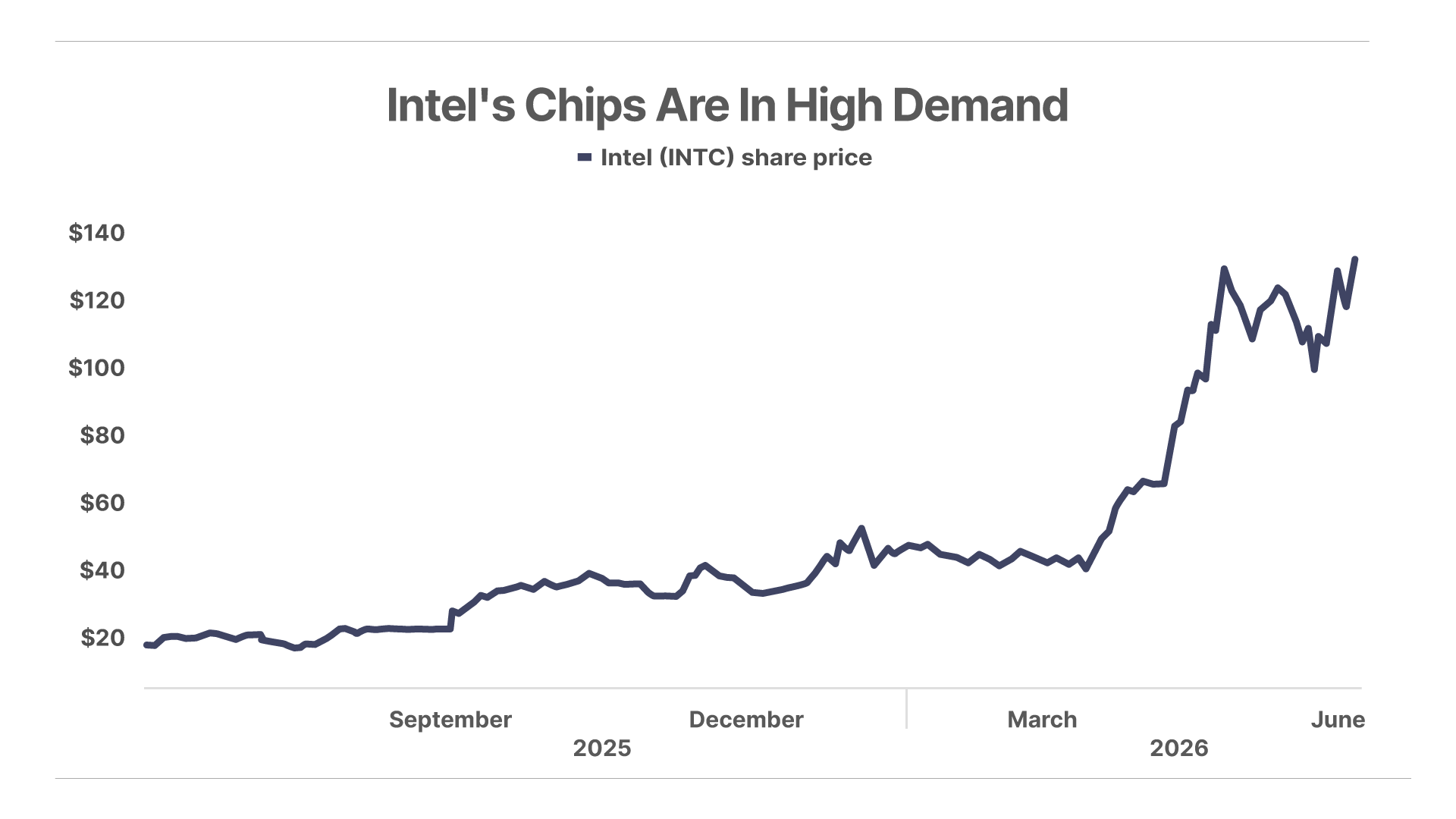
1. Intel jumps 9% on Apple partnership. President Trump announced that Apple (AAPL) has agreed to work with Intel (INTC) to design and build chips domestically for some of its products – shares of Intel are now up 464% over 12 months, and the U.S. government’s 10% stake is worth north of $60 billion… Separately, Apple CEO Tim Cook says product price increases are now “unavoidable” as AI data-center buildouts have quadrupled costs.
2. The AI boom is turning to a new corner of the market for funding. U.S.-listed companies have issued roughly $54 billion in convertible bonds this year – up 43% from 2025 and the heaviest volume since COVID, according to financial data firm Dealogic. The reason: Convertible debt bundles a bond with a call option on the issuer’s stock, and the more volatile the stock, the more valuable that option is. AI shares are both volatile and near record highs, so investors are currently willing to accept rock-bottom yields in pursuit of potential upside from conversion. AI cloud computing firm CoreWeave (CRWV) just priced $4 billion at 1.75%, while Akamai (AKAI) sold $3.5 billion at 0%.
3. U.S. and Iran sign peace agreement. President Donald Trump signed a Memorandum of Understanding (MoU) between the U.S. and Iran on Wednesday. The 14-point plan provides a framework for an immediate cessation of hostilities, followed by a 60-day window to negotiate a permanent settlement of the conflict. The news sent oil down to around $73 per barrel. However, most analysts estimate that the lingering fallout from the conflict – shutting down the strategic Strait of Hormuz for four months – will keep global supply from returning to pre-conflict levels until 2027, keeping pressure on inventories and prices.
Chart Of The Day… uniQure (QURE)
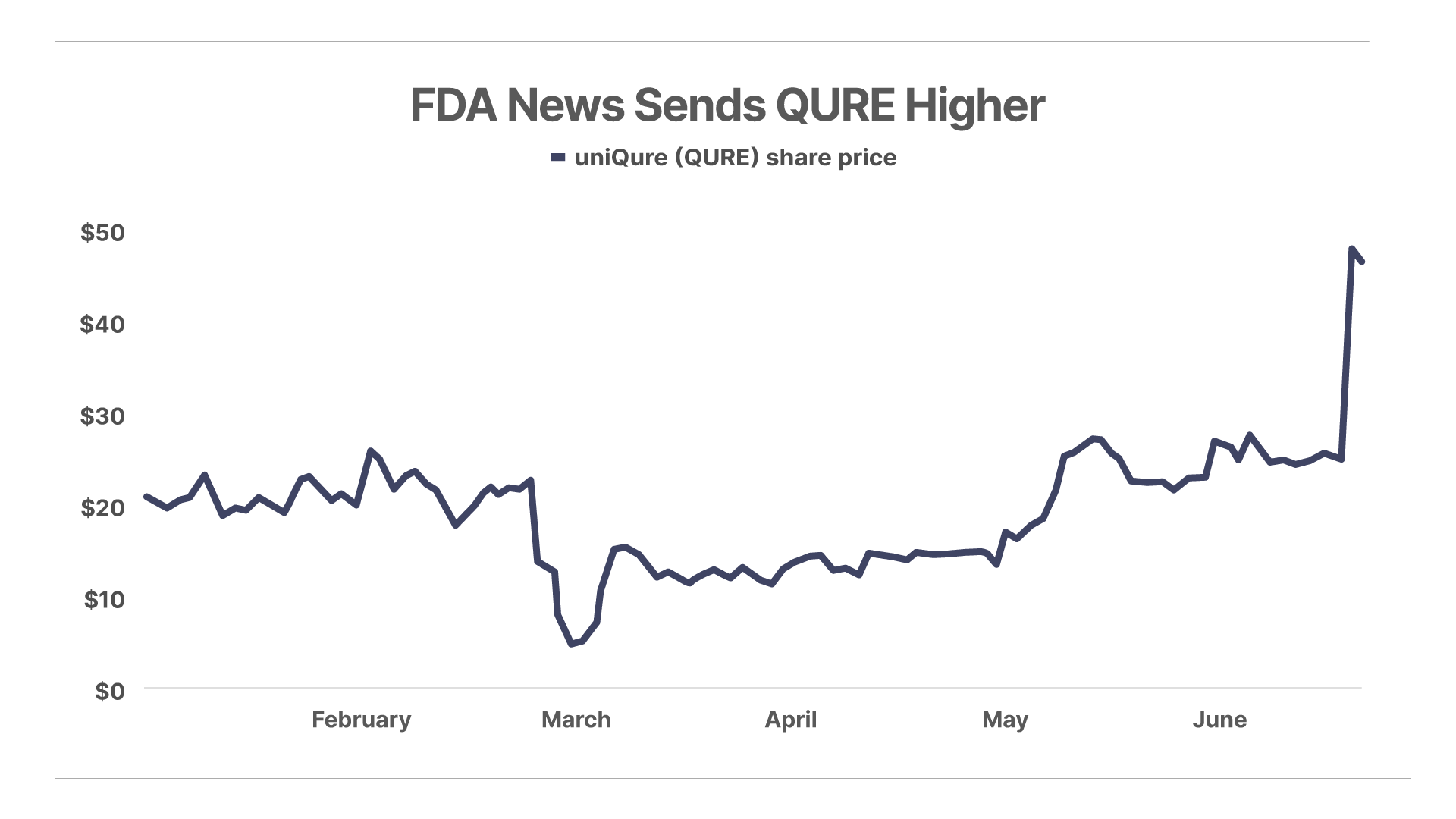
Shares of biopharma company uniQure (QURE) skyrocketed yesterday after it announced a major regulatory milestone for AMT-130, its gene therapy for Huntington’s disease. Shares are now up 106% since Erez Kalir’s recommendation to Tech Frontiers subscribers in January.
Mailbag
“The Prophet System”
Dan D. writes:
I get the system, and it is very impressive. But it is a trading system, not an investing system. You can end up with high trading expenses (commissions) and short-term capital gains taxes that materially eat into your returns. I haven’t heard anyone bring that up yet.
“Lindy Stock Question – Procter & Gamble”
Charlie S. writes:
Mr. Stansberry,
You mentioned in 2029: The End of America that when selecting stocks for a permanent portfolio to consider using Lindy stocks. I noticed Procter & Gamble (PG) is not something you mentioned in the list. I used AI to determine why PG is not a Lindy stock and I still do not fully understand why. I own PG and am wondering if you had a key reason or two you could share with me as to why it doesn’t qualify.
“Policies For Banks”
Cassandra A. writes:
Dear Porter,
I’m quite the fan, and I have been a subscriber for many years. I appreciate what you do to help out the individual.
At some time, we are going to need to face up to the fact that the current banking system is ruining our country. Pretty much everything the Fed was supposed to prevent has happened – in spades – since it was chartered. This can be very messy….or not. We are in danger.
We don’t know what the reset will look like or which assets will survive it, as you point out.
I have a good friend who has written three books, two dealing with monetary “slavery” and what could be done to get out of the system that perpetuates it, into something that works for people and creates prosperity.
Here’s what he wrote me recently:
The Fed eliminated reserve requirements in 2020, but replaced them with liquidity rules and interest payments that actually pay banks to hold cash rather than lend it. The reserve requirement is gone, but the control isn’t – it just changed form.
Banks aren’t hoarding cash because they want to. They’re doing it because the rules reward it. The Fed pays interest on reserves parked at the Fed, and post-2008 liquidity regulations penalize banks for putting that money to work. So trillions sit idle while small businesses struggle to get loans.
Fed Chair Kevin Warsh and Treasury Secretary Scott Bessent want to loosen these rules so the Fed can shrink its balance sheet without strangling bank lending. That’s a step in the right direction. But it still leaves the Fed deciding how much freedom banks get – and that’s the deeper problem.
If you want to understand how banking could actually work without the Fed pulling the strings – where banks hold real reserves, make productive loans, and answer to depositors instead of regulators – read Standard Banking: The Solution To America’s Monetary Crisis by David R. Young (Book 3 of the Freedom vs. Enslavement Series, available on Amazon). It lays out a complete blueprint that any bank can start implementing today, no legislation required.
Porter & Co. Market Snapshot
| Price | Yesterday’s Return | Year-to-Date Return | |
|---|---|---|---|
| S&P 500 Index | $7,420.10 | -1.21% | 9.0% |
| Gold per ounce | $4,256.93 | -1.81% | -1.5% |
| Bitcoin | $64,369 | -2.15% | -27.4% |
| Oil (West Texas Intermediate) per barrel | $76.79 | 0.26% | 29.1% |
| Berkshire Hathaway (BRK) | $737,300.00 | -0.69% | -2.3% |
| Porter’s Permanent Portfolio | – | -0.79% | -1.8% |
| The Better Than Berkshire Index | – | -0.90% | 2.7% |
| Total Return | Annual Return | ||
| Porter & Co’s Top Ranked* | 30.7% | 12.7% | |
| Yield | Yesterday’s Change | Change Year-to-Date |
|
| U.S Treasury 30-Year Yield | 4.97% | -1 bps | 9 bps |
*A Complete Investor risk rating of 1 is defined as a “low risk, high allocation” security, while positions rated closer to a 5 are higher risk. Porter & Co.’s top-ranked positions include those rated either 1 or 2 in Complete Investor portfolio.
Porter & Co. Top Positions
| Publication | Ticker | Description | Total Return |
|---|---|---|---|
| Complete Investor | BWXT | BWX Technologies | 256% |
| Tech Frontiers | QURE | uniQure | 237% |
| Complete Investor | ARM | ARM Holdings | 203% |
| Tech Frontiers | TGTX | TG Therapeutics | 146% |
| Complete Investor | BTC/USD | Bitcoin | 138% |
| Tech Frontiers | ROIV | Roivant Sciences | 138% |
| Tech Frontiers | QURE | uniQure | 131% |
| Complete Investor | PM | Philip Morris | 123% |
| Tech Frontiers | SGMT | Sagimet Biosciences | 121% |
| Complete Investor | WINA | Winmark | 104% |
Prices as of 4:00 pm ET June 17, 2026
Please note: The investments in our “Porter & Co. Top Positions” should not be considered current recommendations. These positions are the best performers across our publications – and the securities listed may (or may not) be above the current buy-up-to price. To learn more, visit the current recommendations page of the relevant service, here. To gain access or to learn more about our current recommendations, call our Customer Care team at 888-610-8895 or internationally at +1 443-815-4447.