Issue #93, Volume #3


An ETF Mastermind Just Built A Rules-Based, Lower-Volatility Portfolio
Inside today’s Daily Journal…
|
Editor’s note: Porter has turned today’s Journal over to Matt Tuttle. As CEO of Tuttle Capital Management, Matt is portfolio manager of the Porter & Company Porter Portfolio Index ETF (PCPP), available to trade on all major exchanges.
Matt explains the details behind the Porter Portfolio Index ETF…
The reason I am writing the Journal today is because I believe there are structural inefficiencies on Wall Street. But also because, as of this week, there’s something you can do about it.
Together with Porter, I’ve just launched the Porter & Company Porter Portfolio Index ETF – ticker PCPP – available to trade right now on all major exchanges. Today’s essay provides the backstory.
Over the past 20 years, I’ve built ETFs – exchange-traded funds let any investor buy or sell a basket of assets as easily as trading a single stock. Some of my best ETFs were designed to bet against the crowd.
When the financial press crowned portfolio manager Cathie Wood of Ark Invest the next Warren Buffett, I launched an ETF that shorted (that is, it bet on a decline in the share price) her flagship fund. Nothing against Cathie – but the fund’s holdings appeared significantly overvalued at the time, and the media coverage may have reflected heightened enthusiasm.
Then I built the Inverse Cramer ETF, which took the opposite side of the trades that CNBC commentator Jim Cramer touted on his “the louder you say it, the more true it is” investment show. Cramer – the very definition of “investment talking head” – is generally a good barometer of the investment consensus… but should not be relied upon as a predictor or market direction.
Suffice to say, I’m not on Jim Cramer’s Christmas card list. (I also earned myself a still-ongoing multi-year ban from appearing on CNBC.)
So it’s no surprise that the tagline of my firm, Tuttle Capital Management, is: “The antidote to Wall Street.” We mean it.
Similarly, Porter has spent close to 30 years being a thorn in the side of conventional wisdom… sounding the alarm about the end of U.S. dollar dominance, warning Americans about the perils of the federal deficit, and helping regular investors figure out their own financial destiny. He gives people the knowledge and the insight to understand the consensus, and the powers behind it – so as to be able to reject it.
I’ve made it my mission to build the tools to help investors act on this very idea. I’d been wrestling with one dimension of that challenge, when a few years ago I first read Porter’s permanent portfolio framework. It felt like finding someone who’d been digging the same tunnel, only from the other side.
When Porter’s team asked Tuttle Capital to turn his strategy into an ETF, my answer took about four seconds… Yes.
Here’s the backstory to what we’ve built with the Porter & Company Porter Portfolio Index ETF (PCPP).
What Harry Browne Got Right
In the 1970s, author and investor Harry Browne developed a four-pillar portfolio – 25% stocks, 25% bonds, 25% gold, and 25% cash. It’s one of the most elegantly simple ideas in the history of finance.
Browne’s insight was deceptively straightforward: in a world dominated by a single government’s paper money, there will always be a cycle of inflation, punctuated by short bouts of deflation. Stocks do well in prosperity. Bonds do well in deflation. Gold does well when the currency is being debased. Cash gives you ammunition when everything else is cheap.
In short: you own stocks. You attempt to hedge them with bonds. You attempt to hedge both of them with gold.
Of course, straightforward doesn’t mean easy. Maintaining the discipline to stick to such a portfolio stretches the patience of even the most Mother Teresa-like investors.
A mutual fund built on Browne’s concept has compounded at around 7% a year since its launch in 1982, with a maximum drawdown of roughly 26% during the Global Financial Crisis – compared to a 50% drawdown for the S&P 500 over that same period. It captured a very significant portion of the stock market, with half the volatility.
In a market that’s captivated by fast money, 7% per year might not sound like much. But compounded over the 43-plus years since the fund launched, that would have turned $1,000 into nearly $17,000.
Browne’s concept worked. But the world has changed in ways that make one of his four pillars – government bonds – risky in certain market environments. And that’s one of the problems the Porter Portfolio Index ETF is designed to address.
Why Bonds Present Challenges Under Certain Macroeconomic Conditions
The sovereign bonds of developed economies – most of all, U.S. Treasuries – have historically served as the safe-haven hedge in a permanent portfolio. That logic may be less reliable in the current environment.
The math is relatively straightforward. The U.S. continues to run massive annual deficits approaching $2 trillion. The net present value of unfunded Social Security and Medicare liabilities adds trillions more annually. There may be a limited or uncertain path to repaying these obligations with honest money.
Inflation is a potential outcome – which means printing currency to dilute the debt — and long-duration bonds are precisely the instrument that may experience significant declines when that happens.
The long-dated U.S. Treasury ETF (TLT) went from around $170 to just over $80 in 2020-2023. When the “safe” part of your portfolio declines by close to 50%, the strategy may face meaningful challenges.
This is the kind of structural risk, and potential unrepairable portfolio damage, that Porter has been highlighting in his research for decades. He’s done so publicly, on the record, long before it was fashionable. He called the dollar’s decline before most people were willing to say it out loud. He identified what some describe as a bond trap before TLT supported that view.
In the Porter Portfolio, the solution is to replace the bond allocation with a basket of high-quality property and casualty (P&C) insurance companies.
This may sound counterintuitive at first. After all, these businesses are, at their core, giant piles of bonds. They own and actively manage massive fixed-income portfolios.
But they fund those portfolios using float: the insurance premiums clients pay upfront before any claims are filed. The best P&C companies invest this float and keep the spread. They are paid, in effect, to borrow money. Warren Buffett built Berkshire Hathaway on exactly this structure.
There is one critical condition: this approach tends to be more effective when applied to top-tier underwriters – insurance companies that consistently collect more in premiums than they pay out in claims. These firms don’t just avoid the duration risk of government bonds. Through active portfolio management, they may help reduce exposure to market declines. When COVID hit and the bond market subsequently collapsed, William Berkley moved W.R. Berkley’s (WRB) entire fixed-income book from long-dated bonds into short-term notes before the damage landed. Traditional bond ETFs may not offer this flexibility.
So in the Porter Portfolio Index ETF, instead of a bunch of bonds, you own a basket of what we consider to be the best-run insurance companies in the world – names like W.R. Berkley, Chubb (CB), and Markel (MKL). You get the bond exposure. You get active management. You get the float leverage. And you eliminate the single biggest structural weakness in the original Browne model.
Lindy Stocks, Not The S&P
In the Porter Portfolio Index ETF, the equity pillar gets the same upgrade.
When I first read Porter’s Lindy thesis, my instinct was to push back. I run leveraged single-stock ETFs. I’m not exactly a buy-and-hold evangelist. But in this case, I believe the data is hard to argue with.
Rather than allocating to an S&P 500 Index ETF, like SPY (which means owning hundreds of businesses that could eventually go to zero), Porter’s framework concentrates on what he calls Lindy companies.
The logic comes from philosopher and investor Nassim Taleb’s application of Lindy’s Law: for things without a natural lifespan, every year of survival increases the expected future lifespan. Businesses that have historically demonstrated durability aren’t slowing down – and they’re demonstrating something real about their competitive position that the market perpetually underestimates.
Out of 29,078 common stocks publicly traded in the U.S. since 1925, fewer than 10% survived longer than 40 years, and a majority – 51.6% – produced negative cumulative returns. The top 4% of stocks account for all the net wealth ever created in the U.S. market. Time, and the businesses that survive it, are a significant factor.
Philip Morris turned every $1 invested in 1925 into around $2.6 million today. Coca-Cola (KO). Johnson & Johnson (JNJ). The Hershey Company (HSY). These are the companies often considered for inclusion in a permanent portfolio. Not because they’re glamorous, but because they’ve already proven what most businesses never do.
The Bitcoin Pivot
Now we get to the part that I find most interesting. And I suspect you might have already thought about it.
Gold has been the hard-money hedge in the four-pillar portfolio since Harry Browne first drew it up. And it’s earned its place. Five thousand years of track record. No counterparty. A store of value that has outlasted every empire, every currency, every government that tried to inflate it away.
And Bitcoin has characteristics that differ from traditional hard assets.
Bitcoin is peer-to-peer. No counterparty, no custodian required, no vault with armed guards. The supply is mathematically fixed. It’s difficult for central banks to control directly. It transfers anywhere in the world in minutes, to anyone – outside the scope of governments entirely.
For most of the last decade, the honest objection to Bitcoin in a permanent portfolio was volatility and liquidity. In 2013 that was a reasonable concern. In 2026, concerns have evolved.
Spot Bitcoin ETFs now trade billions of dollars a day. Institutional adoption has increased in recent years. And by Taleb’s own Lindy logic, Bitcoin’s survival through multiple crashes, regulatory attacks, exchange collapses, and media obituaries may support the case for continued adoption.
The Porter Portfolio Index ETF allocates 25% to hard assets – a combination of gold/precious metals and Bitcoin – providing exposure to both the classic 5,000-year store of value and the newer digital network.
Bitcoin may provide diversification benefits that cover two different failure modes of the same underlying fiat system. When governments inflate, both assets benefit. When the currency system itself breaks down, some investors may consider exposure to both.
The Execution Problem
Here’s the honest question any serious investor should ask:
Can I just build this myself?
Yes. And if you have the time and discipline, Porter has written reports that walk you through how.
You could construct a basic permanent portfolio today with four ETFs in your brokerage account. But if you want the full framework – the Lindy stocks, the P&C insurance basket, the hard-assets allocation – you’re looking at roughly 30 positions across five asset classes, rebalancing annually, adjusting cash based on valuation metrics like Tobin’s Q and the Buffett Indicator. That requires ongoing effort and monitoring.
Many people start strong and drift over time. Not because they’re undisciplined – but because life intervenes. The cash position quietly shrinks in a bull market. The insurance allocation gets second-guessed when it lags. Rebalancing means selling your winners, which requires a cold-blooded consistency that’s genuinely difficult to sustain when the market is screaming at you to do the opposite.
And now, there’s an alternative approach to access Porter’s permanent portfolio: the Porter Portfolio Index ETF (PCPP). The portfolio follows a clear rules-based index with fixed target allocations that are systematically rebalanced. The discipline is applied systematically regardless of market conditions. It aims to provide access to the full framework in one ticker, designed to limit drift.
I want to be direct about something, though. I didn’t build this fund because I thought I could improve on Porter’s thinking. Porter has spent decades developing this framework – the Lindy thesis, the insurance company insight, the Bitcoin conviction. All of it is his.
What Porter can’t do is run a registered investment product himself. He’s a publisher and analyst, which means he’s in the investment-research business – not the portfolio-management or ETF business. Turning a portfolio strategy into an Securities And Exchange Commission (“SEC”)-registered ETF requires a registered investment adviser, a fund trust, exchange relationships, and compliance infrastructure.
That’s what Tuttle Capital seeks to provide.
Porter sketched the blueprint. We built the structure.
The Porter & Company Porter Portfolio Index ETF is available on all major exchanges under the ticker PCPP.
And One More Thing…
The most common objection I hear to the permanent portfolio – from the sophisticated investors I work with every day – is that it’s too conservative. That the cash drag is too painful. That you’re leaving too much on the table in a bull market.
My answer: you’re thinking about the wrong benchmark.
The goal of a permanent portfolio isn’t to track or outperform a specific benchmark such as the S&P 500. The strategy seeks to produce market-like returns with potentially lower volatility, through every economic environment – inflation, deflation, boom, crisis – without requiring you to predict which one is coming.
That is an extraordinarily difficult thing to build.
We believe Browne figured it out 50 years ago. And in my opinion, Porter’s improved it. The question isn’t whether it beats the S&P in a bull market. The question is what happens to your S&P portfolio when the bull market ends. And whether you have something underneath that doesn’t.
I’ve worked with a lot of smart people in this industry. Porter is one of a small number who I’d describe as genuinely independent. He’s not captured by Wall Street, not shackled by Washington, not telling you what’s convenient. That’s rare. And it’s why this framework exists.
You can learn more about the Porter & Company Porter Portfolio Index ETF (PCPP) and how to invest at porterandcofunds.com.
Matt Tuttle, CEO/CIO
Tuttle Capital Management
P.S. Every morning before the open, I publish The Daily H.E.A.T. — the framework behind PCPP, applied to whatever the market is doing that day. It’s free. Sign up here.
Tell us what you think of today’s Journal: porterstansberrydirect@gmail.com
Disclosures
Before investing, carefully consider the Fund’s investment objectives, risks, charges, and expenses. This and other information is contained in the prospectus. Please read the prospectus carefully before investing. A prospectus may be obtained by visiting PorterandCoFunds.com or by calling toll-free 833-759-6110.
Investing involves risk, including possible loss of principal. There is no guarantee that the Fund will achieve its investment objective. An investment in the Fund is not a bank deposit and is not insured or guaranteed by the FDIC or any government agency. Principal risks include: Market Risk; Equity Securities Risk; Passive Strategy/Index Risk; Sampling Risk; Large Capitalization Securities Risk; Subsidiary Investment Risk — the Fund invests through a Cayman Islands subsidiary not registered under the 1940 Act; Tax Risk — the Fund’s exposure to Bitcoin and precious metals through its subsidiary may affect its status as a regulated investment company; Derivatives Risk; Non-Diversification Risk — the Fund may invest a greater percentage of its assets in fewer issuers than a diversified fund; ETF Trading Risk — shares may be bought and sold at market price, which may be above or below NAV; and New Fund Risk. The Fund has no operating history. ETF shares are bought and sold at market price (not NAV) and are not individually redeemable from the Fund. Market price returns are based upon the midpoint of the bid/ask spread at 4:00 PM ET.
The Porter & Company Porter Portfolio Index ETF (PCPP) is distributed by Foreside Fund Services, LLC, which is not affiliated with Tuttle Capital Management, LLC.

3 Things To Know Before We Go…
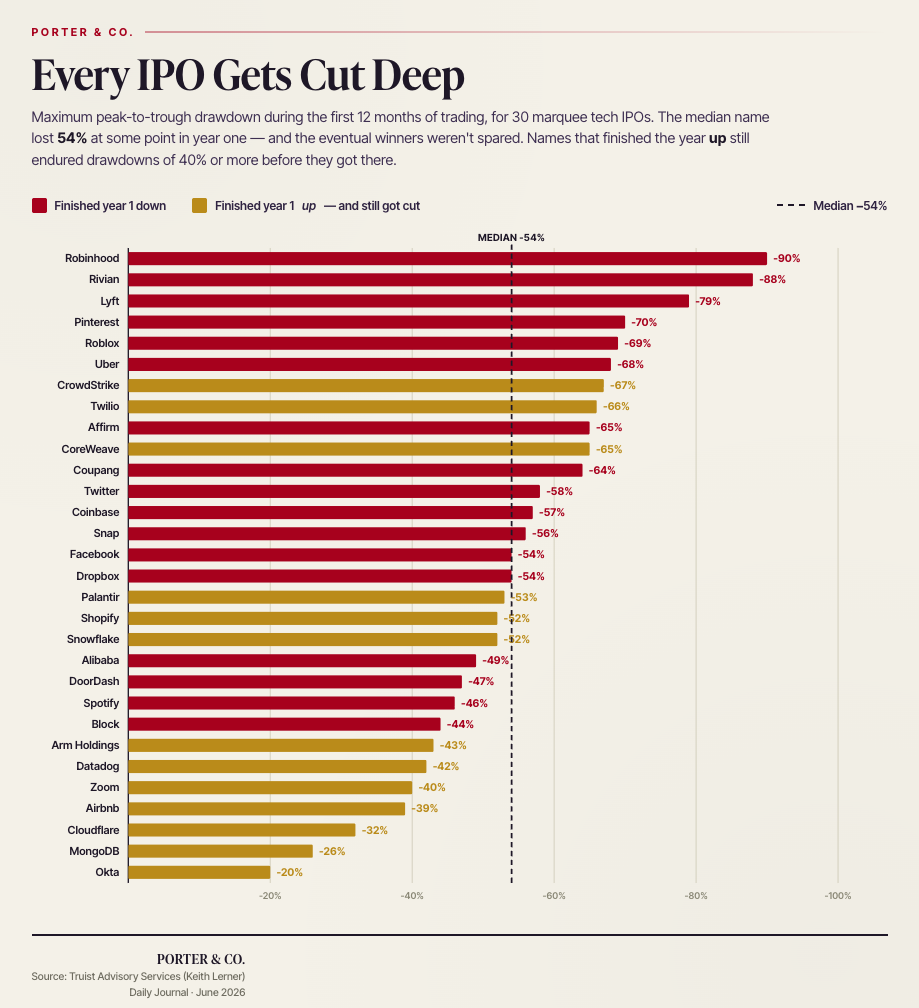
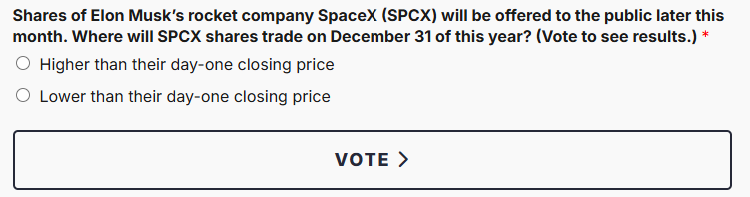
1. Beware the first-week IPO pop. Elon Musk’s rocket company SpaceX (SPCX) will likely go public next week at $135 per share and a $1.75 trillion valuation – the largest IPO ever. University of Florida Professor Jay Ritter (“Mr. IPO”) has found two iron laws: IPOs pop 15% to 20% on day one, then underperform for the next three to five years. Truist’s Keith Lerner ran the numbers on 30 marquee tech IPOs (as shown in the table above) and found the median ticker fell 54% at some point in year one. Like Musk’s rockets, SpaceX shares will likely start with a burst and return to Earth, ready to fly again.
2. Mitsui positions itself for Asian markets. Yesterday, production began at the Costa Azul liquefied-natural-gas export plant in Mexico where Mitsui & Co. (MITSY) holds a supply contract off-loading 2.5 million metric tons per year. This terminal provides Mitsui with a direct pipeline to high-demand Asian markets and a key bypass of the Panama Canal. The facility offers shorter, more reliable, and lower-cost shipping routes, ultimately boosting Mitsui’s energy trading margins and fortifying its global logistics portfolio. MITSY shares are up 29% since our October recommendation in Complete Investor.
3. “Unleashing beautiful, clean coal.” On Thursday, the White House invoked the Defense Production Act to prevent closures of coal-fired power plants while investing in expanded production capacity and export infrastructure. This includes $425 million in funding for upgrades at 13 coal-fired power plants, plus another $75 million investment into the West Gateway coal export terminal in California.
Chart Of The Day… Eli Lilly (LLY)
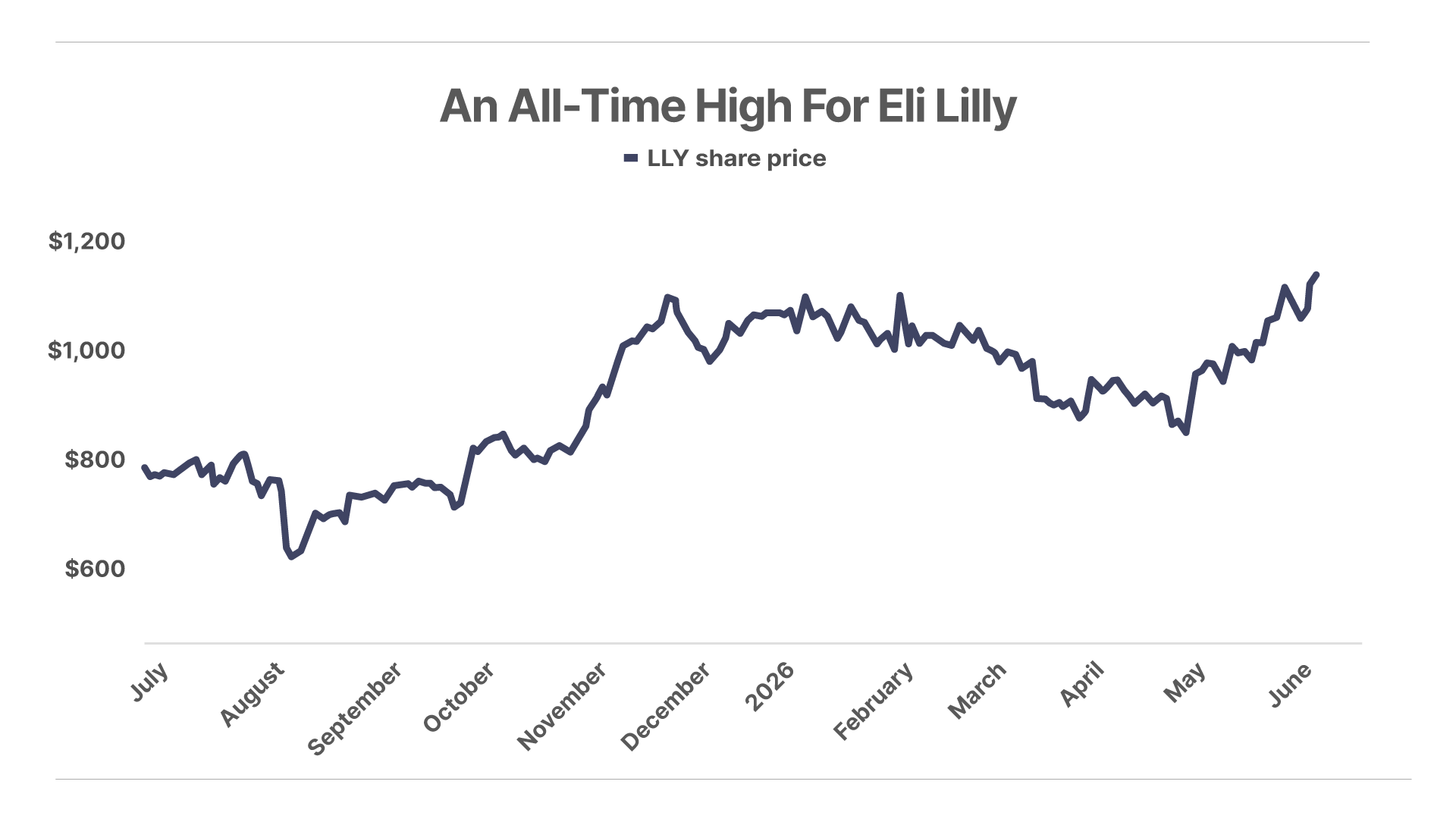
Shares of pharmaceutical giant – and GLP-1 leader – Eli Lilly (LLY) defied the broad-market selloff to trade at an all-time high today, after investment bank TD Cowen raised its global sales forecast for obesity drugs to $150 billion by 2030. Complete Investor subscribers are now up more than 48% since we recommended the stock last June.
Today’s Poll… SpaceX IPO
Mailbag
“Honeycomb Portfolio”
Robert M. writes:
Porter,
I read your Honeycomb Portfolio paper. It made great sense and seemed like a simple and elegant way to invest.
Just wondering if you planned to do an update each year for the Best-In-Class (“BIC”) and possible Lindys’ changes.
Also, as with many of your modeled portfolios, have you considered creating ETFs to assist investors in following these well-thought-out ideas and also help with tax reduction for taxable account holders?
“2029: The End Of America”
Tom G. writes:
Porter,
I read your new book 2029: The End of America. It was GREAT! Thanks for writing this book. I think it is very educational for the majority of the people.
I have a couple of questions for you. I know that you can not give individual investment advice and I am not asking for that.
My question is: Can you do like you do with Porter’s Permanent Portfolio and give a recommended percentage?
Two instances I am interested in. On page 148 you say that a person should put a “serious allocation” to productive timberland in our portfolio. What is a serious allocation as to the percentage of the total portfolio? Secondly, when a person does a stack of gold, what percentage of the four different gold investments should be put into one’s portfolio?
One last question, if a person is all in with the Permanent Portfolio, as I am, should the person pick a few of your other portfolio items and sprinkle them in also?
Thanks again Porter for all you do. It is obvious that you enjoy helping other people and I think you do a great job.
Porter Comment: Tom —
Thank you for reading my book. And thanks for your kind words.
As you may know, I can’t answer questions like these for you. I’m very sorry, but doing so would get me into all kinds of trouble.
Normally, that wouldn’t stop me!
But, I would also be doing you a terrible injustice. You would assume that my answers are based on knowledge that I simply don’t have. There are no “right” answers to these questions. What matters most is that you understand how to build a non-correlated portfolio of high-quality assets. That puts you way, way ahead of most investors.
So far I’ve built out completely allocated portfolios for Porter’s Permanent Portfolio and for my Better Than Berkshire Index.
I’ll be doing the same this fall, for my Honeycomb Strategy for all of our Partners.
You can, of course, copy my allocations. But, again, I’ll warn you: there are no “right” answers. Much of what you decide depends on your wealth, your risk tolerance, and your need for current income.
Again, thanks for your support of my business. You’ve given me the best job in the world!
Porter
“2026 Software Playbook”
Sherwin R. writes:
Thank you for a very interesting article. I have read similar theses relating to the “SaaSpocalypse,” but never expressed it quite this way. I guess the problem is that there is no way to know at this point with any certainty at all which companies will emerge bloodied but unbowed?
Porter & Co. Market Snapshot
| Price | Yesterday’s Return | Year-to-Date Return | |
|---|---|---|---|
| S&P 500 Index | $7,584.31 | 0.41% | 11.3% |
| Gold per ounce | $4,475.80 | 0.91% | 3.4% |
| Bitcoin | $63,801.57 | -2.06% | -28.6% |
| Oil (West Texas Intermediate) per barrel | $93.04 | -2.83% | 61.6% |
| Berkshire Hathaway (BRK) | $718,420.00 | 0.66% | -4.8% |
| Porter’s Permanent Portfolio | – | -0.83% | -2.5% |
| The Better Than Berkshire Index | – | -0.66% | 2.7% |
| Total Return | Annual Return | ||
| Porter & Co’s Top Ranked* | 31.4% | 14.1% | |
| Yield | Yesterday’s Change | Change Year-to-Date |
|
| U.S Treasury 30-Year Yield | 4.98% | -2 bps | 13 bps |
*A Complete Investor risk rating of 1 is defined as a “low risk, high allocation” security, while positions rated closer to a 5 are higher risk. Porter & Co.’s top-ranked positions include those rated either 1 or 2 in Complete Investor portfolio.
Porter & Co. Top Positions
| Publication | Ticker | Description | Total Return |
|---|---|---|---|
| Tech Frontiers | QURE | uniQure | 237% |
| Complete Investor | BWXT | BWX Technologies | 235% |
| Complete Investor | ARM | ARM Holdings | 184% |
| Complete Investor | BTC/USD | Bitcoin | 136% |
| Tech Frontiers | QURE | uniQure | 131% |
| Tech Frontiers | ROIV | Roivant Sciences | 131% |
| Tech Frontiers | SGMT | Sagimet Biosciences | 131% |
| Complete Investor | PM | Philip Morris | 118% |
| Tech Frontiers | TGTX | TG Therapeutics | 116% |
| Distressed Investing | PTON | Peloton Interactive | 110% |
Prices as of 4:00 pm ET June 4, 2026
Please note: The investments in our “Porter & Co. Top Positions” should not be considered current recommendations. These positions are the best performers across our publications – and the securities listed may (or may not) be above the current buy-up-to price. To learn more, visit the current recommendations page of the relevant service, here. To gain access or to learn more about our current recommendations, call our Customer Care team at 888-610-8895 or internationally at +1 443-815-4447.