Why There’s No Such Thing As A Tech Stock Anymore
Inside Today’s Issue
Editor’s Note: On Wednesday, September 16, Porter is hosting a special broadcast for readers to explain how almost every investor is playing the AI boom backwards and the abandoned sector that will generate the real wealth from AI.
Click here to save your seat and during Wednesday’s event you’ll get the large cap stock Porter says could, in his view, potentially 5x in five years as the AI capex trickles down to this sector.
There are a lot of AI skeptics today – including several on my staff.
Here’s what they’re missing: over the last 50 years, the most important, broadly applicable corporate moat was compute. And that moat is getting wider, much wider, thanks to artificial intelligence (“AI”).
By compute, I mean three specific things: computation (the speed and processing power of various types of semiconductors), digital memory (the ability to store vast quantities of digitized information), and bandwidth (how much and how fast information can be shared across a network).
When you break down virtually any business to its most basic elements, you end up with a sequence of decisions (product development, marketing, hiring, design, pricing, capital allocation, etc.), all of which must be made with partially incomplete information.
Lots of famous businessmen, like my friend, the late T. Boone Pickens, revel in the risks of making “bets” – allocating capital into business operations with wide outcome dispersions… “all or nothing” bets. (And I saw Boone make some horrible decisions even when he had access to reliable information simply because he thought the facts were wrong! That’s what made him a great gambler.)
I’m not saying that you can’t succeed when you gamble – Boone did! I’m saying that one of the reasons why Boone was so famous was because he was one of the very, very few people who survived running their companies that way.
For the people who are trying to avoid risk – or at least price it appropriately – investing in compute has given them an enormous advantage.
A firm that shrinks the possible outcome dispersion of its educated guesses earns more on every dollar of capital it deploys and can reinvest the difference into shrinking risks further.
I know this works because I’ve done it often in my career.
Steve Sjuggerud and I spent millions of dollars building proprietary databases between 2002 and 2019 to discover the patterns and correlations that drive the markets. We discovered dozens of valuable anomalies – for example, the Lindy factor that proves the value of long-lasting businesses that I still write about today. Sjug built out an incredible global strategy based simply on knowing the limits of various correlations, which he called market extremes. In 2015, along with Bryan Beach and Mike DiBiase at Stansberry Research, I built an entire proprietary credit quality database so that we could assign our own ratings to over 6,000 widely traded corporate bonds – allowing us to spot where the market’s price and our ratings diverged the most.
At every step of my career as an investor, I’ve been trying to gain an information advantage (legally). I’m constantly seeking new ways to minimize risk. And the best way to do that is through investments in compute (processing, memory, and bandwidth).
The same is true for every great business.
In 1987, Walmart (WMT) finished building the largest private satellite communications network in the United States. (It wasn’t the first: Holiday Inn had been running HI-NET since 1979, and Schlumberger (SLB) took delivery of the world’s first Ku-band very-small-aperture terminal for oilfield crews in the early 1980s.) Walmart’s system cost $24 million, took two and a half years to build, and connected more than 1,200 sites across 24 states with two-way voice and data and one-way video communication.
Walmart founder Sam Walton was famously cheap. So what did he buy for $24 million…? No more guessing. Every register in the chain reported what it had sold, overnight, to one building in Arkansas. By 1992, Teradata (TDC) had built Walmart the first commercial data warehouse to cross a single terabyte. By fiscal 2005, that warehouse held more than 570 terabytes and tracked 680 million item-store combinations every week.
A competitor down the road reordered on a merchandiser’s instinct and a monthly report. Walmart reordered on Tuesday’s actual sales, store by store, item by item. That database was probably more valuable than Walmart’s physical stores.
How do I know?
Kmart was the larger discount chain by revenue when those satellites went up. By the time Kmart understood what the network was for, it was hopelessly behind. It never built a similar system and ended up in bankruptcy, mostly because of Walmart.
AMR, then the parent of American Airlines (AAL), spent roughly $40 million and 400 man-years building the Semi-Automated Business Research Environment with International Business Machines (IBM). Known today as Sabre, it went live in 1960 and was fully operational in 1964. A booking that normally took 90 minutes now took only seconds.
What was worth more: all the airplanes and all of the routes, or the database?
In March 2000, AMR spun Sabre off, distributing its 83% stake to its own shareholders. AMR carried that stake on its books at about $600 million. The market valued it at $5.2 billion. The New York Stock Exchange adjusted AMR’s shares from $60.56 to $25.56 to account for the distribution. The database was worth way more than the planes.
Capital One Financial (COF) was founded on the premise that a credit card is not a product but an experiment. In 1999 alone, it ran 36,114 tests on pricing, terms, and solicitations, and more than 45,000 per year by 2000. Its accounts went from 8.6 million to 33.8 million in four years. Its competitors mailed one offer to everyone at one price and wrote off the resulting defaults as a cost of doing business. Capital One stopped guessing.
Amazon.com (AMZN) is the version everyone knows, and it is still understood. Amazon did not add technology to retailing. It was a technology company that sold books. Amazon found provisioning its own computing so hard and so expensive that it packaged the whole thing as a service and sold Amazon Web Services (“AWS”) to everyone else, too. It eventually used that technology to offer an entirely new way to read: Amazon launched the digital reader Kindle on November 19, 2007, and, even at $399, it ran out of inventory in five and a half hours! In fiscal 2025, AWS produced $128.7 billion of revenue and $45.6 billion of operating income, against total operating income of $80.0 billion for all of Amazon. The infrastructure a retailer built for itself now generates 57% of that company’s operating profit on 18% of its revenue.
My mentor, Bill Bonner, famously claimed that Amazon was the “River of No Returns” because it invested so heavily in compute. But was that a mistake?
And then there’s insurance, my favorite business.
Insurance is pure information. An insurance company has no factory and no inventory. Its entire product is a probability estimate. It is no surprise then that the two best-run property and casualty (P&C) insurers in America are both compute stories.
Kinsale Capital (KNSL) writes excess and surplus lines: the hard, odd, one-off risks that standard carriers decline. We recommend Kinsale to our subscribers because it was built from the ground up on a single proprietary system that its underwriters, its brokers, and its claims adjusters all work inside – an entirely new, compute-centric structure.
In 2025, the P&C industry ran a 92.9% combined ratio – combined ratio is an insurance company’s operating costs (overhead and claims) against its premium income, the industry standard measure of operating profit. The A.M. Best surplus-lines composite (Kinsale’s specific type of insurance) ran 90.8% in 2024. Kinsale ran 75.9%. That is 17 points better than the broad industry, and roughly 15 points better than the surplus-lines composite.
Where do those 17 points come from? Great underwriting, sure… but Kinsale’s even larger advantage is in direct operating costs. Kinsale’s 720 employees processed 988,000 submissions and produced 711,000 quotes in 2025 – each within 24 hours. That is about $2.75 million of gross written premium per employee against roughly $1.76 million at W. R. Berkley (WRB), which is itself a very well-run specialty insurer. Kinsale founder Michael Kehoe explains the gap in plain language: his expense ratio is under 21% while competitors “tend to run in the mid-30s or higher, some even above 40%.” He says Kinsale has a 15-percentage-point cost advantage.
Think about what a 15-point cost advantage does in a business where the product is commoditized. Kinsale can quote the same policy below its competitor and still book the wider margin. It wins the accounts it wants and walks away from the ones it doesn’t, and it never has to argue about price. Then it does it again next year, on a larger base. But how? How does Kinsale achieve this incredible advantage? With compute.
In 1998, Progressive (PGR) was granted U.S. patent 5,797,134, covering a method of pricing auto insurance from actual recorded driving behavior. It tested Autograph, a GPS and cellular unit, in Texas that same year. TripSense followed in 2004, MyRate in 2008, Snapshot in 2010, surcharges for bad driving in 2014, the smartphone version in 2016, and continuous monitoring in 2022. By 2014, Progressive had collected 10 billion miles of driving across 1.5 billion trips, about 110 terabytes. It licensed the patents to Allstate (ALL) in 2011 and to USAA in 2013.
Progressive passed GEICO for second place in U.S. personal auto in 2022 and, in the 12 months ending March 31, 2026, Progressive passed State Farm for first, ending a run State Farm had held since 1942. Progressive’s policies in force grew 11% in Q1 2026. GEICO’s grew 2%.
But is PGR an insurance stock or a tech stock?
This is my message: there is no such thing as a company that isn’t a tech company. If you’re not leading your field in applying compute, you’re going out of business in the next 10 years.
Everything above happened while computation was scarce and expensive. It is now neither.
There’s no such thing as a tech stock anymore. There are simply companies that are good at applying compute and companies that fail. What does applying compute look like in “old school” businesses?
Deere & Company (DE) bought Blue River Technology for $305 million in 2017 to teach a sprayer to tell a weed from a soybean. See & Spray now shoots herbicide only at the weed. It cut herbicide use 59% across a million acres in 2024, and in 2025 it covered 5 million acres and eliminated 31 million gallons of chemical. About a third of Deere’s North American sprayers on order carry it. Underneath sits roughly 1.2 million connected machines, more than 520 million engaged acres, and over 450,000 monthly digital users – all producing recurring revenue. Deere wants 10% of revenue recurring by 2030.
Is that strategy working? In its fiscal Q3, which ended August 2, Deere earned $1.38 billion on $12.61 billion of revenue, up 7% and 5%, with large agriculture equipment in the U.S. and Canada down 15% to 20%. Deere grew earnings in the worst farm economy in a decade.
Tesla (TSLA) was a car company. It now runs more than 230,000 H100-equivalent fast processing GPU compute chips across its two Cortex clusters to replace human engineers with AI. Why? To build the world’s first fully autonomous driving fleet.
The older system had humans coding instructions for situation after situation, and every new situation required a new instruction. The new model learns the mapping from millions of examples of human drivers handling the same roads. Driverless service now runs in six metropolitan areas. And what a lot of people still don’t understand is that these new robotaxis aren’t cars at all. They don’t even have a steering wheel: they’re robots. And there are more robots coming. Optimus humanoid production began in Tesla’s Fremont, California, factory last month.
Get ready for more “river of no returns” headlines about Tesla – some from my analysts! Tesla’s Q2 2026 operating income fell 57% to $398 million on $28.24 billion of revenue, with $5.79 billion of capital spending and negative free cash flow of $1.1 billion. But the question isn’t whether Tesla is going to burn cash for a few quarters. The question is whether those investments in compute will pay off.
And then there’s my favorite example.
On January 12, 2026, Eli Lilly (LLY) announced a co-innovation lab with Nvidia ( NVDA) worth up to $1 billion over five years, inside a broader $50 billion U.S. capex commitment. By late February the machine was running: LillyPod, 1,016 Blackwell Ultra GPUs, more than 9,000 petaflops, 290 terabytes of high-bandwidth memory, built in four months. Drug discovery is the highest-value intelligence game there is, because a pharmaceutical company spends roughly a decade and billions of dollars to find out whether a molecule works. Compress the cost of that search and you change the economics of the entire industry. Lilly is compressing that search while its revenue grows 48% year over year, to $22.97 billion in Q2 of 2026, with weight-loss drug Mounjaro alone up 91% to $9.94 billion. Unlike Tesla, Lilly can pay for its entire AI buildout with current earnings.
And finally, our last example, the opposite of Lilly.
Oracle (ORCL) spent its first 40 years selling software licenses and maintenance contracts, which is one of the finest business models ever constructed: write the code once, collect the rent forever. Today, that model is dying: Oracle’s software license revenue fell 15% last quarter.
To reinvent itself, Oracle decided to invest massively in compute. It plans to become one of America’s leading data-center operators and is building out that infrastructure on an unprecedented scale.
Oracle delivered 850 megawatts of data-center capacity last quarter, containing more than 300,000 GPUs. That is almost three times what it delivered in the entire prior quarter, and 73% of everything it delivered in the prior fiscal year. Utilization of that AI infrastructure ran 97.9%. At its Abilene, Texas, data center – one of the largest in the world – it delivered 131,000 GPUs and 618 megawatts.
As a result, total revenue was $19.35 billion, up 30% year-over-year. Cloud infrastructure revenue was $7.38 billion, up 121%. That growth rate has now accelerated for nine consecutive quarters: 55%, then 68%, then 84%, then 93%, and now 121%.
Non-GAAP operating income was $8.15 billion, up 31%. Counting stock compensation and amortization, GAAP operating income was $6.73 billion, up 57%. GAAP earnings per share rose 55% to $1.56. Management raised fiscal 2027 revenue guidance to at least $90 billion, which is 34% growth.
But what about depreciation? Oracle’s GPUs coming up for renewal in the quarter were at least four years old. They were renewed or resold at an average 20% premium to the prior contract. Four-year-old computing hardware repriced upward.
Can this insane growth continue?
Oracle’s current order backlog is $664 billion. That is up $209 billion in a year and up $26 billion in the quarter, and it includes more than $30 billion of new AI contracts signed in the last three months. The market values the whole company at $490 billion. Oracle’s contracted, unbilled backlog is larger than Oracle.
Why? Because the market believes this is all another “river of no returns.”
Oracle’s capital expenditures in the last quarter were $28.5 billion, against $8.5 billion in the same quarter a year ago. Free cash flow was negative $5.4 billion, against negative $362 million a year ago. And Oracle is financing these investments with debt: it carries about $125 billion of debt currently. Interest expense ran $1.43 billion in the quarter, up from $923 million. It sold $43 billion of debt in fiscal 2026, issued $20 billion of stock through an at-the-market program in this quarter alone, and shrank its own headcount 13% to 141,000 while doing it.
And then there’s the real risk: Oracle’s main counterparty is OpenAI, producer of ChatGPT. Roughly $300 billion of its backlog is reportedly OpenAI’s, a company with about $25 billion of annualized revenue that loses money and funds itself from investors.
Walmart, American Airlines, Capital One, Amazon, Kinsale, Progressive, Deere, and Lilly all built compute for their own operations, paid for it out of their own cash flow, and used it to price their own products better than a competitor could. Oracle is building compute for other people’s operations, on borrowed money, at enormous scale. Oracle’s position is a landlord’s rather than an underwriter’s, and a landlord’s return depends entirely on one thing: renewal.
Right now, the model is working: Oracle saw a 20% renewal premium on four-year-old GPUs. If those premiums hold, Oracle is not a landlord with a depreciating building. It is the owner of the most valuable capital asset in the economy, with 97.9% occupancy, $664 billion of signed leases, and the ability to reprice on renewal.
Is Oracle spending its way into bankruptcy, is this another “river of no returns,” or is it buying an enormous moat?
Oracle, with $8.10 in earnings per share this year and growing revenue 34%, is worth at least 50% more than its current market value – but only if its renewals continue to pay.
It’s very hard to know if that will happen. What I can tell you is, over the last 50 years, investors have done very well taking that exact risk.
Here is a prediction you can hold me to, with a date on it.
By 2031, the 10 most valuable companies in America will all be leaders in AI. Half of them will be companies that today nobody files under “tech stock.” The technology sector is not arriving. It is dissolving into every other industry. And, in 10 years, the phrase technology company will describe every business still earning an above-average return on capital.
Tell me what you think of today’s Daily Journal – good, bad, or somewhere in between: porterstansberrydirect@gmail.com
Good investing,
F. Porter Stansberry
Stevenson, Maryland

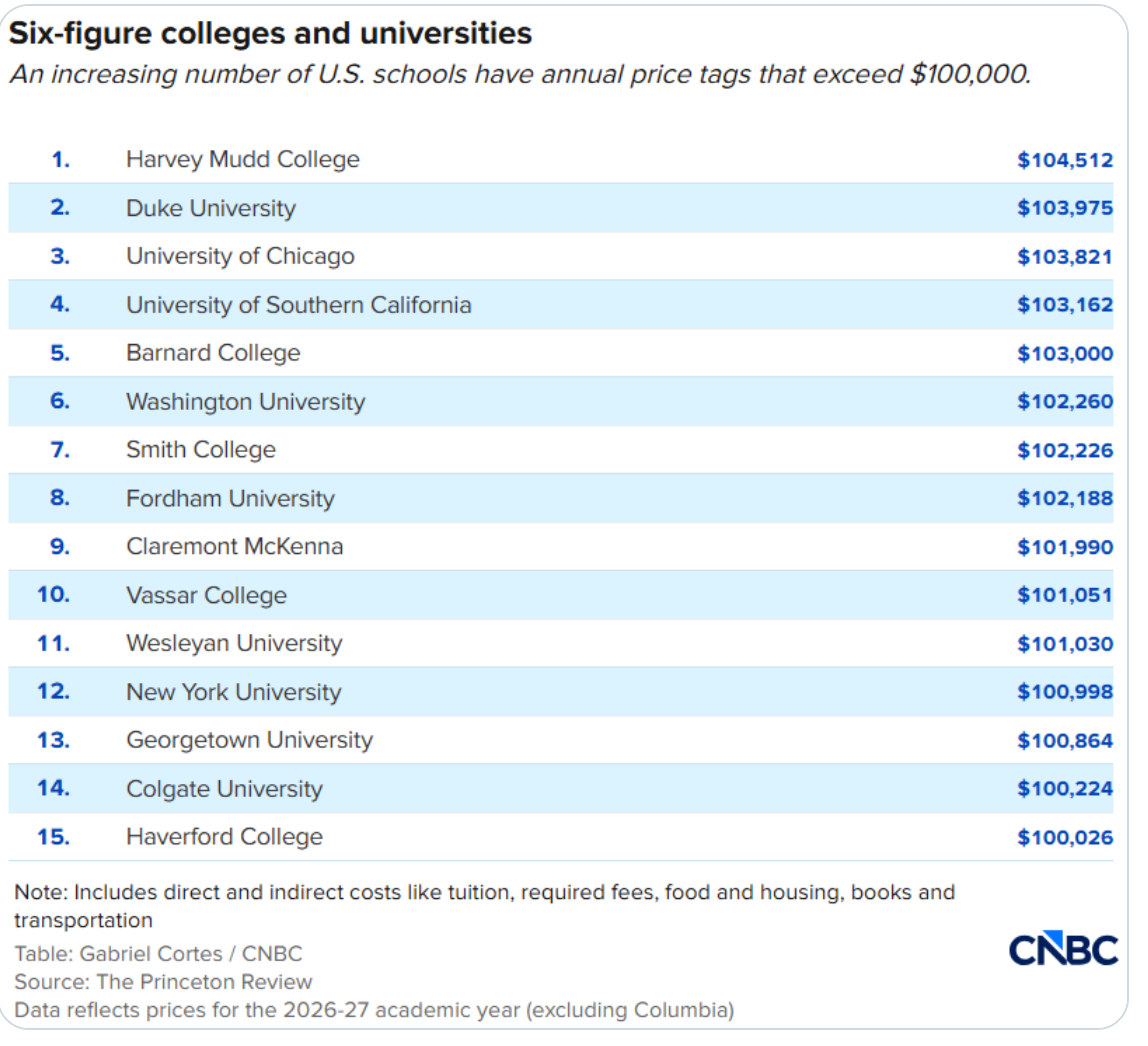
1. $100,000 for one year of college. Adding to the average consumer’s household spending burden is the growing cost of college – the annual nut has increased more than 110% over the last 20 years. CNBC recently reported that there are now 15 U.S. colleges and universities that have annual tuition above $100,000 – topping the list are Harvey Mudd College (California) and Duke University (North Carolina) at $104,000, with Colgate University (New York) and Haverford College (Pennsylvania) both squeezing onto the list at just over $100,000.
2. Inflation held steady at 3.4%, but gasoline was the biggest reason. Consumer prices rose 0.4% in August, the largest increase since May and up from July’s 0.1%. Gasoline alone rose 3.9% and 27.4% over the past year, accounting for more than a third of the entire monthly increase. Strip out food and energy, and core inflation fell to 2.4%, down from 2.9% in May. In short, the broad economy appears to be cooling while energy costs are not. Traders now put the odds of a Federal Reserve rate hike at next week’s meeting near 90%, up from around 72% Thursday. However, the part of price inflation the Fed can actually influence is already falling. Higher interest rates will not reopen the Strait of Hormuz.
3. Saudi Arabia’s last oil export route may be damaged. Reuters verified satellite imagery from Thursday showing black smoke along the East-West pipeline south of Medina, the 1,200-kilometer line that carries crude from the Persian Gulf to the Red Sea port of Yanbu. With the Strait of Hormuz effectively closed, that pipeline is the only remaining way Saudi crude can be exported in volume. The country’s supply had already fallen to 6 million barrels a day in August, a three-decade low, before this fire. Saudi Aramco has yet to confirm, but Brent crude jumped more than 6% following the news and is headed for its first weekly close above $100 since May.
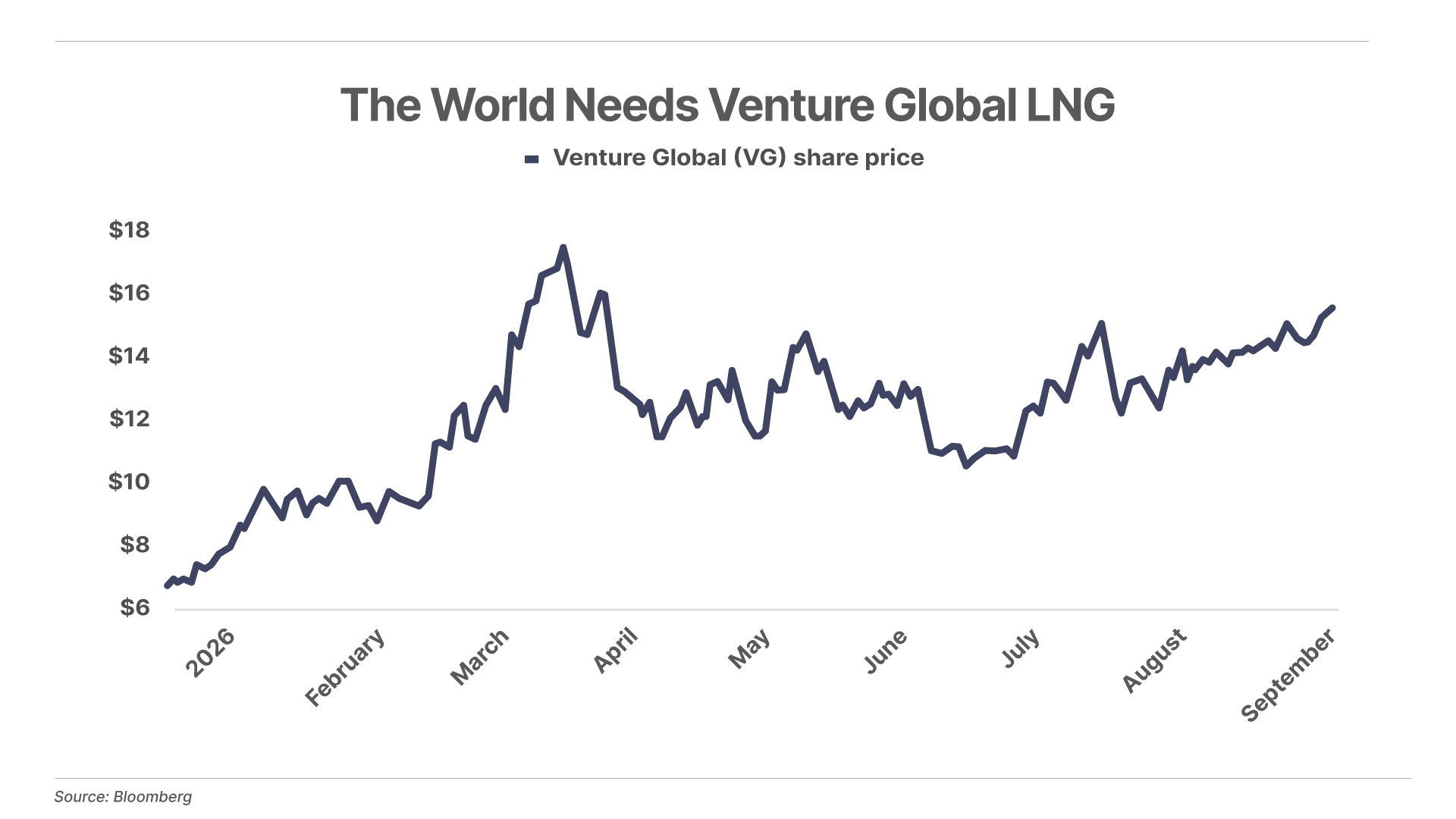
Shares of Venture Global (VG) are up 130% year to date as each escalation in the Persian Gulf reprices the same asymmetry: a ceasefire can reopen the Strait of Hormuz overnight, but rebuilding the liquefied natural gas capacity behind it takes three to five years.
Yesterday, Distressed Investing editor Martin Fridson spelled out the difference between gambling, prediction markets, and the stock market. Prediction markets are gambling, he determined, while the stock market is not.
“Stocks Are A Zero-Sum Game”
David R. writes:
You are wrong that investing in stocks is not a zero-sum game… it absolutely is. Stock market gains of the past 50 years are completely in line with inflation over the past 50 years. You could argue that stocks outperform inflation if you use government numbers, but we all know they are a crock. Real-world inflation is three times higher than what the government says it is. So if you earn 7% a year for 50 years… you’ve in effect gone nowhere. Why do you think gambling has become so prevalent recently? People absolutely are aware that 7% isn’t anything but breaking even… and if you’re gonna just break even, may as well do it at night at the casino.
“Very Enjoyable”
Lum L. writes:
Very enjoyable and informative 🙂