Unless You Play Your Coins Right
Inside Today's Issue
Editor’s note: Today, Porter turns the Journal over to his Porter & Co. colleague Justin Brill, lead analyst on Porter & Co. Systematic Crypto, which we launched for Partner Pass members in September. It will become available more widely soon.
It was really just a high-tech bank heist – wielding stolen passwords rather than a gun…
Shortly after 4 pm on Thursday, October 29, an attacker began moving about $6.36 billion out of Binance's "hot" wallets – the internet-connected accounts this leading cryptocurrency exchange uses to process everyday withdrawals.
The hacker acted across 10 different blockchains. Most of the funds left within 20 minutes, according to TRM Labs, a firm that traces crypto transactions for law enforcement and banks.
TRM and its rival Chainalysis both attribute the attack to TraderTraitor, a North Korean state-backed hacking group the FBI previously blamed for a similar theft from another crypto exchange, Bybit, in February 2025. Binance's early findings pointed to a compromised engineer's laptop, though the company has since found "additional points of breach."
The Binance cleanup has been pretty quick and efficient, in part because roughly $2.5 billion of the stolen funds was in stablecoins, according to an early tally by on-chain data firm Glassnode. Stablecoins are digital tokens designed to hold a steady $1 value – and unlike Bitcoin, they are issued by companies that can freeze them. The two largest issuers – Tether, which issues USDT, and Circle Internet (CRCL), which issues USDC – froze more than $1.5 billion and $800 million of their tokens, respectively, and roughly $3 billion of stolen assets had been frozen by Friday, October 30.
Binance says it has set aside $6.34 billion of company money to cover all customer losses, $5 billion of which it already held in the same tokens that were stolen. Deposits were working normally almost immediately, and the company resumed withdrawals by the following Sunday.
Prices fell, but not far. As of early last Friday, Bitcoin (BTC) had been down 4.9% over 24 hours to about $76,900, Ether was down 5.7%, and BNB – the token Binance created to power its own blockchain and discount trading fees – was down 8%. The stolen funds equal about 4% of the roughly $144 billion in customer assets Binance held before the hack, according to data tracker DefiLlama. It represents less than 0.5% of Bitcoin's total market value.
What Bitcoin Does After A Heist
Hacks are nothing new in crypto. So we went back and studied 27 of the largest and most notable since 2014 – from the collapse of Mt. Gox, the Tokyo exchange that then handled most of the world's Bitcoin trading, to April's $292 million theft from Kelp DAO, an Ethereum-based staking service – and measured what Bitcoin did afterward.
The short-term picture is about what you'd expect. In the 30 days following a hack, the price of Bitcoin fell – its median return was negative 4.5%, versus a 2.2% increase for a typical 30-day stretch since 2014. Prices were higher a month after a hack only 10 times out of 27.
The longer-term view is the one that matters – 15 of those hacks hit during one of Bitcoin's three bull markets (2015–2017, 2018–2021, and 2022–2025). Bitcoin went on to set a new all-time high after every hack, a median of 116 days later. In 12 of the 15, it was back above its pre-hack price within a week. And none of these events marked the ultimate top: from the date of each hack to the eventual cycle peak, Bitcoin gained a median 316%.
That doesn't mean bull-market hacks were painless. Bitcoin fell as much as 31% in the 90 days after hackers drained The DAO – an early investment fund run entirely by software on Ethereum – in June 2016, and 22% after Bybit. In each case, the rally resumed.
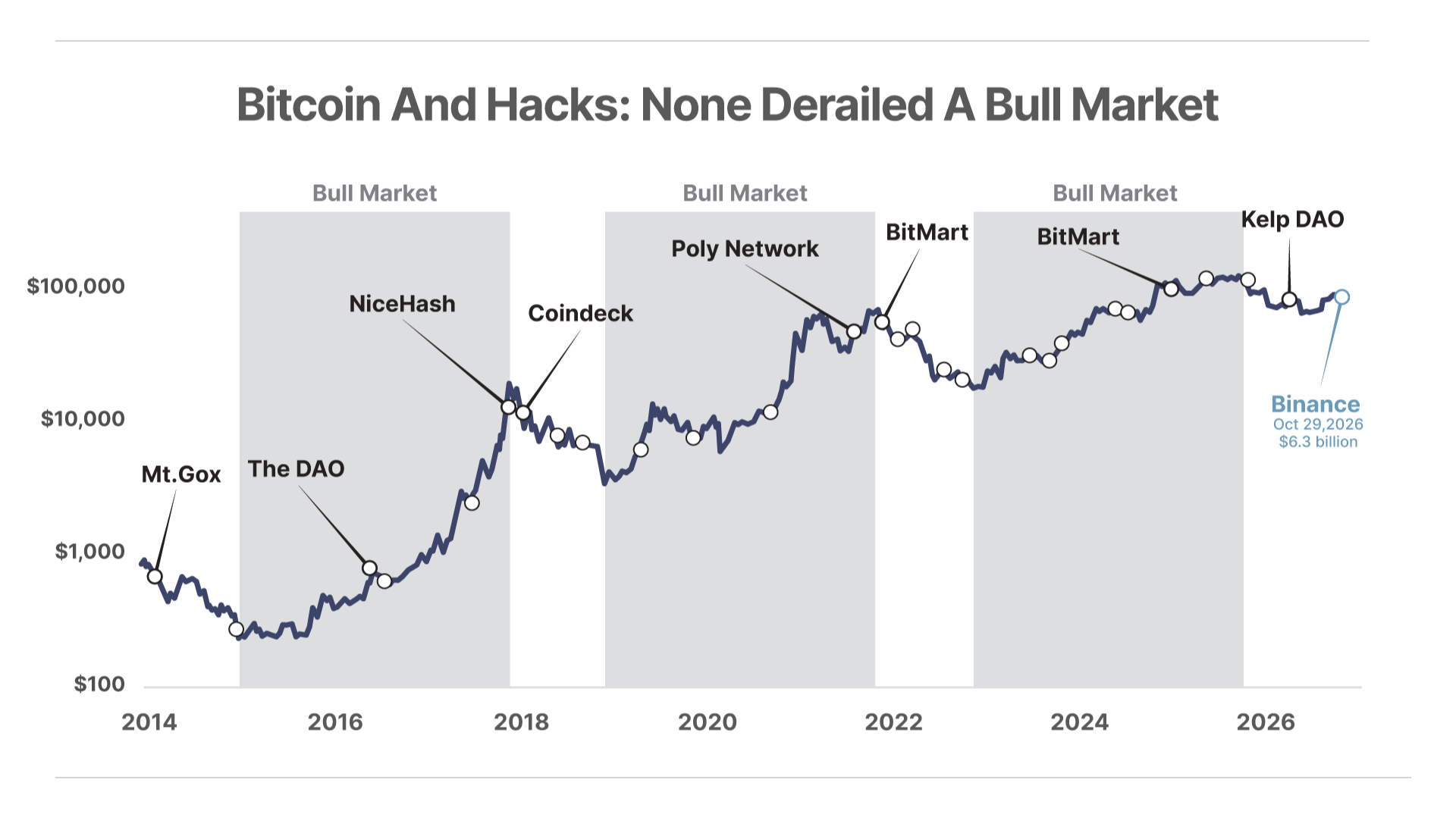
The serious damage came only after the trend had already turned. Every lasting decline after a hack began at a cycle top, not at the hack itself. Japanese exchange Coincheck lost $530 million on January 26, 2018, about six weeks after Bitcoin's December 2017 peak. Exchange BitMart lost $196 million on December 4, 2021, less than four weeks after the November 2021 peak. Bitcoin fell 68% over the following year in both cases… but both bear markets were already underway.
Across all the hacks, Bitcoin's median return over the following 12 months was a positive 52%. That trails the 69% median increase for random dates in similar market conditions, but a gap that size shows up by pure chance about three times in 10. Statistically, the year after a hack looks like any other year in Bitcoin.
Bottom line: No hack in Bitcoin's history has derailed a bull market..
In our September 1 Systematic Crypto issue, which we sent to Partner Pass members, we said we were optimistic that a new crypto bull market was already underway. If that's right, history says there’s little reason to worry. Either way, our system doesn't read headlines. It reads Bitcoin's price at each month-end close.
Hitting Home For Individual Investors
But big-time institutional players such as Binance are not the only ones getting hacked.
Many individual crypto owners opt to skip exchanges and funds, and hold their coins in "self-custody," most often on a hardware wallet – a small device, similar to a USB stick, that keeps the keys to your crypto offline. A French company called Ledger is the best-known maker, but there are several others, including Trezor and Coldcard.
Setting one up generates a 24-word "recovery phrase" that essentially works as a master password for that wallet. Anyone who has those 24 words controls the coins in that wallet. And unfortunately, criminals have become quite skilled at getting access to those words.
For example, on October 9, Ledger wallets began draining across Southeast Asia. The victims had bought their devices through CryptoBilis, an authorized Ledger reseller. According to Ledger, a criminal group bought genuine devices, fitted them with a hidden implant, and slipped them back into the sales channel.
The implant – a small circuit board with an antenna and a cellular chip tucked under the screen – read the recovery phrase off the display during setup and transmitted it to the thieves.
Incredibly, the tampered devices still passed Ledger's own authenticity check, so even the company itself was unaware the tampering had occurred until it was too late. Researchers tracing the stolen funds estimate losses of up to $93 million across about 300 wallets.
A few months earlier, in late July, attackers began draining wallets made by Coldcard, a hardware wallet popular with Bitcoin purists. It turned out a software error had caused some of its devices, dating back to March 2021, to create private keys – the secret codes behind each wallet – that were far easier to guess than intended. About 1,816 Bitcoins (roughly $116 million) were taken from more than 5,200 addresses, according to Galaxy Research, part of crypto financial services firm Galaxy Digital.
What is especially troubling about these hacks is that the Ledger and Coldcard victims followed the rules the industry has preached for a decade. They bought hardware wallets from approved sources and kept their recovery phrases offline. They arguably did everything right.
The reality is that self-custody has been sold to investors as far easier to manage than it really is. Doing it safely today means not only following the somewhat technical steps to the letter, but also protecting yourself from tampered hardware and buggy software, often built or exploited by attackers with far more resources than any individual.
So we’ve spent the past several months building something completely new: a crypto service worthy of the Porter & Co. brand. Porter & Co. Systematic Crypto follows two rules-based crypto portfolio strategies that are built to beat Bitcoin where it matters: after taxes and across a full market cycle.
And what’s key for the individual investor is that we built it entirely around exchange-traded funds ("ETF") and stocks.
Now, to be clear, we aren’t dismissing self-custody entirely. For technically minded investors willing to make the time and effort to learn how to self-custody correctly, it can still make sense. But it means becoming your own bank and your own security department at once. And that’s a responsibility many people don’t want to shoulder.
For most investors, the safest and easiest solution is simply owning crypto through your traditional brokerage account until self-custody becomes more user friendly. And that’s exactly the approach we’re taking in Systematic Crypto.
Right now, this system is available to Partner Pass members only, but we’ll be opening it up to all readers later this month. Keep an eye on your inbox for more details.
Tell us what you think of today’s Daily Journal – and if you’ve ever invested in crypto: porterstansberrydirect@gmail.com.
Justin Brill
Stevenson, Maryland

1. Wall Street swung from relief to panic in two days. Goldman Sachs’ Panic Index – a 10-point gauge of how much investors are paying for protection against a stock market drop – fell 3.5 points Wednesday as stocks rallied after the midterm elections. On Thursday, the index jumped about 5 points to 9.57. The two-day swing of 8.55 points was the largest on record. Investors rushed to buy back the hedges they had just sold, and volume in put options (bets that prices will fall) hit a record 11 million contracts. In the 15 earlier cases when the index exceeded 9.5, the S&P 500 was higher 80% of the time over the next three months, with an average gain of 4.6%. 2. Hot October inflation likely locks in a December rate hike. Consumer prices rose 0.4% last month, above forecasts, after a 0.6% jump in September. Core prices, which leave out volatile food and energy costs, rose 0.3%. Economists had expected 0.2%. That is the third straight 0.3% core gain, which works out to about 3.6% a year versus the Fed’s 2% target. This is the last inflation report the Fed will see before its December 8-9 meeting, and most economists expect a quarter-point hike. 3. Exxon returns to Venezuela… maybe. Yesterday, oil super major ExxonMobil (XOM) signed a Memorandum of Understanding (MOU) with Venezuela’s state-run oil company, PDVSA, to evaluate exploration and production opportunities in the country. This marks the first formal step toward Exxon re-entering the South American nation, with the largest oil reserves in the world, nearly 20 years after its oil assets were seized and nationalized by former President Hugo Chávez in 2007. Exxon CEO Darren Woods has emphasized that any investment commitment will require a transparent legal framework with robust property rights. Shares of fast-food leader McDonald’s have risen 20% over the past month – though sales have been sluggish, the Big Mac maker has outperformed its competitors and recently announced a deal to use UberEats as its exclusive delivery partner. We made the Complete Investor recommendation a Best Buys in October. In yesterday’s Journal, Porter suggested that Social Security will begin paying out more than it takes in as early as 2029. He said that there are safe places to protect against inflation and overall economic decline – one of them being timber owner Weyerhaeuser (WY). Marc Z. writes: Easy fixes to at least stretch the date for default on SS promises until members of Congress start thinking of the nation first rather than their own ambitions: Christopher R. writes: This is outright scary. People hear this about the SS situation but I do not think they believe it will happen… Government will fix it. At this point, just pray because it isn't going to be pretty!!! Charles W. writes: Your conclusion that the government will renege on SS is not logical. Why didn't you choose the print-more-money option for SS? That's the logical decision. Otherwise, there would be a revolution and civil war. Charles O. writes: If the government taxed the millionaires and billionaires just 1% more would that not save Social Security?” Michael B. writes: I remember there was a formula for deciding when to buy WY. I don't remember exactly how to figure it out, but it was based on BV. Will you give us a sell when that time comes? Porter & Co. Comment: Yes, we will keep Partner Pass members up to date on Porter’s recommendation for buying and selling shares of Weyerhaeuser (WY). Tom K. writes: Porter says it is "my book" in the email – when checking at Amazon, it says it is written by Stannis V. Robert – Is this the book being referred to? Porter & Co. Comment: No, “Stannis V. Robert” is a comparison between two characters (and brothers) Stannis and Robert Baratheon from the book series The Game Of Thrones. Porter Stansberry is the author of 2029: The End Of America: Why The Age Of Paper Money Is Ending And How To Survive The Coming Global Monetary Reset. And it is available on Amazon.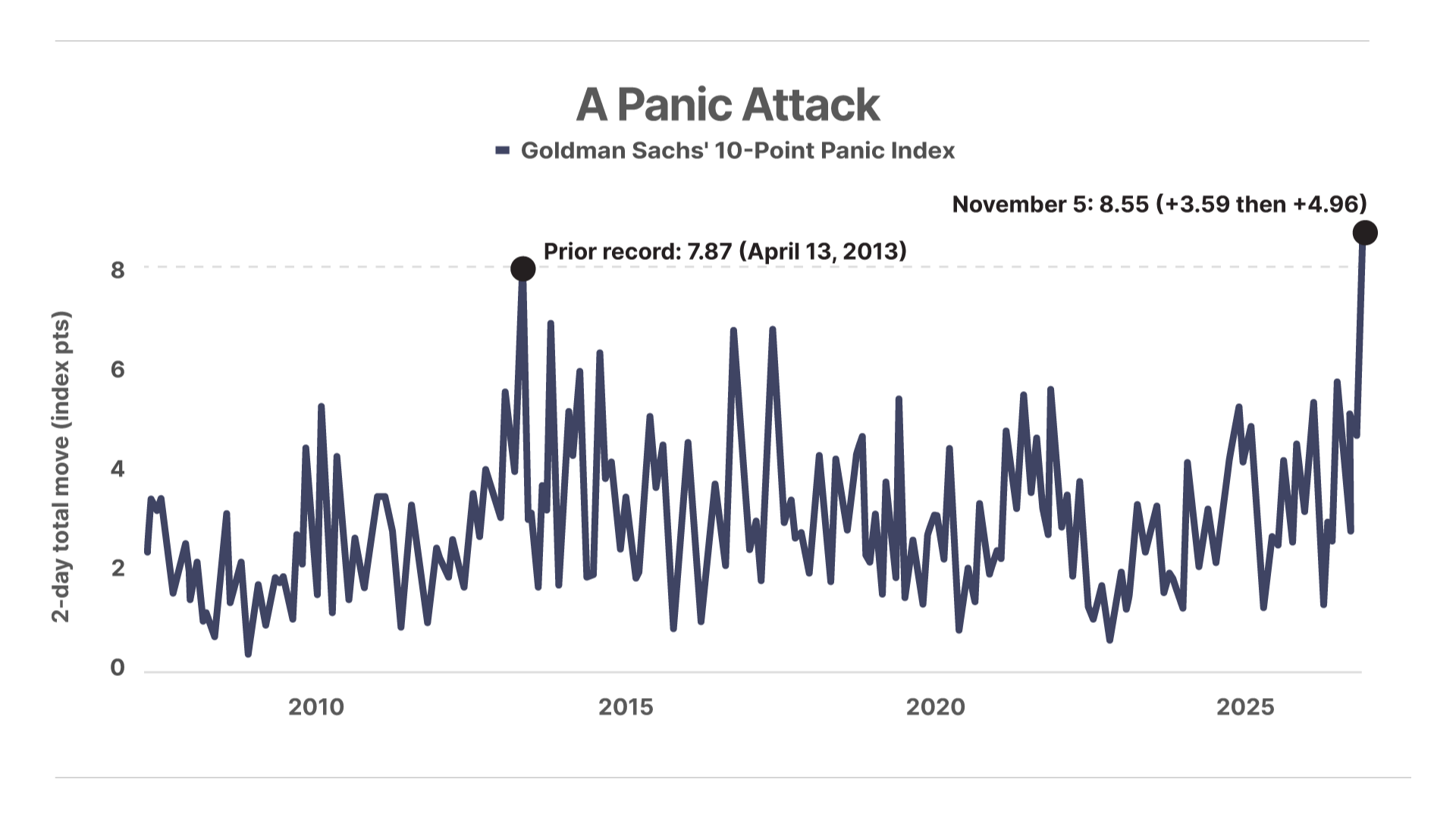

“Easy Social Security Fixes”
1) Recognize that life spans when SS was formulated fell between 58 and 62. Now it is in the mid to upper 70s. For those under age 50, make the first eligibility claims commencing at age 75.
2) For those upper-class individuals with interest or dividend income more than (for example) $125,000 annually (indexed to inflation), phase out payments on a sliding scale inversely proportional to increases in income from the same categories.
Having worked in Congress, I know these ideas will be rejected outright, since power over principle reigns supreme.
“Fears About Social Security”
“Weyerhaeuser”
Porter & Co. Market Snapshot
Through Monday, November 9, 2026 close
Markets
Index or asset
Last
1-Day
YTD
1-Year
752.69
+2.37%
+11.2%
+13.4%
$4,114.50
+0.97%
−5.2%
+2.6%
$74,780.00
−1.29%
−14.6%
−27.9%
$86.85
−4.38%
+51.3%
+45.4%
$853,500.00
−0.36%
+13.1%
+14.1%
U.S. Treasury yields
Maturity
Yield
1-Day
YTD
1-Year
4.56%
+5 bps
+109 bps
+101 bps
4.88%
+2 bps
+70 bps
+77 bps
5.26%
0 bps
+42 bps
+56 bps
Porter & Co. strategies
Strategy
1-Day
YTD
Since start
Per year
+0.47%
+7.3%
+35.3%
+15.3%
+1.17%
+3.6%
+4.0%
+2.7%
+0.06%
+3.7%
+28.6%
+9.6%
Porter & Co. Top Positions
Through Monday, November 9, 2026 close
#
Position
Total return
1
+256%
2
+252%
3
+237%
4
+178%
5
+149%
6
+142%
7
+141%
8
+127%
9
+123%
10
+96%