Issue #114, Volume #3


The Biggest Hidden Risk In Your Retirement Account
Inside today's Daily Journal…
|
Americans have virtually all of their wealth (94%) exposed to the same major risk.
They’re not being paid to take this risk. And, in fact, most investors would claim it doesn’t even exist. But it certainly does, and right now it poses an existential level of danger for many investors.
What’s the big risk? America. Most American investors have zero exposure to any other equity market in the world. They only invest here. Today, that’s a huge risk.
America’s current Shiller CAPE ratio (a cyclically adjusted price-to-earnings multiple that smooths a decade of real earnings) sits above 40. The long-run average is 18! American stocks have only been this overvalued twice before in the last 100 years: 1929 and 2000. Neither of those periods worked out well for most investors.
My friend Meb Faber has done the most sophisticated research on the impact of global versus U.S.-only investing. He studied every country that ever saw a CAPE of 40 – the U.S. in the late 1990s, Japan in the 1980s, China and India in 2007. In every case, the subsequent 10-year real returns averaged about zero. Not once, in all of market history, did a country reach a CAPE above 40 and go on to deliver even an average decade.
The other thing that happens at market extremes is what analysts refer to as “concentration.” The extreme risk in America’s market is not spread evenly. It is concentrated into a handful of names. The 10 largest companies in the S&P 500 now account for roughly 40% of the entire index, a concentration that eclipses the dot-com peak and stands at the highest level in five decades. Forty cents of every dollar flowing into passive index funds is now buying only 10 stocks. And virtually all of them track their sales and earnings back to information technology.
That is not diversification. That’s a massive bet on one investment trend. And that investment trend has shifted from being equity-financed to being debt-financed. That makes the risks even bigger.
The traditional shock absorber Americans have used to mitigate equity risk – bonds – are no longer investable. Since 2020, long-term U.S. Treasury bonds – the asset that was supposed to protect portfolios when stocks fell – have endured their worst bear market in the history of our Republic. The Treasury total-return index has been underwater for roughly 69 straight months, more than double the previous record. The iShares 20+ Year Treasury Bond ETF (TLT) has fallen 50% from its 2020 peak, a loss deeper than the S&P suffered in 2008. So, the 60/40 stock-and-bond portfolio that a generation of advisors sold as "safe" took its worst beating since the 1930s. And that beating isn’t over.
Add the geopolitical risk – a dollar-based order that half the planet is now openly working to route around, sanctions weaponized, trade blocs redrawn – and the picture is complete. Extreme valuations, extreme concentration, a broken hedge, and a shifting global structure. This is precisely the configuration in which a single-country bet can wipe out a generation of investors.
And yet, “Homer” still invests only in America.
Meb Faber’s numbers reveal why that’s such a big mistake. Today, American stocks make up more than half of the world’s equity valuation, but the U.S. economy is only about 25% of the world’s gross domestic product (“GDP”). The U.S. stock market isn’t merely overvalued. It is overvalued relative to those of other countries by the largest amount ever. Meanwhile, emerging markets hold 85% of the world's people and, by Faber's math, close to 60% of its economic output. Yet emerging-market stocks make up only 10% of global stock market value… and Americans own virtually none of those equities.
Keeping 100% of your eggs in one country basket opens you to a bona-fide existential risk. An investor who put everything into the German stock market in the early 20th century, or the Russian market, or the Chinese market, saw his wealth permanently erased. Not dented. Erased. Germany, China, and Russia all have equity markets that went to zero in the last 100 years.
But these extreme cases aren’t the biggest danger. The biggest risk is what happened to Japan.
In 1989, Japan was the second-largest economy in the world. It had the largest and most sophisticated financial markets, including the largest global banks. It was the largest stock market on Earth, 41% of the world index, trading at a CAPE near 100. Nearly four decades later, the Japanese stock market still hasn’t gotten back to breakeven. That’s an entire investment lifetime with zero return and massive real (after inflation) losses.
The lesson is that the most expensive, most beloved, most heavily weighted market is exactly the one you least want to concentrate in – and today that market is the United States.
But that doesn’t matter to Homer. He will only invest in America, or as Faber says, he has “home country bias.”
I began my career in finance as an emerging-markets analyst. For years, I traded in Latin America’s seven major markets and in Asia ex-Japan. These markets are extremely volatile and there are many pitfalls. But there are also many world-class businesses that trade for peanuts. And there’s a very obvious way to sort the wheat from the chaff – a way that dramatically reduces risk and volatility too.
And here’s the good news. Financial risk has become extremely concentrated in developed markets. Emerging markets have rarely been this attractive relative to developed markets. In fact, going back to 1980, the U.S. and foreign markets have carried nearly identical average CAPE ratios of about 22 – the historical valuation premium for owning America has been exactly zero. But today that spread is one of the widest in 40 years. Foreign developed markets trade in the high teens to low 20s. Emerging markets sit around 14. The cheapest quartile of countries trades near 11 – roughly 60% below the U.S. – and that cheapest bucket returned about 55% last year.
When Faber ran this analysis at the start of 2025, the cheapest large markets on Earth were Poland, Colombia, and Brazil.
I know from experience that these markets will be volatile. So my first rule for emerging markets is: insist on a high dividend. Make the company hand you real money, every quarter, for your capital. A fat, well-covered payout is the discipline that converts a speculative foreign investment into a successful, low-risk, high-quality investment.
But you don’t have to take my word for it.
The S&P Dow Jones Indexes studied 16 years of emerging-market equities, from the end of 1998 through the end of 2014, sorting the entire S&P Emerging universe into dividend payers and non-payers. Dividend payers returned an average of 15.79% a year. Non-payers returned 3.52%.
Dividend payers are real, investable businesses. The other companies aren’t. It really is that simple. And these factors improve with the payouts – in a straight line.
S&P sorted the payers by yield into five buckets. The highest-yielding quintile returned 24.93% a year. The lowest-yielding quintile returned 3.80%. And critically, the highest yielders did not fall into a value trap: they posted the best risk-adjusted returns and the lowest drawdowns of any group.
In emerging markets, reaching for yield isn’t reaching for risk.
At Porter & Co., our emerging-market strategy (and our soon to be launched Emerging Investor) resolves into one sentence: Invest where it's cheap. Buy the highest quality you can find. And make sure you get paid.
I have a feeling that there’s a Homer in most of my subscribers. “Invest in Brazil? Porter, you’ve lost your mind!”
No, I haven’t. Let me show you BB Seguridade Participações S.A. (BBSEY).
This is an insurance company, and if you’ve read my work for any length of time, you know how much I admire the economics of these businesses. But there isn’t a single American insurance company that compares, in any way, to BB Seguridade. It has a return on equity of almost 90% a year, making it roughly 3x more profitable than America’s best: Kinsale Capital (KNSL).
BB Seguridade is the insurance and pensions arm of Banco do Brasil, which is the largest bank in Latin America. It sells insurance policies (and collects commissions for doing so) through the bank's roughly 5,400 branches, giving it access to 90-million-plus customers for free. That’s a distribution network no rival can replicate, anywhere in the world. Meanwhile, it is structured as a stand-alone public company and books the earnings of its five underlying insurance ventures by the equity method, much like Berkshire Hathaway does, so it barely carries any capital of its own. That structure gives it the economics of the most elite compounders in the world, companies like Franco-Nevada (FNV), S&P Global (SPGI), and McDonald’s (MCD).
This is a top-quality business in the cheapest quartile of the world. How can I be sure? Because it is a dividend-paying machine.
BB Seguridade yields 12% annually and has grown that payout at nearly 20% a year since inception.
Yes, it pays in a foreign currency. There’s a risk that if the U.S. dollar strengthens (as it has, recently) this dividend yield, in dollars, could fall. But with the payout growing at 20% a year, you’re being well paid for that risk. Likewise, because BB Seguridade is in Brazil, it trades at only 8x earnings. For comparison, I happily pay 15x to 25x for top-tier American compounders.
I know the vast majority of you will never buy a foreign stock. But I also know that when I started writing about property and casualty insurance stocks 20 years ago, many of you said the same thing.
Don’t be a Homer.
Tell me what you think of today’s Journal: porterstansberrydirect@gmail.com
F. Porter Stansberry
Mantoloking, New Jersey
P.S. Today’s Journal features longtime friend, and founder and the Chief Investment Officer of Cambria Investment Management, Meb Faber. Meb has just released his newest book, Investing in America: The Rise Of A 250-Year Bull Market. This is a landmark coffee table book that charts the complete history of US financial markets, decade by decade, from 1792 to today.

3 Things To Know Before We Go…
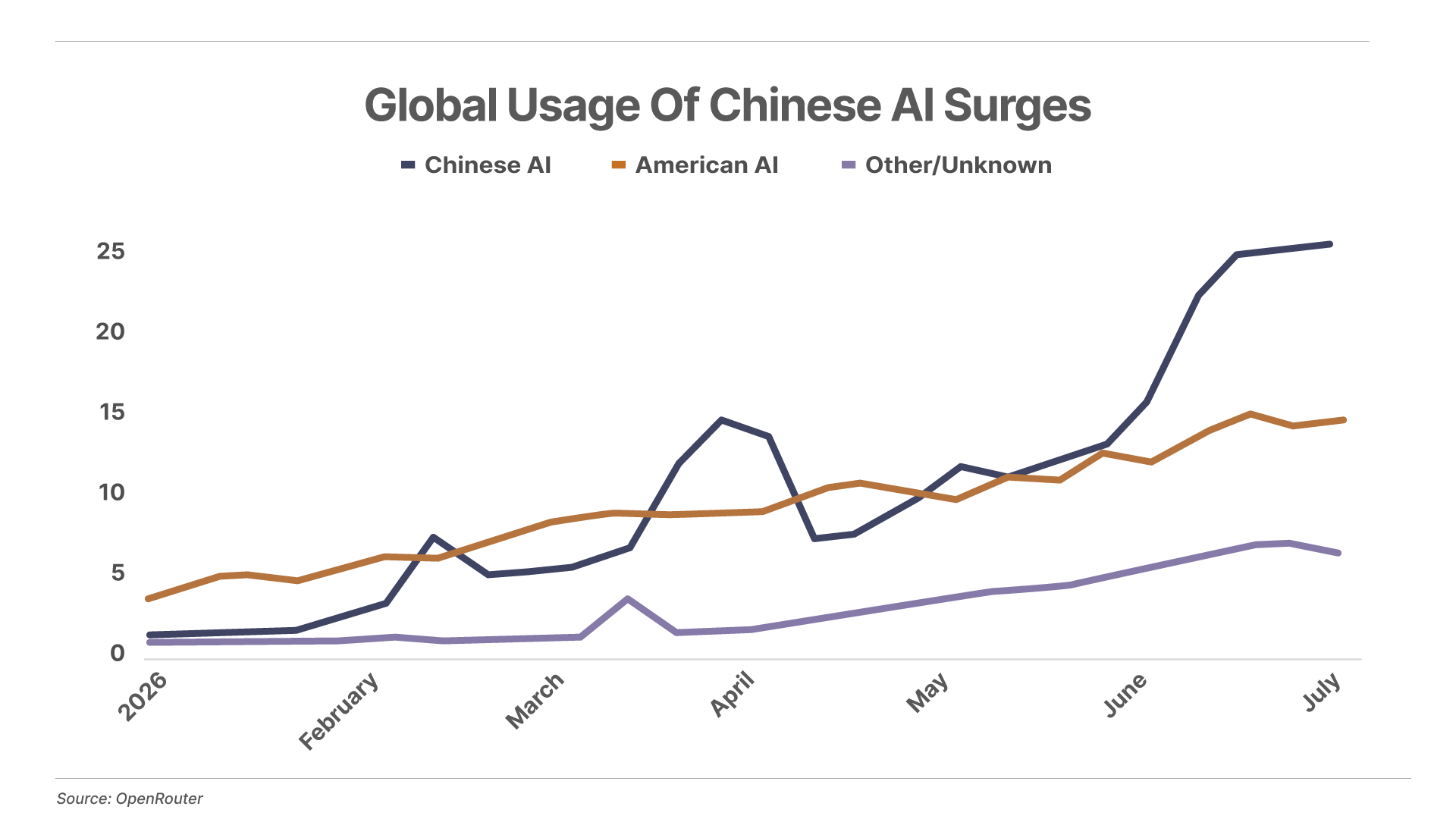
1. China’s AI usage is booming. Daily AI token consumption in China skyrocketed to over 140 trillion in March 2026 – meaning, China is processing over half of the world’s AI tokens. The performance gap between top-tier U.S. models and leading Chinese models (such as DeepSeek) has narrowed to just 2.7%, according to Boston Consulting Group.
2. Starbucks (SBUX) is using AI to build its own software and dump its vendors. The coffee chain is developing in-house tools – with AI-assisted coding – to replace a Microsoft (MSFT) system that tracks inventory and an IBM (IBM) tool that manages maintenance, according to an internal presentation reviewed by Bloomberg. Starbucks spends roughly $400 million a year on software and is chasing $2 billion in total cost cuts. If Starbucks is successful, expect other companies to follow suit.
3. SK Hynix's U.S. listing is more than seven times oversubscribed. The South Korean memory chip maker’s roughly $24.5 billion ADR sale ranks among the largest U.S. debuts by a foreign company, despite a sell-off that has cut the shares 30% from their late-June record. But strong order books don’t necessarily translate into positive performance: SpaceX (SPCX) drew more than $350 billion in orders in its recent initial public offering (“IPO”), but has since given back all of its post-offering gains. The ADRs will begin trading tomorrow on the Nasdaq under the ticker SKHY.
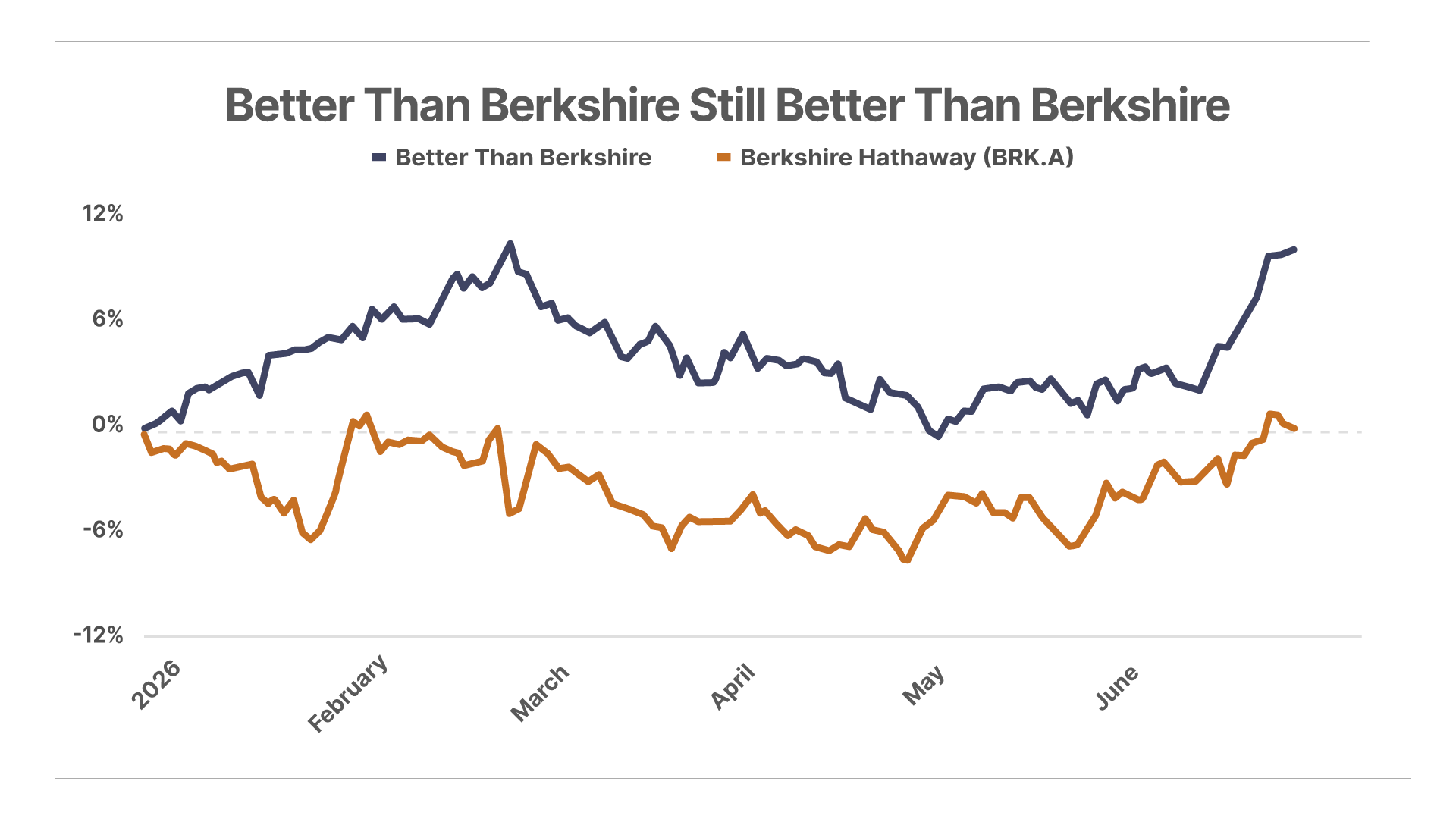
Chart Of The Day… Better Than Berkshire
Porter & Co.’s Better Than Berkshire Index – which Porter compiled for Complete Investor subscribers last year and re-allocated in May – is up 10.2% year-to-date compared with its namesake benchmark Berkshire Hathaway (BRK), which has risen 0.16% for the year.
For those interested in learning about Porter Stansberry’s Complete Investor, Porter is currently offering a recklessly generous offer to become a subscriber. Click here now to learn more.
Mailbag
Yesterday, Porter wrote in the Journal about the complexities of Obamacare that make it an expensive burden for patients, the government, and everyone involved.
“One-Sixth The Cost”
Don R. writes:
Spot on. My family resides in Mexico. They have a massive public healthcare system there, and it has some similar challenges as Canada but from what I know the wait times are not nearly as long. On the topic of private care, we were given a price quote upfront by an orthopedic surgeon that included all costs from the point of entering the hospital and exiting it two days later with no complications. That also included several at-home, physical-therapy sessions. That price was literally 1/6 of the price of the same procedure in a mid market Midwest city in the USA. The quality of care and outcome in Mexico was excellent.
Americans are truly getting ripped off.
“No Free Lunch”
Suzanne R. writes:
This needs to be published in every newspaper in the country. While Medicare pays my health cost, I also pay a premium every month plus a supplemental insurance premium. There is no free lunch here although you would be hard pressed to find anyone who does not think Medicare is free.
Good work, Mr. Stansberry
“Your Analysis Is Spot On, But…”
Dr. James M. writes:
Your analysis of the problems is spot on. Your solutions are not.
I spent a good portion of my international career on health finance and national healthcare reforms. This includes an in-depth analysis of many national systems and study tours for decision-makers to observe other systems firsthand. For the most part, international comparisons are fraught with hazard. The actual determinants of health status have a very low correlation to expenditures or access to health care. Both in the U.S. and internationally, access to healthcare usually ranks 12th-14th in terms of correlation. Healthcare is what you do when the other 11th-13th correlates don’t work. If you fix it, you still won’t significantly impact health status or lifespan. A more radical reform is needed.
Currently, with the inexorable devaluation of the dollar and reduced purchasing power, we stand to lose about 20% of our current health infrastructure. There is no avoiding it. So the challenge is to provide meaningful services that would actually improve national health status and lifespan, and do so with 80% of the assets and half the cost.
Briefly, let me review your suggestions.
1. Severing insurance from routine care – this removes the risk reduction impact on underwriting. The outpatient providers have no incentive to engage in prevention or health promotion. As a result, the inpatient costs will rise. Incentives for outpatient providers via value-based payments also fail, as inpatient care will increase costs to address the revenue cycle shortfalls. This is exactly what happened with the HMOs in the 1980s. I know – I was there.
2. “legalize honest underwriting again, and quarantine the genuinely uninsurable in a transparently funded high-risk pool paid for out of general taxation.” Whether you pay through increased premiums or general taxation, the source of the money is the same. The problem with high-risk government-funded approaches is government inefficiency and waste. Risk pooling is the whole point of insurance. What you suggest wastes most of the power of a risk pool.
3. The impact of publishing prices disappears if there is a transition from fee-for-service to advanced value-based payment models.
There is a way. A way to improve national health at half the cost, address the impending bankruptcy of Medicare, provide relief for employers, eliminate cost-shifting, and achieve universal care without mandates or a large government role. If you have any interest. See this.
Porter Comment: James —
Thank you for sending "Toward a New Paradigm in U.S. Healthcare." It's a serious, humane piece of work.
You and I are looking at the same corpse. The U.S. spends roughly 18% of GDP for outcomes that rank near the bottom of the developed world.
The employer-sponsored tax exclusion is an accident of World War II wage controls that has quietly distorted the entire market for 80 years.
Care is priced in the dark.
And the government's dual role – writing the rules while operating the biggest plans in the market – is a genuine conflict of interest that no honest analyst can defend.
Several of your proposals I'd sign tomorrow:
-
Universal, above-the-line deductibility for health spending, and HSAs for everyone regardless of plan type. Right now the tax code rewards the person whose employer buys a gold-plated plan and punishes the freelancer paying cash. That's indefensible. Fix it.
-
Ending the government's schizophrenic regulator-and-competitor role. Yes. A referee shouldn't also field a team.
-
Real price transparency. This is the heart of the matter, and you know it – the Surgery Center of Oklahoma example is the whole argument in one data point. When a price appears, discipline appears.
-
Decoupling insurance from employment. Job-lock is a tax on entrepreneurship. I'd add that it also lets people carry their catastrophic coverage across a lifetime, which is how underwriting is supposed to work.
If your paper were only those four ideas, I'd print it under my own name.
But the paper is more than those four ideas, and the rest is where I think you've talked yourself into the very machine you set out to escape.
1. You've re-created guaranteed issue and community rating – which is an economic impossibility.The Whole Health Basic Benefit (“WHBB”) must be "offered without underwriting discrimination and with consistent rating rules." That is community rating, which I wrote about yesterday. You know it's a premium accelerant, so you bolt on Dutch-style risk equalization to neutralize it. But look closely at what that machinery actually is: over 100 risk adjusters, retrospective withholds, a national adjustment pool, an independent commission recalibrating annually. You haven't repealed the death spiral – you've hired a very large bureaucracy to fight it in perpetuity, and you're paying that bureaucracy out of the same premiums you're trying to lower. Risk equalization doesn't make the sick cheaper to treat. It just launders the cross-subsidy through a formula instead of a premium. The cost doesn't vanish; it moves to a place where the voter can't see it. That's precisely the sleight-of-hand I object to.
2. A refundable tax credit "equal to the full actuarial cost" is a blank check written against a moving number – yet another enormous, endless entitlement. What happens to any price that a government body guarantees to pay in full? It rises. Medicare and the student-loan program are two natural experiments on exactly this point – when Washington promises to cover "the cost," the cost obligingly expands to meet the promise. You've correctly diagnosed that suppressing a price below cost creates a queue. But guaranteeing to pay whatever cost a committee certifies creates the opposite disease: unbounded inflation. Singapore, your model case, works because the patient spends his own dollars first – the MediSave account is his money, and he feels every dollar. A full-freight tax credit paid directly to the insurer severs that link. The patient never sees the price, so the price never has to answer to him. You've kept the vocabulary of ownership while removing the ownership.
3. "Prepaid, capitated, two-sided risk" is an HMO with a new haircut. We ran this experiment in the 1990s. Capitation pays providers a fixed sum per patient and lets them keep the difference – which is a wonderful incentive to prevent disease and an equally powerful incentive to deny care to the sick. The paper acknowledges this danger and answers it with more oversight: benchmarks, performance standards, a national payment authority auditing "unjustified overperformance." But now stack the incentives on top of each other. The insurer is rewarded for enrolling the healthy (checked by risk equalization). The provider is rewarded for spending less per patient (checked by quality metrics). Two committees are refereeing two sets of gamed incentives, and the patient – the one person with an actual stake in his own body – has been handed a benefit card and told not to worry about the price. The genius of the Surgery Center of Oklahoma is that it needs none of this apparatus. Cash price, posted, take it or leave it. The moment you route the money through capitation and risk pools, you need every committee in your paper to police the distortions you just introduced.
4. "A reform with no losers” isn’t reform. In economics, "no losers" is never a description of a policy. It's a description of a sales pitch. Every real reform reallocates something. If the WHBB genuinely lowers costs, someone's revenue falls – a hospital's, a specialist's, an administrator's. If no one's ox is gored, no waste is being wrung out; the "savings" are assumed, projected, expected. The paper uses those three words – expected, projected, anticipated savings – to carry an enormous amount of fiscal weight. That's the same arithmetic faith that built the Affordable Care Act (“ACA”): order the price below the cost, and trust that efficiency will close the gap by decree. It didn't. It won't.
5. Folding Medicare and Medicaid into one universal pool solves fragmentation by eliminating exit. You're right that dual-eligibles fall through the cracks and that the trust funds are marching toward insolvency. But a single national benefit pool doesn't fix insolvency – it universalizes it. Today, when one program is mismanaged, the others survive and the failure is visible and contained. Fold them all into one WHBB and you've removed the firebreaks. There is nowhere left to flee when the single pool is underfunded, and no comparison case left to prove it's underfunded. Federalism's 50 laboratories are annoying precisely because they generate evidence. One national plan generates only one outcome, and you'd better hope it's the right one.
Your paper wants to keep the price (you say so explicitly, and you praise Singapore for using price to allocate) while also guaranteeing to pay it in full for everyone.
That’s impossible.
A price only disciplines behavior when the person deciding also bears the consequence. The instant a third party promises to cover the full freight, the price stops being a signal and becomes a target – and targets that Washington guarantees only ever move one direction.
Singapore didn't square that circle with a hundred-adjuster risk formula and a national payment commission. It squared it with the humblest tool imaginable: the patient's own money in the patient's own account, catastrophic insurance for the genuinely ruinous, and direct subsidy for the poor – a subsidy that doesn't touch the price everyone else pays. That's four moving parts. Your paradigm has closer to 14, and every one of them requires a federal body to keep the other 13 honest.
It’s a horrible idea.
Regards,
Porter
“Who Wrote This?”
Keith H. writes:
My only question: Who actually writes these articles? I don’t think Porter writes them. Are these articles written exclusively by AI or only bolstered by AI or hopefully not in any way influenced by AI.
BTW: Whoever wrote the article did an excellent job.
Still looking for an answer as to why you don’t respond to letters to you that are very well written and have specific questions which would be instructive if any answers were forthcoming.
Porter Comment: Jeez… that’s a back-handed compliment.
Great article. Porter couldn’t have written it.
Lol.
And yes, I wrote every word. Trust me AI would have never thought of the East German car analogy. Or ever allowed me to criticize St. Obama. AI is a terrible writer and constantly makes stuff up. I certainly use it for basic research, much like I have used search engines in the past. But the ideas, the sentences, and all of the words are mine.
Porter
P.S. The day isn’t long enough for me to answer every letter. But I’m trying!
| Publication | Ticker | Description | Total Return |
|---|---|---|---|
| Tech Frontiers | QURE | uniQure | 237% |
| Complete Investor | BWXT | BWX Technologies | 223% |
| Tech Frontiers | TGTX | TG Therapeutics | 161% |
| Tech Frontiers | ROIV | Roivant Sciences | 160% |
| Complete Investor | SKWD | Skyward Specialty Insurance | 145% |
| Tech Frontiers | SGMT | Sagimet Biosciences | 138% |
| Complete Investor | PM | Philip Morris | 133% |
| Tech Frontiers | QURE | uniQure | 131% |
| Tech Frontiers | NUVB | Nuvation Bio | 131% |
| Complete Investor | BTC/USD | Bitcoin | 130% |
Prices as of 4:00 pm ET July 8, 2026
Please note: The investments in our “Porter & Co. Top Positions” should not be considered current recommendations. These positions are the best performers across our publications – and the securities listed may (or may not) be above the current buy-up-to price. To learn more, visit the current recommendations page of the relevant service, here. To gain access or to learn more about our current recommendations, call our Customer Care team at 888-610-8895 or internationally at +1 443-815-4447.