Issue #97, Volume #3


The Proposed AI Tax Will Cost All Of Us
Inside today’s Daily Journal…
|
Editor’s Note: Today’s Journal essay was written by Shannon Stansberry. Shannon holds a Bachelor of Science in Civil Engineering from Dalhousie University in Halifax, Nova Scotia. She is currently working as an analyst for Complete Investor. Shannon and her husband Porter are expecting their first child, a girl, any day now.
Read Shannon’s first essay here: “The Most Dangerous Lie In Modern Economics”
The Bay of Fundy is a 168-mile inlet on the eastern coast of Canada.
It lies between New Brunswick and Nova Scotia. It has the highest tidal range on Earth – rising and falling up to 52 feet, twice every 24 hours. The energy contained in all that water moving in and out is staggering. Canadian government studies have estimated the theoretical extractable power of the Minas Passage alone at roughly 2,500 megawatts – enough, on paper, to electrify a small country.
When I first met Porter, I told him about an essay I had written in high school on the Bay of Fundy’s potential as an energy source. I won a scholarship for the essay… from the government.
Porter listened politely for about 10 minutes. Then he asked me one question:
“What about the Second Law of Thermodynamics?”
I still half-laugh at myself when I think about that moment – because the Second Law is the single most important principle in physics for understanding why most political schemes to transform our energy system fail. And it is why a recent proposal U.S. Senator Elizabeth Warren outlined will fail, too.
Let me explain.
The Second Law Of Thermodynamics Has Two Parts
The first part is simple: every energy conversion produces waste heat. You can never extract 100% of the energy from any system. Some fraction – usually a large fraction – is lost as low-grade heat that cannot be recovered.
The second part is much harder for people to understand, but it is extremely important: entropy always increases through time. What this means is that the useful work that can be produced in systems only moves in one direction, from hotter to colder. From more dense forms of energy to less dense forms of energy. Your kitchen pan doesn’t get hotter. It only gets colder until you apply more energy.
In short, there’s no free lunch in nature.
As a result, extracting the tidal energy from the Bay of Fundy is extremely inefficient because of these factors: the destruction of equipment by ice and floating debris (several of the in-stream tidal turbines tested at the Fundy Ocean Research Centre for Energy between 2009 and 2018 were physically destroyed by the very tides they were designed to harness), the relentless corrosion from saltwater, and the predictable intermittency of the tidal cycle. By the time you account for turbine efficiency, the theoretical 2,500 megawatts of the Minas Passage shrinks to a practical number closer to 50 megawatts – at a capital cost per kilowatt-hour that’s almost an order of magnitude more expensive than coal-sourced electricity.
That’s why the Annapolis Royal Generating Station, the largest tidal facility in North America, was decommissioned in 2019 after 35 years of operation. The Second Law is undefeated. And it doesn’t care about virtue signaling.
Energy is the most important variable in human civilization. Cheap, dense, reliable energy is the greatest determinant of national wealth, life expectancy, infant mortality, education quality, technological progress, and personal freedom.
You can plot per-capita energy consumption against almost any positive metric of human well-being and produce a near-perfect correlation…
-
In the United States, per-capita energy consumption is approximately 300 gigajoules per year, and life expectancy at birth is 79
-
In sub-Saharan Africa, per-capita energy consumption is roughly 15 gigajoules per year, and life expectancy is 62
The world’s poorest billion people – concentrated in central Africa, parts of South Asia, and rural Latin America – share one trait above all others: they do not have access to abundant, affordable electricity. Human flourishing tracks human energy consumption with greater fidelity than any other variable in the social sciences.
The recurring impulse of politicians to tax, regulate, restrict, or otherwise impede the energy supply should worry every American. Every politically motivated restriction on energy supply produces a worse economic outcome than the problem it was designed to address.
Which brings us to last week.
Senator Elizabeth Warren was interviewed on CNBC’s Squawk Box, outlining a tax proposal designed to make artificial-intelligence (“AI”) companies “pay their fair share.” The interview seemed straight out of a scene from Ayn Rand’s Atlas Shrugged. Senator Warren is a classic political “looter.”
Her proposal has three legs:
-
a wealth tax on AI billionaires
-
a new federal excise tax on data center electricity consumption scaled to facility size
-
a vague promise to fund universal health care, free college, and expanded unemployment insurance with the proceeds
Taxing billionaires is politically popular, but it doesn’t work. They will just move.
It is the second part of the proposal that’s extremely dangerous. Senator Warren is proposing a tax on energy. Taxing electricity consumption, in the single most productive sector of the American economy, at a moment in history when American electricity demand is rising faster than at any point since the 1950s, is a direct tax on human progress.
She is not just taxing AI. She is taxing the master resource – energy. And every time a politician has taxed the master resource, the result has been the same: much slower growth.
The AI buildout currently underway in the United States is the largest capital investment cycle in American history, surpassing even the 1990s telecom and fiber buildout that laid the physical foundation of the internet.
By the end of 2026, the four largest American hyperscalers – Microsoft (MSFT), Alphabet (GOOG), Amazon (AMZN), and Meta (META) – will have committed over $1 trillion in cumulative capital expenditure since 2022, the large majority of it directed at AI infrastructure. By 2030, that figure is on track to exceed $3 trillion. We are building the physical substrate – the land, power, and data centers – for the next era of the American economy. And the center of gravity is unmistakably American, not Chinese or European – because of a specific combination of deep capital markets, deep talent markets, abundant land, and an electricity grid that can still absorb the load, for now.
American hyperscalers are projected to consume approximately 150 terawatt-hours (“TWh”) of electricity in 2026 for AI training and inference workloads – roughly 3.5% of total U.S. electricity generation. By 2030, that figure is projected to reach 500 TWh to 700 TWh, or 10% to 14% of total U.S. electricity generation.
This is, by any historical standard, an enormous demand shock to the American grid. Senator Warren is correct that electricity prices have risen sharply in communities near major data center clusters. The 267%-increase figure she cites comes from specific localities in northern Virginia (where the largest concentration of U.S. data centers is located) and parts of Texas and Arizona. The number is technically accurate, though it cherry-picks the most severely affected geographies. The national average residential electricity price has risen approximately 18% over the same five-year period.
But here is the question Senator Warren never asks: what is the American economy getting in exchange for that electricity consumption?
The answer: the most productive set of capital investments in modern American history. Every kilowatt-hour of electricity consumed by a data center in 2026 is being used to train and operate the AI systems that will, over the next 20 years, drive productivity gains comparable to the introduction of electricity itself, or the introduction of the internal combustion engine, or the creation of the internet.
The McKinsey Global Institute estimates that AI will add $13 trillion to global GDP by 2030. Goldman Sachs research projects that generative AI could lift global GDP by roughly 7% – about $7 trillion – over a 10-year horizon. Compounded over decades, those productivity gains are worth more to the American economy than any tax base Senator Warren’s wealth tax could realistically reach.
Senator Warren is proposing to tax the electrical input to that productivity revolution – at a per-kilowatt-hour rate that scales with the size of the facility.
The bigger the AI training facility, the higher the per-unit tax. This is precisely backward from every principle of energy economics. The largest data centers are the most efficient ones, measured by computational output per watt of electricity. The power usage effectiveness (“PUE”) ratio of a hyperscale Microsoft or Google data center is approximately 1.10, meaning that 91% of the electricity consumed is used for actual computation rather than cooling or overhead. The PUE of a small enterprise data center is typically 1.50–2.00, meaning that 30%–50% of the electricity is wasted.
A tax that scales with facility size, therefore taxes efficiency and subsidizes waste. It pushes computational workloads from the most efficient facilities to the least efficient ones. It is the energy equivalent of a tax on solar panels designed to encourage more coal use. The policy is so technically illiterate that it could only have been written by someone who has never spoken to a single electrical engineer about how the AI buildout actually works.
The Revenue Promise: Universal Health Care, Free College, And A Math Error
The Tax Policy Center estimates that the full Elizabeth Warren wealth-tax proposal, including the AI excise tax, will raise approximately $300 billion to $400 billion per year at peak, before accounting for behavioral responses (capital flight, tax avoidance, reduced economic growth).
After accounting for behavioral responses, the more rigorous independent estimates put the net revenue at $150 billion to $250 billion per year.
The programs Senator Warren has identified as the spending priorities have the following annual cost estimates:
-
Universal health care (Medicare for all): $3.4 trillion per year (Urban Institute, 2024)
-
Free public college tuition: $80 billion per year (Penn Wharton Budget Model)
-
Universal pre-K: $40 billion per year
-
Expanded unemployment insurance: $60 billion per year
Total: approximately $3.6 trillion per year.
The revenue is $150 billion to $250 billion. The spending commitments are $3,600 billion. The proposal is short by a factor of roughly 14x to 24x.
This is not a rounding error. This is not a “we’ll work out the details in committee” gap. This is a proposal whose stated revenue source is incapable of funding 10% of its stated spending obligations. The rest would have to come from broad-based taxation – which is to say, from the middle class, the working class, and the small businesses that Senator Warren claims her policies are designed to protect.
When you hear “tax the billionaires to fund universal health care,” you are listening to a number that does not work. The math has been done. The Warren framework cannot fund its own promises, and every economist who has analyzed it – including economists from her own ideological neighborhood, such as Clinton Treasury secretary Lawrence Summers – has said so publicly.
Why This Matters For Capital Markets
If a meaningful version of the AI wealth tax and data center excise tax were enacted, the consequences would unfold in three distinct waves.
Wave 1 (immediate) AI-related equity values would reprice downward by an estimated 15%–25%. The hyperscalers, the chip designers (Nvidia, AMD, Broadcom), the foundries (TSM), the data center REITs (Equinix, Digital Realty), and the power providers (Vistra, Constellation, GE Vernova) would all take immediate hits. Approximately $4 trillion in U.S. equity market capitalization would be destroyed within 30 days of legislative passage.
Wave 2 (medium-term) Capital expenditure on new AI infrastructure would slow by an estimated 30%–40% as the economic returns on incremental investment fell below cost-of-capital thresholds. The AI buildout would not stop – too much money has already been committed – but the marginal capital that would have flowed into 2027-2030 construction would dry up. The next generation of training facilities would be built in Mexico, Canada, the United Arab Emirates, Singapore, and Ireland rather than the United States.
Wave 3 (long-term) The U.S. would lose the AI race. The Chinese government, which has been struggling to keep pace with American AI development since 2023, would have its single largest barrier removed: the United States would voluntarily handicap itself. By 2032, China would lead in AI deployment, AI talent, and AI revenue generation. The strategic consequences for U.S. national security, economic competitiveness, and standard of living would be permanent and severe.
This is not a right-versus-left prediction. It is what happens when you tax the most productive investment cycle in modern history at a rate designed to extract revenue rather than encourage productive activity. The British did this to their textile industry in the 1880s. The Argentines did it to their agricultural sector in the 1940s. The French did it to their financial sector in the 1980s. In every case, the productive activity moved elsewhere, and the country that imposed the tax went into multi-decade economic decline.
The American AI sector is not magic. It can be taxed into oblivion just like every other productive sector in human history.
Tell us what you think of today’s Journal: porterstansberrydirect@gmail.com
Good investing,
Shannon Stansberry
New York, New York

3 Things To Know Before We Go…
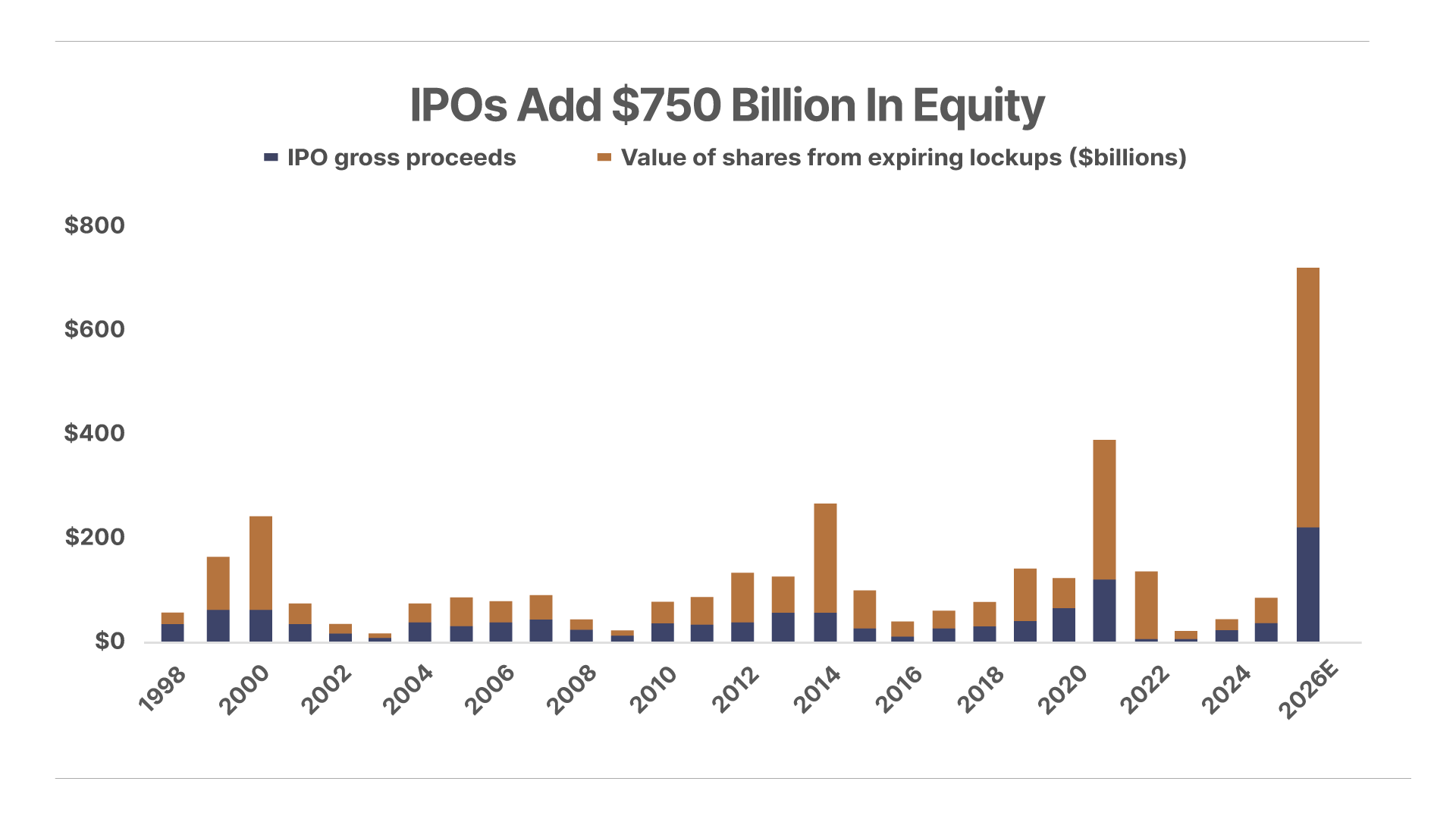
1. SpaceX (SPCX) kicks off a record year of mega-IPOs. Elon Musk’s rocket company made its public debut today, issuing $75 billion of shares at a $1.77 trillion valuation. It’s the first of three trillion-dollar initial public offerings (“IPOs”) set to hit the market this year, including Anthropic (last valued at $965 billion) and OpenAI (last valued at $825 billion). These three blockbuster IPOs will contribute an estimated $750 billion in new shares to the market this year, nearly double the prior record set in 2021.
2. PIMCO calls the turn in credit markets. Giant fixed-income manager PIMCO (with $2.3 trillion under management) says that “the credit loss cycle is upon us” – it expects bigger losses in leveraged loans and private direct lending as AI spending eats into the cash flow of heavily indebted, old-economy borrowers. But the real damage is likely building in private credit, where payment-in-kind (“PIK”) and maturity extensions keep stress hidden… for now. The market is pricing little risk in the public markets, while the cycle turns in private markets.
3. Coupang (CPNG) jumps 14% on data-breach resolution. South Korea’s privacy regulator fined the e-commerce giant $409 million, the largest data-breach penalty in the country’s history – yet well under the $680 million the market had priced into CPNG shares. At roughly 1.4% of revenue, about a year of operating profit, the fine is punitive but not existential. A fine resolved at well below the maximum penalty sent shares up 14% yesterday.
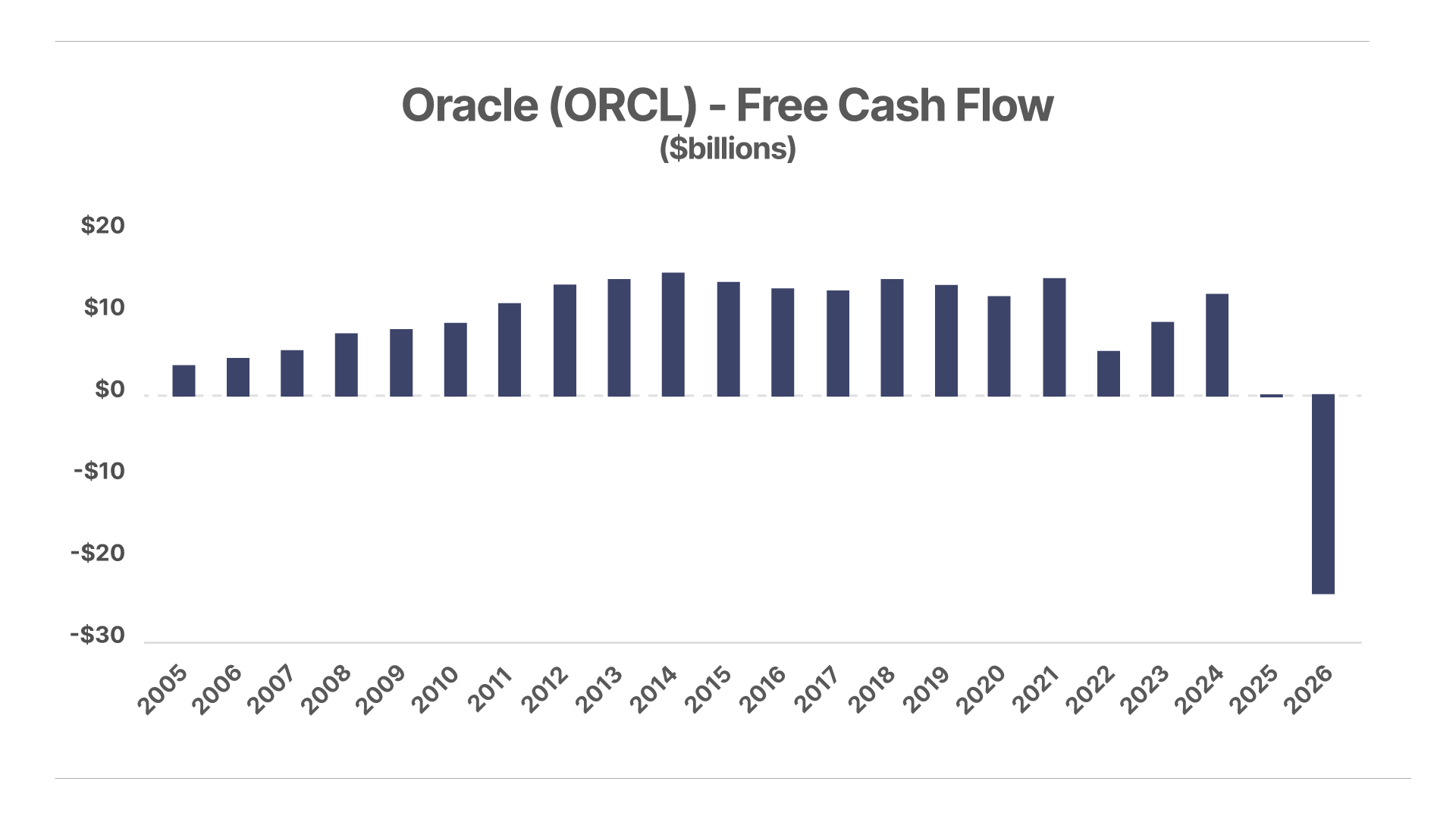
Chart Of The Day… Oracle (ORCL)
After more than 30 consecutive years of positive free cash flow generation, enterprise technology giant Oracle (ORCL) has lost $24 billion over the last 12 months – the largest cash outflow of any company in the world over that period – as it has ramped up capital expenditures on AI infrastructure.
Reader Poll… The $20,000 Option
Mailbag
On Wednesday, Porter wrote “The Perfect War,” explaining the lies politicians use to justify global conflicts. Readers share their thoughts…
“What Does America Gain From The Iran Conflict?”
Edward B. writes:
Porter,
Your background story of June 11 detailing the background of our commitment to the Middle East conflicts was a revelation to me, and I suspect, many of your readers.
While interesting from a historical perspective, it is less useful as a therapeutic one. The media besieges us with stories and opinions about the mistakes we have made in the past regarding Middle East policies, but fails spectacularly in how to fix the current problem and prevent future ones. Problem identifiers are legion – problem solvers not so much. At the same time, proposed solutions must be cognizant of the dangerous possibility of a worldwide conflict with Islam.
To address the issue of how we end the current conflict and prevent future ones in the Middle East, we must ask why we are there in the first place. Your article helps to answer this question. What specifically does America gain from our involvement in this conflict – protection of the petrodollar? Hardly, as signs of its decline are everywhere, highlighted by Saudi Arabia’s recent withdrawal. This remarkable action from the co-originator of the petrodollar has received precious little attention. America’s need for Middle Eastern oil? Hardly, as we are now the principal producer of oil in the world, and we don’t need Middle Eastern oil. Support for the state of Israel? Perhaps, as the Jewish bloc wields considerable political and financial power in the U.S. However, it seems as though this relationship is becoming more and more a one-way give with us on the short end. Protection for the needs of Europe? Shouldn’t European nations be largely responsible for their own petroleum needs? In this same vein, would American dislodgment from the conflict threaten NATO? Why should it? NATO is a mutual protection treaty, not a guarantor of oil. To make up any slack we would be happy to provide some of our oil to Europe.
What, then, should we do to fix the current problem? It would help to learn from history that Middle Eastern conflicts have been ongoing for centuries without our involvement. Given America’s recent poor results in resolving foreign conflicts, it is entirely unlikely that our continued involvement will produce a favorable result. If that is true, then the solution to our Mideast problems is to withdraw. Declare the impossibility of reaching a mutually beneficial agreement with Iran and let Allah sort it out! The continuation of our regional efforts will only hasten the dollar’s decline and the rise in inflation. It seems to be time for less talk and more corrective action!
“Perfect War”
Danny D. writes:
Interesting read, but I wonder why you felt compelled to mention that Robert Gray was a homosexual. Would you have mentioned that he was a heterosexual if he were? Not even necessary to tell the story. Very telling and reflective of your personal beliefs and biases IMO. But it squares with your beliefs about people with purple hair.
Porter Comment: I thought it was extraordinary that, in the 1950s and 1960s, Robert Gray was openly homosexual in Washington D.C.
I think that says a lot about how powerful he was and demonstrates he was an exceptional person. I don’t think most people would have done that or could have succeeded if they had.
Being homosexual also played a role in how he built his network: he became close friends with the wives. Other men couldn’t do that.
Thus it is a key part of understanding who Robert Gray was and how he became so incredibly powerful.
You are attributing some kind of bigotry to me that’s unfounded. Recognizing differences isn’t prejudice.
And, since you think I am a bigot, I’ll explain how I think about homosexuality.
I feel sorry for homosexuals. I wouldn’t want to engage in those sex acts and I wouldn’t want to have to adopt my children, etc. To me it seems like a hard way to go through life. I believe men and women have better lives when they are partnered. And I also believe every adult has the right to live how they choose.
Porter
“Great Column On Gray”
Carter C. writes:
Great column on Bob Gray and his massive influence on Washington politics, Porter.
I worked for Bob for several years in the early 1980s, just after he founded Gray & Company. He was all that you say, and more. A masterful manipulator. And charming as the day was long.
If you read the book The Power House, I am mentioned more times than anyone other than Bob, himself – largely because he almost got me locked up in a Spanish jail.
Thanks for the expose!
Porter & Co. Market Snapshot
| Price | Yesterday’s Return | Year-to-Date Return | |
|---|---|---|---|
| S&P 500 Index | $7,394.30 | 1.75% | 8.6% |
| Gold per ounce | $4,212.26 | 3.43% | -2.7% |
| Bitcoin | $63,340 | 2.59% | -27.8% |
| Oil (West Texas Intermediate) per barrel | $87.71 | -4.92% | 48.4% |
| Berkshire Hathaway (BRK) | $726,581.00 | -0.06% | -3.7% |
| Porter’s Permanent Portfolio | – | 0.74% | -2.4% |
| The Better Than Berkshire Index | – | 0.93% | 3.4% |
| Total Return | Annual Return | ||
| Porter & Co’s Top Ranked* | 30.8% | 13.1% | |
| Yield | Yesterday’s Change | Change Year-to-Date |
|
| U.S Treasury 30-Year Yield | 4.96% | -7 bps | 11 bps |
*A Complete Investor risk rating of 1 is defined as a “low risk, high allocation” security, while positions rated closer to a 5 are higher risk. Porter & Co.’s top-ranked positions include those rated either 1 or 2 in Complete Investor portfolio.
Porter & Co. Top Positions
| Publication | Ticker | Description | Total Return |
|---|---|---|---|
| Complete Investor | BWXT | BWX Technologies | 241% |
| Tech Frontiers | QURE | uniQure | 237% |
| Complete Investor | ARM | ARM Holdings | 147% |
| Tech Frontiers | TGTX | TG Therapeutics | 136% |
| Complete Investor | BTC/USD | Bitcoin | 135% |
| Tech Frontiers | ROIV | Roivant Sciences | 132% |
| Tech Frontiers | QURE | uniQure | 131% |
| Complete Investor | PM | Philip Morris | 124% |
| Tech Frontiers | SGMT | Sagimet Biosciences | 119% |
| Complete Investor | SKWD | Skyward Specialty Insurance | 106% |
Prices as of 4:00 pm ET June 11, 2026
Please note: The investments in our “Porter & Co. Top Positions” should not be considered current recommendations. These positions are the best performers across our publications – and the securities listed may (or may not) be above the current buy-up-to price. To learn more, visit the current recommendations page of the relevant service, here. To gain access or to learn more about our current recommendations, call our Customer Care team at 888-610-8895 or internationally at +1 443-815-4447.