

What It Means When Volatility Is Not The Guiding Force
By Martin Fridson • June 2, 2026
Issue #89 | Volume 3
Inside Today's Issue
Editor’s note: Porter has turned the Journal over to Marty Fridson, lead analyst for Porter & Co.’s Distressed Investing. For nine consecutive years, Marty was ranked No. 1 in high-yield strategy. He has written seven books, the most recent of which is The Little Book Of Picking Top Stocks… and Marty is such a legend that there is a recently published book about corporate finance that devotes an entire chapter to him. We excerpted it last year in the Daily Journal.
Here’s Marty…
Warren Buffett didn’t calculate risk the way most investors do.
“I agree with Buffett that volatility does not represent risk,” says James Hansbury, one of the portfolio managers profiled in the recently published Stock Market Maestros, by Lee Freeman-Shor and Clare Flynn Levy. “People should use Sortino ratios, not Sharpe ratios, to judge risk-adjusted performance.”
Hansbury’s point is not that investors do not or should not care about volatility. Not unreasonably, most investors prefer to put their money in a fund that achieves returns as high or higher than its competitors, with less erratic price swings along the way.
Companies in the business of evaluating the performance of mutual funds and money managers therefore calculate Sharpe ratios, which compare an investment’s return with its volatility. That measure treats upside volatility the same as downside volatility. But that’s not the way most investors who I know view it. They actually like the upside type, thank you very much.
The Sortino ratio reflects investors’ preference by comparing average return only with the downside volatility. By this measure, the most successful manager is the one who delivers the highest return on your investment – including price appreciation, income, and reinvestment income – per unit of pain in the form of periodic declines in market value.
So Sharpe Or Sortino – Which To Use?
This all makes sense from the standpoint of matching the performance measure with how investors conceptualize results. But as a practical matter, does it make a difference whether you use the Sharpe ratio or the Sortino ratio as an input to the decision on which fund to buy or which manager to hire?
To address that question, I compiled a list of 30 growth-stock mutual funds – large-cap, mid-cap, and small-cap funds are represented. I then ranked them by both the Sharpe ratio and the Sortino ratio. (To be clear, we’re not recommending or offering opinions on any of the funds in the accompanying table. Investors who are interested in buying a growth stock fund should consider other factors besides the five-year risk-adjusted return.)
The choice of ratio does turn out to affect the question of which fund has provided the most gain for the pain. The #1 fund by Sharpe ranks only #3 according to Sortino. In an interesting symmetry, the #1 Sortino fund is #3 by Sharpe.
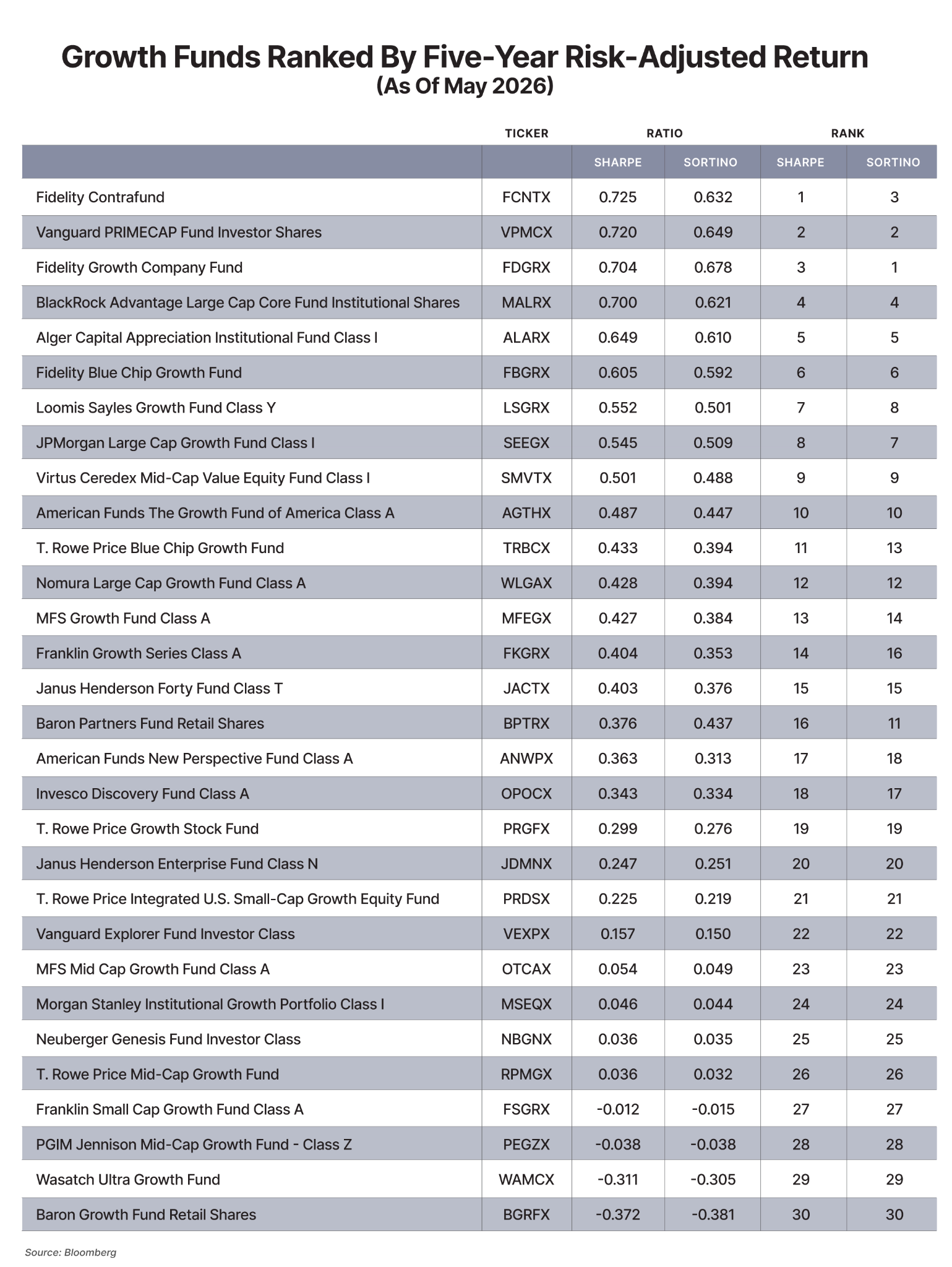
In the bottom third of the list, #20 to #30, every fund ranks the same by both measures. That’s related to the fact that bigger amounts separate each fund from the next in rank than in the top portion of the table.
For example, on the Sharpe scale, just 0.005565 separates Fund #1 from Fund #2. The differential between #29 and #30 is 10x as great at 0.061170. But it’s the top end of the list that investors really care about. After all, they’re aiming to identify the very best performer in the entire group.
The bottom line is that when you assess investment opportunities, it pays to do more than just take statistics at face value. A little bit of online research can arm you with a fuller understanding of what’s being measured. See, for instance, here and here.
Next week, Marty will be recommending the stock of a company whose bond he recommended to Distressed Investing subscribers a few months ago. It’s a one-two-punch strategy he refers to as “topping off” – like getting a free pour of coffee to fill up your mug at the diner. And he’s done it seven times in Distressed Investing… recommending a company’s bond, which soon rises as the company turnaround takes shape. Then, months later, stock market investors take notice of the company’s turnaround and bid up the share price. The closed stock-bond combo buys have returned an average of 59%.
He releases the next stock recommendation next week. To be among the first to see that recommendation, click here to learn about joining Porter & Co.’s Distressed Investing.
Tell us what you think of today’s Journal: porterstansberrydirect@gmail.com
Good investing,
Martin Fridson
New York, New York


Things To Know Before We Go
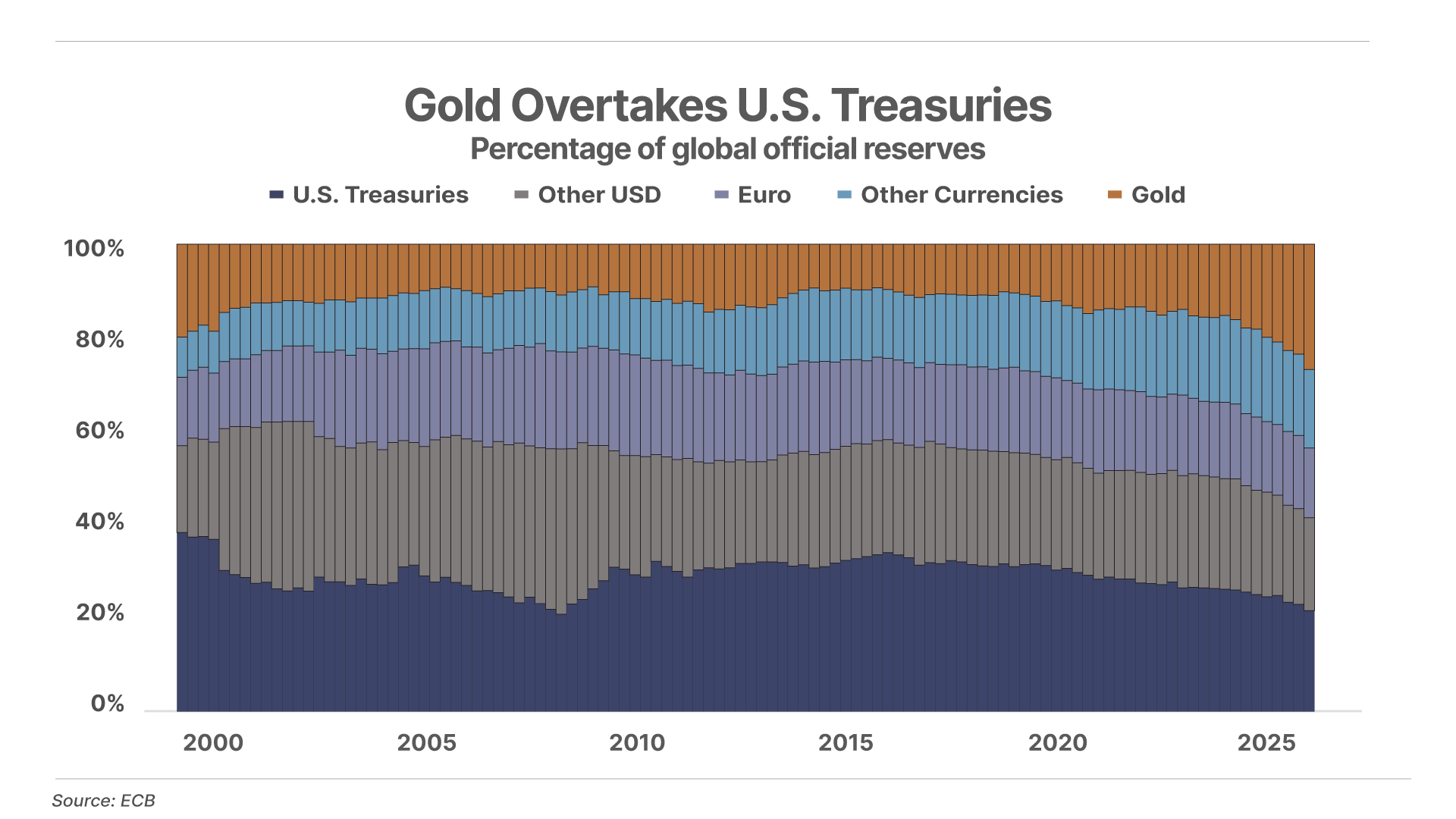 1. Gold has replaced U.S. Treasuries as the world's top reserve asset. A European Central Bank (“ECB”) report published this morning shows that bullion accounted for 27% of global central bank reserves at the end of 2025 – up from 20% a year earlier – while U.S. Treasuries slipped to 22% from 25%. The shift reflects both a historic gold price rally – the metal topped $5,500 an ounce in January – and a deliberate retreat from the dollar that accelerated after Washington froze Russia's reserves in 2022. China, Poland, Turkey, and India led the gold buying.
2. Nicotine-pouch wars heat up. Philip Morris (PM) announced it will launch its new ZYN ULTRA nicotine pouch this month – featuring a slim design with 20 moist pouches versus the original 15. The move comes in response to competition from the moist, 20-pouch VELO Plus cans from British American Tobacco’s (BTI), as well as Turning Point Brands (TPB) FRE and ALP products. We continue to believe that the fast-growing nicotine-pouch market is large enough to support the two nicotine companies we have recommended in Complete Investor.
3. Alphabet braces itself for the artificial-intelligence (“AI”) arms race. Complete Investor holding Alphabet (GOOG) announced an $80 billion equity raise for its AI buildout, anchored by a $10 billion private placement from Berkshire Hathaway. The $80 billion will fund Alphabet’s growing 2026 capex budget of $190 billion, as Google says demand for its AI services is running ahead of supply. Plus, it is $80 billion that Alphabet can grab ahead of the wave of capital-hungry IPOs… including SpaceX, Anthropic, and OpenAI.

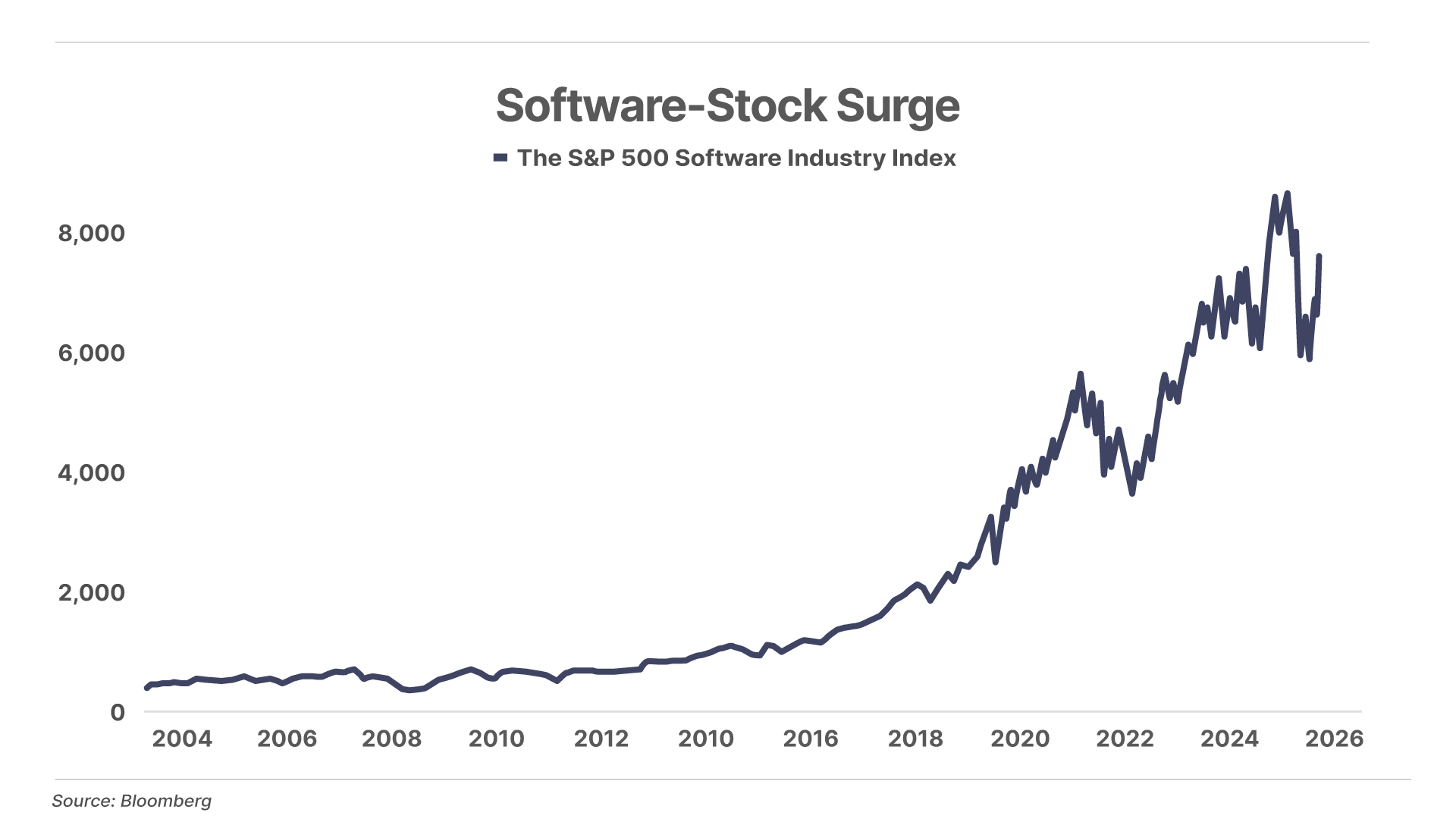
Chart Of The Day... Software

Mailbag
“Stop Bashing Berkshire” – David A. writes:
“Berkshire has billions of dollars to hire the best of the best and make the decisions it does to invest. The overall track record speaks for itself. Do you have nearly $400 billion to invest in the market? Ouch. Perhaps it is time to stop bashing Berkshire and move on with life. Just saying.”
Porter Comment: If you’re right, then why doesn’t that show up in the numbers? Berkshire Hathaway (BRK) used to beat the S&P 500 by more than 10% a year. Over the last 10 years it has underperformed by 2.7% – a year. Over the last five years, it has underperformed by more than 3.5% a year. And in the last year it has underperformed by more than 35%. Most of the commentators don’t have any idea why. The reason is structural. Berkshire used to be an insurance company with a focused equity portfolio, led by the greatest investor in history. It was a compounding machine. But not anymore. Now it’s now a conglomerate that has fundamentally mismatched capital structure. You can’t run a railroad or a utility with equity funding. And you can’t run an insurance company with debt funding. Until this fundamental structural flaw is fixed, Berkshire will not beat the S&P 500.
You see this as me “bashing” Warren Buffett, who just retired as Berkshire CEO. It isn’t. I’m warning that Buffett’s legacy is being destroyed – mostly because he broke a promise he made to investors in 1983. Buffett always promised that: if Berkshire didn’t beat the market over any five-year rolling period, he’d return capital. When that happened in 2013, he didn’t live up to the promise. And he kept compiling more and more marginal assets.
We – the investors who helped build Berkshire – deserve the Berkshire that was promised to us. We deserve an ultra-high-quality insurance company with an equity portfolio, filled with America’s best businesses. That structure allowed investors to beat the market, for free, for decades! There’s no reason it can’t go back to doing that. But it needs to honor its promise.
Berkshire must spin-off its utilities, its railroads, and its motley collection of marginal businesses. Berkshire should own McDonald’s (MCD), not Dairy Queen. It should own NVR (NVR), not Taylor Morrison Home (TMHC). And it should have never sold its stake in Apple (AAPL) – not without a fundamental reason.
I hope you’ll read my book, Warren’s Mistakes. It’s available on Amazon. If you do, you’ll realize that I’m not bashing Warren. I’m actually helping people understand how extraordinary he was and how badly Berkshire has gone astray.
“Buffett’s Mistake – Again” – Tim P. writes:
“Hi Porter,
Great insight as usual! Clearly, Berkshire continues to miss the mark with yet another purchase of a capital-intensive business. Your facts are indisputable.
I'm surprised you didn't mention Hovnanian Enterprises in your article. Given that it follows the NVR model, wouldn't it have been a much better acquisition option than Taylor Morrison as well?
Keep up the great analysis. I always look forward to reading your work!”
“Asset-Light Homebuilder Model” – Craig L. writes:
“I bought NVR 3.75 years ago and have a 39.5% total gain. That is only so-so, but it is good for a bad new housing market.
I don't understand why other builders don't adopt NVR's capital-light model. Do you have thoughts on that?”
Porter Comment: They’re stupid. No, that’s not it. They’re delusional. The homebuilders have always been family-led businesses. In most cases they got their start building homes on a long-held piece of land. So what do land people do? They buy more land. They’re only building homes because they just want to buy land. That ethos – that the value is in the land – has been very hard to shake out of them.
“NVR” – Kevin B. writes:
“Hello,
I am glad Berkshire didn't buy NVR. I want to continue holding it as a "free trade" in my account. Have been thinking about adding to it again.”
Porter Comment: You’re a lot smarter than Greg Abel.
Porter & Co. Market Snapshot
Porter & Co. Top Positions
Please note: The investments in our “Porter & Co. Top Positions” should not be considered current recommendations. These positions are the best performers across our publications – and the securities listed may (or may not) be above the current buy-up-to price. To learn more, visit the current recommendations page of the relevant service, here. To gain access or to learn more about our current recommendations, call our Customer Care team at 888-610-8895 or internationally at +1 443-815-4447.