The Market Doesn’t Price $1.00 At $0.55 Very Often
Inside Today’s Issue
- Essay: Half Price For A Compounding Portfolio
- With Tariffs Come Inflation
- Now A Housing Glut?
- Disparities In The S&P
- Chart Of The Day… S&P 500 In Ounces Of Gold
- Today’s Mailbag
If you read the outstanding book Buffett’s Early Investments by Brett Gardner, you’ll find all kinds of great investment lessons about what can go right (and wrong) when you invest in super cheap, small, and illiquid businesses.
I found a company just like that… it’s compounding capital at 17% a year and it’s trading for around half of book value. Those numbers imply huge returns going forward.
So why not recommend the stock? Let me explain…
In 1977, Patrick Paddon founded a high-tech equipment-financing business. And today, at 75, he still runs its successor, California First Leasing Corporation. The original business helped companies obtain high-tech equipment via lease transactions that minimized the debt on their balance sheets. By 2001, it operated as Amplicon (AMPI) – a national lessor of high-technology equipment.
This business gave Paddon key insights into the high-tech capital equipment cycle. After all, as a lessor, his company retained ownership of the equipment. Thus, to make a profit, Paddon had to become an expert at estimating residual values – what the equipment would be worth in the market after the lease period. This experience sharpened his judgment about replacement cycles, enduring usefulness, and the difference between technical obsolescence and economic obsolescence. It’s a fair bet to say there are very few people in the world who have more hands-on insight into the ongoing AI capex boom.
The other lasting trait you see in this long-term business operator is a relentless focus on keeping costs down. Amplicon’s profitability was due partly to its reliance on telemarketing. Plenty of high-tech executives would turn their noses up at building telemarketing expertise, but doing so rendered marketing costs that were approximately one-third of his competitors’ (relative to sales).
To drive down his funding costs, in 2001 Paddon bought California First National Bank. Amplicon was restructured as part of a holding company, California First National Bancorp. The bank’s deposits would help finance equipment leases and business loans. Paddon could combine the customer relationships of an established leasing company with a bank’s deposit funding.
Twenty years later, on the cusp of the largest tech capital equipment boom in history, Paddon began to liquidate. In February 2021, the company sold the bank but kept its leases and loans, eliminated the bank-holding-company structure, and adopted the California First Leasing name.
But what did Paddon do with all of the capital?
He bought a very select group of tech equipment makers: Micron Technology (MU), Applied Materials (AMAT), Marvell Technology (MRVL), Advanced Micro Devices (AMD), and Taiwan Semiconductor (TSM). He also bought some “ballast” – ExxonMobil (XOM), Comfort Systems (FIX), and Goldman Sachs (GS). He bought one, and only one, hyperscaler, Alphabet (GOOGL).
Today, California First Leasing owns $500 million in a handful of stocks, around $50 million in cash, and less than $2 million worth of leases. Because of this clear change in business strategy, in 2022, it registered as an investment company.
It’s an investment company that doesn’t want to carry the costs of being a public company. It dropped its Nasdaq listing (it only trades on the “pink sheets” – the OTC market). And it’s been trying to reduce the number of its outside shareholders – if the company has fewer than 100 shareholders, it could terminate its investment-company registration and reduce reporting and administrative expenses.
How do you get small shareholders out of the deal? This past June, California First Leasing consolidated every 50 shares into one share through a 1-for-50 reverse stock split and paid cash instead of issuing fractional shares. Thus, if you owned fewer than 50 shares, you received cash and ceased to be an owner. The proxy explicitly described these small shareholders as being involuntarily cashed out. I don’t think I’ve ever seen that done before.
But it backfired. A management that is this focused on overhead actually attracted more investors! But it is still a business that spends remarkably little on its overhead. Last year, the company spent $2.46 million, or 0.7% of average book value, leaving its owners with an administrative cost below a penny per dollar of average net assets.
Why would anyone want to invest in a company that just owns other stocks? Because Paddon is a great investor. Net asset value (“NAV”) per share rose from $1,429 to $2,410 during fiscal 2026, a 68.6% return. Across the last five fiscal years through June, the annualized NAV return was approximately 17.6%, after operating expenses and corporate taxes.
And… there’s this. On October 1, California First Leasing traded at $1,275 per share. I estimate its net assets are $2,326 per share. Thus, the value of its stock is only about 55% of the value of its assets. Or said another way, for every $0.55 you spend on this stock, you’re getting $1.00 in value.
Why such a discount?
First of all, because, like a closed-end fund trading at a discount, there isn’t an easy or quick way to unlock this value through arbitrage. The company is controlled by Paddon. And even though the company’s existing $91 million tax liability is accrued and part of the calculated NAV, he’s understandably not in a hurry to pay these deferred taxes. There’s a chance of another deal down the road to avoid these taxes through acquiring another business with losses or tax-loss carryforwards. So he’s not going to liquidate the portfolio and dividend out the cash.
The other problem is that this is a very small stock with virtually zero liquidity. The entire company’s quoted stock-market value is about $229 million, while OTC Markets reported only 18,400 shares of public float. At that price, the public float was worth about $23.5 million. Usually there are only about 10 shares a day that trade. Although, if you’re patient, you can get shares. I’ve picked off 400 shares over the last two weeks – probably because investors are growing leery of the tech stocks that Paddon holds.
Why would I be interested in a situation like this…? This is just fun for me. I have no idea if Paddon can continue to compound value like he has. But, at roughly half of NAV, I’m playing with the house’s money. And I’m genuinely curious to see how this will all play out.
Warren Buffett made a fortune investing in stuff like this in the 1950s. It requires a lot of patience. Philadelphia and Reading, a declining coal company, became Buffett’s largest investment in 1954. He was buying shares for about half of NAV. Management redirected its capital into other businesses, transforming the company instead of waiting for coal to recover. By 1959, the shares had gone from under $10 to over $45.
I’m also aware that Paddon has already transformed his company more than once. It will be interesting to see what he does next. One thing is certain: I’m not expecting him to return any capital. While there are tax penalties for investment companies that don’t distribute earnings, long-term capital gains don’t apply. Paddon will try to avoid dividends, interest, and taxable net short-term gains, which can create a distribution requirement to avoid a tax penalty.
In fiscal 2024, dividends and interest exceeded 70% of its ordinary gross income, and management paid what it believed was the required minimum dividend: $0.40 per old share, equivalent to $20 after the reverse split. You can bet they’ll try to avoid that going forward.
So… why would I want to own a stock if I know it’s not going to pay any dividends?
His long-term 17% annual return produces year 10 NAV of approximately $10,913 per share. I only paid $1,300 per share. That’s a compound annual growth rate of 23.7%.
And I suspect the results might be even better than that…
Suppose Paddon finds a strategic acquisition involving an operating business with substantial tax-loss carryforwards. Now combine those tax benefits with a transaction seven years from now – potentially a reverse merger – that converts our ownership into a more liquid, publicly traded security. For this seven-year scenario, assume a 17% annual return. At conversion, the annualized return would be about 29%.
Are there risks here? Well, of course. The biggest risk is that this entire enterprise is controlled by one man, Patrick Paddon. You’re making an investment in his acumen, nothing more. I probably wouldn’t do that at full net asset value. But… at half net asset value…? Seems worth the risk.
Situations like these never make it into our recommended lists because there’s near-zero liquidity. That’s why I’m not even going to give you the ticker symbol. I’m not recommending that you buy this stock. It would be terribly difficult to sell if you decided to do so and, like I’ve explained, this is an all-in bet on Patrick Paddon. That’s not a moat or something that’s genuinely investable.
It’s just an odd-ball security trading at a crazy cheap price. And for me, finding these things and watching what happens is better than following sports.
Pass the popcorn.
Good investing,
F. Porter Stansberry
Stevenson, Maryland
P.S. I’ll be away for a few days to attend a family wedding in Nova Scotia. But while I’m away, I’ll be checking my inbox. Would love to know what you think about our work, and how we can make it better: porterstansberrydirect@gmail.com

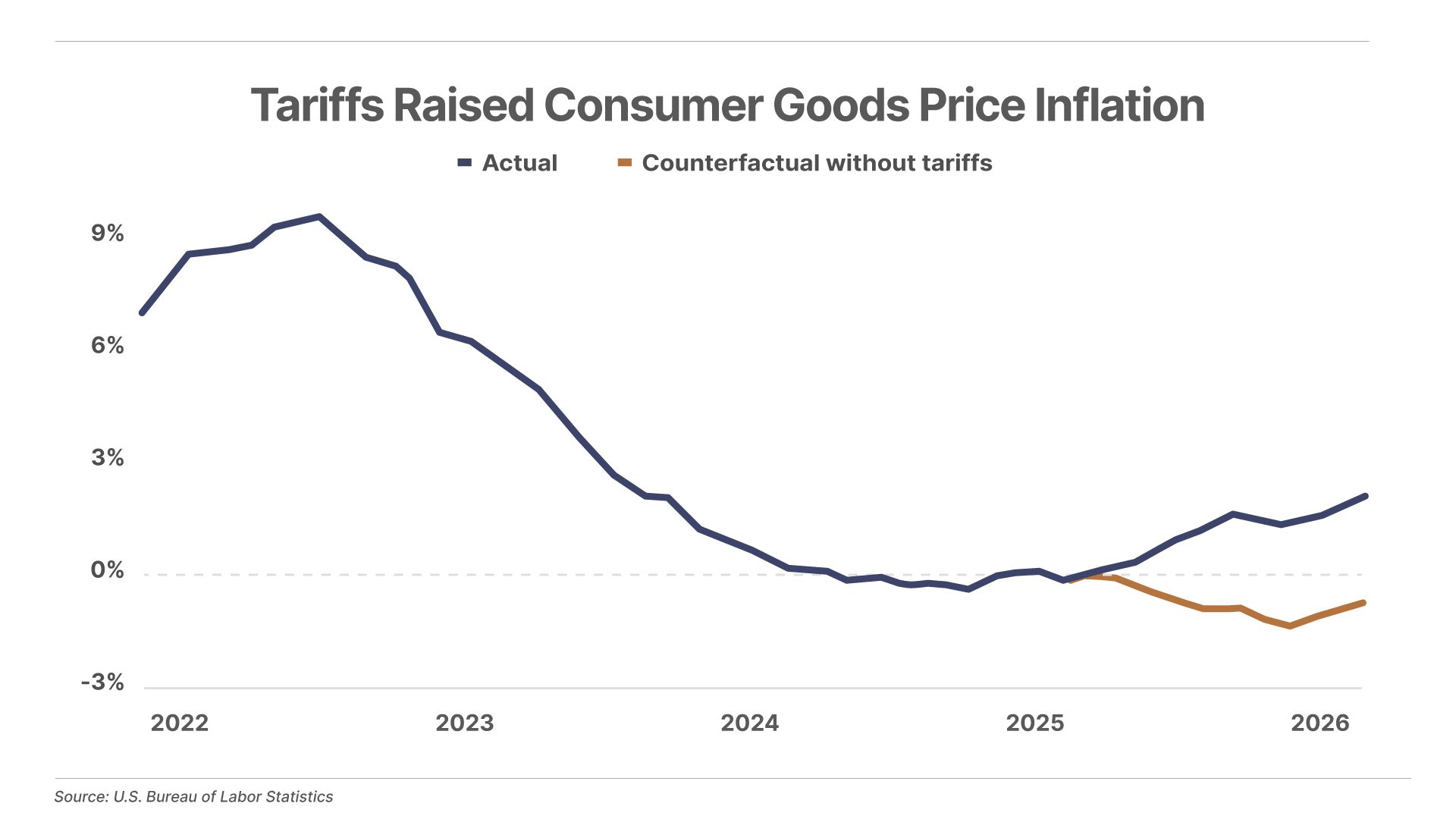
1. Tariffs contributed 2.9 percentage points of inflation. Without tariffs, prices of goods would have fallen slightly over the past year. Instead they rose about 2%. Roughly a quarter of every point of higher tariff rates reaches consumer prices within 12 months. Two-thirds of that comes from imports, which reprice quickly. The remaining third comes from U.S.-made goods, as domestic producers raise prices on higher input costs and weaker import competition. That piece takes six to 12 months to show up, which means the inflation already in place from 2025 tariffs is still working through the system.
2. The U.S. housing shortage may be turning into a glut. Builders finished about 1.35 million homes and apartments over the past 12 months, while the economy added only about 500,000 jobs – 2.7 new housing units for every new job is the highest ratio in recent records. Before the pandemic, the relationship ran the other way: for most of the 2010s, job growth was more than double housing completions. The National Association of Home Builders considers 1.25 to 1.5 new jobs for every new housing permit a balanced market. This is good news for buyers – home prices and rents are now falling in Florida, Texas, Tennessee, Georgia, Arizona, and Colorado.
3. A top-heavy market. The equal-weight S&P 500 index (RSP) is trailing the market-cap weighted S&P 500 (SPY) by the largest margin since 2002. This divergence is being fueled by relatively weak returns among small and medium stocks versus the record run in the largest technology heavyweights, leading to an increasingly concentrated group of tickers driving the overall gains in the market.
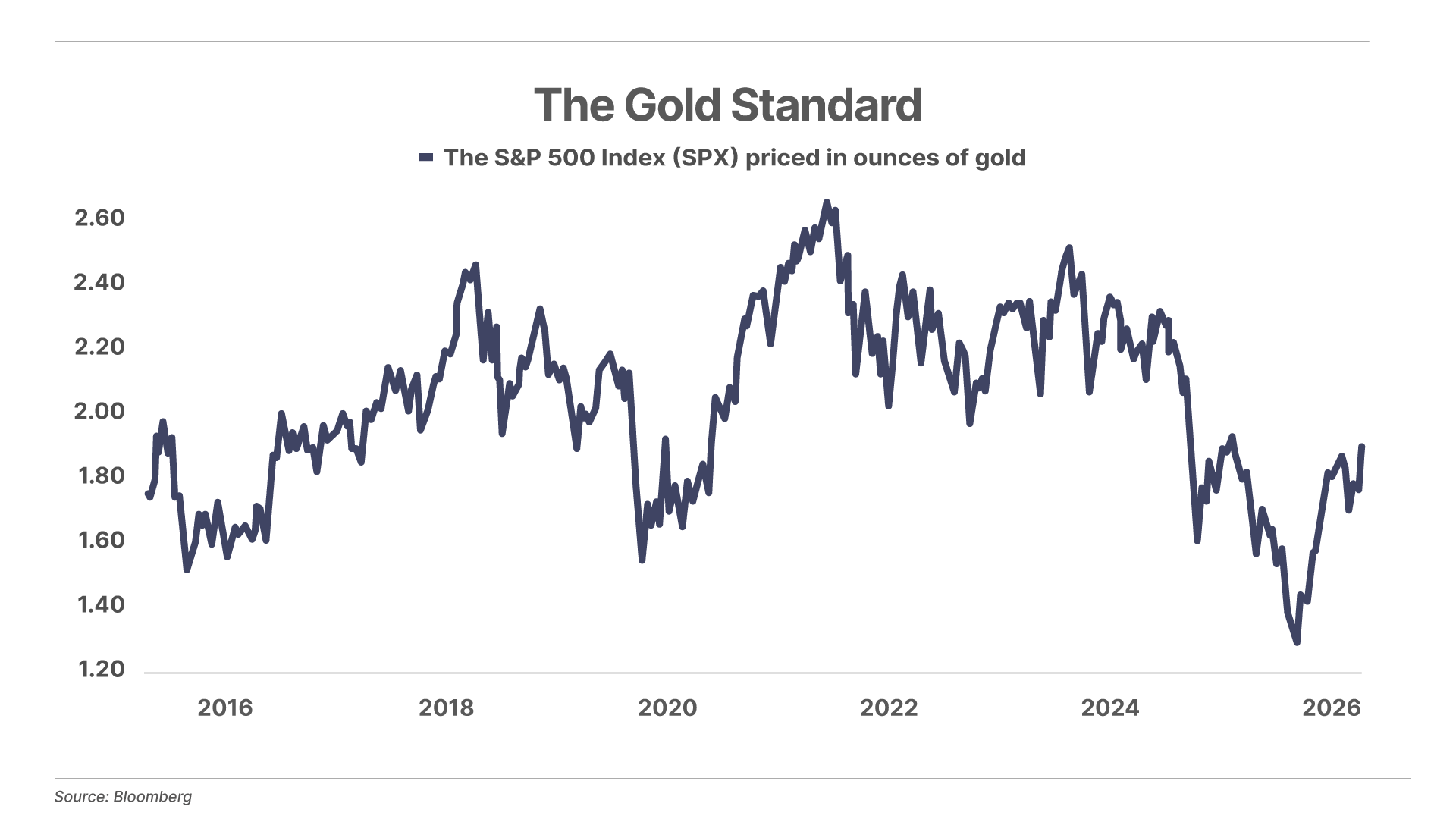
Measured in gold, the S&P 500 is about where it was 10 years ago. The chart divides the S&P 500 by the price of one ounce of gold. In October 2015, the ratio stood at about 1.74 and today it’s 1.89.
mRNA’s Next Frontier
Mark M. writes:
Given the carnage caused by the COVID-19 “vaccines” that used the same technology, are you sure you want to be recommending this?
This evidence forms part of the case against Bill Gates, Albert Bourla, Mark Rutte, and others brought in the Netherlands.
And according to (recently and surprisingly deceased) Francis Boyle, lipid nanoparticles should be legally regarded as a biological weapons system.
And apparently, any instruction to your body to produce a foreign protein is inherently dangerous, hence the cytokine storm you mention.
Otherwise, keep up the good work.
Best wishes.
Marjorie C. writes:
Oh good. Another way to kill people, just like the COVID faux-vaccines. Have you not read any of the science that proves the untold damage done by these mRNA jabs?
Larry B. writes:
Great article. I myself am a CAR-T recipient. So far so good. Three months.
Roderick W. writes:
The Journal was fabulous! Clear, concise explanation. Hopeful. Well done.