And An Investment Strategy Designed Specifically To Manage These Risks
Inside Today’s Issue
It’s been a tough week for stocks.
On Thursday, the Nasdaq 100 fell 6.4%, its worst day since March 2020. Semiconductor stocks fell 12.1%, their second-worst day in 20 years, behind only March 16, 2020.
From their October 6 peak through Thursday’s close, the Nasdaq 100 fell 14.7% and technology stocks fell 19.6%, just short of the 20% decline that defines a bear market.
Chip stocks are down 39.6% from their June peak. For comparison, the Nasdaq 100 fell 35.6% in the 2022 bear market and 53.7% in the 2008 crisis.
We’ve been writing for over a year that President Trump’s ideas about tariffs (they’re just taxes) and the war in Iran were woefully wrong. Lots of you said that meant I had “Trump Derangement Syndrome.” Not true. I just knew something about economics and the world’s market for crude oil… which I tried to explain. My job isn’t to write what makes you feel good. My job is to do my best to give you the information I’d most want, if our roles were reversed.
And today, that’s more important than ever. The mirage is wearing off. The market is pricing in the impact of much higher inflation. That means lower equity valuations. And it means that companies that require a lot of capital investment are going to have a much harder time going forward.
This correction isn’t the end. It’s only the beginning: the market has just begun to adjust to higher input costs and higher interest rates.
If we had a government that was serious about fixing inflation, then I would be bullish about our economy. But that’s not happening. In fact, I’ve never seen a group of policymakers more delusional about the basic underlying foundation of our economy.
What do I mean? Well, for starters, the Federal Reserve continues to print money (about $160 billion this year). If they were serious, at all, about inflation they wouldn’t do that. So why are they? To make sure the government can continue to roll its debts.
The federal government is running a 6% of GDP deficit, with full employment, and on top of $40 trillion in debt! In the next 24 months, it’s going to have to borrow something around $15 trillion (roughly 50% of GDP) to meet its new borrowing needs and refinance existing debts. This is nuts – this will destroy our society, as blue-collar and low-income workers see their wages disappear into constant inflation, while interest costs begin to consume more than 50% of all income taxes.
With the recent election, we now have a divided government, very much like we have a divided country. And that means the debt, the deficits, and the inflation are all going to get worse through 2028. By 2029 (see my new book) when the new president is sworn in, we’ll be heading into a major crisis and complete monetary reset.
So… what do you need to know right now?
We’ve created an investment strategy that’s designed specifically to help you manage these risks. I hope you’ll take the time to learn about it and understand why it works.
I’m talking about Porter’s Permanent Portfolio, my version of Harry Browne’s Permanent Portfolio. The reason it works so well is that it’s specifically designed to protect investors from inflation. It’s a balanced approach that owns stocks, bonds, gold + Bitcoin, and cash. It rebalances once a year to keep volatility low. And, inside each of the four investment buckets it’s specifically geared to be resilient.
So… did it do its job of protecting your wealth during this market correction?
The S&P 500 is now down about 5% over the last three months. But Porter’s Permanent Portfolio is up 5% in the last three months.
Over the last year, Porter’s Permanent Portfolio is up more than 10%, while the S&P 500 is up 8.2%.
The reason our approach works so well is that our equity allocation (25%) goes into 20 different “Lindy” stocks that were picked specifically because they’re resilient. Sixteen of the 20, or 80%, beat the index over the last three months and at their current weights the group rose 1.6% – even as the market fell. Eli Lilly (LLY) led with a 15.1% gain. Coca-Cola (KO) followed at 10.0%, then ExxonMobil (XOM) at 8.0%, and Microsoft (MSFT) at 7.2%.
The other factor that makes a huge difference is instead of owning bonds (long-duration fixed income) directly, we allocate 25% of Porter’s Permanent Portfolio into America’s best property-and-casualty (P&C) stocks. These companies own huge portfolios of bonds (their market caps are virtually equal to the size of their bond portfolios). They own the bonds to make sure they will have the money to pay claims on their insurance policies if those claims arise. But… if those claims don’t happen… then these companies are going to make a lot of money. So even though they are exposed to interest rate risk, they can manage that risk with their underwriting. They can also actively manage how much duration risk they’re taking. Those are advantages you will never get from investing in bonds directly.
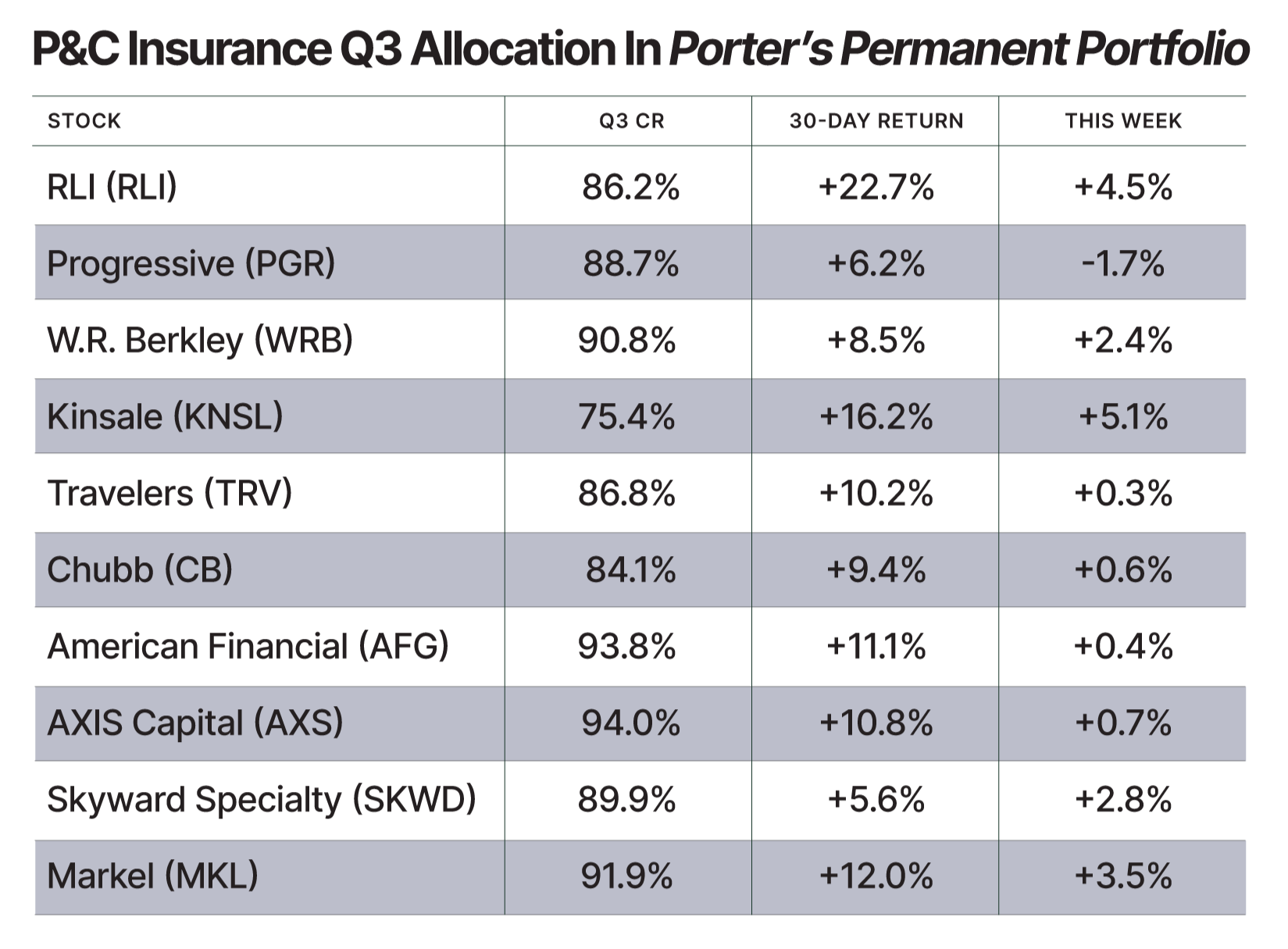
So, for example, Kinsale Capital (KNSL) took a $37.6 million pre-tax loss last quarter when it sold lower-yielding bonds. After the tax benefit, the net loss was around $30 million. These bonds lost value because interest rates have moved higher. Kinsale took the loss (rather than holding to maturity) because moving the capital into higher-yielding bonds will produce more earnings over time. The net effect on book value is not material. And, meanwhile, its insurance business made $107.1 million in underwriting profit in the last quarter, up from $105.7 million a year ago. Kinsale’s shares are up 16% over the last 30 days.
Here’s the performance of our entire P&C allocation in Porter’s Permanent Portfolio. (Q3 CR is their most recent quarter’s “combined ratio,” which tells you how profitable their underwriting has been over the last quarter. Below 100% means they’re making money on their underwriting alone.)
As I hope you’ll recall, I’ve been warning about higher inflation and higher interest rates since the beginning of the Iran war (in February). After the 10-year U.S. Treasury yield went above 5% in mid-September, my advice for retired investors (or anyone who didn’t want to have to sit through a 20% drawdown) was to move out of our P&C insurance stocks, to raise even more cash. If you did, then your allocation went to 50% cash (short-term fixed income), 25% Lindy stocks, and 25% gold + Bitcoin. And, if you elected that ultra-conservative allocation, your return over the last three months was 2%, your return since a year ago is about 7%, and you haven’t had to worry, at all, about the big fall in stock prices this week.
It might turn out that I’m being too conservative, as P&C stocks continue to perform well this year. But, for now, I’m continuing to advise all investors who are retired (who have no outside income) to move to 50% cash.
One more thing: Matt Tuttle at Tuttle Capital has licensed Porter’s Permanent Portfolio and our P&C Insurance Index (which ranks 20 different P&C companies by their underwriting profitability) and created exchange-traded funds (“ETF”). You can learn more about those products here.
And, just to be clear, we don’t manage those funds. Those products are the purview of Matt Tuttle and Tuttle Capital. We merely supply the underlying research that those products are built on.
Tell me what you think of today’s Daily Journal: porterstansberrydirect@gmail.com.
Good investing,
F. Porter Stansberry
Stevenson, Maryland
P.S. Last week, Porter was a guest on Australian finance podcast G’day Bitcoin, discussing the popular cryptocurrency and the future of money with host Sean Clarke, asking the question: “What does it mean to own assets they can’t print?” To watch it now, click here.
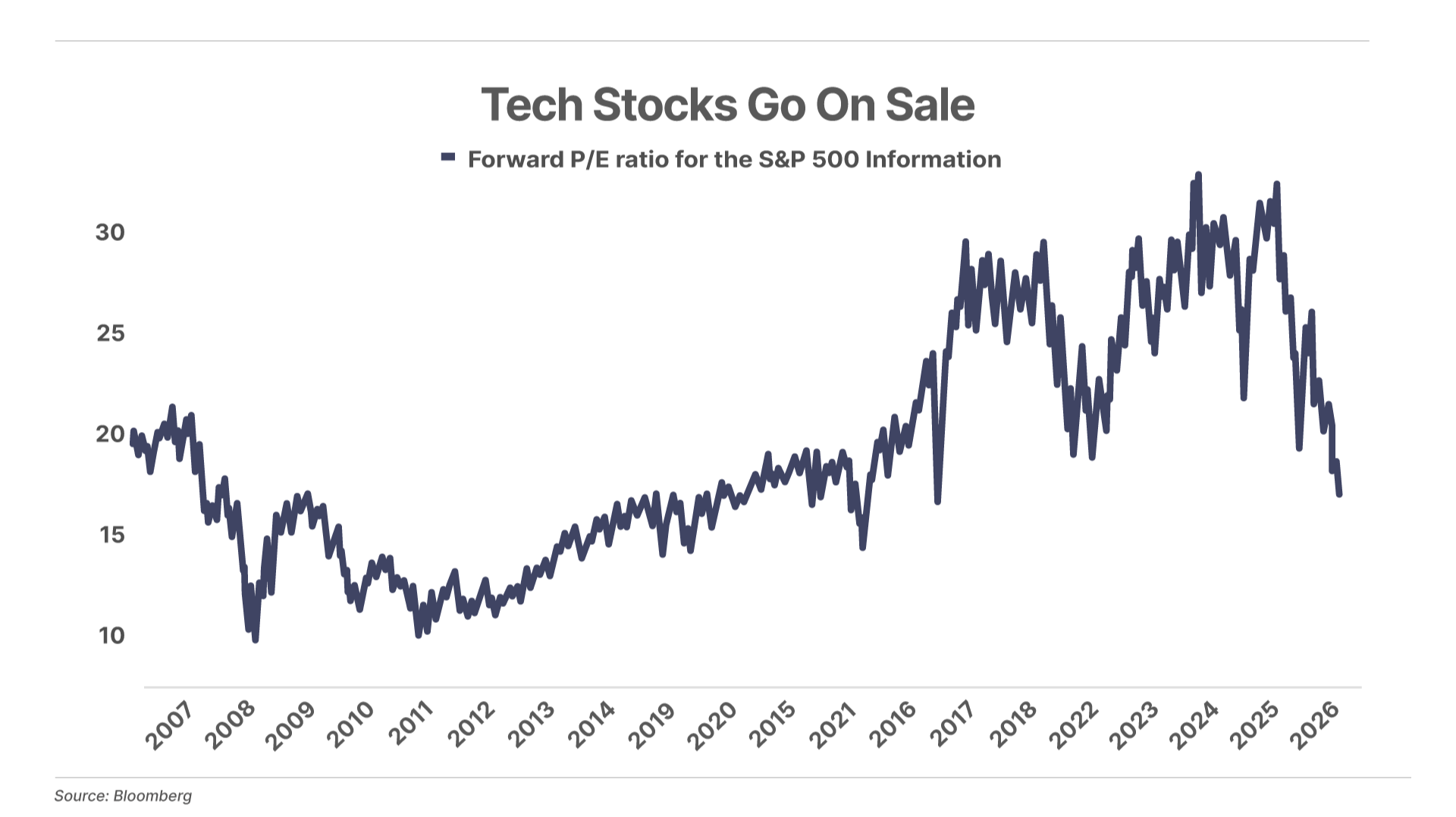 1. Tech stocks are the cheapest they’ve been since COVID. The S&P 500 technology sector trades at 16.9x the profits analysts expect over the next 12 months, its lowest forward price-to-earnings ratio since March 2020. Thursday’s 7.3% drop, the sector’s worst day since then, followed the Democratic sweep of Congress that could bring tighter rules on AI spending.
2. Strong October hiring makes a December rate hike more likely. U.S. employers added 165,000 jobs last month, nearly triple the 59,000 economists expected. The Labor Department also revised August and September up by a combined 84,000. Unemployment fell to 4.1% from 4.2%. Futures traders now put the odds of a quarter-point hike at the Fed’s December 9 meeting at 78%, up from 70% before the report. A hike would be the Fed’s second in three months and would lift its benchmark rate range to 4% – 4.25%.
3. ING is selling $500 million of data-center loans. The Dutch bank is reportedly auctioning a dozen loans, including a $25 million slice of New Mexico’s Stargate project, where Oracle (ORCL) has already invoked force majeure to protect itself against potential construction delays. The November 19 auction will provide another important pricing test for AI-infrastructure credit, which is already showing cracks. The news arrived as the Nasdaq 100 closed 6.4% lower Thursday and days after Texas elected a governor who has pledged to freeze new data center approvals. If buyers demand steep discounts, other lenders could face pressure to revalue similar loans, and the dominos begin to fall.
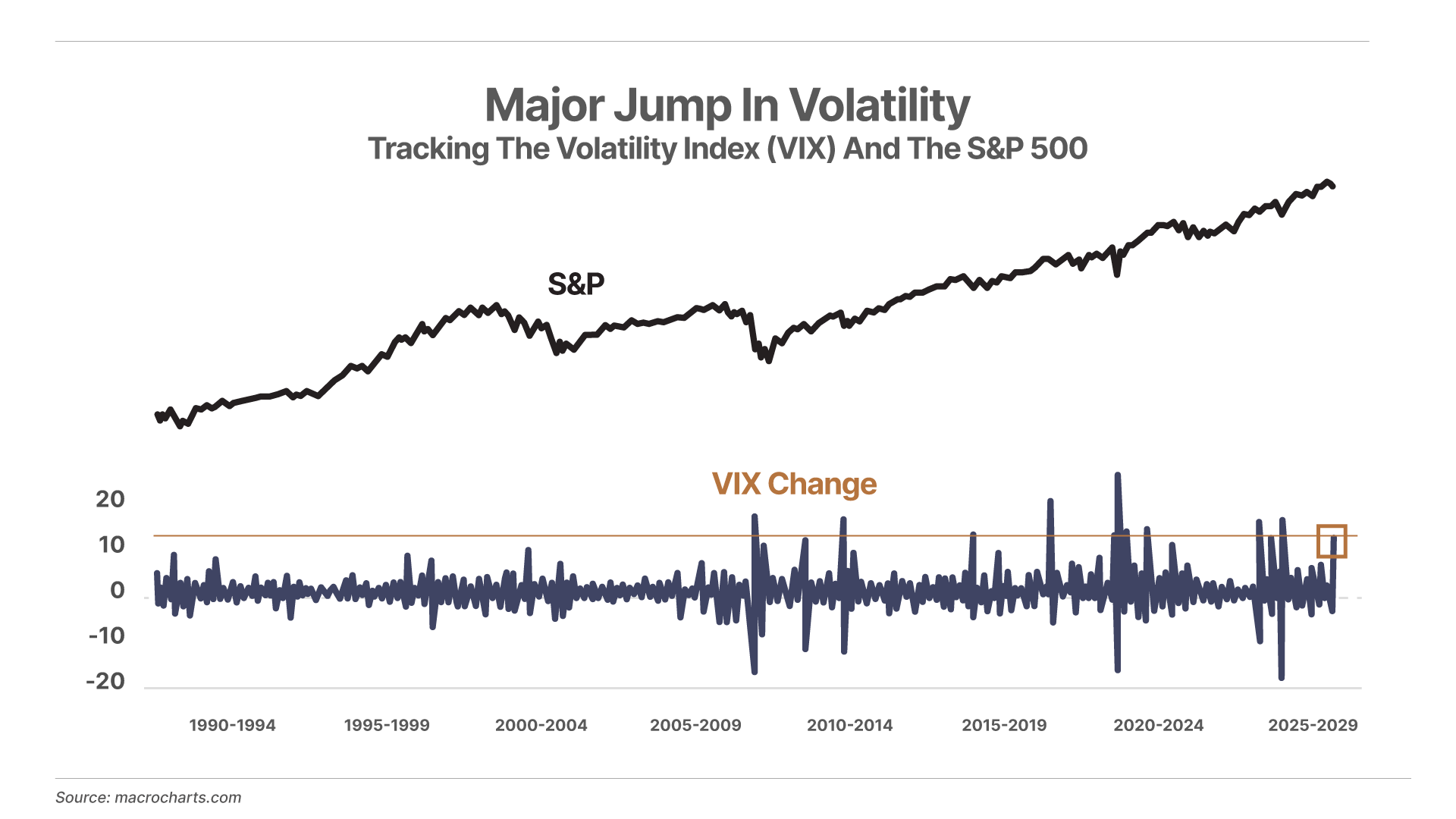
The CBOE Volatility Index (VIX) – a measure of how much traders expect the S&P 500 to swing over the next 30 days – rose 11.57 points yesterday. That’s more than on any single day of the 2000-2002 dot-com bust. Only 21 other days since 1990 have seen a jump of more than 10 points. Outside of global crises – including 2008 and the 2020 COVID shutdown – these spikes have occurred at or near major lows in stocks.
“You Protected Me”
Raymond H. writes:
Well, Porter, you did it. You protected me.
I am still working to finish rebalancing our portfolio into Porter’s Permanent Portfolio, but after Thursday’s market meltdown, I thought I should give you a report. I am substantially invested in your recommendations, going back 20 years. On Wednesday, in the melt-up, I was up about 1.05%. On Thursday, the Dow was down 3.44%, Nasdaq was down 5.5%, the S&P 500 was down 4.3%, and Russell down 4.45%.
For the day, I am down 1.01%.
But through it all, we are stable. At age 81, I don’t have the years left to recoup large losses. Thank you for all you do.
“There’s Only Learning”
Opher L. writes:
Porter, your 2010 End of America made me pay more attention to economy and history. At some point, my income jumped up significantly and I started having excess funds, and so started my interest in protecting and growing my surplus money. By that time, I had internalized your twin messages of “I tell you what I wish I had been told” and “No one cares about your money as much as you do.
The knowledge gained is worth the “tuition” of subscription fees and potentially lower results compared with possible results a professional may achieve. So I upgraded my subscription. I learn something every time I read your pubs. I read your Daily Journal about investing outside the U.S., rating Brazil and Poland as the “cheapest” stock markets. You mentioned BB Seguridade in that issue, so I started looking. I came up with BB Seguridade and PZU in Poland. It looked good, so I went with this. That you mentioned PZU in a recent Daily Journal made me feel good. I took it as a confirmation that I had learned something from you. Thanks!
Over the last 10 years I doubled my portfolio thanks to your advice, Chris Weber’s, and Bill Bonner’s with Tom Dyson’s writing. I heard about those people from you, and I thank you for that too. I also liked your writeup on the Honeycomb portfolio. I hope you plan to update it each year. It looks very stable, with good growth and low beta, so another kudos.
Porter Comment: Opher!
Thank you. Your note made my night.
As you know – there’s no such thing as teaching. There’s only learning.
I think it’s fantastic that you’ve been learning so well –
Porter
Porter & Co. Market Snapshot |
Through Thursday, November 5, 2026 close |
| Markets |
| Index or asset | Last | 1-Day | YTD | 1-Year |
|---|---|---|---|---|
|
S&P 500
Total return
|
733.00 | −4.41% | +8.3% | +9.3% |
|
Gold
Front-month futures
|
$4,113.50 | +0.99% | −5.2% | +3.0% |
|
Bitcoin
4 pm ET print
|
$76,085.00 | −4.95% | −13.1% | −26.7% |
|
Crude oil
WTI, per barrel
|
$90.52 | +2.72% | +57.6% | +51.9% |
|
Berkshire Hathaway
NYSE: BRK-A
|
$856,700.00 | −1.45% | +13.5% | +16.4% |
| U.S. Treasury yields |
| Maturity | Yield | 1-Day | YTD | 1-Year |
|---|---|---|---|---|
|
2-Year
|
4.46% | −12 bps | +99 bps | +83 bps |
|
10-Year
|
4.84% | −6 bps | +66 bps | +67 bps |
|
30-Year
|
5.25% | −3 bps | +41 bps | +51 bps |
| Porter & Co. strategies |
| Strategy | 1-Day | YTD | Since start | Per year |
|---|---|---|---|---|
|
Porter’s Permanent Portfolio
Since September 25, 2024
|
−0.19% | +8.1% | +36.3% | +15.8% |
|
Better Than Berkshire Index
Since May 16, 2025
|
−2.50% | +3.6% | +4.0% | +2.7% |
|
Porter & Co. Top Ranked*
Since July 14, 2022
|
−0.11% | +5.8% | +31.4% | +10.5% |
Porter & Co. Top Positions |
Through Thursday, November 5, 2026 close |
| # | Position | Total return |
|---|---|---|
| 1 |
Roivant Sciences ROIV
Biotechnology
|
+220% |
| 2 |
Roivant Sciences ROIV
Complete Investor
|
+216% |
| 3 |
TG Therapeutics TGTX
Biotechnology
|
+209% |
| 4 |
Bitcoin BTC/USD
Complete Investor
|
+181% |
| 5 |
Skyward Specialty Insurance SKWD
Complete Investor
|
+159% |
| 6 |
Philip Morris PM
Complete Investor
|
+151% |
| 7 |
APA Corporation APA
Porter & Co. Asymmetry
|
+144% |
| 8 |
W.R. Berkley WRB
Complete Investor
|
+126% |
| 9 |
BWX Technologies BWXT
Complete Investor
|
+104% |
| 10 |
Chubb CB
Complete Investor
|
+101% |