Artificial Intelligence Is About To Eliminate 50%-75% Of All White-Collar Jobs
Inside Today's Issue
- Essay: How AI Will Wipe Out Social Security
- AI Eats Up Venture Capital
- A Tesla Car Flies… For A Minute
- ExxonMobil’s Earnings Boost
- Chart Of The Day… AI Gets The Venture Money
- Today’s Mailbag
Good news, if you’re retired: Social Security just locked in its biggest raise in 40 years.
On Wednesday, the Social Security Administration announced that nearly 72 million Americans will get a 3.6% cost-of-living adjustment (“COLA”) starting in January. Social Security benefits have risen 26% since 2021 – the biggest five-year increase since the end of America’s last great inflation, 1982-1986.
And these enormous increases to the government’s costs are just getting started. We are not at the end of a great inflation – we’re only at the very beginning.
This week the Labor Department reported that producer prices rose 6.3% over the past year, led by higher energy prices. Brent crude oil, the global energy benchmark, is up 73% this year. Wholesale diesel has more than doubled.
America buying diesel from Russian President Vladimir Putin is a sign. Energy costs aren’t going to come down anytime soon. These much higher input costs will flow through to higher consumer prices over the next several months. Meanwhile, September was the 67th straight month – that’s going back to early 2021 – that consumer inflation ran above the Federal Reserve's 2% target.
If energy costs were the only issue, maybe we wouldn’t be facing such a serious problem. But energy is only the beginning. Strip out energy, and producer prices still rose 4.7% over the past year. Strip out food, energy, and retail markups, and they rose 5.0%.
What we’re seeing is a monetary phenomenon. The Fed has printed trillions of dollars over the past seven years. And the government continues to spend vastly more than it brings in in taxes. This is monetary inflation, not a failure of the markets or the outcome of a war.
And the worst of it has not reached us.
In September alone, crude oil prices jumped 28.3%. Over the past year, the raw materials American businesses buy rose 21.5%, and the processed materials and parts they need rose 14.1%. Those costs take months to work through supply chains, even if the price of oil stops rising. They will show up in the consumer prices that will set the COLA for Social Security in January 2028. By that point, the annual increases will be 6% or higher.
But these soaring cost-of-living adjustments aren’t the real threat to Social Security.
The real problem is how every business in America is going to react to rapidly rising input costs. They’re going to cut whatever costs they can to maintain their margins. More and more, that will mean replacing expensive white-collar employees with AI solutions.
And you should know, Social Security only has one real source of funding: a 12.4% tax on wages, split between workers and employers. The system’s surplus and its resulting interest income is almost gone. The current payroll tax supplies more than nine of every 10 dollars the program takes in.
So as long as paychecks grow faster than prices, the system works. But sustained inflation above 4% breaks the system.
How do I know?
Between 1970 and 1981, wages more than doubled, consumer prices rose 136%, and Social Security benefits tripled. The trust funds ran a deficit every year from the first automatic COLA (in 1975) through 1981. Congress raised payroll taxes to close the gap.
And what happened?
The economy got worse. By early 1983, Social Security was out of money and began paying checks with money borrowed from the disability and Medicare funds. When President Ronald Reagan signed the rescue bill in April 1983, the system was four months from shutting down.
Today's system starts from a worse position: Look at who pays for our government.
Using the Labor Department's latest wage survey, we added up the occupations most exposed to AI: managers, business and finance staff, programmers, engineers, scientists, lawyers, writers and designers, sales workers, and office support.
They hold 42% of American jobs and earn 52% of all wages, $5.7 trillion a year. Their average pay is $86,500, about a quarter more than the average American worker makes.
They also carry the government’s tax burden: according to the latest IRS data, the top tenth of earners pay about 70% of all federal income taxes, and virtually all of those taxes come from white-collar paychecks.
Challenger, Gray & Christmas, the outplacement firm that has tracked layoffs for decades, reports that AI was the leading reason employers gave for job cuts for five straight months through July.
Employers cited AI for more than 112,000 announced layoffs in the first seven months of this year, double the total for all of last year.
How bad will it get? Dario Amodei, who runs Anthropic, the company that builds the Claude AI models, told online news site Axios last year that artificial intelligence could wipe out half of all entry-level white-collar jobs and push unemployment to 10% to 20% within five years.
We believe that AI will eliminate at least 15 million white-collar jobs by the end of 2028. It will be a few million at first, then more each year. With that many more people out of work, unemployment will grow to over 10%.
Meanwhile, inflation will push annual COLA adjustments to 6% or 7%. The result? Payroll-tax revenue will fall 10% or more. And Social Security spending will be up 26% or more. As a result, Social Security will be completely out of money by about 2029.
Can the rest of the government cover the gap? No. The rest of the government is in worse shape. The federal deficit for the fiscal year that ended in September was $2.0 trillion – and that was with virtually full employment.
In my book, 2029: The End of America, Why The Age Of Paper Money Is Ending And How To Survive The Coming Global Monetary Reset, I modeled what rising inflation does to the government’s interest bill each year.
More than a third of the government’s entire $40 trillion debt comes due within a year. Those obligations must be refinanced at whatever rate investors demand.
We’ve seen a huge increase in bond yields this year, and that will continue as inflation moves higher. With inflation climbing to 6% and unemployment reaching 10%, the annual deficit will grow to $4 trillion per year by 2029.
What will the Fed do…? Unemployment near 10% tells the Fed to cut interest rates. Inflation near 7% says hike interest rates. But higher rates will not lower the price of diesel. The Fed can suppress demand, but it cannot reopen shipping routes or restore refining capacity. If the Fed hikes, interest costs rise. If it cuts and buys Treasury bonds to fund the deficit, inflation rises further and the bill from COLAs explodes.
We’re flying into a financial box canyon. We can’t climb fast enough to escape these obligations and there’s no way to turn around.
We cannot just print our way out of this mess. Every point of inflation the Fed tolerates goes straight into the next year’s COLAs. Each extra percentage point adds about $16 billion a year to our benefit bill – permanently – and it compounds every year after.
The printing pays for the COLA, and the COLA requires more printing. See the problem?
That is the trap Congress walked into in 1983. Back then, it had a way out: a huge generation of baby boomers in their 20s and 30s paying into the system. Today, the boomers are the beneficiaries, and the workers who were supposed to replace them are competing with AI.
They’re going to lose.
The result is going to be far more inflation than we saw in the 1970s and, eventually, a huge reduction to Social Security benefits, most likely by raising the retirement age to 75, means testing benefits, and greatly increasing payroll taxes.
The resulting political fallout will be epic.
What should you do to protect yourself? Tomorrow, in the latest issue of my newsletter, Complete Investor, I’ll introduce you to the best inflation hedge that’s ever been built. This company was the best-performing stock in the S&P 500 from 1970 to 1990 and it will be again between now and 2046 too.
If you are not a paid-up subscriber, you can be just by clicking here.
I’d also urge you to read my new book, 2029: The End Of America, Why The Age Of Paper Money Is Ending And How To Survive The Coming Global Monetary Reset.
What’s about to happen to our currency and to the Social Security system is going to wipe out a lot of Americans. This happens frequently in paper-money systems and it’s happened twice in America over the last 100 years (1933, 1971). But there’s a solution, and it’s an easy one for anyone who understands it. It allows you to profit, massively, from the coming inflation.
I hope you’ll take this seriously and act today.
Tell me what you think of today’s Daily Journal: porterstansberrydirect@gmail.com
Good investing,
F. Porter Stansberry
Stevenson, Maryland

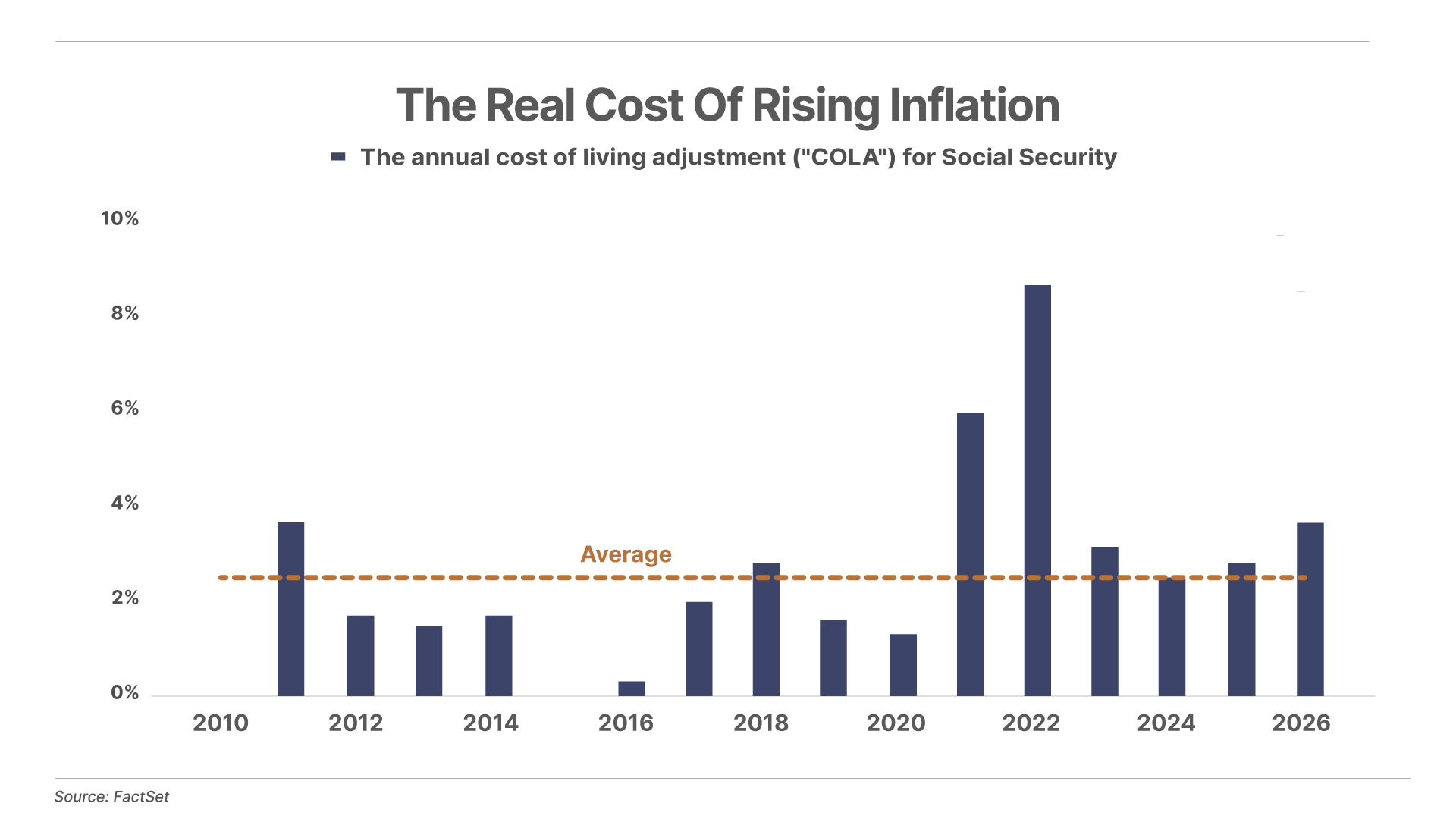
1. Social Security checks will rise 3.6% in January, the largest increase in four years. As Porter references above, the annual cost-of-living adjustment (“COLA”), which ties benefits to the government’s official measure of consumer prices, will add about $75 a month to the average retirement check. Energy, mostly gasoline, accounted for roughly a third of the increase. Without it, the raise would have been about 2.5%, in line with the past two years.
2. Tesla’s long-delayed Roadster can briefly “fly.” Last night, at a SpaceX test site in McGregor, Texas, Elon Musk showed the sports car using compressed-air thrusters to drive up a wall, hover above the ground, jump over a row of parked Teslas, flip upside down, and land. The electric-vehicle maker also demonstrated that the car can accelerate from zero to 60 mph in 0.81 seconds. Production is now targeted for 2028, eight years after Tesla first promised deliveries. Tesla (TSLA) shares jumped 5.4% in early trading, but the gain quickly faded.
3. ExxonMobil signals profit bump from refining operations. In an 8-k regulatory filing today, oil supermajor ExxonMobil (XOM) noted it expects a $4.5 billion earnings boost from its refining segment in Q3. The company’s refining arm is benefiting from a record spread between input prices for crude oil versus the output prices for refined products, like diesel and jet fuel. The company will report its official Q3 earnings on October 30, and all signs point toward a blowout quarter.
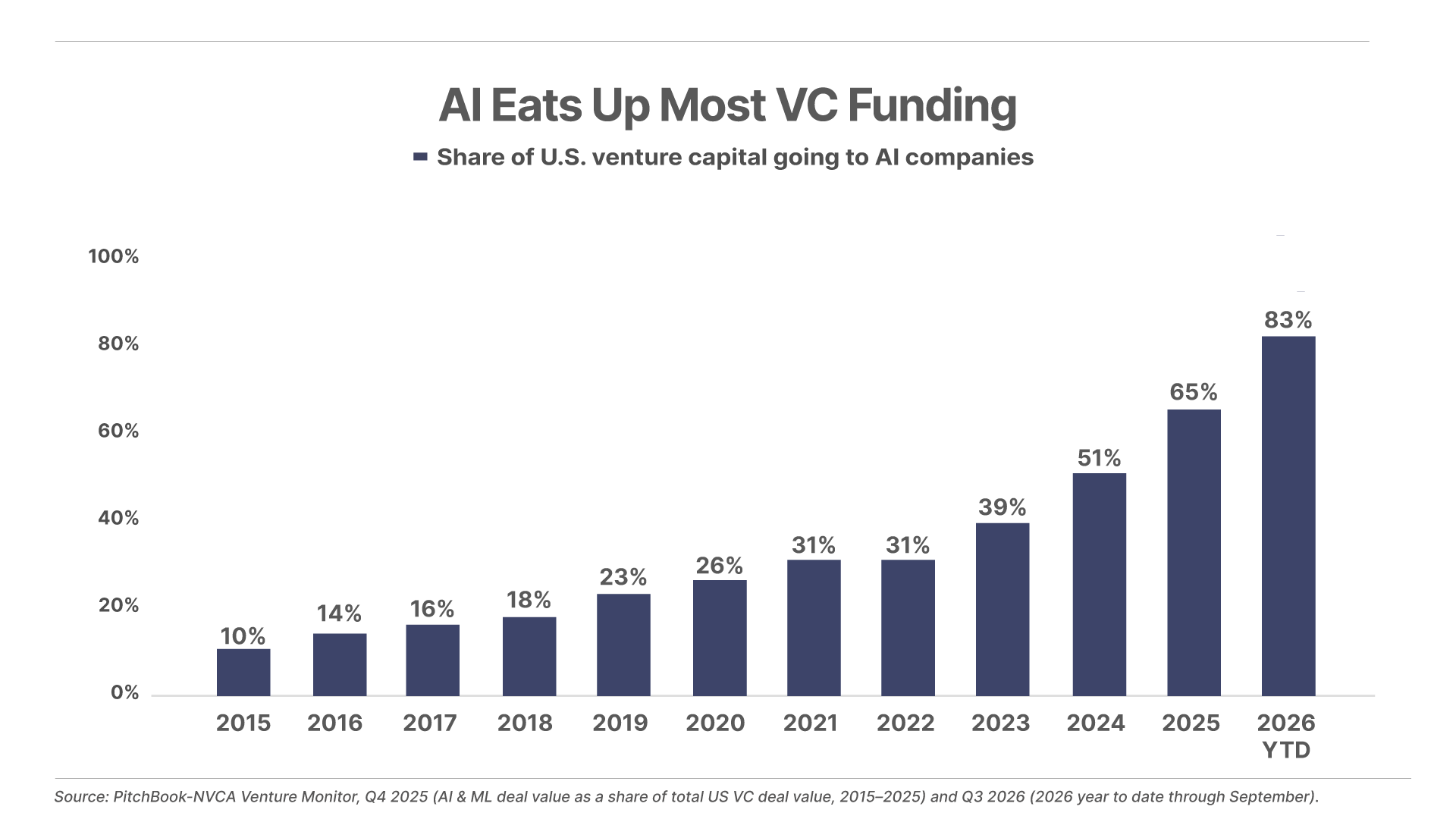
PitchBook reports that AI now takes 83% of every venture-capital dollar invested in the U.S. – up from 10% in 2015.
Yesterday’s Journal told the story of design-software leader Adobe, our August Complete Investor recommendation, whose share price is down but whose performance is stronger than ever.
“Sticking With Adobe”
Steven P. writes:
Porter, I follow your theory, and up until last week that was my belief also. That is when I learned and checked out the open-source clone suite called Artcraft by Brandon Thomas. While I agree that large corporate creatives won't be using this, I suspect many independents and hobbyists will. I am not sure any of it is legal, but the alpha versions are pretty impressive.
Linda T. writes:
I totally agree, and I bought the stock in Complete Investor when you said to. I am down 22% but I have faith and stops too.
Thanks, Porter.
John C. writes:
Great job on the Adobe analysis. Thank you.