Issue #73, Volume #3


Why You’ll Need A Better Berkshire Soon
Inside today’s Daily Journal…
|
For the last two weeks, I’ve been telling you what’s wrong with Berkshire Hathaway.
My thesis is simple. It is very well proven. But it’s the kind of thing you are not supposed to say out loud:
Warren Buffett, the greatest capital allocator in history, has been making bad decisions for 25 years.
In fairness to Buffett, who ran Berkshire for six decades until the end of 2025, things didn’t really go off the rails completely until after the Global Financial Crisis – when he was 80 years old! I’m not suggesting that an 80-year old Warren Buffett was a bad investor. I’m saying that the 80-year old version of Buffett couldn’t hold a candle to the 40-year old version of the same mind. That’s no sin. That’s nature. Father time is undefeated. For 30 years between 1970 and 2000 (between the ages of 40 and 70), Buffett beat the S&P 500 by 11 points per year. Cumulatively, he beat the market’s return by a factor of 48x.
This is the greatest sustained investment performance in history, and no one else comes close.
But… since 2006 Berkshire hasn’t beaten the S&P 500. And last year was the company’s worst year (comparatively) since 1999.
Over the last 20 years, Buffett simply did a terrible job. The largest capital allocations of his late career – Berkshire Hathaway Energy (written down by $50 billion in 2024), BNSF Railway (lowest-margin Class I railroad in North America), Precision Castparts ($10 billion written down), Pilot Flying J (also written down), Kraft Heinz (written down twice!) – were all disasters. And they were all wrong in the same way:
Buffett bought 100% of inferior private operating companies when he could have bought a fraction of the dominant public competitor for less money and gotten a better business that Berkshire didn’t have to manage.
On a capital-weighted basis, Buffett’s largest take-private investments since 2000 have massively underperformed compared to the obvious public-market alternative. The Hershey Company (HSY) instead of See’s Candies. The Home Depot (HD) instead of Mrs. B’s Nebraska Furniture Mart. McDonald’s (MCD) instead of Dairy Queen. NVR (NVR) instead of Clayton Homes. CSX (CSX) instead of BNSF Railway. ExxonMobil (XOM) instead of Berkshire Hathaway Energy (BHE). The cumulative difference comes to roughly $700 billion.
Seven hundred billion dollars.
I knew, when I wrote this analysis, that all of the Buffett fans would accuse me of making an impossible comparison. After all, I have the advantage of hindsight. But that’s not what I did. I used the largest, the oldest, and the most obvious public company analog, at the time. I didn’t “curve fit.” I didn’t try to pick the stock Buffett should have bought. I simply compared his take-private deals to the largest, most established, most obvious public company analog.
What the exercise taught me was something novel, which I didn’t expect when I began the research. Despite getting all kinds of special deals – like high-yielding preferred shares and warrants – Berkshire would have been better off, in every case, if it had simply bought the highest-quality, largest, public company analog.
To prove this, I knew I would need to test it without the benefit of hindsight. That led me to develop Porter & Co.’s own version of Berkshire Hathaway… represented by The Better Than Berkshire Index.
Last year we took Berkshire’s actual asset allocation – 40% Property and Casualty (P&C) Insurance, 20% Manufacturing, Service, And Retail, 5% Energy, 5% Financials, 5% Technology, 5% Railroads, 15% Consumer Products, 5% Healthcare – and inside each allocation “bucket” we replaced almost every Berkshire holding with the highest-quality public-market alternative. These include…
-
P&C leaders Progressive (PGR) and Kinsale Capital (KNSL) instead of Berkshire’s insurance company GEICO
-
Aerospace business HEICO (HEI) instead of Precision Castparts
-
Homebuilder NVR (NVR) instead of mobile-home company Clayton Homes
-
CSX railroad (CSX) instead of BNSF Railway
-
Energy businesses Texas Pacific Land (TPL) and BWX Technologies (BWXT) instead of BHE
-
American Express (AXP) and Visa (V) instead of Bank of America (BAC)
And so on.
Then we tracked the portfolio, in real time, in public. No curve fitting possible. No “if you had bought…” rear-mirror analysis. Live performance.
Here’s what happened:
-
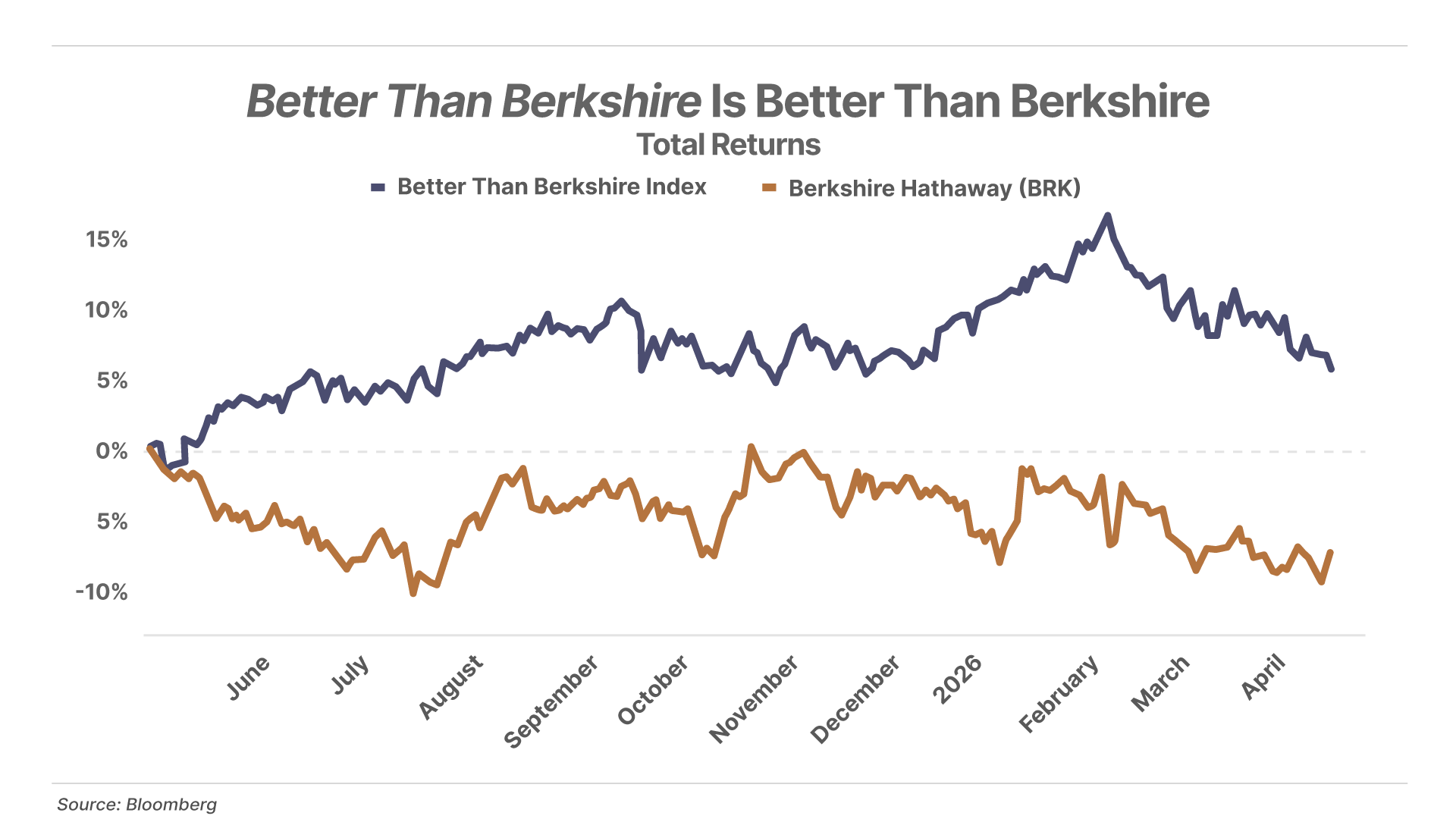
The Better Than Berkshire Index returned 5.5%, with a beta of 0.55 – or about half the volatility of the market.
-
Berkshire Hathaway returned negative 7.1%.
We beat Berkshire by 12.6 percentage points. Going long our version and shorting Berkshire would have made you equity-like returns with zero risk and zero leverage. While that may not be practical (borrowing costs, friction, etc.), it is proof that our analysis is correct: Berkshire is a lousy conglomerate.
Inside our portfolio, the railroad we said was better than BNSF – CSX – returned 54%. The technology compounder we identified – Alphabet (GOOG) – returned 158%. BWX Technologies (BWXT), our small-modular nuclear bet, returned 95%. British American Tobacco (BTI) returned 40%. Eli Lilly (LLY) returned 30%. The energy bucket we built specifically to capture AI-driven power demand returned 28%.
Where we lost – and where Berkshire lost too – was in the 40% P&C insurance sleeve. Progressive (PGR) fell 24%. Kinsale Capital (KNSL) fell 32%. Our 40% of the index exposure ran straight into a once-in-a-decade soft pricing cycle in P&C insurance. That single sleeve cost us 6.16 percentage points on the year. Without it, Better Than Berkshire would have beaten the S&P 500.
But here is the number that matters the most.
In the last year, Berkshire Hathaway lost to the S&P 500 by more than 30 percentage points (-31.6%).
That is the worst relative result Berkshire has produced in a quarter century. The last time Berkshire underperformed the S&P 500 by more than 30% was the only time it underperformed by that much: 1999, at the extreme peak of the dot-com bubble. Berkshire underperformed by a 40-point gap in 1999.
The market had become temporarily insane about technology stocks, and Buffett refused to participate – and he was right! Within two years the new economy was rubble and Berkshire owned the highest-quality portfolio in the United States. The 1999 collapse turned out to be the greatest buying opportunity Berkshire ever created.
We believe that the artificial intelligence (“AI”) revolution is real. It is going to change everything about the way we live, work, and govern. It’s the beginning of an autonomous robotics revolution that will change the world more profoundly than the industrial revolution did. All of that can happen… and stocks can (and likely will) form bubbles that pop. At some point in the next five years, owning assets that are safe – like the assets in Berkshire’s portfolio – will matter again to investors.
But… I don’t believe owning Berkshire will beat the S&P 500. It has serious structural problems that won’t be solved until the company is significantly restructured. Its biggest problem is a $50 billion misallocation to regulated utilities that have invested heavily in very inefficient energy generation equipment (windmills). Windmills ain’t gonna power robots. That’s not going to happen.
Where Berkshire’s 1999 underperformance was caused by an external mania about an asset class (technology) Buffett refused to own, this time the damage is self-inflicted. There will be no equivalent buying opportunity after the underperformance because the structural mistakes are inside Berkshire’s balance sheet. New Berkshire CEO Greg Abel cannot “sell BHE” the way Buffett sold his airline shares in 2020. And Abel will not spin off the regulated-utility empire he spent his career assembling.
Ajit Jain – the head of Berkshire’s insurance operations, the man Buffett has called the most important manager he ever hired – sold half of his Berkshire shares in September 2024. There’s a reason.
And so… this year… we have a bigger goal in mind. We’re no longer only trying to beat Berkshire. That’s like ganging up on the retarded kid at recess. Going forward, we want to build an ultra-high-quality, ultra-low-volatility, diversified stock index (25 positions) that should beat the S&P 500 with much less risk. The original Better Than Berkshire Index was Berkshire-shaped on purpose – we wanted an apples-to-apples test of our central thesis. The test succeeded. We beat Berkshire by 12 points in real-time, with matching allocations.
Berkshire is locked in. It owns 100% of GEICO, 100% of BNSF, 100% of BHE, 100% of Precision Castparts. When the P&C cycle softens, Buffett (or Abel) cannot reduce Berkshire’s exposure to insurance. When the railroad’s volumes deteriorate, Buffett cannot sell BNSF.
But we are not locked in. Our decision to match Berkshire’s allocations was an experiment, not a commitment. Porter & Co.’s Better Than Berkshire portfolio is built out of liquid public equities that we can rebalance, reweight, and replace once a year. We can respond to the market. We can move against cycles instead of being held hostage by them.
The new portfolio will go to Complete Investor subscribers and Partner Pass members next week.
We are cutting our Better Than Berkshire Index P&C insurance allocation from 40% to 10%. The soft P&C cycle has further to run. We’re shifting that 30% allocation into places I believe will prove resilient to the kind of volatility we may see in tech stocks at some point soon.
We’ve raised Consumer Products from 15% to 25%. This is now the largest allocation in the Index, as I believe it should be for a Berkshire-inspired portfolio. It is concentrated in five of the most reliable wealth-creation machines in the public market. These low-beta compounders are the kind of businesses Buffett himself bought for decades. This is where the Better Than Berkshire Index is going to quietly compound for the next five years, no matter what happens with AI and robotics, with stocks involved in beloved consumer products, like tobacco stocks, beverages, and chocolate.
We raised Energy from 5% to 15%. The Persian Gulf disruption caused by the war in Iran is going to drive a meaningful expansion in U.S. midstream and liquefied natural gas (“LNG”)-export economics over the next year, and almost nobody on Wall Street is positioned for it. We have restructured the Index significantly around this theme.
We raised Healthcare from 5% to 15% – because it’s the highest return on equity (“ROE”), and the most defensive part of the market. We concentrated into two ultra-high-quality pharma businesses. One of them is the longest-tenured pure pharma operator in U.S. public markets, founded in 1891. It is currently trading at a multi-year low because the market is panicking about a single patent expiry it has known about for a decade. The other is a contrarian buy I have wanted to make for two years – a company down 30% from its high on competitive fears that have been wildly overstated, while it continues to post a 60% to 80% ROE on the highest-margin therapeutic category in healthcare.
Despite my concerns about a bubble emerging in technology, we increased Tech from 5% to 10%. We did so to make room for what is going to be the most-discussed addition in the new portfolio: Apple (AAPL) – the highest-quality consumer-products company in the world, and it is going to be a major implementer of AI in consumer products.
Apple’s unified memory architecture is the technical detail almost no investor understands. This unique architecture lets Apple integrate frontier AI models directly into its devices: no PCIe-bus copy penalty, no separate VRAM constraint, with 614 gigabytes per second of memory bandwidth on the latest M5 Max. Every other AI inference platform pays a memory-transfer tax that Apple does not pay. The same architecture is what makes Apple the eventual platform for consumer robotics. I will be writing more about this in the months ahead. A 10% allocation means, even if these stock prices fall in half, our portfolio can easily weather the storm. And, if (or when) that happens, we will surely increase our exposure to these names.
We added two new, classic Buffett-style monopolies to the Manufacturing, Service, and Retail allocation. Both have sold off 37% in the last year and both have the kind of switching costs and recurring revenue streams Berkshire’s late vice chair Charlie Munger spent decades looking for. We have also added two best-in-class aerospace OEM (original equipment manufacturer) franchises – companies with multi-decade aftermarket revenue streams and pricing power into the global rearmament cycle.
And here is the most important feature of the new Better Than Berkshire Index. We did not just add quality. We added quality that is rigorously screened to permit safe leverage.
Every name in the new Better Than Berkshire Index passes a 15% return-on-invested-capital (“ROIC”) gate, sustained in each of the last three calendar years. (For the insurers and lenders, where ROIC is mechanically depressed by float and balance-sheet leverage, the gate is 15% ROE instead.) Every name has a positive five-year average buyback yield. And the average beta of the portfolio is well below the market’s.
What that means in practice is that this is a portfolio you can own with leverage. Investors with margin accounts should consider applying 1.5x margin to this portfolio, to match the impact of Berkshire’s ability to invest with its insurance float. Doing so will, of course, increase the size of the drawdown in market corrections, but I believe, over time, it will greatly increase your returns.
A portfolio of 25 high-ROIC, low-beta, buyback-disciplined compounders, owned with modest leverage, is the most powerful wealth-creation engine available to an individual investor today. It is what Warren Buffett built Berkshire Hathaway to be in 1965. It is what Berkshire stopped being around 2000. That’s why we’ve rebuilt it for you.
To get our full Better Than Berkshire Index, with our buy-up-to prices and our position-by-position reasoning, make sure you’re a paid-up subscriber to Porter Stansberry’s Complete Investor or a current Partner Pass member. The Partner Pass is the single best deal in financial publishing. It includes everything we publish – Complete Investor, Distressed Investing, Tech Frontiers, The Trading Club, Best Buys, and all our proprietary content, for life.
Call our Customer Care team at 888-610-8895, or +1 443-815-4447 internationally. Tell them you read about the Better Than Berkshire Index in Porter’s Daily Journal and you want to make sure you’re qualified to get it.
Berkshire just lost to the S&P 500 by more than 30 percentage points. Buffett is gone. Greg Abel cannot fix what Buffett built. The structural mistakes are baked in.
We are not Berkshire. We can avoid the cycles Berkshire is locked into. We can compound at 15% a year – Buffett’s own benchmark – without owning a single regulated utility, without owning the wrong railroad, and without owning any useless windmills.
If you’re looking for a full solution that you can leverage, I know you’ll want our Better Than Berkshire Index.
Tell me what you think of today’s Journal – good, bad, or anything in between: porterstansberrydirect@gmail.com
Good investing,
Porter Stansberry
Stevenson, Maryland
P.S. If you haven’t gotten a copy yet, I’d love for you to read my nearly 300-page full exposé on what’s gone wrong at Berkshire Hathaway. I spent a decade writing this book. There’s no more thorough explanation for what Berkshire did right over the 50 years from 1965 to 2015 and what has gone wrong since. Get your copy of Warren’s Mistakes.
The SpaceX Text Message You Were Never Supposed To See

A Wall Street insider just revealed that the SpaceX IPO may be coming sooner than expected.
Here’s how to get pre-IPO exposure — before the frenzy starts.
Use this 4-letter ticker symbol and just $50.
👉 Watch now and get the ticker now, free.
Editor’s Note: Keep in mind, we only accept advertising from publishers we know to offer well-researched ideas vetted by a legal team, excellent customer service, and reasonable refund policies. Crowdability is one such partner. We do not, however, under any circumstances make any representations about their investment ideas or strategies, nor will we warrant them as equal to our own. We do recognize that the markets are tempestuous and, at times, ideas that we may not endorse prove valuable.
3 Things To Know Before We Go…
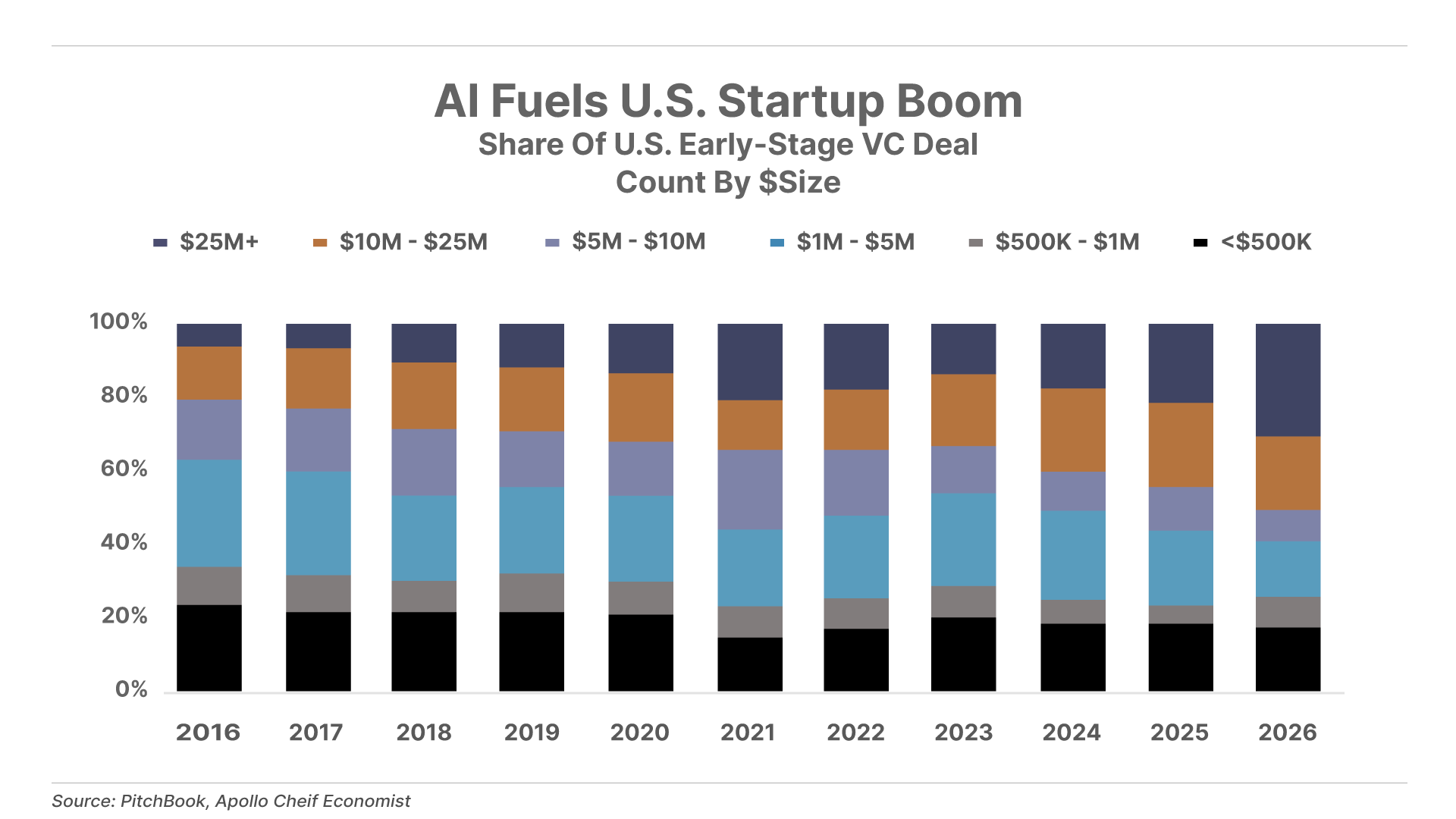
1. AI fuels a startup boom. U.S. business formation is running at the highest weekly pace on record, with artificial intelligence (“AI”) and large language models reducing the needed cost of launching a business, per Apollo Global Management’s Torsten Slok. AI businesses captured 65% of the record $339.4 billion in venture capital money in 2025 – yet it accounted for only 40% of deal count. Ultimately, the AI boom rests on whether a few of these startups can become the next Apple (AAPL), Microsoft (MSFT), or Nvidia (NVDA): behemoths large enough to carry the broader economy.
2. “Consumers are literally running out of money.” Five months into trying to revive the packaged food giant, Kraft Heinz (KHC) CEO Steve Cahillane told The Wall Street Journal this week that shoppers’ wallets are increasingly empty by month’s end – forcing the company to cut prices, expand promotions, and roll out smaller package sizes. With Iran-driven price inflation threatening another resurgence, consumers’ struggles are unlikely to improve anytime soon.
3. White House faces a second tariff roadblock. Yesterday, the Court of International Trade struck down the Section 122 tariffs announced by the White House in February. These tariffs were designed as a workaround to the IEEPA tariffs President Trump unveiled last April, which the Supreme Court nullified in February. In the meantime, a large question looms over the legal status over billions of dollars worth of tariff refunds that will be owed if the ruling is upheld.
Chart Of The Day… Better Than Berkshire
Porter launched the Better Than Berkshire Index on May 16, 2025, and since that time it has outperformed its namesake competitor by 12.6 percentage points – up 5.5% for Better Than Berkshire versus a 7.1% decline for shares of Berkshire Hathaway (BRK-A)…
Mailbag
“Results From Prophet”
Keith M. writes:
On April 15, I invested an average of $3,745.80 per stock with Prophet‘s (mywallst.com) picks. Today they are worth $4,200.27. With three closed winners and 10 open winners, I am currently up $5,908.19, so at the moment I’ve covered my $4,000 lifetime subscription and you can see that I didn’t invest all that much money. Every stock is currently positive – that’s ridiculous! Since it was Porter recommending these guys, I chose the lifetime subscription – a great choice. I understand there will be drawdowns, but I’m in there for the long haul. Thank you so much, Porter.
“Buffett And Leverage”
Daniel J. writes:
Buffett and Munger made a point of not using leverage, at least that is what they said. They did sell CSPs [cash-secured puts] for income, but that is different since they had treasuries behind them. Actually, they sold CSPs to buy the stocks cheaper. Could their extra returns be due to put sales and not leverage?
“Problems At Kinsale Capital”
Christina E. writes:
Dear Porter and Emmet,
I am a subscriber and follower of Porter’s Permanent Portfolio and have also recently signed up for Nova and Prophet. I am extremely happy with both.
Since I watched Porter’s yearly summit from last year, I have also been following The Bearcave, receiving regular emails.
To my surprise, Edwin Dorsey picked out Kinsale Capital as a company in trouble. And yet Kinsale Capital figures in Nova as a bedrock company.
Can you guys help me match that up? Should I be worried?
Porter Comment: All nonsense.
These claims have been around for a long time and are driven by insurance brokers because Kinsale doesn’t use them – they do all of their own underwriting.
E&S lines are unregulated (in regards to terms and pricing.)
And yes, insurance companies write policies in ways that are specific.
It is a great business. – P
Porter & Co. Market Snapshot
| Price | Yesterday’s Return | Year-to-Date Return | |
|---|---|---|---|
| S&P 500 Index | $7,365.12 | -0.38% | 7.6% |
| Gold per ounce | $4,691.36 | -0.12% | 9.4% |
| Bitcoin | $81,421 | -1.91% | -8.5% |
| Oil (West Texas Intermediate) per barrel | $95.08 | -1.55% | 64.4% |
| Berkshire Hathaway (BRK) | $705,940 | 1.46% | -5.1% |
| Porter’s Permanent Portfolio | – | -0.39% | -0.7% |
| The Better Than Berkshire Index | – | -1.02% | 0.2% |
| Total Return | Annual Return | ||
| Porter & Co’s Top Ranked* | 31.7% | 14.1% | |
| Yield | Yesterday’s Change | Change Year-to-Date |
|
| U.S Treasury 30 – Year Yield | 4.96% | 2 bps | 12 bps |
*A Complete Investor risk rating of 1 is defined as a “low risk, high allocation” security, while positions rated closer to a 5 are higher risk. Porter & Co.’s top-ranked positions include those rated either 1 or 2 in Complete Investor portfolio.
Porter & Co. Top Positions
| Publication | Ticker | Description | Total Return |
|---|---|---|---|
| Complete Investor | BWXT | BWX Technologies | 267% |
| Tech Frontiers | QURE | uniQure | 237% |
| Complete Investor | BTC/USD | Bitcoin | 196% |
| Tech Frontiers | SGMT | Sagimet Biosciences | 142% |
| Tech Frontiers | QURE | uniQure | 131% |
| Tech Frontiers | ROIV | Roivant Sciences | 125% |
| Tech Frontiers | TGTX | TG Therapeutics | 123% |
| Complete Investor | PM | Philip Morris | 113% |
| Distressed Investing | PTON | Peloton Interactive | 103% |
| Distressed Investing | HLF | Herbalife | 102% |
Prices as of 4:00 pm ET May 7, 2026
Please note: The investments in our “Porter & Co. Top Positions” should not be considered current recommendations. These positions are the best performers across our publications – and the securities listed may (or may not) be above the current buy-up-to price. To learn more, visit the current recommendations page of the relevant service, here. To gain access or to learn more about our current recommendations, call our Customer Care team at 888-610-8895 or internationally at +1 443-815-4447.