Issue #117, Volume #3

How The Greatest Compounder In History Stopped Believing In Compounding And Destroyed His Legacy
Inside Today’s Issue
It turns out my book Warren’s Mistakes was wrong.
Warren Buffett’s biggest mistake wasn’t buying BNSF Railway with Berkshire Hathaway stock, like the book claims. It wasn’t selling McDonald’s (MCD) to buy Dairy Queen. It wasn’t even losing billions running NetJets – which is one of the worst capital allocation decisions of all time. And it wasn’t even buying $40 billion worth of windmills because of the false belief that America was running out of oil.
Buffett’s biggest mistake ever was his friendship with Microsoft founder Bill Gates and the resulting decision to give away his entire fortune by 2034. The graveyard of good intentions has a new headstone – Warren Buffett’s.
This morning, Buffett announced he is withholding his annual gift to the Gates Foundation while an outside review picks through the foundation’s ties to Jeffrey Epstein – the scandal now swallowing Bill Gates whole. Just remember: Gates established his relationship with Epstein after Epstein served jail time for soliciting teenagers in Palm Beach. It’s hard to believe that Buffett didn’t know about that until now.
In 2006, before Gates knew Epstein, Buffett pledged to give away first 85%, then more than 99%, of his shares in Berkshire Hathaway. Most of it to the Gates Foundation. He explained…
Nothing will go to endowments. I want the money spent on current needs.
Buffett is now demanding that the entire fortune – estimated at around $150 billion – be given away by 2034.
That is an enormous capital-allocation mistake. It violates every principle Buffett ever taught or used as an investor.
Buffett’s investment principles were:
- Capital compounds best in disciplined hands
- Never sell a wonderful business
- Distrust the manager who gambles other people’s money on things he’d never fund with his own
- Structure is everything – permanent capital, free from redemption, is the rarest asset in finance, because it lets you hold and compound forever while everyone else is forced to sell
The Giving Pledge breaks all four rules.
Trying to give away $150 billion within a decade is how you guarantee waste, fraud, and theft on a massive scale. It hands the money to people with no operating record, no market discipline, and no owner orientation. This is the exact short-term, adverse selection he warned investors about for 60 years.
Why Buffett Decided To Give Away His Billions
The history of great fortunes left to charity is a legacy of ashes.
The resulting foundations inevitably become captured by paragons of “virtue signaling” and are entirely corrupted by “luxury beliefs.” They end up sponsoring political initiatives the founders would have despised.
James J. Hill built the Great Northern – the only transcontinental railroad constructed without a federal land subsidy. Hill famously argued that railroads must pay their own way or fail, criticizing the corruption and inefficiency tied to subsidized lines. His railroad was profitable and never declared bankruptcy – unlike most subsidized competitors. His son Louis inherited his fortune and, in 1934, built a charitable foundation. Ninety years later, that foundation is the Northwest Area Foundation. And what it spends the Hill fortune on is an insult to everything James J. Hill stood for, including campaigns that spread the luxury belief myths of “racial, social, and economic justice,” and other redistributionist campaigns. A fortune created by bringing civilization to the frontier now funds the argument that civilization is built on exploitation.
John D. Rockefeller built Standard Oil and chartered the Rockefeller Foundation in 1913 with 73,000 shares of it – “to promote the well-being of mankind.” In 2020 that foundation announced it was divesting from fossil fuels! The foundation built on hydrocarbons, which are the bedrock of the entire modern world, considers them a sin.
Henry Ford built Ford Motor and then, with his son, built the Ford Foundation. By 1976, his grandson, Henry Ford II, had seen enough and quit the board with a letter that ought to be carved over the door of every foundation in America:
In effect, the foundation is a creature of capitalism – a statement that, I’m sure, would be shocking to many professional staff people in the field of philanthropy. It is hard to discern recognition of this fact in anything the foundation does.
Henry Ford II watched the fortune his family made building cars turn, within one generation, into a permanent engine funding the people who despise capitalism.
These examples proved to Buffett that creating your own foundation doesn’t work. And now Buffett is going to prove that giving the money to other people’s foundations doesn’t work either. All of Buffett’s capital will be squandered by 2034.
Just imagine what Buffett’s $150 billion could have built!
That fortune could have seeded venture firms, funded frontier science, built profitable private high-speed rail between American cities – the long-shot, build-the-future bets Elon Musk makes and Buffett never once attempted. Musk spends his fortune to build things. Buffett hoarded his fortune for a lifetime and then arranged to scatter it to the wind – and ended up giving most of it to one of the worst people in America, Bill Gates.
But that’s not the real problem. The real problem is where the money that doesn’t go to Gates will go now, instead: The Susan Thompson Buffett Foundation. Named for Buffett’s late wife, the foundation is the largest funder of abortion on Earth. This foundation believes reducing the number of human beings is a charitable goal.
Studying Buffett for the last 30 years, I’ve seen the same core error, expressed in several different ways.
Buffett lost faith in America’s abundance and our ability to continue to produce wealth. He quit buying assets that compound forever and started buying capital traps (like a 150-year old railroad) that will last a long time, but that won’t produce new wealth. He’s invested $50 billion in the idea (“peak oil”) that energy abundance was over. With his support of abortion, he’s bankrolled, at industrial scale, the idea that people are a surplus to be reduced. By committing to his Giving Pledge, he’s arranged to liquidate one of the greatest pools of permanent capital ever built.
Buffett built his life around the idea that “time is the friend of the wonderful business, the enemy of the mediocre.” But since about the year 2000, he’s consistently bet against duration and abundance. He stood on the sidelines as U.S. shale entrepreneurs turned Texas into a bigger and better version of Saudi Arabia… and… bought windmills.
Buffett’s biggest mistake was forgetting that in America, thanks to the boundless energy and innovations of its free people, tomorrow will always be bigger and better than today.
The compounding will not stop.
I urge you to read my book, Warren’s Mistakes. You won’t just learn about what Buffett did wrong. You’ll learn what he did right – and what you can too – to compound wealth safely and effectively. Now on sale at Amazon.
Investing doesn’t have to be hard. And Buffett – before about the year 2000 – showed everyone how to do it.
Tell me what you think of today’s Journal: porterstansberrydirect@gmail.com
Good investing,
F. Porter Stansberry
Stevenson, Maryland

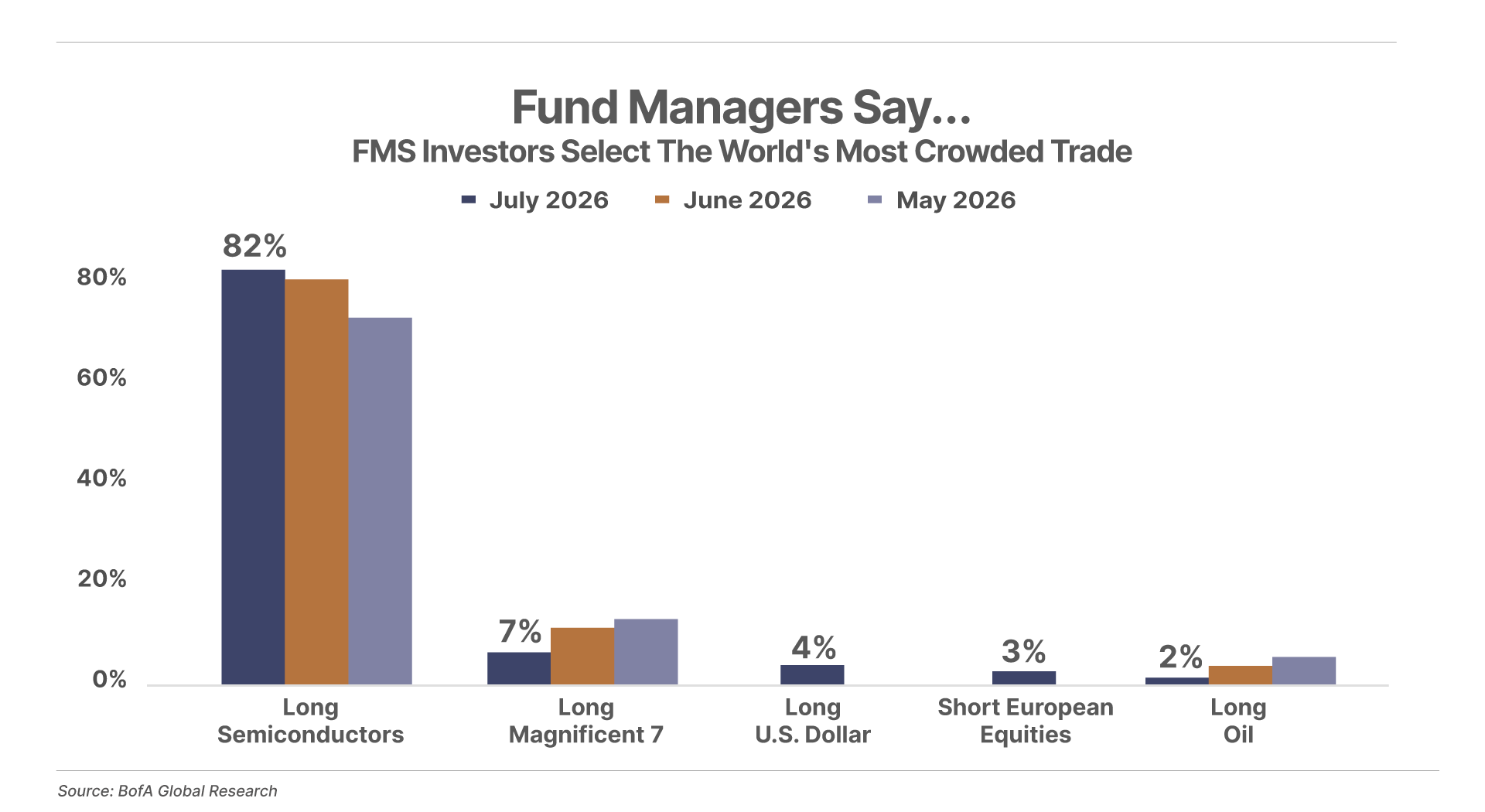
1. The most crowded trade ever. According to Bank of America’s Global Fund Manager Survey (“FMS”), 82% of institutional investors polled believe long semiconductors is the most crowded trade in today’s market. That’s the highest reading for any trade in the history of this survey.
2. U.S. debt increased 9% in the last 12 months. Since 2020, federal debt has ballooned by $16.3 trillion, just hitting a record $39.4 trillion. Continuing at the current annual growth rate, we’ll see $50 trillion in 2029. See what else happens in 2029 by clicking here.
3. Kevin Warsh says the inflation surge will soon be a “thing of the past.” In testimony prepared for Congress this morning, the new Fed chairman called inflation “a tax on the American people and businesses” and pledged “regime change” to get rid of it. His sharpest criticism was directed at the flexible “inflation targeting” the Fed adopted in 2020, which permitted above-target inflation after stretches of low prices. Two months in, Warsh has stood up five task forces to review the Fed’s communications, technology, balance sheet, economic data, and inflation approach. Unmentioned in his testimony was the Fed’s $161 billion of government Treasury purchases this year.
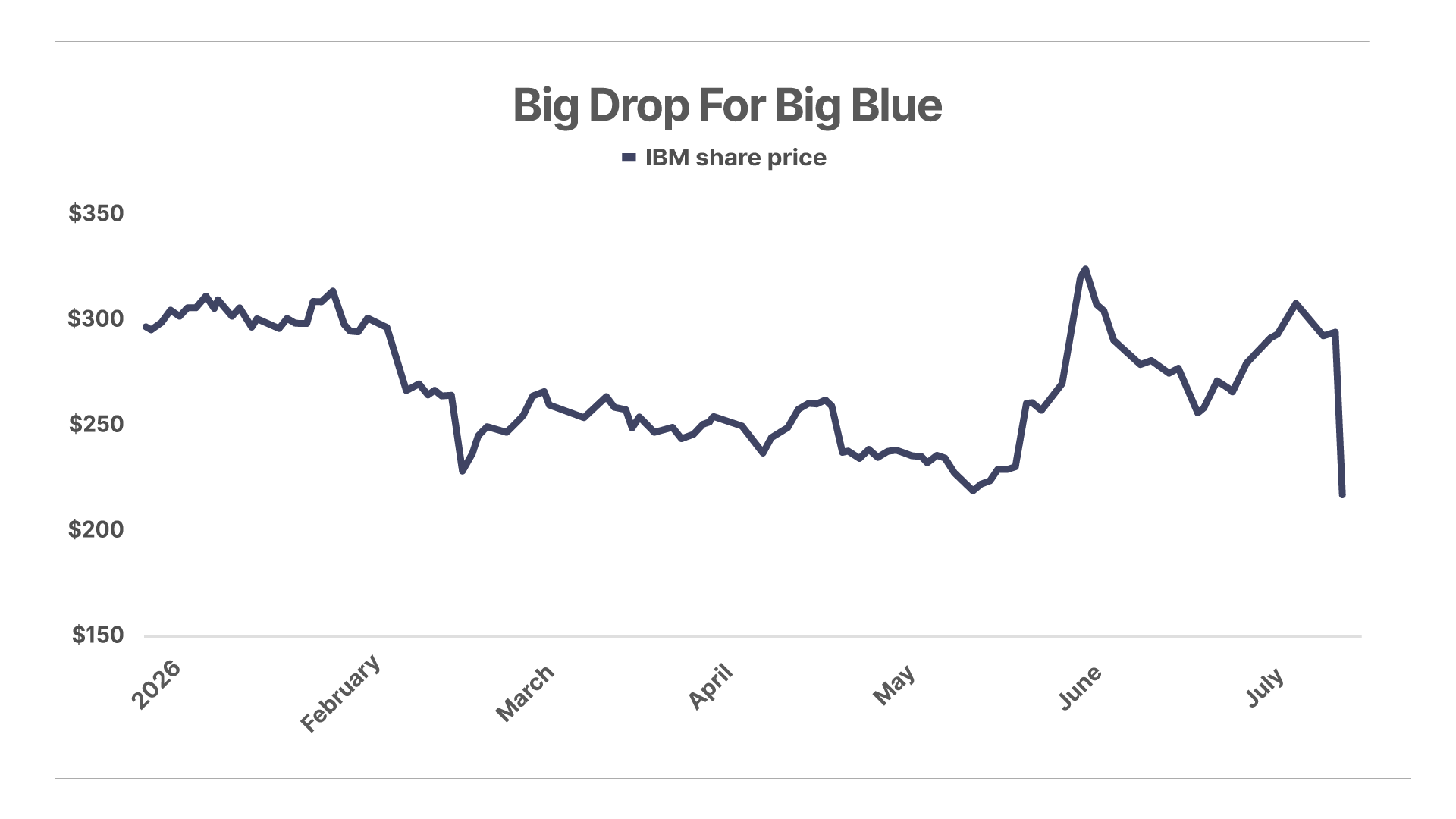
IBM shares plunged 26% this morning – their worst day since the 2000 dot-com bust – following the company’s warning that Q2 revenue and earnings would miss estimates, due to “weakness in the software and infrastructure business.” Today’s decline is particularly notable given that CNBC’s Jim Cramer – whose ill-timed calls have earned him an Inverse Cramer Tracker ETF (SJIM) – recently called IBM undervalued and “a buy right now.”
In yesterday’s Daily Journal, Porter presented his investment strategy for Tech Frontiers – now that its founding editor Erez Kalir has left the advisory.
“Great Talent Attracts Great Talent”
James M. writes:
I have no doubt you’ll find another great tech person. I’ve learned over the years that great talent attracts great talent.
I also like the tollbooth idea as it has worked very effectively in other industries – just wondering whether to act on the list of stocks mentioned (actually already aware of HALO from Brownstone).
Bayly T. writes:
Thanks for responding quickly to Erez’s departure. Can you give us an idea of timing around establishing your tollbooth strategy? As a 32-year veteran asset manager, I know how important it is to have a professional making decisions on security selection even if the sector is in a bull phase.
Barry H. writes:
Great article but when are you going to tell us the companies that make-up the Tollbooth Index? I currently own six of Erez’s recommendations. Do you recommend buying XBI versus continuing to buy individual stocks?
Porter Comment: Erez only told us of his plans last week, so I’ll be spending the next two weeks reviewing the entire list of recommendations. You’ll see our new strategy and our new lineup in the next issue, which will be published on-time Saturday, August 1. I don’t expect to change Erez’s positions, but as I’ll be publishing directly under my own name, I’ve got to personally go through each position and evaluate it. I also want to make sure that we have enough exposure to the primary trend, which I believe will be the most powerful bull market ever in biotech. I appreciate the challenge thrown at me by some subscribers doubting my ability as an analyst in these markets. I mean, who do you think recruited both David Lashmet and Erez Kalir in the first place? No, biotech hasn’t been my primary focus since around 2005, but I have decades of experience in the space. And you can bet that in a year or two, I’ll be showing you results that prove it. I’ve got all of those emails posted in my office.
Porter & Co. Top Positions
Please note: The investments in our “Porter & Co. Top Positions” should not be considered current recommendations. These positions are the best performers across our publications – and the securities listed may (or may not) be above the current buy-up-to price. To learn more, visit the current recommendations page of the relevant service, here. To gain access or to learn more about our current recommendations, call our Customer Care team at 888-610-8895 or internationally at +1 443-815-4447.