Issue#130, Volume#3

Introducing Porter & Co. Biotechnology (Final In A Series Of Three)
Inside Today's Issue
Over the last two days, I showed you the new railroad – the hundreds of billions of dollars a year going into data centers.
And I explained the paradox of transformative infrastructure: new railroads destroy virtually everything that came before them, while creating a new economic map. For us today, that means as massive new data centers cut the cost of compute to virtually zero, many businesses that provide compute-based services will die. The key to understanding the next 20 years is: which forms of compute-centric businesses can maintain their moat?
The industry that survives is the one the government protects with a patent. The moat is the government.
Yesterday I showed you one of the most important new biotech targets: Lipoprotein(a), Lp(a), an inherited cholesterol particle that one in five people carry, that diet won’t fix and that other drugs don’t target. I believe these drugs will do about $40 billion a year at maturity, even though Wall Street is currently only modeling $4 billion to $10 billion in revenue at maturity.
The drug that leads the Lp(a) race is called pelacarsen. It was invented by a company called Ionis Pharmaceuticals (IONS). (Ionis used to be called Isis… but changed its name in 2015 for obvious reasons.) Ionis has spent 35 years perfecting one kind of chemistry behind gene silencing. If you went looking for the pure play on the biggest cardiovascular drug of the coming decade, you would buy Ionis. But that would be a huge mistake.
In February 2019, Novartis (NVS) licensed pelacarsen from Ionis and took over everything – the manufacturing, and the worldwide rights. It now owns the front-runner in the race for a Lp(a) therapy. Ionis will only see a small sliver of the resulting revenue. First, Ionis will get milestone payments – one-time checks for hitting specific events. More than $275 million is already in the bank. But the entire arrangement is capped at roughly $900 million. Second, Ionis will receive generous royalties – a permanent cut of sales, starting near 15% and climbing toward 22% as the drug grows. That sounds like a very good deal… but… In January 2023 Ionis sold 25% of its pelacarsen royalty to Royalty Pharma for $500 million in cash up front.
So, if pelacarsen sells $3 billion a year, Novartis collects about $2.4 billion of it. Ionis gets roughly $450 million. Royalty Pharma (RPRX) takes the remaining $150 million. Novartis keeps four dollars out of every five. The company that discovered this molecule, that spent three decades learning how to build it, will keep about 15 cents of every dollar it earns.
The other leading gene-silencing company besides Ionis is called Alnylam Pharmaceuticals (ALNY). Its chemistry works in a slightly different way, and in some ways it’s superior to Ionis’ technology. Alnylam’s drugs can last even longer in the body, including its twice-yearly cholesterol injection, Leqvio. And guess who owns Leqvio? I’ll give you two guesses. Novartis licensed this drug too, on almost identical terms, and private-equity firm Blackstone bought most of Alnylam’s royalty.
Leqvio sold $1.2 billion last year. In the quarter ending June 30 alone it did $480 million, up 59% year over year, which puts this year’s total revenues around $2 billion. Novartis sells this drug in 87 countries and currently expects the drug to reach $4 billion a year at maturity. Novartis holds patents on Leqvio into the mid-2030s. Leqvio should produce something around $50 billion before a generic knock-off can possibly touch it.
Alnylam – which discovered the molecule and proved the chemistry – will get about $5 billion of that. Novartis keeps the other $45 billion.
That’s why we will own Big Pharma in our Porter & Co Biotechnology portfolio. Yes, we will follow the science to know where the most valuable new drugs are being created. And then we will follow the money. Novartis is likely to be one of the single biggest growth companies in the world over the next 20 years, despite its current (large) size.
Novartis traces back to a dye works founded in Basel, Switzerland, in 1758 – a business older than the United States. It has sold chemistry for human use through the Napoleonic wars, two world wars fought on its doorstep, and the entire creation of the modern regulatory state. Talk about a Lindy business.
More important, it has produced a first-in-class medicine in nearly every modality. Gleevec, in 2001, was the first drug designed to jam a single enzyme driving cancer. Kymriah was the first approved therapy that removes a patient's own immune cells, reprograms them to hunt cancer, and puts them back. Zolgensma delivers a working gene inside a virus to infants born without one. Pluvicto bolts radiation onto a molecule that seeks out a tumor and burns it from the inside.
That is four of my 11 Kingdoms, and Novartis got to each of them first or nearly first. It’s now the leading Big Pharma producer of gene-silencing drugs too. And Wall Street still doesn’t understand it. All Wall Street knows is patent deadlines. Entresto, Novartis’s heart-failure drug, sold $7.7 billion in 2025. But it is now off patent. Generic copies launched. Entresto only sold $1.18 billion in the June quarter – down 51%.
Seems like bad news. But it’s actually just business as usual. And look what’s coming next…
To sell Leqvio, Novartis built a sales force calling on the world's cardiologists about a twice-yearly injection for cholesterol. Pelacarsen will go to the same doctors, for the same organ, and using the same basic modality. There is no launch to build. It already exists – and it is already growing 59% a year.
Yes, Eli Lilly (LLY) and Amgen (AMGN) are developing similar drugs. But Novartis will get there two years ahead of them, with a sales force that’s ready to distribute. It will dominate the field for four to five years.
Novartis trades at 18x earnings and pays a 3% dividend. At that price, you are paying for the business that already exists – the cancer drugs, the radiation drugs, the gene therapies. The biggest cardiovascular launch of the decade comes free.
And while I believe Novartis is an excellent way to profit from the coming biotech boom, there are even better ways to own gene-silencing drug makers – ways that promise 10x returns, not merely market-beating returns.
We’ll cover all of them. Join us – tomorrow, August 1, when we launch Porter & Co. Biotechnology with a full portfolio – every recommendation with a risk rating, a buy-up-to price, and a specific position size.
Tell me what you think of today’s Journal: porterstansberrydirect@gmail.com
Good investing,
F. Porter Stansberry
Stevenson, Maryland

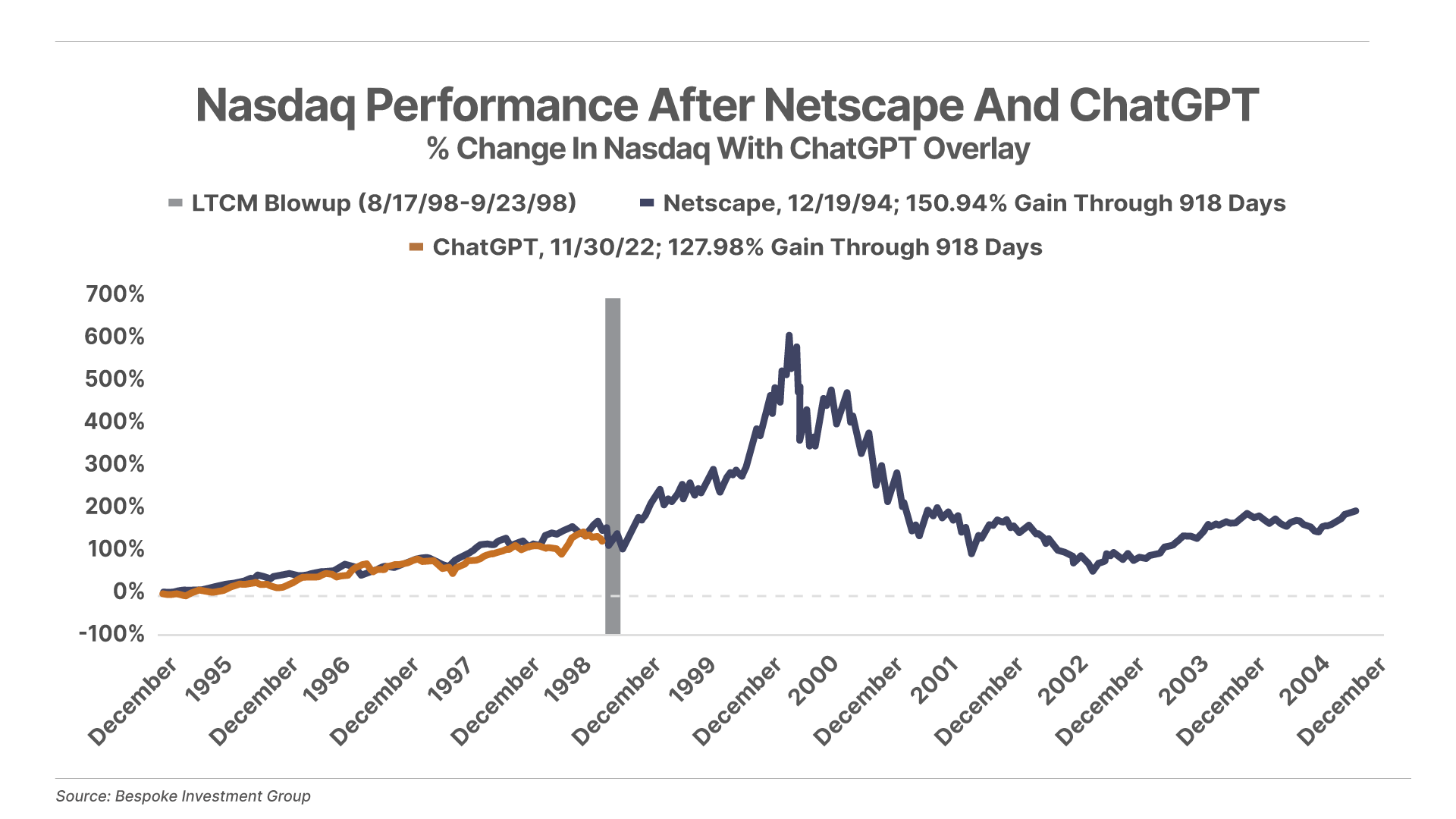
1. Situational Awareness just got margin-called. Leopold Aschenbrenner, 25, left private AI platform OpenAI in 2024 and published an essay that became the blueprint for the AI infrastructure trade: He predicted AI would demand an enormous buildout of chips, memory, and power. He turned that idea into a hedge fund – named Situational Awareness, after the title of his essay – that returned more than 1,000% since its launch and 439% in the first half of this year alone. As of June, the fund was 4x levered long AI hardware stocks and short software stocks. July saw both of those trades move sharply against him, triggering a margin call this week that ended with Ken Griffin's Citadel buying all of the fund’s public equity exposure at fire-sale prices. Coincidentally, this week’s blow-up occurred just over 900 trading days after the launch of ChatGPT, which kicked off the AI boom. This parallels the failure of Long-Term Capital Management – the leveraged bond fund the Fed had to rescue in 1998 – just over 900 trading days after the launch of Netscape, which set off the dot-com boom.
2. The hyperscalers have the backlog – now they just have to deliver it. Combined cloud backlog at Microsoft (MSFT), Oracle (ORCL), Alphabet (GOOG), and Amazon (AMZN) jumped 185% from Q2 2025 to $2.3 trillion in Q2 2026. Much of that backlog was contracted at lower compute prices. If rates stay anywhere near the current higher levels, renewals reprice sharply higher, and nearly all of that increase drops straight to gross profit, since the infrastructure build-out has happened. Morgan Stanley pegs hyperscaler return on invested capital at 31% on GPU rental and 25% to 46% on inference.
3. Oracle’s default risk spikes. The price of Oracle credit default swaps – an insurance contract protecting against a bond default – jumped to 205 basis points. That means the cost of insuring $1 million of Oracle bonds is $20,500 per year, and exceeds the levels reached during the height of the 2008 Financial Crisis. Investors are growing increasingly concerned about Oracle’s ability to repay its debt, as it takes on significant leverage to build data center capacity for OpenAI.
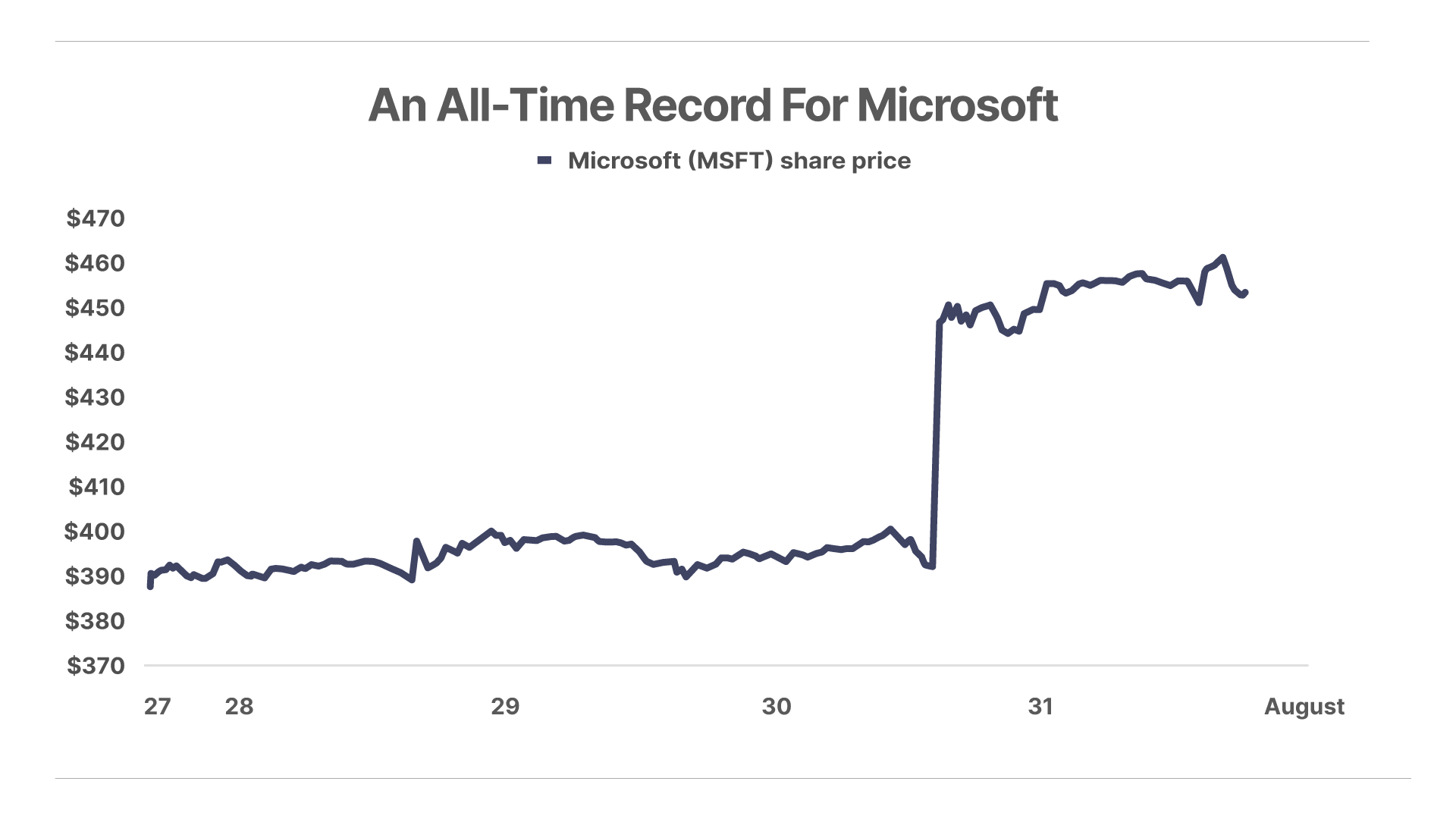
Part of Porter’s Permanent Portfolio, Microsoft (MSFT) soared 16% on Thursday following its blowout Q4 earnings report, its biggest one-day rally since October 2008. The stock gained more than $450 billion in market cap, an all-time record for any company in stock market history.
"Statins Are A Fraud"
In yesterday’s Journal, Porter presented part two of his three-part series on Porter & Co.’s Biotechnology newsletter, which releases tomorrow.
Kendrick M. writes:
The cholesterol theory of heart disease is known to be wrong and statins are a fraud, except for a rare genetic issue.
Porter Comment: If you mean the nonsense that was taught for years about avoiding cholesterol in your diet, yes, you’re correct.
On the other hand, chronically elevated LDL cholesterol (and related apoB-containing lipoproteins) have a causal role in the development of coronary heart disease in many people.
- Large observational studies have shown a close correlation between LDL levels and coronary heart disease risk across populations and time
- Interventional trials are the main evidentiary pillar: lowering LDL reduces clinical events
- Landmark statin trials like the Scandinavian Simvastatin Survival Study (4S), West of Scotland Coronary Prevention Study (WOSCOPS), and CARE demonstrated that statins lower LDL and reduce major coronary events and mortality vs placebo
- A major meta‑analysis by the Cholesterol Treatment Trialists, pooling 170,000 participants in 12 randomized trials, found that each 39 mg/dL reduction in LDL produced about a 20% reduction in major vascular events, with no evident lower threshold beyond which benefit disappears
And… yes… it is also true that LDL isn’t the only significant precursor. Other risk factors, like Lp(a) remain untreated.
But, I believe the evidence is overwhelming that LDL cholesterol is one of several major modifiable risk factors (along with blood pressure, smoking, diabetes, obesity, etc.)
Regards,
Porter
"I Am Over-The-Top Impressed"
Dick S. writes:
I am very impressed with your knowledge and insight, but now I am over-the-top impressed. I taught biology and physiology for 35 years. Your understanding of Lp(a) is excellent. How do you learn information in other fields of knowledge so different from money? I would have loved to teach you as one of my students.
Porter & Co. Market Snapshot
| Price | Yesterday's Return | Year-to-Date Return | |
| S&P 500 Index | $7,437.63 | 1.66% | 9.3% |
| Gold per ounce | $4,100.10 | 0.86% | -6.7% |
| Bitcoin | $64,725.31 | 2.01% | -27.9% |
| Oil (West Texas Intermediate) per barrel | $83.59 | -1.25% | 49.2% |
| Berkshire Hathaway (BRK) | $764,990.01 | 0.24% | 1.4% |
| Porter's Permanent Portfolio | - | -0.61% | 1.4% |
| The Better Than Berkshire Index | - | -0.85% | 9.1% |
| Total Return | Annual Return | ||
| Porter & Co's Top Ranked* | 34.5% | 16.5% | |
| Yield | Yesterday's Change | Change Year-to-Date |
|
| U.S Treasury 30-Year Yield | 5.21% | 1 bps | 37 bps |
| Prices as of 4:00 pm ET July 30, 2026 | bps = basis points (or 0.01%) | |||
| *A Complete Investor risk rating of 1 is defined as a "low risk, high allocation" security, while positions rated closer to a 5 are higher risk. Porter & Co.'s top-ranked positions include those rated either 1 or 2 in Complete Investor portfolio. | |||
Porter & Co. Top Positions
| Publication | Ticker | Description | Total Return |
| Tech Frontiers | QURE | uniQure | 237% |
| Complete Investor | BWXT | BWX Technologies | 191% |
| Biotechnology | NUVB | Nuvation Bio | 164% |
| Biotechnology | ROIV | Roivant Sciences | 153% |
| Biotechnology | TGTX | TG Therapeutics | 151% |
| Complete Investor | SKWD | Skyward Specialty Insurance | 143% |
| Complete Investor | BTC/USD | Bitcoin | 140% |
| Complete Investor | PM | Philip Morris | 138% |
| Biotechnology | SGMT | Sagimet Biosciences | 135% |
| Tech Frontiers | QURE | uniQure | 131% |
| Prices as of 4:00 pm ET July 30, 2026 | |||
Please note: The investments in our “Porter & Co. Top Positions” should not be considered current recommendations. These positions are the best performers across our publications – and the securities listed may (or may not) be above the current buy-up-to price. To learn more, visit the current recommendations page of the relevant service, here| New Window. To gain access or to learn more about our current recommendations, call our Customer Care team at 888-610-8895 or internationally at +1 443-815-4447.