My Mentor Chris Weber's Max Yield Strategy Turns Your Cash Into Wealth, Automatically
Inside Today's Issue
One of my most valuable mentors is someone you've probably never heard of, Chris Weber.
Weber is an autodidactic genius. He’s such a great investor that he's never had a real job. His education came from libraries, where he spends most of his time. He took his teenage lawn-mowing money and then used gold futures to pyramid that grubstake into several million dollars. He got out of the 1970s commodity boom in 1981 when long-term rates hit 15% in the U.S. From there, he had a simple hurdle: he wasn't going to buy anything unless it was virtually certain to beat a guaranteed 15% a year.
By the time I met him in the mid-1990s, he was living in the house next to the Kennedys in Palm Beach. He later sold that during the internet boom for 10x more than he paid. He told me he made $1,000 per day just by living in that house! Then he moved to Monaco.
Weber is unlike any other investor I've ever met. He has an unrivaled sense of market timing and has successfully invested in more countries, in more asset classes, and in more sectors of the global economy than any other investor – ever. He’s in a league of his own.
He’s taught me some of the most valuable ideas about investing that I've ever learned. And one of the very best is his Max Yield strategy. Like everything Chris does, it's so simple it's almost childlike.
All you do is find the best place in the world to make money this year: the country that's offering the highest yield on a one-year maturity government bond.
That’s it.
You buy it every year on January 1. And sell it one year later, rolling 100% of the capital into whatever country is offering you the highest rate for the next year. Simply doing this will make you unbelievably wealthy.
How do I know?
I've watched Chris do it for 30 years.
We once had lunch with my mother at the Highlands Inn – a gorgeous hotel overlooking Big Sur in California. My mom was asking Chris about where he lived. (Chris, who has a stutter, doesn't like to talk about himself... or anything else, really.) So, he said, "Monaco," without any further explanation.
And my mom (who was a schoolteacher and housewife) could hardly believe it. "But isn't that where all the world's wealthiest people live...?"
"Well.... yes... and me," Chris said, modestly.
"But, I thought you said you have a house in San Francisco," my mom kept prying.
"Well, that's just for the summer," Chris stammered, without elaborating.
This, for my mother, was beyond comprehension. "San Francisco... that's one of the most expensive cities in the world. And you already have a home in Monaco? How does that work with your budget?"
Chris: "B-b-b-b-budget? What's that?"
I've taken Chris Weber’s Max Yield strategy and I've updated it, a bit, in ways that I think make it more robust. When Chris built the strategy, things like zero interest rates didn’t exist. So I’ve added some sensible low-yield guardrails and a simple investment quality guardrail.
If you want to live without a budget, consider this incredibly simple and lucrative strategy. I know it works.
Why does it work? Because it makes sure your capital will continue to compound, year after year. A bond yield isn’t like a dividend. It can’t be cut. A government offering 17% on a 1-year bond means you’ll get 17%. No more. But also, no less. There is nothing to forecast and no balance sheet to read. You don’t need to follow the news or the earnings reports. You simply collect. Year after year.
There's one important catch: foreign governments pay you in their own currency, so your return in dollars is the yield plus or minus whatever that currency does against the dollar.
On January 1, 2007, a 1-year Turkish government bill paid 20.1%, and the lira rose 21% against the dollar that year, for a total return of 45.8%.
A year later, the yield was 16.3%. Then the 2008 financial crisis hit, the lira fell 25%, and the trade lost 12.2%.
The very highest yield often belongs to the country closest to a currency collapse. In 2001, Turkey paid 40% on its 1-year bills, and the lira lost half its value that year. In 2018, Argentina paid 29%, and the peso lost half its value too. Each trade lost about 35% in dollars.
So I added three rules to Chris' idea.
Rule #1: Only lend to reliable countries.
S&P Global grades governments the same way it grades companies, from AAA at the top down to D for default. Below BB-, the bottom rung of the BB category, the odds of default jump. From 1975 through 2023, governments rated BB defaulted within a year only 0.36% of the time, while governments rated B defaulted 2.72% of the time: 7.5x as often.
You're holding a 1-year bond, so the 1-year odds are the ones that matter, and at BB- or better you're lending to a country that almost always pays. Below that line, you're taking on a lot more risk.
I’ve also crossed a few countries off the list, as I believe their bond markets are un-investable. Russia defaulted on its own ruble debt in 1998 and remains one of our main political rivals. Brazil taxes foreign money on the way in (it charges foreigners 6% just to buy its bonds – no thanks). And China kept foreign investors out of its bond market until 2016. Today, owning its debt is, as with Russia, a national security risk. We also skip any country that won't let your money leave, as Argentina did for most of the past 25 years and Iceland did from 2008 to 2017.
Rule #2: Buy the highest yield, unless there's no clear winner.
A clear winner pays at least two percentage points more than the next-best reliable country. Turkey, for example, was the clear winner every year from 2005 through 2009. But when the top yields are bunched together, there is no clear winner. When that happens, you should split the money equally among every country within two points of the top. In 2023, that meant buying Hungary, Colombia, and Chile, which were all paying between 11% and 13%.
Rule #3: You only follow the Max Yield strategy when you’re getting paid for it.
This is the most important rule. Getting paid means a double-digit yield as a hard minimum. Anything under 10% leaves too little cushion against a falling currency, so in those years we skip bonds entirely and buy an S&P 500 index fund instead.
This rule kept the strategy in stocks from 2010 through 2022 (as countries around the world lowered interest rates to record low levels) and the Federal Reserve and the other major central banks held interest rates near zero.
What would this have done for you?
Here is every year since 2000.
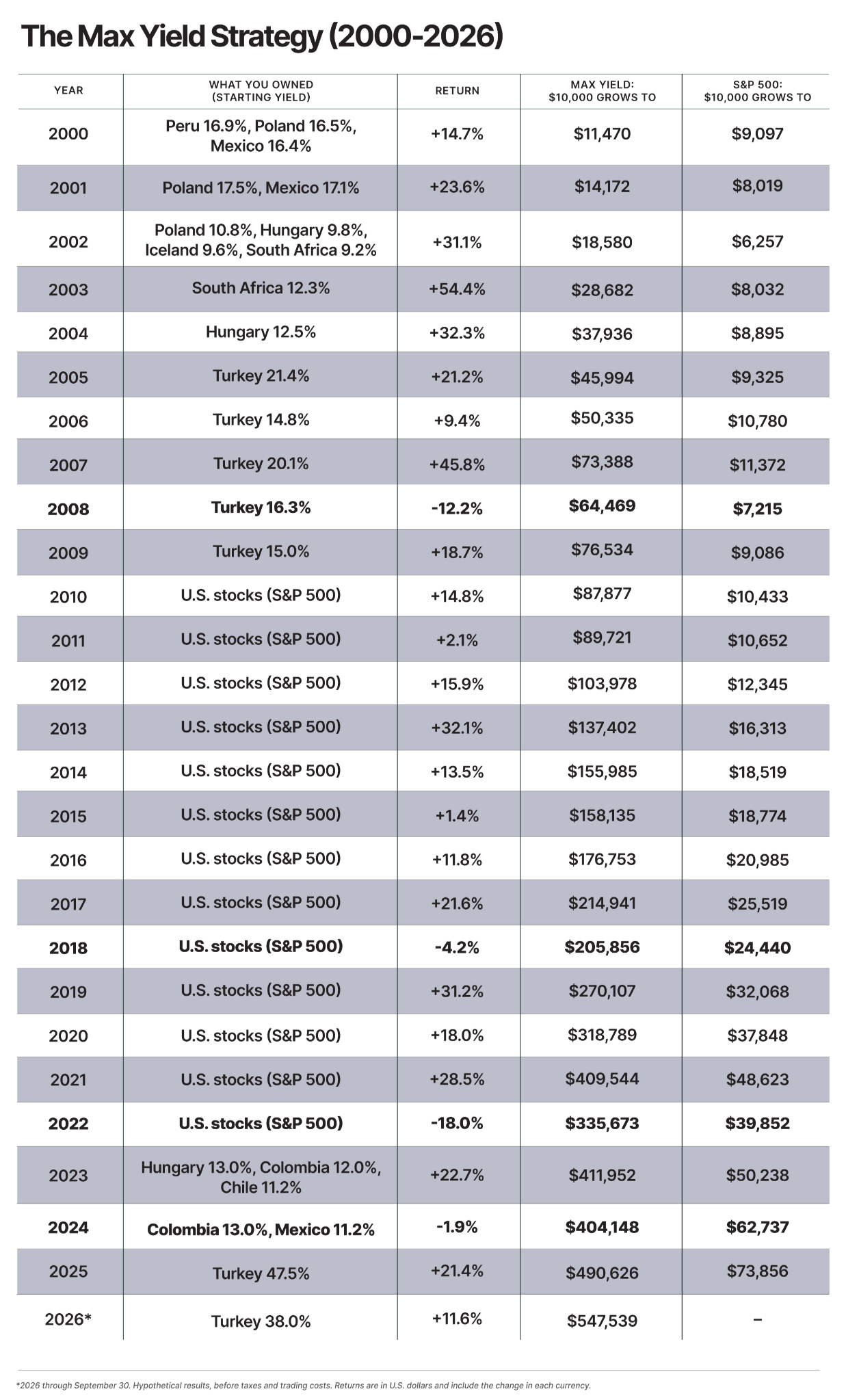
Over 26 years – through 2025 – the strategy compounded at 16.2% a year and turned $10,000 into $490,626, which is more than 6x what the same money would have become in U.S. stocks alone.
The same $10,000 in the S&P 500 grew to $73,856.
The strategy only lost money in four of 26 years. And really, if you look at the results, the actual Max Yield years (where you were buying foreign bonds, not U.S. stocks) only produced two bad results – negative 1.9% in 2024 and negative 12.2% in 2008, when the entire world’s financial system collapsed.
It’s the consistency of this strategy that enables it to work so well. Max Yield pays, no matter what’s happening in the world. From 2000 through 2009, the S&P 500 lost money, and $10,000 shrank to $9,086. But during those years Max Yield turned the same $10,000 into $76,534, because safe governments around the world were paying 11% to 21% a year.
What do you buy now?
On January 1, 2026, Turkey paid 38% and was rated BB-. The next-best safe country, Colombia, paid 9.25%, which made Turkey the clear winner. Through September the position returned about 11.6% in dollars: the lira fell 12%, and the 38% yield more than covered it.
At the end of September, Turkey's short-term rate stood at 37%, and Colombia's at 12%, so Turkey is still the clear winner. Lira-denominated Treasury bills can be purchased through a Turkish broker or bank such as İş Yatırım, Garanti BBVA, Akbank, or Ziraat. The minimum purchase is 500 lira (about $10).
Weber never kept a budget. He didn’t need to: he knew his capital was going to compound far faster than he could spend it.
Yes, it’s almost childishly easy. But it’s also very, very hard to beat.
Horse, meet water.
Tell me what you think of today’s Daily Journal: porterstansberrydirect@gmail.com
Good investing,
F. Porter Stansberry
Stevenson, Maryland

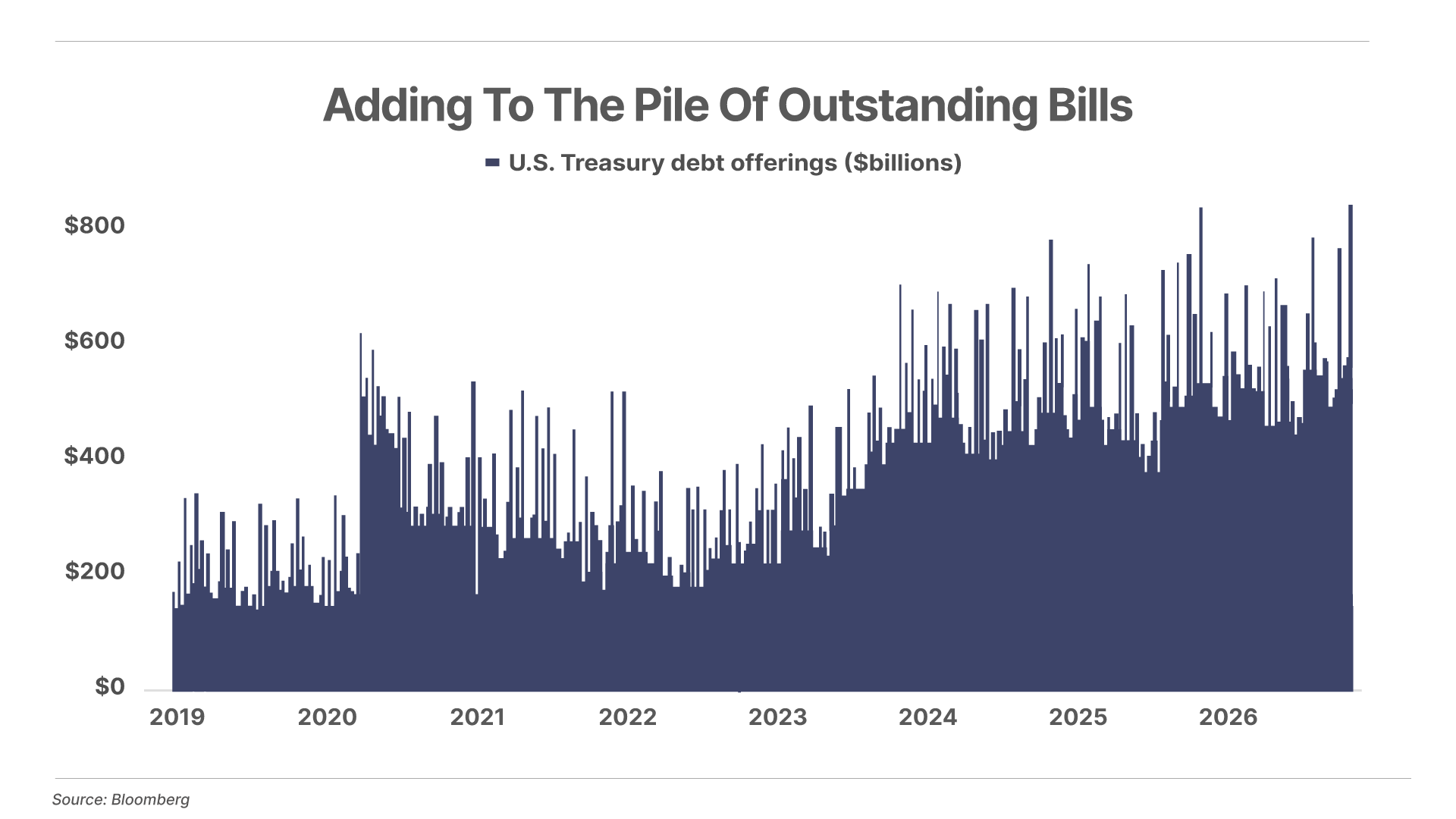
1. The U.S. Treasury sold a record $839 billion of debt last week – more than the entire federal deficit for fiscal 2018 ($779 billion)... in one week of auctions. Only about $106 billion was new borrowing – the rest refinanced maturing bills and notes. The pile of outstanding bills is now so large that the Treasury has to roll more than $700 billion a week – repricing at today’s higher yields. Another reminder that the government’s funding needs are permanent.
2. Hedge funds have cut their stock bets by the most in a decade. Equity long/short funds, which buy some stocks and bet against others, reduced their gross exposure (the combined value of both sets of bets) by about 7.8% from its peak through October 27. That is the largest drop in Morgan Stanley data going back to 2016. After the four previous drops of similar size, in 2016, 2018, 2020, and 2021, the S&P 500 was higher six months later each time.
3. A record gas arbitrage. The price ratio between natural gas in overseas markets versus America has reached a record high 12-to-1. With gas exports from the Persian Gulf disrupted, importing countries in Europe and Asia are experiencing a significant shortage and rising prices. Meanwhile, ample supplies from shale drillers has kept U.S. prices hovering near multi-year lows. The biggest winners are U.S. liquefied natural gas exporters, which are capturing a record arbitrage spread between cheap domestic prices versus rich overseas prices.
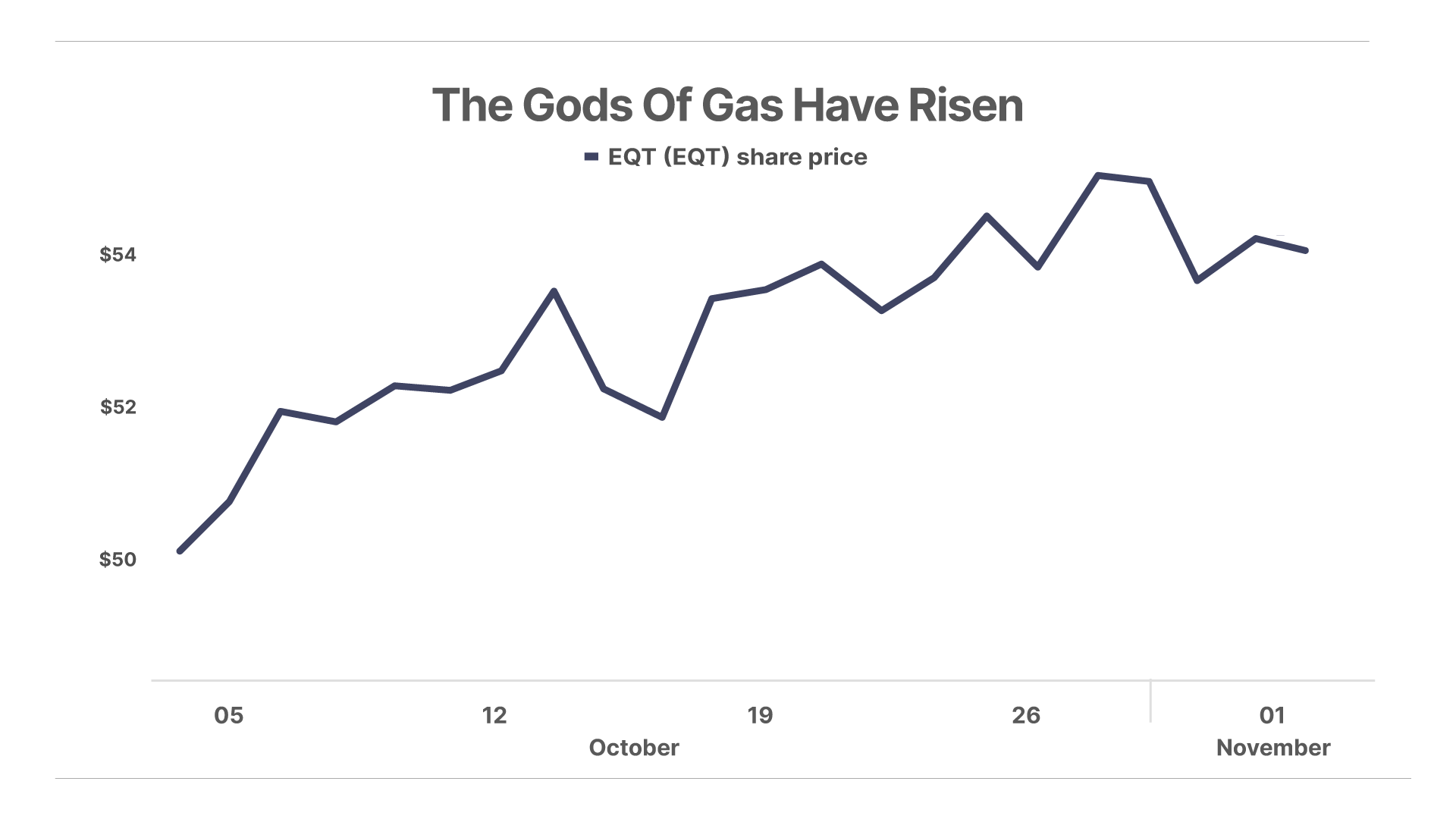
In Friday’s Daily Journal, Porter analyzed the recent performance of natural-gas producer and Complete Investor recommendation EQT (EQT), concluding: “Over the next decade, I’m certain we’ll see natural gas become the majority energy source (over 50%) for electricity in the U.S.” Shares of EQT have risen 10% over the last month.
“Sunday Screener”
Charlie L. writes:
Regarding the “Modified Munger Screen”: Curious how one manages this portfolio over time… do you send the list weekly as it changes over time? Also, do you have any performance info since you’ve offered this list?
Tim G. writes:
I would like to follow a “Porter’s 3X Screen” investing strategy. Will there be a Daily Journal follow-up with the updated list of stocks that meet the criteria?
Porter & Co. Comment: Thanks for taking the time to write. The screens that we send to readers every Sunday morning are not meant to be ongoing or actively traded portfolios, but rather one-off lists that result from very clearly defined filters. The filter criteria we apply to each screen present both a learning opportunity – revealing key metrics we look for – and a tool that investors can use on their own.
We publish our Sunday Screener weekly – rotating our five regular stock screens so readers can see the tools we use to find the best investment opportunities in the market. Each of the five screens seek a different type of opportunity…
- “Modified Munger Screen”: High-quality, larger than small-cap businesses that have been trading below their 200-week moving average
- “Porter’s 3x Screen”: Companies with high capital efficiency, steady revenue growth, and that trade at reasonable valuations
- “Marty Fridson’s Stock Screen”: Companies with non-top-grade scores from rating agencies and that have variable earnings-per-share performance – showing a volatility that provides high upside opportunities
- “The Emerging Lindy Screen”: Future Amazons or Apples that currently show signs of qualitative insight with quantitative rigor – finding firms that exhibit both structural innovation and financial traction
- “Following The Smart Money Screen”: Ideas from the world’s top money managers to see who is putting enormous resources into which securities
Each Sunday, we also produce two other regular lists: stocks that hit their 52-week high and those that hit a 52-week low. Then, every other week, our analysts select a stock from the featured screen or one of the 52-week lists that the analysts will keep their eyes on. We provide a fuller, more detailed writeup of that stock with our Partner Pass members. Many of these stocks in these Partner exclusives later emerge as a featured recommendation in Porter Stansberry’s Complete Investor.
So, in short, the Sunday Screener is meant to be an educational tool for investors – and the weekly reveal of stocks provides potential winners for us and our readers to look at, but we don’t manage the created lists as ongoing recommendations.
Porter & Co. Market Snapshot |
Through Friday, October 30, 2026 close |
| Markets |
| Index or asset | Last | 1-Day | YTD | 1-Year |
|---|---|---|---|---|
|
S&P 500
Total return
|
755.72 | −1.77% | +11.7% | +12.4% |
|
Gold
Front-month futures
|
$3,898.90 | −3.29% | −10.2% | −2.9% |
|
Bitcoin
4 pm ET print
|
$76,753.00 | −4.94% | −12.3% | −27.9% |
|
Crude oil
WTI, per barrel
|
$104.12 | +2.08% | +81.3% | +71.9% |
|
Berkshire Hathaway
NYSE: BRK-A
|
$815,600.00 | −0.23% | +8.1% | +13.6% |
| U.S. Treasury yields |
| Maturity | Yield | 1-Day | YTD | 1-Year |
|---|---|---|---|---|
|
2-Year
|
4.56% | −5 bps | +109 bps | +95 bps |
|
10-Year
|
4.94% | −4 bps | +76 bps | +83 bps |
|
30-Year
|
5.31% | −1 bps | +47 bps | +66 bps |
| Porter & Co. strategies |
| Strategy | 1-Day | YTD | Since start | Per year |
|---|---|---|---|---|
|
Porter's Permanent Portfolio
Since September 25, 2024
|
+0.21% | +6.4% | +34.2% | +15.1% |
|
Better Than Berkshire Index
Since May 16, 2025
|
+0.41% | +5.6% | +5.9% | +4.0% |
|
Porter & Co. Top Ranked*
Since July 14, 2022
|
−0.08% | +5.5% | +30.2% | +10.2% |
Porter & Co. Top Positions |
Through Friday, October 30, 2026 close |
| # | Position | Total return |
|---|---|---|
| 1 |
Roivant Sciences ROIV
Complete Investor
|
+219% |
| 2 |
Roivant Sciences ROIV
Biotechnology
|
+209% |
| 3 |
TG Therapeutics TGTX
Biotechnology
|
+194% |
| 4 |
Bitcoin BTC/USD
Complete Investor
|
+190% |
| 5 |
Philip Morris PM
Complete Investor
|
+159% |
| 6 |
Skyward Specialty Insurance SKWD
Complete Investor
|
+139% |
| 7 |
APA Corporation APA
Porter & Co. Asymmetry
|
+138% |
| 8 |
BWX Technologies BWXT
Complete Investor
|
+132% |
| 9 |
W.R. Berkley WRB
Complete Investor
|
+117% |
| 10 |
Chubb CB
Complete Investor
|
+97% |