Not Everyone Should Do It, But All Investors Should Understand How And Why
Inside Today's Issue
Editor’s Note: Before you vote on November 3, Porter warns there’s one more urgent move you need to make – an investment he now calls “a core asset.” Because whoever wins, he believes a bipartisan pact could devastate the financial future of millions of Americans… and he wants you protected before the chaos ensues.
He reveals the name, for free, in his emergency election broadcast.… along with the three-step test he believes every investment you own must now pass, and the names and tickers of some of his favorite businesses.
Get the name here – before you vote.
We believe that we’re entering an era when the majority of stocks are likely to decline in value.
This is based on our long-running thesis that the artificial-intelligence (“AI”) boom is vulnerable to a significant unwind, which could ripple across the broader economy. And over the past several weeks, we’ve seen signs that this process may have already begun.
The epicenter of the AI “picks and shovels” trade, semiconductor stocks, has officially entered a bear market, down 22% from their June high. Other key suppliers to the boom, including memory makers like Micron Technology (MU) and Sandisk (SNDK), have dropped 30% to 50%. We’ve seen similar declines across the power suppliers like Caterpillar (CAT) and Vertiv Holdings (VRT). More recently, the declines are spreading into hyperscalers like Amazon (AMZN) and Alphabet (GOOG), which posted its single largest daily market loss following Q3 earnings this week.
For investors with the risk tolerance to take advantage of this broad market decline, I want to share insights for placing short sales. As I tell the members of The Trading Club, which I lead for Porter & Co., this could become a valuable tool for generating returns and hedging downside risks.
To be clear, we rarely recommend shorting stocks because, over the long run, it’s a tough way to make money. But in the right environment, a well-placed short can be a powerful tool for hedging a portfolio.
For a quick explanation… when shorting, you earn a profit if the price of the stock goes down. The best possible outcome with a short is a 100% return if the stock goes to zero. The worst possible outcome, though, is losing more than the value of your original investment. There’s no limit to how high a stock can go – and thus, no limit on the potential losses from shorting it.
This lopsided risk/reward proposition makes short selling a high-risk trading strategy. And thus for those investors who do not have a high risk tolerance, we do not recommend these kinds of trades. But it’s something any investor should have an understanding of.
So why do it? Because, even though shorting stocks is a very difficult way to make money in most market environments, the odds of success improve dramatically in a bear market. The upside goes beyond the simple profits earned from falling prices. The real opportunity comes from what’s known as crisis alpha, or the ability to generate profits when everything else in a portfolio is falling in value. Those profits can then be redeployed into buying stocks at deeply discounted prices, setting the stage for massive long-term wealth creation.
In 2008 – in the midst of the worst bear market for U.S. stocks in decades – Porter made seven short recommendations that returned an average of 25%. His long recommendations fell in value, along with everything else during 2008. But the profits from shorts offset those losses. The end result was an average loss of 1.4% versus a 37% loss in the S&P 500. That’s exactly what you want your shorts to do.
In other words, the value of short selling is not so much about the speculative profits made from falling prices. The real opportunity comes from using this as a tool for limiting losses, reducing portfolio volatility, and preserving capital during a bear market.
And that’s exactly the type of environment I’ve been preparing for in The Trading Club, where I recommend real-time trading ideas tracked in a live account, using various strategies including short selling as well as buying and selling puts – which is another method of shorting. We believe the economy and financial markets are approaching a tipping point. The debt-fueled capex boom of the AI revolution is coming under strain from rising borrowing costs. If this trend continues, we see significant risks of a deceleration in AI infrastructure spending. And given the importance of this spending in driving corporate profits and overall U.S. economic growth, we believe such a scenario could trigger a broader bear market and recession.
So in order to navigate this environment, we recently added short selling into our toolbox of strategies. Today, we’re sharing our short-selling guide, designed to help subscribers navigate the risks and avoid the pitfalls involved in this trading strategy.
Let’s jump into the process of how this works.
The Mechanics Of Short Selling
Short selling is the inverse of traditional investing. Instead of trying to buy low and then sell high, you’re aiming to sell high first and then buy low later. This means the trading orders are reversed: you sell to open the position, and then buy to close.
The process of selling a stock that you don’t already own requires that you borrow it from another investor who owns the stock, through your broker. The incentive for investors to make their shares available for shorting comes from the fees they can earn from lending out their shares, which the short seller pays.
Of course, there is no guarantee that your broker will have access to a large enough pool of loanable shares to initiate or maintain a short position. Thus, you must pay close attention to the supply of available shares on loan through your broker when short selling, which we discuss in greater detail below.
For now, the key point to be aware of is that each short position technically behaves as a loan. And the mechanics involved in borrowing shares can create significant risks that short sellers must know how to navigate.
Managing The Risks
Risk management begins with a careful process for selecting the optimal short candidates. You’re not simply looking for stocks that are most likely to fall in value – that’s only the beginning of the process. From there, you must narrow the field down to eliminate the stocks that can cause major headaches in a portfolio.
The biggest risk comes from a lack of available shares to borrow. Two key metrics help us determine whether a stock has sufficient available borrowing capacity, including the utilization rate and the borrow fee, described below.
Utilization rate: defined as the ratio of shares currently on loan divided by the total lendable supply – a lower rate is better, as that means more shares available. This is the single best gauge of determining how much borrowing capacity is left.
Borrow fee: the market price of borrowing shares from your broker. Low rates indicate ample supply and higher rates indicate scarcity.
When utilization rates and/or fees begin climbing week after week, this is an early warning signal that the supply of loanable shares in a specific company is drying up, even if overall levels remain low.
One thing you’ll discover as a short seller is that these guidelines will naturally prohibit you from targeting some of the juiciest short candidates in the market – those stocks with the most obvious problems, and most likely to collapse in price. Like a wounded fish in the ocean, the blood trail on these stocks attracts hordes of sharks – fellow short sellers looking for an easy meal. That’s how you get “crowded shorts,” which should be avoided at all costs. Otherwise, you run the risk of a GameStop situation, which provides a cautionary tale in how short selling can go horribly wrong.
A Case Study In What Can Go Wrong
In 2020, GameStop (GME) was one of the most heavily shorted stocks in the market, and for good reason. The video-game retailer was stuck in secular decline for many years, and its prospects were made worse by the COVID-19 pandemic. With declining sales, no earnings, and a bloated balance sheet, it was teetering on the verge of bankruptcy. And yet, it briefly became the single best performing stock in the market in early 2021.
Retail investors organized on social media platforms like Reddit, led by ringleader Keith Gill (“Roaring Kitty”), and developed a thesis that the company was undervalued and the shorts were dangerously overextended. Ryan Cohen’s activist investment and push for a turnaround gave that thesis credibility.
In January 2021, a wave of retail buying triggered what’s known as a “short squeeze.” This occurs when a heavily shorted stock begins rising in value, which triggers margin calls and share recalls from brokers. The buying pressure from short sellers forced to close their positions then drives prices higher in a vicious, self-reinforcing loop.
That’s how GameStop – a dying company on the verge of bankruptcy – rose 2,300% from a split-adjusted $5 to as high as $120 over the course of 11 trading days in early 2021:
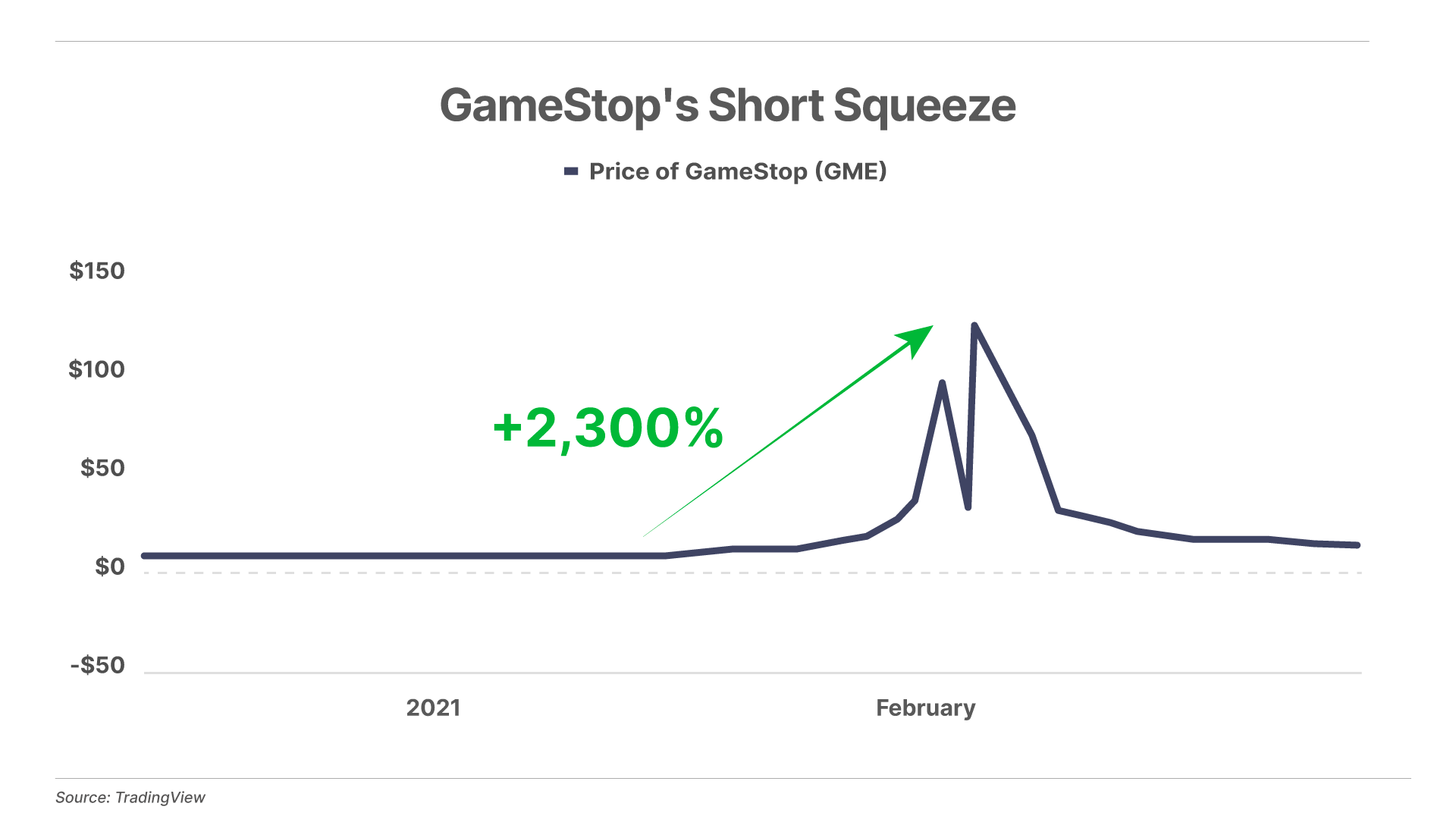
The ferocity of the move is what made it so painful for the shorts. On a single trading day during the height of the squeeze, GameStop shares surged from a prior closing price of $37 to an opening trade of $87 the next day. This kind of instantaneous move is known as a “gap,” meaning no trades took place between these two prices. This is one of the ultimate dangers for short sellers, who normally try to exit their positions gradually as the price moves against them and triggers stop losses or margin calls. Anyone who held a short position in GameStop overnight woke up to an instant move of 135% in the wrong direction on the opening trade the following morning.
Of course, like most short squeezes, the stratospheric rally was ephemeral. By mid-February 2021, GameStop had collapsed to $10 per share. But for many short sellers, it didn’t matter – they were forced to buy in at the inflated prices from margin calls all the way up.
This included major hedge funds like Melvin Capital, which managed $13 billion at its peak and was backed by legendary trader and billionaire Steve Cohen. Melvin, run by manager Gabe Plotkin, lost billions of dollars on its GameStop short. The fund ended 2021 down 39%, and closed its doors the following year. The saga between Melvin and the retail army fueling the short squeeze was covered in the film Dumb Money – a highly entertaining account of what can go wrong in the world of short selling.
Melvin Capital’s downfall provides a classic case study in what not to do when selecting short candidates. It wasn’t just that GameStop was a crowded short. This was compounded by the fact that the stock attracted a cult following of millions of traders who were willing to buy shares just to squeeze the shorts, regardless of the company fundamentals.
With these risks in mind, we have established five key rules to avoid suffering the same fate:
- Rule #1: Avoid crowded shorts at all costs. We recommend limiting your selection universe to stocks that have less than a 50% borrowing utilization rate and less than 1% borrowing costs.
- Rule #2: Maintain a strict stop loss and position-size limits. We recommend not risking more than 5% of total capital on a single short. To stay within this limit, define a stop loss and position size limit for every trade.
- Rule #3: Mind the “gap risk.” This refers to the risk of an instant “gap” in price, which can send a stock soaring above your stop-loss price. Avoid crowded shorts, and other types of stocks that are likely to generate significant price gaps. Examples include thinly traded small-capitalization stocks, biotechs with major drug development news looming, and potential takeover targets. While it’s impossible to eliminate this risk completely, we attempt to minimize it by focusing on large capitalization, highly liquid stocks that have low odds of a takeover or other catalyst that could result in a sudden, extreme price movement.
- Rule #4: Avoid cult stocks. GameStop is the classic example of a cult stock. A company on the edge of bankruptcy, but which managed to rally 2,300% on little more than the cult-like support among retail traders willing to buy shares regardless of the underlying fundamentals. This rule also extends to stocks run by highly promotional CEOs with cult-like followings, who can energize their followers to buy shares with nothing more than a social media post or positive commentary on an earnings call, regardless of the underlying financial reality. And that brings us to one final rule…
- Rule #5: Never short a company run by Elon Musk. The eccentric founder of Tesla (TSLA), SpaceX (SPCX), and other companies always manages to make surprising comebacks after his companies look as if they are going south (ask me how I know!).
While these rules alone won’t eliminate all risk, we’ve found that they can at least dramatically reduce the odds of any single short position dealing a fatal blow to a portfolio.
How Often Is Short-Selling Successful?
Successfully shorting a stock requires impeccable timing. You not only need to be right about the direction of the stock, but also the timing of its decline. A company might be fundamentally overvalued, but it could remain that way or even climb higher for an extended period. This can lead to mounting borrowing costs and the risk of a short squeeze that forces you to close the position at a loss before your thesis plays out.
That’s why we only recommend this strategy for investors with a high risk tolerance, and with substantial trading experience. Even then, history is littered with examples of seasoned professionals suffering devastating losses from ill-placed short positions. Melvin Capital’s multibillion-dollar loss in GameStop is just one in a long line of similar case studies.
Despite these challenges, the success rate for short selling can improve dramatically during bear markets. Of course, these are rare occurrences. But when they do strike, the vast majority of stocks fall in price, and often by a significant amount. And it’s in these kinds of environments that short selling can become a powerful hedge within a portfolio. The ability to redeploy profits from short selling into long positions at discounted prices after a market correction is where the true value of short selling lies for long-term wealth creation.
In addition to short selling, we use other strategies for profiting from falling stock prices in The Trading Club, including purchasing out-of-the-money put options. The trade below shows our put-option trade in the Invesco Nasdaq QQQ Trust (QQQ) – an exchange traded fund (“ETF”) tracking the Nasdaq index – which we placed in our live tracking account on October 2. This position is up by 79% as of this morning, and contributed to our 6% gain in October while the broader Nasdaq index dropped by more than 3%

I walk members step-by-step on how to place each trade we recommend in The Trading Club, where our goal is to show you how to use advanced strategies for earning more and risking less. And we track it all in a live, real-money account for full transparency.
To learn more about becoming a Trading Club member, click here.
Ross Hendricks
Houston, Texas
Tell us what you think of today’s Daily Journal: porterstansberrydirect@gmail.com

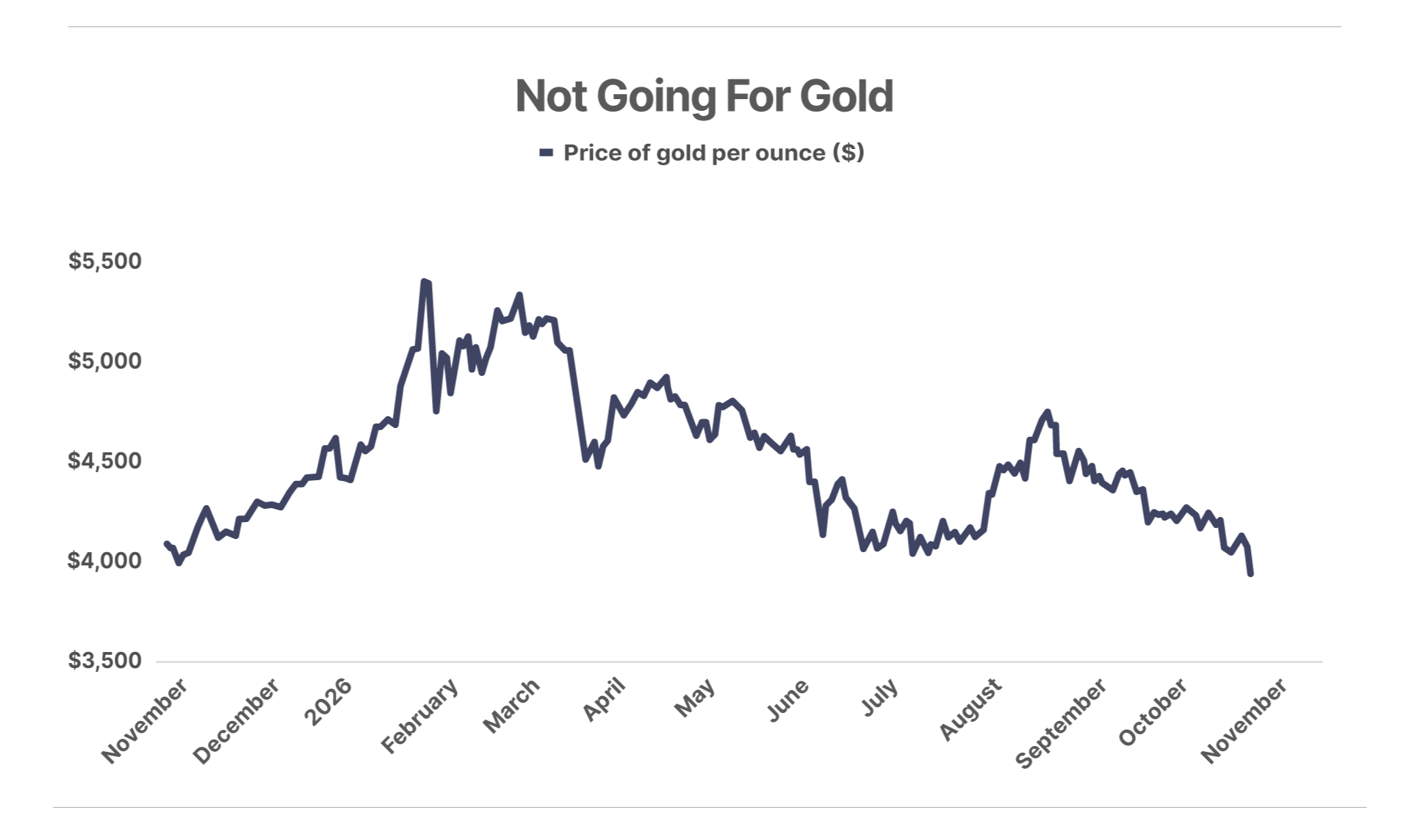
1. Tech sell-off isn’t going into gold. Nasdaq-100 futures fell 2.5% before today’s open after weak results from Intel (INTC) and Amazon (AMZN), and Bitcoin (BTC) dropped 3.5% after a $6.3 billion hack at crypto exchange Binance. None of that money appears to be moving into gold. The metal traded below $4,000 an ounce, and the SPDR Gold Trust (GLD), the largest gold fund, fell about 2% premarket to $361. That puts it below its July low of $365 and about 27% below its January peak.
2. For the first time in four decades, the S&P 500 fell but 80% of stocks were up. There was a sharp sell-off in tech and AI-related heavyweight stocks – such as Alphabet (GOOG), Nvidia (NVDA), and Intel (INTC) yesterday – pulling the headline index down significantly. Because these few mega-cap companies make up a massive portion of the index's total weight, their steep losses easily overpowered gains elsewhere. Outside of big tech, many smaller or non-tech companies like energy, consumer staples, and healthcare stocks performed well.
3. Intel’s biggest loss since 1974. Chipmaker Intel (INTC) dropped 28% after publishing Q3 results yesterday, which included Q4 guidance that fell below analyst expectations for revenue, earnings, and margins. The company warned of a significant slowdown in PC demand, driven in part by the shortage in memory chips that’s driving up costs. This could have negative implications for Apple’s upcoming quarterly results scheduled for Monday, as the company’s management has also signaled cost-challenges from rising memory prices in recent months.
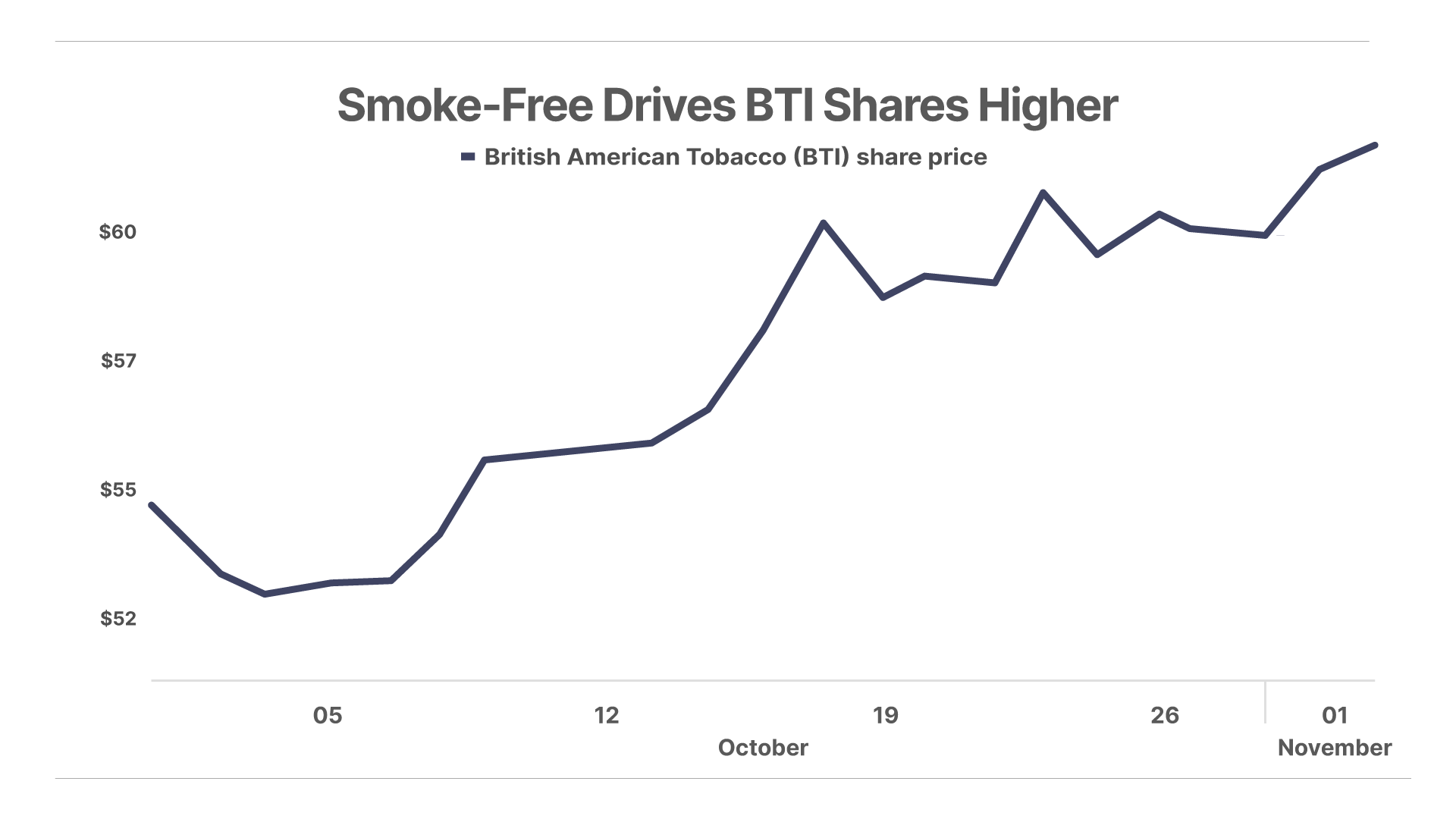
Shares of Complete Investor recommendation British American Tobacco (BTI) are up 13% this month – to over $61.50 per share – driven by strong operations, continued growth in smoke-free products, and a flight to safety among dividend-seeking investors.
“Pricing Pharmaceuticals”
In yesterday’s Journal, Distressed Investing’s Marty Fridson discussed the importance of the government staying out of over-regulating the market, and trying to control prices.
Bill R. writes:
Great point by Marty Fridson that the market should decide business models and not the government. It might sometimes lead to high drug prices, but it generally leads to a free and fair market. Thank you for the clarity.
Richard P. writes:
While Hillary Clinton is well known for her evil stupidity, she did have a point. It is a well-known fact that these evil people only create medicine to mask, not cure, the ills of American people. There is ample proof that they only want to fill pockets with cash rather than cure anything. This must end or they should be prosecuted, and this also applies to those in the stock market who get richer because of advantages they have in perks in knowledge available to them that are not there for small investors.
Bill W. writes:
Like a bait and switch. Headlines include “msft bonds” but I haven’t all day to hunt. Use subheads so we (customers) can find what we want, and not have to read all your wonderful words. I’ve all but given up on you, your creds notwithstanding.
Porter & Co. Comment: On the web, all of the subheads in the table of contents contain jump links to the relevant sections. And please see the excerpt below from yesterday’s Daily Journal…
Porter & Co. Market Snapshot |
Through Thursday, October 29, 2026 close |
| Markets |
| Index or asset | Last | 1-Day | YTD | 1-Year |
|---|---|---|---|---|
|
S&P 500
Total return
|
769.36 | −0.38% | +13.7% | +13.1% |
|
Gold
Front-month futures
|
$4,031.40 | −0.50% | −7.1% | +0.8% |
|
Bitcoin
4 pm ET print
|
$80,746.00 | −0.92% | −7.8% | −27.1% |
|
Crude oil
WTI, per barrel
|
$102.00 | −0.76% | +77.6% | +68.7% |
|
Berkshire Hathaway
NYSE: BRK-A
|
$817,500.00 | +0.68% | +8.3% | +14.7% |
| U.S. Treasury yields |
| Maturity | Yield | 1-Day | YTD | 1-Year |
|---|---|---|---|---|
|
2-Year
|
4.61% | −6 bps | +114 bps | +102 bps |
|
10-Year
|
4.98% | −7 bps | +80 bps | +90 bps |
|
30-Year
|
5.32% | −5 bps | +48 bps | +71 bps |
| Porter & Co. strategies |
| Strategy | 1-Day | YTD | Since start | Per year |
|---|---|---|---|---|
|
Porter's Permanent Portfolio
Since September 25, 2024
|
+0.71% | +6.4% | +34.1% | +15.1% |
|
Better Than Berkshire Index
Since May 16, 2025
|
+1.80% | +5.1% | +5.5% | +3.8% |
|
Porter & Co. Top Ranked*
Since July 14, 2022
|
+0.04% | +5.2% | +29.6% | +10.0% |
Porter & Co. Top Positions |
Through Thursday, October 29, 2026 close |
| # | Position | Total return |
|---|---|---|
| 1 |
Roivant Sciences ROIV
Complete Investor
|
+224% |
| 2 |
Roivant Sciences ROIV
Biotechnology
|
+209% |
| 3 |
TG Therapeutics TGTX
Biotechnology
|
+194% |
| 4 |
Bitcoin BTC/USD
Complete Investor
|
+190% |
| 5 |
Philip Morris PM
Complete Investor
|
+158% |
| 6 |
BWX Technologies BWXT
Complete Investor
|
+144% |
| 7 |
APA Corporation APA
Porter & Co. Asymmetry
|
+138% |
| 8 |
Skyward Specialty Insurance SKWD
Complete Investor
|
+137% |
| 9 |
W.R. Berkley WRB
Complete Investor
|
+115% |
| 10 |
Chubb CB
Complete Investor
|
+96% |