And This Pharma Founder Got Thrown Into Jail
Inside Today's Issue
Editor’s note: Traveling to the New Orleans Investment Conference today, Porter has turned today’s Journal over to Martin Fridson, chief analyst for Porter & Co.’s Distressed Investing.
Disappointment at getting my conference presentation postponed quickly turned to relief when a drug-company founder whose business model I was endorsing was arrested for securities fraud… Let me explain myself here.
In 2015, Turing Pharmaceuticals became a focal point of complaints about prescription drug prices. Founded by U.S. investor Martin Shkreli, Turing bought the manufacturing license for antiparasitic drug Daraprim, then jacked up the price to insurance companies from $13.50 per pill to $750. The UK’s BBC News said Shkreli had consequently become “the most hated man in America.” France’s Le Figaro went further, calling him the most hated man in the world.
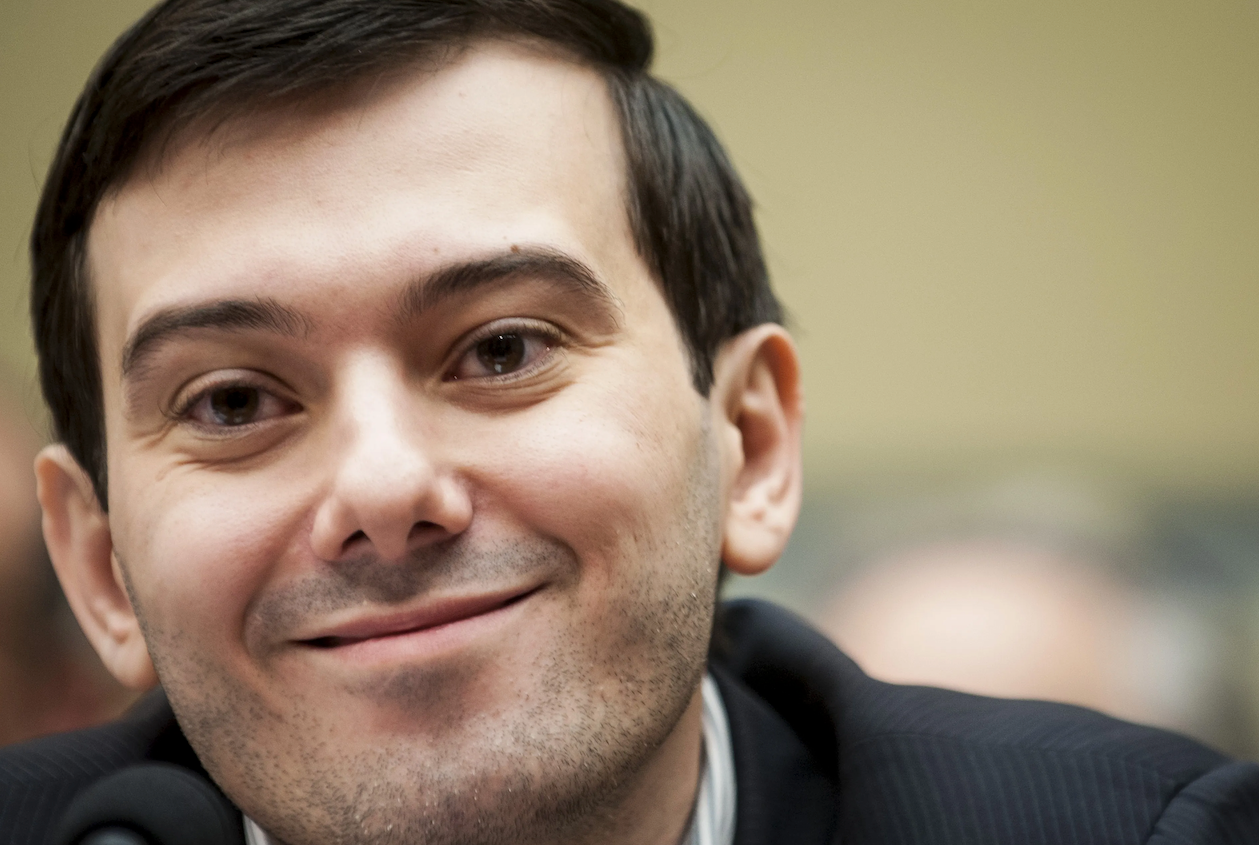
Then-presidential candidate Hillary Clinton grabbed the opportunity to present herself as the defender of everyday Americans against a villain from central casting. As she framed it, the key issue was Turing’s unjust acquisition of the rights to old drugs while it spent little on research and development (“R&D”). Drug companies shouldn’t make billions on drugs, she said, unless they were reinvesting a big chunk of profits to discover new ones that would benefit humankind.
That interpretation fit neatly with one of candidate Clinton’s campaign proposals. At the time, major pharma producers like Merck (MRK) and Pfizer (PFE) were devoting about 15% of revenue to R&D. She wanted to require all drugmakers to do the same.
I disagreed – and I had a forum for explaining why. It was the NYC Junto, a libertarian-oriented discussion series sponsored by the great hedge fund manager Victor Niederhoffer. Niederhoffer was a fascinating character, an eight-time national squash champion who attended formal dinners in a tuxedo and mismatched tennis shoes.
For my scheduled spot on the monthly program, I prepared a slide presentation that began with an illustration of corporate structures within the energy business. I showed the industry’s various sectors – exploration & production, transportation, refining, and marketing. Fully integrated companies such as ExxonMobil (XOM), I explained, compete in all of those activities. Others engage in as few as one.
Management assesses where their company’s skills and competitive advantages lie and the marketplace determines the success of their chosen business models. The government doesn’t force any individual company to perform all of the functions entailed in getting oil and natural gas out of the ground and delivering the final products to gas tanks and furnaces.
Drugmakers are a similarly diverse group, I explained. The industry titans pour billions into R&D and also manufacture and distribute the new medications that result. Some smaller firms, in contrast, forgo the expense of maintaining manufacturing facilities and marketing teams. They concentrate exclusively on finding new drugs. Their scientists may do their best work in a small-company environment. When these companies come up with a blockbuster, they cash in by selling the rights. The buyers might be from Big Pharma or they might be firms focused solely on manufacturing and distribution.
I wasn’t attempting to resolve the Daraprim controversy. My point was simply that it’s perfectly legitimate for a drug company to concentrate on what it does best. That may mean sourcing its products from companies with expertise in R&D rather than internally.
Neither in energy nor in pharmaceuticals, I argued, is the government likely to improve American economic performance by dictating which business models companies must adopt. Therefore, following Hillary Clinton’s prescription and forcing all drug companies to spend 15% of sales on R&D would be a terrible public policy.
After many hours of preparation, I was eager to be the hit of the evening as I sat among the Junto audience, awaiting my timeslot. Imagine my disappointment when the earlier sessions ran over time and mine was canceled! My consolation, I thought at the time, was that my topic would still be timely a month later, when my postponed presentation would finally take place.
A few days later, though, the drug-price-raising pharma head Martin Shkreli was arrested on charges of securities fraud. The U.S. Attorney in the case claimed that he operated his succession of companies as a Ponzi scheme. Shkreli was ultimately convicted on three out of eight counts.

Thanks to other presenters rattling on at excessive length, I was spared the embarrassment of people inevitably misinterpreting my remarks on efficient market economics as defense of a crooked business. Recognizing that it would be impossible to escape such a perception if I went ahead with my talk, I politely gave up my slot for the following month.
But the principle I was laying out was valid then – and it’s valid now: Entrepreneurs and investors who place their fate in the market’s hands are far better equipped than political strategists to devise the most economically productive forms of industrial organization. What ultimately matters for fostering the optimal utilization of scarce resources is what works, not what wins votes.
Martin Fridson
New York, New York
Tell us what you think of today’s Daily Journal: porterstansberrydirect@gmail.com
P.S. The betting markets now give Democrats a 63% chance of taking the Senate on Election Day. But Porter says even a change of House won’t change what’s coming next for your money.
He believes both parties have already locked in the same dangerous policy, pre-election – and that no matter who holds the gavel in January, it keeps moving full steam ahead.
In his emergency election broadcast, Porter names the one move he believes every American should make before the votes are counted… and the handful of businesses he believes are built to keep making money right through what’s coming.

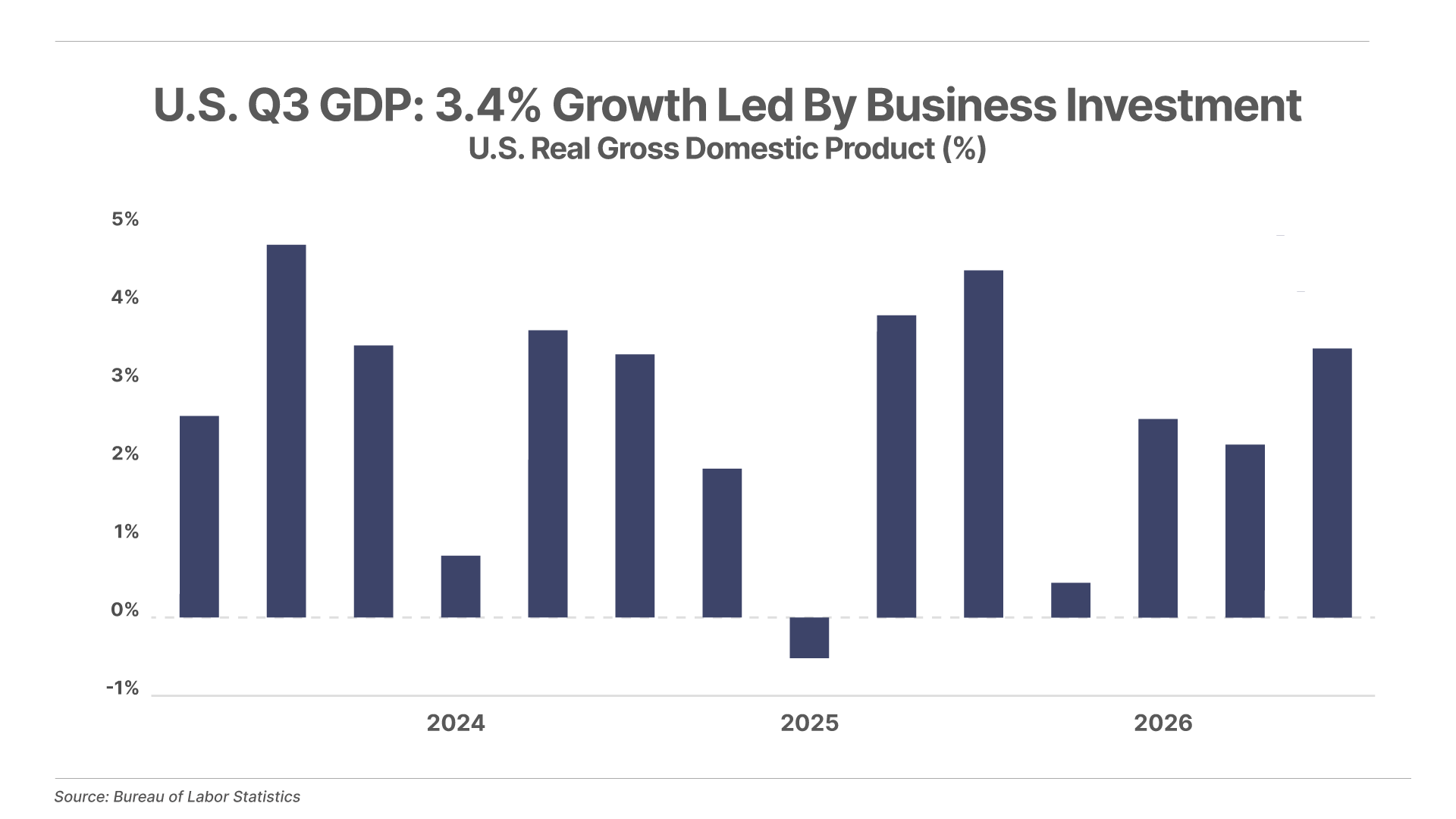
1. The U.S. economy is being fueled by AI investment. Real GDP rose at a 3.4% annual rate in Q3 – up from 2.2% in Q2. Investment supplied 3.2 percentage points of that – more than consumer spending at 2.5. The Bureau of Economic Analysis (“BEA”) says the gain in equipment came mainly from information-processing equipment – computers and peripheral equipment, the category that includes AI servers. Consumer spending rose 3.8%, the same pace as Q2. Growth accelerated as companies bought computers, not because consumers spent more.
2. Alphabet drops on AI monetization struggles. Shares of Alphabet (GOOG) dropped 12% after a disappointing Q3 report, with revenue and earnings both undershooting expectations. Revenue growth decelerated in the company’s search business, to 12% year over year. Despite search queries increasing at the fastest rate in over five years, the company’s new AI overviews are monetizing at lower rates than traditional search. This was compounded by the rising costs of implementing AI search, with higher capex causing free cash flow to drop to negative $9.1 billion, or nearly 3x worse than expected.
3. Three days after offering buyouts to 60,000 employees, Microsoft (MSFT) is looking to borrow at least $25 billion. The software giant launched a 10-part bond sale this morning, its first U.S. investment-grade offering since 2017. Maturities run from two to 40 years, and early prices on the 2066 notes are as much as 135 basis points over Treasuries. Proceeds go to general corporate purposes, including capital expenditures. The September quarter shows why: Microsoft spent $39.4 billion on capex against $58 billion of operating cash flow, leaving $18.6 billion of free cash flow on $92.3 billion of revenue. Cash on the balance sheet has fallen from $102 billion to $64.5 billion in a year. The buyout and the bond deal pay for the same thing – the $170 billion Microsoft plans to spend on capex this year.
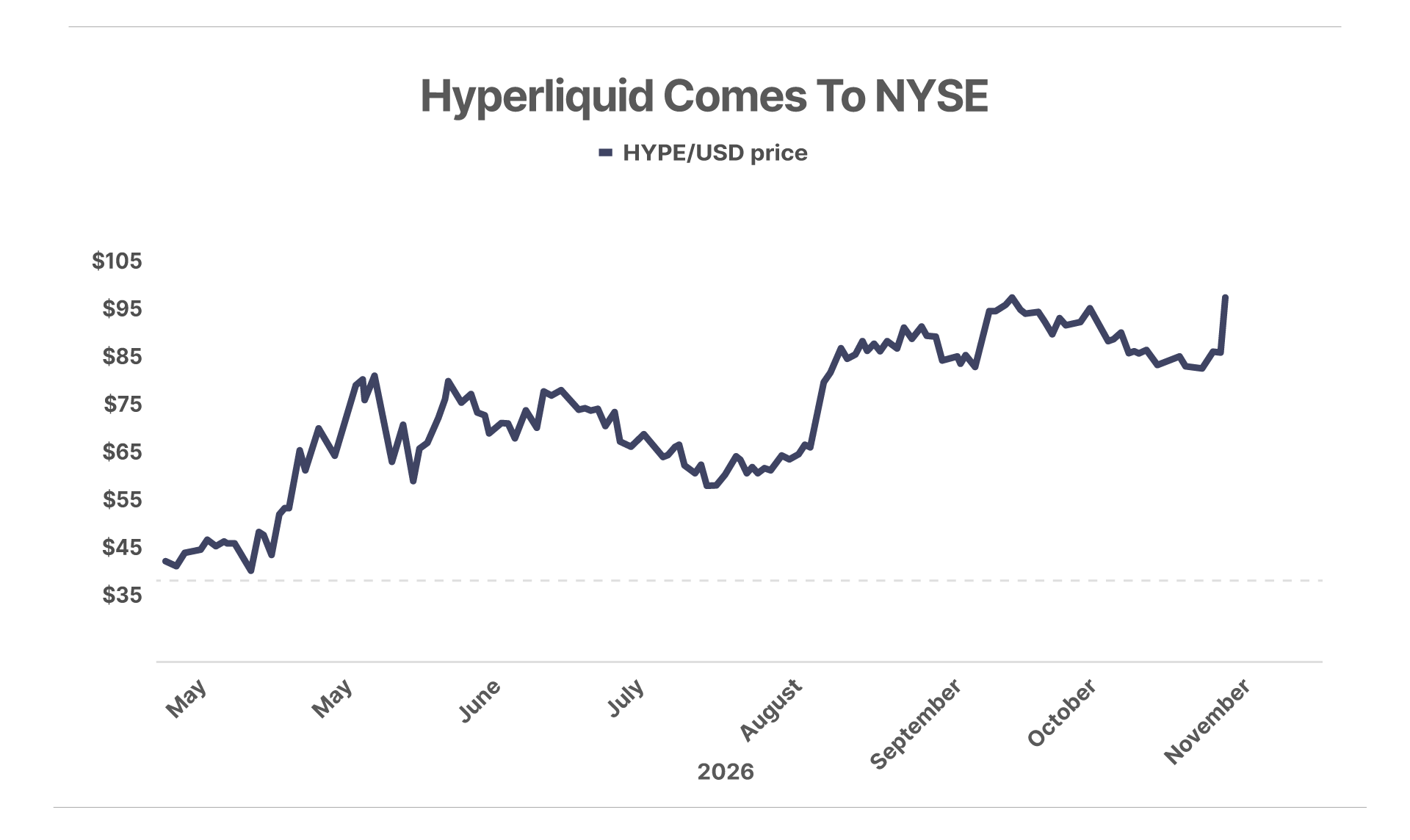
HYPE/USD – the token of decentralized crypto exchange Hyperliquid – soared 19% today after the owner of the New York Stock Exchange agreed to bring Hyperliquid-based futures trading to the United States. Intercontinental Exchange (ICE) will invest in Trade.xyz, which runs stock and commodity markets on the Hyperliquid blockchain, and will seek approval to bring its perpetual futures – contracts that never expire – to American markets for the first time.
In yesterday’s Journal, Porter reported that gas currently generates 40% of U.S. electricity. Over the next decade, Porter went on to say, we’ll see natural gas become the majority energy source for electricity in the U.S. That’s bullish for two of our natural-gas recommended stocks.
“The Gods Of Gas”
Dennis S. writes:
Hi Porter, I have owned EQT several times and have wondered with so much gas and the capacity to produce a lot more for the next 50 years or so, why don't the Rice Brothers build their own LNG facility on Lake Erie? I have been in the oil and gas business for over 50 years and have produced many gas wells in my career so I’m a little skeptical.
In Michigan, where I produce only gas, not only is it hard to sell a gas prospect because of a lack of confidence in pricing but utilities will not hook up any new gas wells.
Thank you, and keep up the good work with your research. You have great presentations and a lot of success.
Liz B. writes:
Each day a treasury of information to be pondered, reflected upon, valued and enjoyed ultimately employed and shared.
A friend you are!
David C. writes:
What's the problem with Venture Global’s (VG) stock price… it was as high as $24 in January of 2025 and now trades for $14 and change?
Porter Comment: Why is a volatile stock price a bad thing?
Porter & Co. Market Snapshot |
Through Wednesday, October 28, 2026 close |
| Markets |
| Index or asset | Last | 1-Day | YTD | 1-Year |
|---|---|---|---|---|
|
S&P 500
Total return
|
772.31 | +0.34% | +14.1% | +13.6% |
|
Gold
Front-month futures
|
$4,051.60 | −0.56% | −6.7% | +1.7% |
|
Bitcoin
4 pm ET print
|
$81,497.00 | +0.98% | −6.9% | −28.3% |
|
Crude oil
WTI, per barrel
|
$102.78 | +2.88% | +79.0% | +70.9% |
|
Berkshire Hathaway
NYSE: BRK-A
|
$811,947.00 | +0.23% | +7.6% | +12.4% |
| U.S. Treasury yields |
| Maturity | Yield | 1-Day | YTD | 1-Year |
|---|---|---|---|---|
|
2-Year
|
4.67% | −3 bps | +120 bps | +120 bps |
|
10-Year
|
5.05% | +6 bps | +87 bps | +106 bps |
|
30-Year
|
5.37% | +7 bps | +53 bps | +82 bps |
| Porter & Co. strategies |
| Strategy | 1-Day | YTD | Since start | Per year |
|---|---|---|---|---|
|
Porter's Permanent Portfolio
Since September 25, 2024
|
−0.11% | +5.5% | +33.0% | +14.6% |
|
Better Than Berkshire Index
Since May 16, 2025
|
+0.23% | +3.3% | +3.6% | +2.5% |
|
Porter & Co. Top Ranked*
Since July 14, 2022
|
−0.05% | +5.1% | +29.6% | +10.0% |
Porter & Co. Top Positions |
Through Wednesday, October 28, 2026 close |
| # | Position | Total return |
|---|---|---|
| 1 |
Roivant Sciences ROIV
Complete Investor
|
+221% |
| 2 |
Roivant Sciences ROIV
Biotechnology
|
+209% |
| 3 |
Bitcoin BTC/USD
Complete Investor
|
+196% |
| 4 |
TG Therapeutics TGTX
Biotechnology
|
+194% |
| 5 |
Philip Morris PM
Complete Investor
|
+152% |
| 6 |
BWX Technologies BWXT
Complete Investor
|
+139% |
| 7 |
APA Corporation APA
Porter & Co. Asymmetry
|
+138% |
| 8 |
Skyward Specialty Insurance SKWD
Complete Investor
|
+135% |
| 9 |
W.R. Berkley WRB
Complete Investor
|
+111% |
| 10 |
Chubb CB
Complete Investor
|
+92% |