How To Find Great Stocks That Wall Street Ignores
Inside Today's Issue
- Essay: If This Goes Bankrupt, It’ll Be Worth More
- LNG Volume Slowly Returns
- Consumer Confidence Sinks
- Big Moves At The Treasury Department
- Chart Of The Day… BB Seguridade
- Today’s Mailbag
Most investors will never hear the name Auna.
But you will, because Porter & Co. is developing an emerging-markets research practice. We plan to formally launch our emerging-markets research product next year. It will be, like all our forthcoming new products, for our Partner Pass members only.
Why now? Because everyone believes artificial intelligence (“AI”) is an American story. Nvidia, the hyperscalers, the trillion-dollar spending plans – that’s all American. But the binding constraint on AI is no longer chips. It's power – cheap, constant, always-on electricity. A data center doesn't care what flag flies over the substation. It cares about the price per kilowatt-hour.
The search for cheap, continuous power will drive massive amounts of capital into emerging markets. How do we know? Because for the last 15 years, Bitcoin miners have done exactly that. They hunt the cheapest electron on Earth – flared gas in West Texas, geothermal in Iceland, hydro in Paraguay, volcanoes in El Salvador.
The strategy is easy to understand: Tiny economic base meets global AI spending boom.
Most subscribers won’t remember... but I began my career in finance as an emerging-markets analyst. I’ve seen exactly what can go wrong for U.S.-based investors. Our strategy comes down to one sentence – make sure you get paid to take these risks.
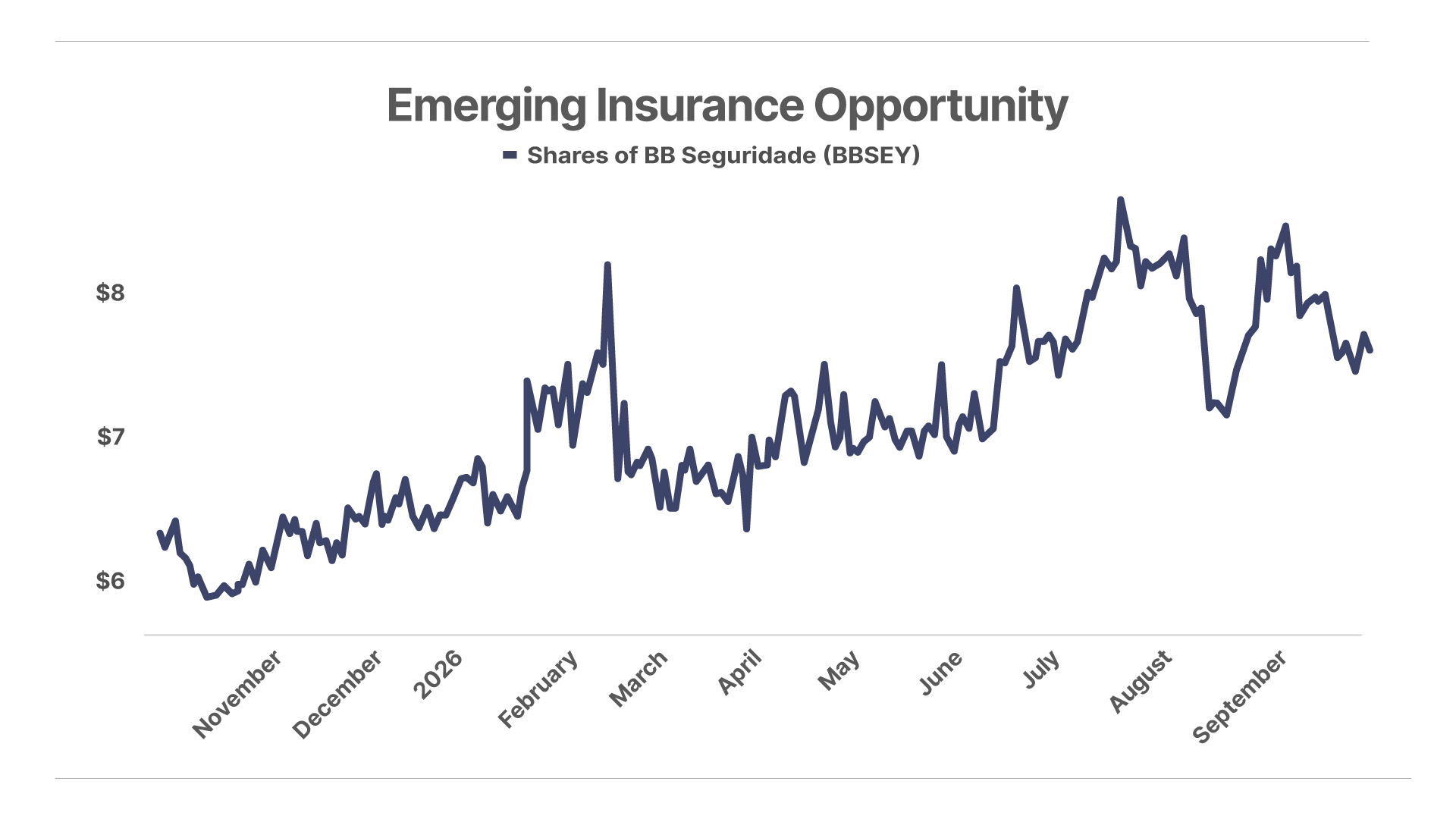
In July, I showed you the first idea that fits our strategy – BB Seguridade (BBSEY), the insurance arm of Banco do Brasil. It earns a return on equity near 90% by selling policies across the counter to the bank's 90-million-plus customers. It trades for about 8x earnings and yields around 12%.
Internally, we've been following eight other stocks alongside it. China Overseas Property (2669.HK) is a Hong Kong-listed property manager with net cash equal to about 62% of its market cap. Itaú Unibanco (ITUB) and Banco Bradesco (BBD) are Brazil's premier private banks. Grupo Financiero Banorte (GBOOY) is Mexico's best-run domestic bank. Vale (VALE) is the iron-ore giant. On the watch list sit China Mobile (0941.HK), CNOOC (0883.HK), and Petrobras (PBR).
How have they done?
It's only been 12 weeks, so I won't pretend this means much. But I promised to keep score. Here's the price change from July 9 through September 30:
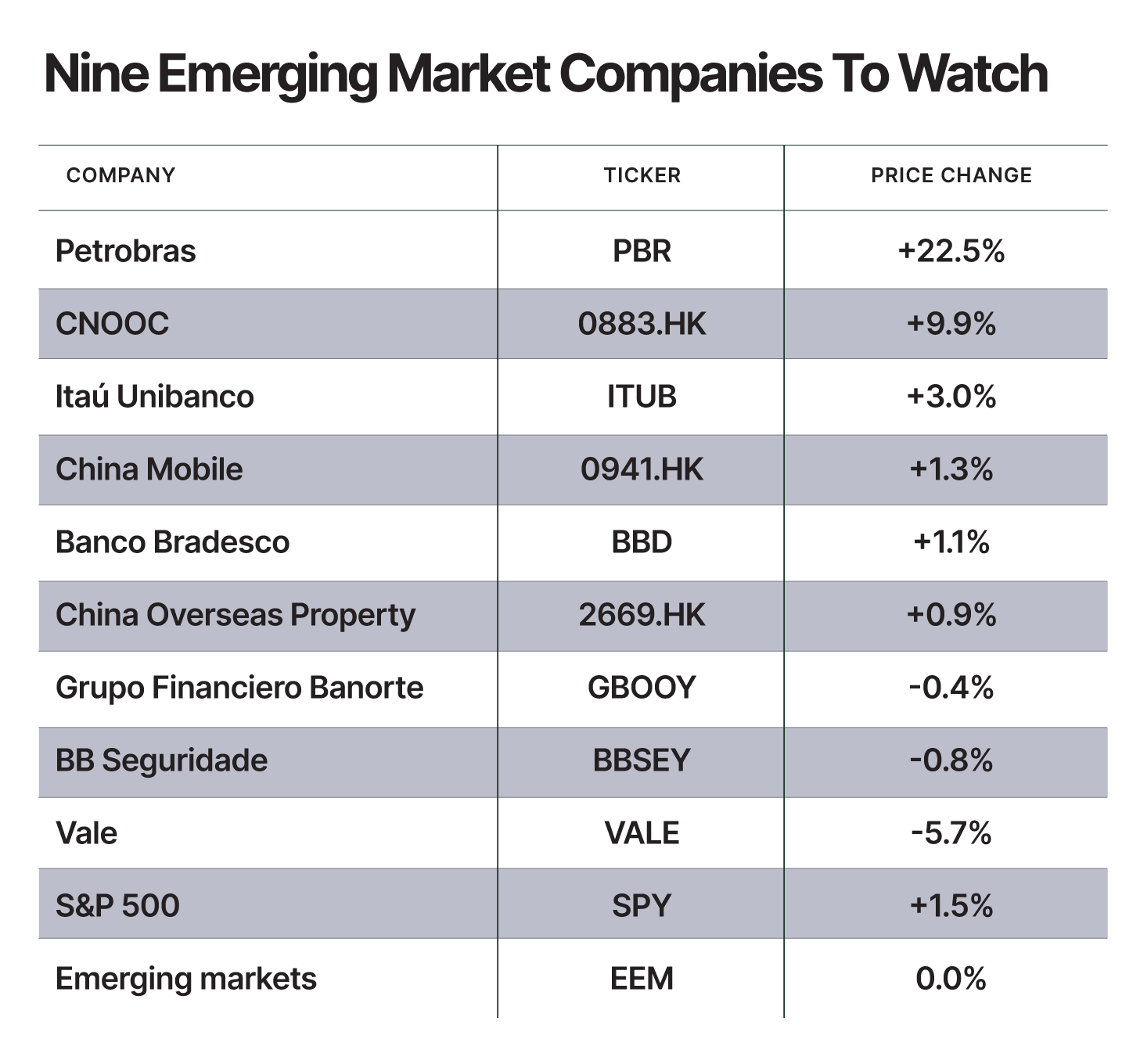
The nine stocks are up about 3.5% on average, before dividends. That's a little ahead of the S&P 500 (up 1.5%) and the emerging-markets index. But remember: our entire strategy is focused on making sure investors get paid.
BB Seguridade paid shareholders R$1.98 per share on September 3 – about $0.39. Add that back, and the stock that's "down" 0.8% has actually returned about 4% in three months. China Overseas Property declared a HK$0.10 interim dividend, which takes its return to roughly 4% as well. That's what getting paid looks like.
Today's idea doesn't pay a dividend. So why am I sharing it with you? Well, there are other ways investors can get paid besides a cash dividend. Why should you care? Because this is one of the cheapest, most misunderstood stocks anywhere in the world.
Treating Cancer In Latin America
In 1989, two Peruvian doctors, Luis Pinillos and Carlos Vallejos, had a problem. Peru's insurance companies would not cover cancer treatments. They considered it a catastrophic illness. At best, a policy covered the cost of diagnosis. Then you were on your own. So the two doctors built their own insurer.
A large group of people would each pay a small monthly fee. The few who got cancer would receive full treatment. They tested it with a small group. It worked. They sold it to employers, then to individuals.
They called it Oncosalud. Today, the company has about 1.47 million plan memberships, roughly 1 million of them oncology plans. Fitch puts its share of Peru's oncology-plan market at about 25%. Each member pays an average of S/63 a month (about $18.50). But Oncosalud pays out only about 56% of premiums in medical costs.
The company is now called Auna (AUNA) and it has expanded into private hospitals. When a member gets sick, they're treated in an Auna facility. Auna collects the premium and controls the cost of care. That is a closed loop, and in a country where the public system is badly overloaded, it's a powerful moat. From its base in Lima, Auna has grown into one of the largest private healthcare platforms in Spanish-speaking Latin America – 31 facilities, 15 hospitals, and 2,337 beds across Peru, Colombia, and Mexico. Last year, it generated S/4.4 billion in revenue (about $1.3 billion).
So what went wrong? An acquisition in Mexico.
In October 2022, Auna paid $677 million for Grupo OCA, a hospital network in Monterrey. It financed the deal with debt – and its controlling shareholder, the Peruvian private-equity firm Enfoca, borrowed against its own holdings to fund its share. Then the integration went badly. Auna lost key physician and supplier relationships. In 2025, Mexico's operating profit (adjusted EBITDA) fell 18% in local currency. Fitch now says Mexican margins will settle at 25% to 26%, not the 30%-plus it originally expected.
In the midst of this, in March 2024, Auna listed on the New York Stock Exchange. It priced its initial public offering (“IPO”) at $12 – a dollar below the low end of its range – and closed its first day at $9.60. In May 2026, it hit an all-time low of $4.15. Then, in August, it missed analysts' Q2 earnings estimate by 41%, and the shares fell another 14% before the open. The stock closed September at $4.98.
Busted IPO. Bad acquisition. Too much debt. Two straight earnings misses. Who would want to own this?
Look at what the business is actually doing.
In Q2, revenue grew 13%, to S/1.24 billion. Every country grew. Mexico grew 4% in local currency, and patient volumes at its flagship Doctors Hospital rose 20%. Oncology patients in Mexico have more than doubled in a year. Management reaffirmed guidance of about 12% revenue growth for 2026.
The earnings miss wasn't the business falling apart. In fact, most of the drop in net income came from smaller non-cash currency gains.
Instead of focusing on margins, which will fluctuate, look at the cash. In the first half of 2026, Auna's operating cash flow rose 76%, to S/441 million. Its free cash flow – cash from operations minus investment spending, before interest – nearly tripled, to S/400 million. That's about $117 million in six months, for a company whose entire market value is about $370 million.
And the cash is going where it should – into paying down debt.
Net debt has fallen from S/3.53 billion at the end of 2024 to S/3.25 billion in June. Late last year, Auna refinanced $825 million of debt, pushing most maturities out to 2029. Leverage sits at 3.6x operating profit, and management is targeting below 3x.
That's how a company with no dividend pays you to wait. Every sol of debt it retires belongs to the shareholders.
Then there's the growth that nobody is pricing.
In February, Auna signed a final agreement with EsSalud, Peru's social health insurer, to build Torre Trecca in central Lima. It's a 23-story, 59,000-square-meter outpatient center with 145 consultation offices and 43 treatment rooms. When it opens in mid-2028, it will be the largest outpatient facility in Peru. It will expand EsSalud's capacity in metropolitan Lima by about 20%, serving a pool of more than 6 million insured Peruvians.
The structure is better than the building. EsSalud reimburses construction costs with progress certificates that Auna can sell to third parties at Peru's sovereign credit rating. So as Auna finishes each stage of construction, EsSalud issues it a government-backed IOU. Auna can sell those IOUs immediately. Auna gets most of its building money back quickly, at a far lower cost than it could borrow. Once the doors open, EsSalud pays a guaranteed minimum monthly fee. The concession runs through 2046 and can be extended to 2064.
In this deal, Auna puts up very little money. It gets a contracted, government-backed revenue stream for up to 36 years.
What's it worth?
At $4.98, Auna's shares have a market cap of about $370 million. Add roughly $950 million of net debt, and you're paying about $1.3 billion for the whole business (enterprise value). That's about 5x its last 12 months of operating profit (adjusted EBITDA). Fitch's recovery analysis – the exercise where it estimates what the company would be worth if it went bankrupt – values Auna at 6x EBITDA.
You can buy this business in the stock market for less than the credit analysts think it would fetch in a reorganization.
At 6x, the shares would be worth about $8.40, roughly 70% higher. At 7x – still a discount for a growing, integrated hospital and insurance platform – they'd be worth about $12. That's the price where it went public 30 months ago.
Who would buy a Peruvian private hospital? In late May, with the stock at its all-time low, Auna's president and executive chairman, Jesús "Suso" Zamora León, bought about $357,000 of shares on the open market at $4.15 to $4.39. Zamora co-founded Enfoca, which owns roughly 73% of Auna's Class B shares. He's no stranger to this business. He's sat on Auna's board since 2008.
Whenever I’m looking at a turnaround situation, I always check the bonds. Auna’s senior secured bonds are rated B+ by Fitch and are trading above par, with yields to maturity of around 8%. The 2032 notes are yielding about three percentage points over the U.S. 10-year Treasury bond, which is about average for a non-investment-grade borrower in Latin America. In short: the debt market doesn’t consider this company to be in distress.
Then why is this stock so cheap? Because almost nobody can own it. Auna is a Peruvian company, incorporated in Luxembourg, reporting in soles, listed in New York. It’s a financial jigsaw puzzle. Its public float is tiny. Most of the shares are locked up with a private-equity sponsor. It's too small for the big emerging-markets funds, too foreign for American small-cap managers, and too controlled for activists. Its IPO lost money for everyone who bought it.
These situations are where you can find extreme mispricing.
Of course, there’s a ton of political risk here. For now, though, politics is a tailwind. Peru just elected Keiko Fujimori as president. She is the daughter of Alberto Fujimori, Peru's authoritarian president from 1990 to 2000. She seems to be taking a page from El Salvador’s strategy: On day one she authorized the armed forces to take over public order in the most crime-ridden regions. She’s also promised a "deregulatory shock" and fiscal discipline. She appointed Elmer Cuba, a market-friendly former central bank director, as economy minister.
Moody's said her win preserves policy continuity and could unlock stalled mining projects. On healthcare, her government has asked for powers to set up a system in which EsSalud and Ministry of Health patients can be treated at private providers, with the public payer reimbursing them. That is directly in Auna's interest, since it is one of Peru's largest private hospital operators.
But... she won the presidency by a margin of fewer than 50,000 votes. She's the country's 10th president since 2016. And she was implicated in the enormous Odebrecht scandal, when the company bribed leading politicians for infrastructure deals all across Latin America. (Peru’s Constitutional Court dismissed the case against her in October 2025.)
This is not a widows-and-orphans stock. It's a speculation that things go from terrible to less bad in Peru.
Auna reports Q3 results on November 19. I expect it to show strong cash generation and I expect leverage to keep falling. No, this situation isn’t part of our core emerging-markets strategy because it doesn’t currently pay a dividend. But, as a speculation, it might work out very well.
Share your ideas about today’s Daily Journal: porterstansberrydirect@gmail.com
Good investing,
F. Porter Stansberry
Stevenson, Maryland
1. Natural gas shipments through the Strait of Hormuz are recovering very slowly. Tankers carrying liquefied natural gas ("LNG") made about 17 confirmed exits from the strait in September, according to tanker tracker Kpler – the most since the Iran war began February 28, but still 80% below the pre-war monthly pace. Qatar, the world's second-largest LNG exporter, accounts for most of the gap. It has no export route outside the Persian Gulf. Iranian missiles knocked out about 17% of its export capacity in March, and it has kept its Ras Laffan export complex at minimum output since one of its tankers was struck near the strait in July. 2. Consumer confidence sinks. The Conference Board’s September Consumer Confidence Index dropped to its lowest level since April 2014. Consumer sentiment plunged across all age groups and nearly all income cohorts. Intentions to purchase vehicles, homes, and major appliances are dropping as consumers cite rising costs as a primary obstacle for big-ticket purchases. 3. The U.S. Treasury appears to be exploring new ways to cut borrowing costs. This week, Treasury Secretary Scott Bessent named two new “counselors” – senior advisers who do not need Senate confirmation. The first was David Zervos – chief market strategist at investment bank Jefferies since 2010 – who has called for lower interest rates and publicly backed Bessent's expanded buybacks to repurchase older long-term bonds to help push their yields down. The second was former Fed Governor-nominee Judy Shelton, who has spent years promoting a Treasury bond that would let holders choose at maturity between repayment in dollars or gold. She has argued that investors would accept a lower interest rate in exchange for that choice. Meanwhile, the 10-year Treasury yield closed near 5.3% yesterday, its highest in about two decades, despite the buybacks. Shares of BB Seguridade (BBSEY), the insurance arm of Banco do Brasil, are up 22% over the last 12 months – a candidate for an emerging-market research project Porter & Co. will launch for Partners next year. Angel A. writes: Hi Porter! I'm Angel from Orlando, I read your "Banks Won't Exist In 10 Years” Journal and 10 minutes later, in my lunch break at work, Bam!! I opened a Public brokerage account! I got approved, plus I got approved for advanced options trading (I trade options). Thanks again for your time and effort. Financial freedom all the way! All the best, Porter! I wish one.day we can meet in person. Mike C. writes: I hope the banks suffer. This is good stuff, I will open an account. Kevin D. writes: Completely agree with your premise about banks being obsolete in 10 years, maybe less. I've had my cash in Schwab for decades, and I noticed something unusual at some point – even Schwab stopped doing their customary "sweep" accounts to provide you with the best interest rates on your cash. So I did the next best thing and used their SWVXX, then discovered SGOV. Maybe the best part of SGOV is the interest/dividend is – in most states, tax free.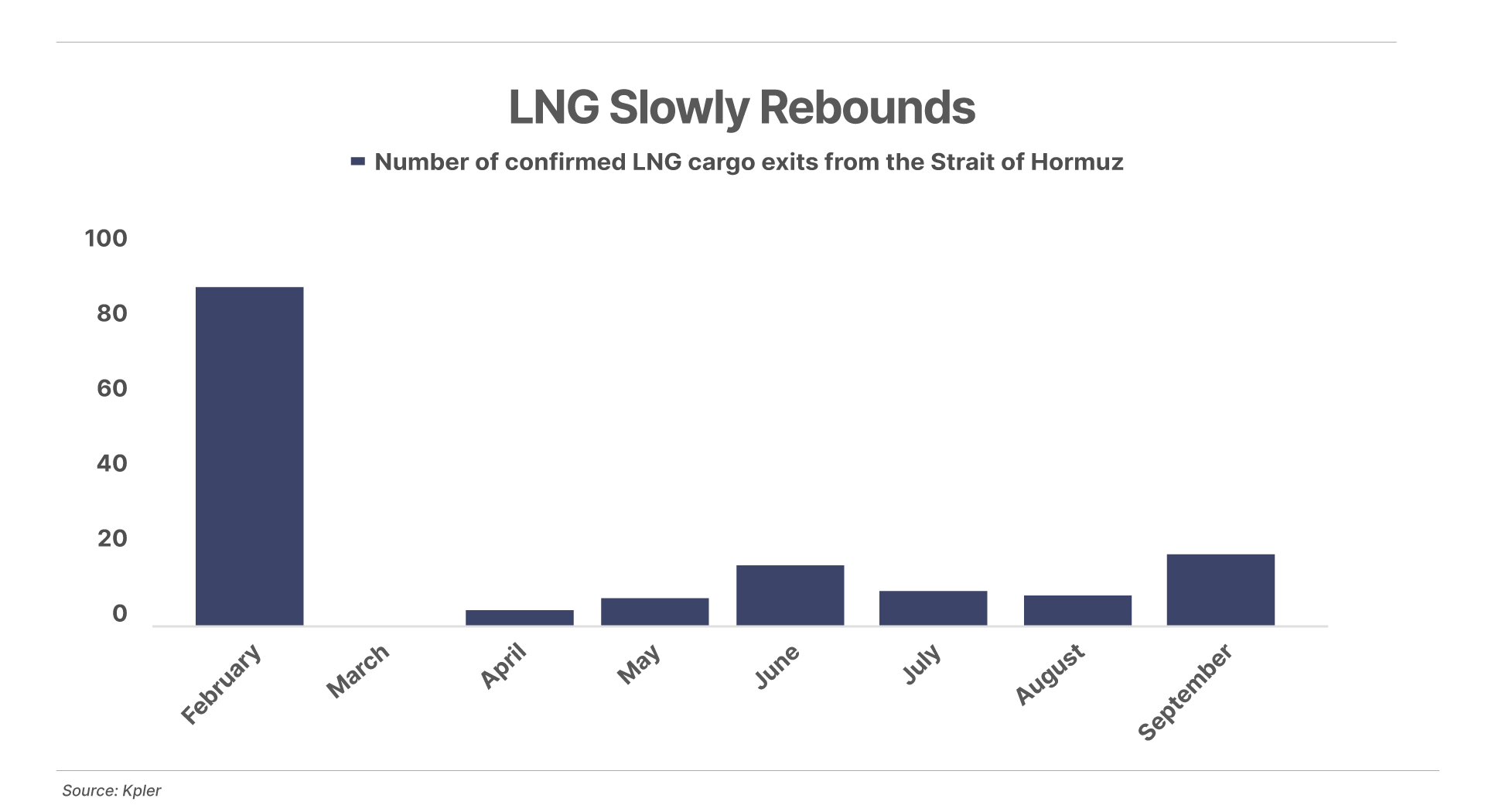
“Goodbye To Banks”
Again, enjoyed your article, thanks for the valuable financial lessons.Porter & Co. Market Snapshot
Porter & Co. Top Positions