Issue #99, Volume #3


Why AI Cannot Replace The Human Mind
Inside today’s Daily Journal…
|
Today, Porter turns the Journal over to his good friend, George Gilder of The Gilder Report… George reveals what his research is showing – who the real winners from the buildout taking place in artificial intelligence are.
Here’s George now…
There is a growing panic in 2026 about artificial intelligence (“AI”) and the push toward artificial general intelligence (“AGI”) as well as machines that can supposedly think completely like humans.
Industry tech giants are even asking for government regulations to control the “dire threats” these systems supposedly pose. But an economic and scientific reality check is overdue…
The concept that AI will soon surpass human intelligence is built on a misunderstanding of how the brain works. Modern AI relies heavily on “left-brain” functions: logic, historical data, and massive language models. It assumes the future will simply be an extension of the past. Human intelligence, however, relies heavily on right-brain creativity, intuition, and imagination.
Medical history and, increasingly, quantum mechanics show that human consciousness isn’t just a product of brain cells reacting to logic – it transcends the physical brain entirely. Furthermore, the physical efficiency of the human mind is unmatched.
AI requires massive, multi-gigawatt data centers that consume enormous amounts of electricity. The human brain runs on just about 12 watts of power, yet it is capable of original discovery and true insight. Human minds are the ultimate innovators.
Instead of fearing that “sexless machines” will take over, we should look forward to human-driven breakthroughs, like 2D graphene and advanced microchips, that will disrupt past tech limitations and create superior investment returns.
Anticipated for a century, from John von Neuman’s warning about a coming singularity back in the 1930s to John McCarthy’s Dartmouth Conference in the spring of 1956 –predicting that AGI awaited merely a summer of concentrated work – AI represents the latest computer platform. Infatuating most computer science is the notion that AI can yield a mind, or even consciousness itself, superior to our own.
Transcending multi-gigawatt data centers, however, are the human minds that create them. With those mere dozen watts, the human mind is capable of insight, imagination, and discovery – humans launch all the gigawatt machines alleged to make humans obsolete.
Human minds are the only real quantum computers. In the face of the qubit counting race at near-zero Kelvin, in which Magnificent 7 apocalyptics predict various catastrophes from quantum computers, even Elon Musk’s solar convertors, battery walls, and Colossal data centers cannot yet compete with human brains and bodies with books on balmy beaches.
To the rise of purely analytical, left-brain mechanisms, humans bring right-brain imagination and creativity. The distinction originated in the 1960s with Nobelist Roger Sperry, who treated extreme epileptics by surgically severing the corpus callosum linking the two hemispheres of their brains. Subsequent experiments found language and logic chiefly on the left side, intuition and imagination on the right.
Further experience led neurosurgeon Michael Egnor, a speaker last year at my annual COSM conference, to conclude that consciousness transcends the brain almost entirely. In all his thousand-plus surgeries, depicted in his book Immortal Minds, he never found that his incisions in the brain eclipsed the consciousness of his patients. No matter how he manipulated their brain cells, they could always distinguish between the effects of his surgeries and their own consciousness of an autonomous identity.
Current AI experts and AGI cerebrations, in fact, seem to be denying the very existence of right brain functions. The logic and large language models (“LLM”) seem to dominate. Thus, they imagine that existing AI advances will continue into a trans-human future eclipsing human brains in a godlike “Singularity.”
But LLMs and retrospective logic systems assume the future will merely extrapolate past paradigms. AGI apocalyptics deny the long experience of surprising disruptions and new paradigms, such as the rise of wafer-scale integrated circuits and 2D graphene computers that we cover in our newsletters. Bearers of a new distributed and superabundant world, these breakthroughs point to investments with exponential returns.
Countering materialist superstitions is an incandescence of human consciousness and transcendence. To sandcastles of chips and chiplets, meshed amid mazes of wires and lasers, interposers and transceivers of codes, wrapped in tons of copper “sheaths,” we bring the majestic simplicities of wafer-scale and human scale.
To fears of carbon pollution, we offer a carbon solution of graphene and a vista of 2D transformations. In contrast to the sterile vision of sexless machines, we celebrate the full humanity of embodied minds, men and women thinking, creating, and discovering together.
Dashing human dreams of glory and divinity decades ago, pop-star physicist Carl Sagan told us that the multitude of stars in the universe outnumbers all the grains of sand on the world’s beaches. The Einstein “reality check” offers a different perspective: not fewer wonders, but more with each grain of sand itself a universe of possibility.
Advanced AI, even AGI, might be able to create a very highly attuned thinking and reasoning entity, even a brain of sorts, but it cannot create a being. That is what makes us human: being. Not the human, or the brain or the individual thinking part, but the being, and its connection to the greater whole, bestowed by the Creator. It is that which quantum physics is scratching at the surface of and of consciousness – of being – beyond the confines of an individual human brain.
Drawing on the work of topological physicist Jennifer Cano reveals the rich and intricate structure of matter at the smallest scales. We take a further step and celebrate each grain of sand as a gift of mind containing more electrons than the universe has stars and offering a silicon constellation of new possibilities for human realization and creativity in the image of our Creator.
Who Will Win The AI Infrastructure Race?
The global semiconductor (microchip) industry is seeing historic growth. In March 2026, global sales reached $99.5 billion. This is an astounding 79.2% increase over March 2025. The Semiconductor Industry Association reports that global chip sales are firmly on track to hit $1 trillion for the full year 2026. Growth is surging worldwide, led by the Asia-Pacific region (up 108.5%) and the Americas (up 83.1%).
Microchips are the literal backbone of the modern economy, and demand is accelerating rapidly.
Investors often ask which company has the “best” AI model. This is the wrong question. The real bottleneck in AI right now is infrastructure: the physical data centers, high-performance memory, and cooling systems required to run complex AI programs. Running AI is vastly different from traditional software. In the past, once software was written, serving a new customer cost almost nothing. AI, however, requires constant, intense computing power and physical resources. As a result, software economics are shifting to look more like heavy infrastructure economics.
Four of the Magnificent 7 tech giants, Microsoft, Alphabet, Amazon, and Meta, are currently locked in a massive spending war to build these data centers. Together, they are spending at an annualized rate of over half a trillion dollars. This massive cash drain is putting noticeable pressure on their free cash flow margins. Here is how these four giants currently stack up:
-
Microsoft (MSFT) has been highly successful at connecting AI directly to revenue by embedding its “Copilot” AI companion into corporate software. However, its growth is currently bottlenecked. Microsoft has more customer demand than it can handle, and its revenue growth is restricted by how fast it can physically build new data centers.
-
Alphabet (GOOG) is in a more resilient financial position because it can monetize AI in two places simultaneously: through Google Cloud and by using AI to make its core Google Search business more efficient and profitable. The company is also saving money by building its own in-house microchips.
-
Amazon (AMZN) is building the largest physical pool of AI data centers, but it faces a key risk. By selling raw computing power to external AI developers rather than focusing on its own proprietary AI apps, Amazon functions more like a low-margin utility company. It bears the heavy cost of building the infrastructure without capturing the premium profits of the AI software running on top of it.
-
Meta (META) uses AI incredibly well to make its social media advertising more efficient. However, it is spending billions of dollars on data centers without having a direct way to charge users for AI computing power, creating a wider gap between investment and direct revenue.
Nvidia (NVDA) is the most visible beneficiary… Nvidia is riding on the expansion of the AI platform. And that is a problem for its competitors. The faster AI infrastructure improves, the stronger Nvidia’s position may become. Cheaper compute, faster networking, and better orchestration expand the ecosystem.
The faster the AI ecosystem grows, the harder it becomes for competitors to reconstruct it from the outside… but this dynamic also increasingly benefits companies like Vertiv Holdings (VRT), whose cooling and power management systems are essential to sustaining high-density data centers.
Investor Takeaway
Because these tech platforms are forced to spend aggressively just to stay competitive, the most reliable profits aren’t going to the platforms themselves. Instead, the guaranteed winners are the companies supplying the hardware, advanced packaging, and cooling systems needed to keep these giant data centers running.
The scale and persistence of capital expenditure confirm that demand for AI infrastructure is structural, not cyclical, creating a multi-year growth environment for semiconductor and infrastructure suppliers.
Until then!

George Gilder, Richard Vigilante, Steve Waite, John Schroeter, Dr. Robert Castellano
Editors, Gilder’s Guideposts, Technology Report, Technology Report Pro, Moonshots, and Private Reserve
Editor’s Note: Artificial Intelligence is about to leave your computer screen and embed itself directly into the physical world through a massive shift I call “Ambient AI.” This emerging market is projected to skyrocket from $20 billion to $1 trillion, and the entire movement will be powered by one tiny company. For months, I’ve been researching this specific $6 stock, which has spent 30 years perfecting the technology needed for this transition. Click here to claim your free briefing on this rare, under-the-radar opportunity.
Tell us what you think of today’s Journal: porterstansberrydirect@gmail.com
Keep in mind, we at Porter & Co. only publish guest essays from publishers we know to offer well-researched ideas vetted by a legal team, excellent customer service, and reasonable refund policies. Eagle Publishing is one such partner. We do not, however, under any circumstances, make any representations about their investment ideas or strategies, nor will we warrant them as equal to our own. We do recognize that the markets are tempestuous and, at times, ideas that we may not endorse prove valuable.

3 Things To Know Before We Go…
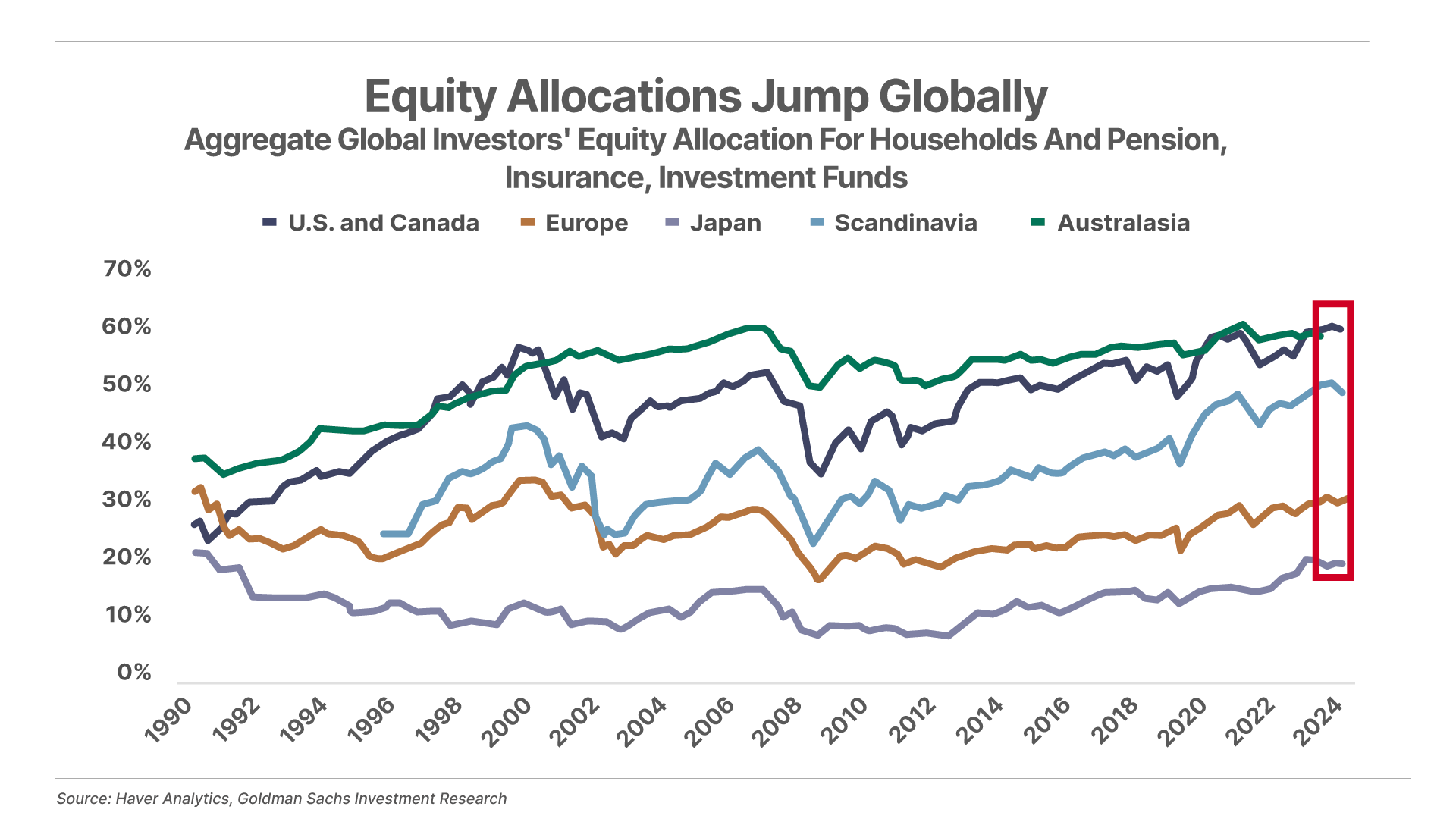
1. Everyone is all-in on stocks. The allocation to stocks among households and pensions and insurance companies is near a record high across the globe. North American and Asian countries have the most exposure to the stock market, at 60% of total assets. With so much wealth concentrated in equities, any downturn in prices could have an outsized impact on consumer spending and the overall economy.
2. SpaceX is buying AI coding startup Cursor for $60 billion. Cursor’s shareholders will be paid entirely in freshly issued SpaceX (SPCX) shares, with the merger set to close in Q3. The currency matters more than the price… SpaceX’s recent initial public offering (“IPO”) floated barely 4% of the company, driving a record valuation near $1.8 trillion and a sharp first-day pop. Now management is spending that richly valued paper – not cash – to buy a disruptive AI business. Companies acquire with their stock when they think it’s expensive, not when they think it’s cheap.
3. South Korean chipmaker SK Hynix is heading to Wall Street. Nvidia’s (NVDA) top high-bandwidth memory (“HBM”) supplier is preparing an American depositary receipt (“ADR”) listing as soon as next month, following a confidential filing with U.S. regulators in March. The move would broaden its shareholder base – many U.S. institutions can only hold U.S.-listed names – and could raise up to $26 billion to fund AI capex. SK Hynix trades at just 6x forward earnings, far below U.S.-listed peers – so a successful debut could also potentially re-rate the entire memory complex, including popular names like Micron (MU).
Chart Of The Day… SK Square
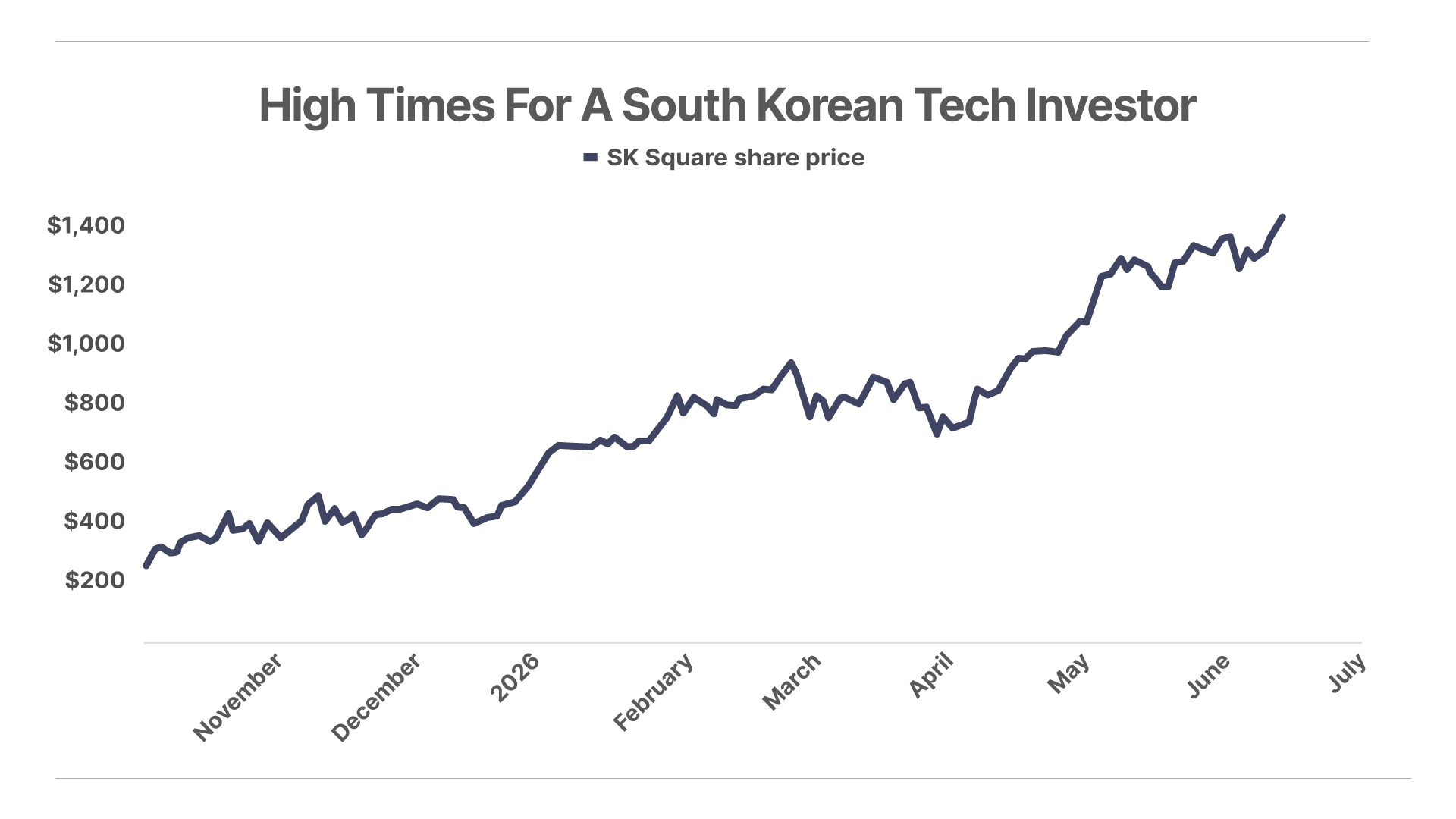
In October, Porter told Daily Journal readers about an under-the-radar South Korean firm – SK Square (402340 on the Korea exchange) – that owns a substantial stake in chipmaker SK Hynix, yet was trading at an enormous 67% discount to book value. Shares of SK Square have done incredibly well since Porter told the story, up more than 530% and beating SK Hynix by nearly 30 percentage points.
Mailbag
“Taxing The Future”
Owen P. writes:
I’m one of your Canadian subscribers, from Alberta. And I can tell you that is exactly what our socialist liberal federal government has been doing to our oil and gas industry for the past 10+ years. Now we are in a technical recession, with the previous two quarters of negative growth. And the regulatory process to get a new energy project even approved is almost insurmountable. All in the name of saving the planet, when the need for energy production has never been greater, and the processes used for energy production in Canada (and the U.S.) are the most environmentally responsible in the world.
I hope you don’t allow the same disease to grow unchecked in the U.S. like it is up here.
Porter Comment: Canada? Where’s that?
“Honeycomb Portfolio And Secular Bear Market Performance”
Alex V. writes:
Hello Porter;
Very impressive research! I am curious why you did not backtest significant secular bear markets with the honeycomb portfolio? This is the most distressing event that can occur to an investor except for a worldwide depression. We are due for one. Are you planning on providing that backtesting data for the honeycomb portfolio?
Porter Comment: Well, we did a complete 13-year backtest that included the COVID panic. And we know that in market panics all of the correlations go toward zero, which, of course, limits the value of the portfolio’s extremely low pairwise correlations. The COVID drawdown was ~30%, which wasn’t materially different from the market’s drawdown. In regards to doing more backtesting, I think you’re underestimating how much data is required to do an accurate best-in-class selection for seven equity sectors, across a 30-year backtest. I’m not saying it’s impossible, but I am saying it’s not worth the trouble. We already know, just by looking at the Lindy-only portfolio’s results, that the drawdown during the Global Financial Crisis was substantial – in excess of 40%. The Honeycomb Portfolio is an all-equity strategy. It isn’t going to offer the kind of diversification and ultra low volatility that the Permanent Portfolio does. Instead, it offers market-beating results (+21.37% CAGR) and a vastly superior Sharpe ratio (1.04 versus the benchmark’s 0.56). It’s also specifically designed to protect investors from inflation. In 2022, when the market declined 18.2% amid the sharpest interest rate tightening cycle in four decades, the Honeycomb returned 21.2% – a spread of 39.4 percentage points. The portfolio’s gold, defense, materials-royalty (Texas Pacific Land, TPL), and insurance holdings all benefited from the same inflationary and geopolitical forces that crushed growth-oriented equities. As long as inflation is the greater threat to the market than deflation, the Honeycomb will provide adequate downside protection. But if there’s another Global Financial Crisis or another COVID panic, it won’t.
“Oil Supplies And Future Price”
Sherwin R. writes:
The Schrödinger’s War analogy is interesting, but to me it’s just a roundabout way of saying that Trump has been lying about the war, which would be par for the course, since Trump is a pathological liar. In connection with Iran, I’ve been calling him the boy who cried sheep. The market continues to believe every utterance of his is to me, completely baffling.
I have zero intention of selling my energy stocks.
And finally, here is my question. The CEO of Chevron and one of ExxonMobil’s senior officers have both recently said that $150 per barrel oil may be in our near future as a result of the Iran “conflict.” This does not seem to be consistent with the table in Monday’s Daily Journal, which seems to indicate that oil shortages may still be several months away. Do you think that the Chevron and ExxonMobil officers were incorrect in their assessments?
Porter Comment: I’d assume the senior officers of Chevron and ExxonMobil are honest and far more knowledgeable about the energy markets than President Trump. In regards to politicians who lie… have you ever met one who didn’t whose last name wasn’t Paul?
Porter & Co. Market Snapshot
| Price | Yesterday’s Return | Year-to-Date Return | |
|---|---|---|---|
| S&P 500 Index | $7,554.29 | 1.65% | 11% |
| Gold per ounce | $4,328.00 | 1.04% | 0.5% |
| Bitcoin | $66,289.50 | 3.94% | -25.1% |
| Oil (West Texas Intermediate) per barrel | $80.75 | -0.8% | 33.1% |
| Berkshire Hathaway (BRK) | $742,046.00 | 1.36% | -1.7% |
| Porter’s Permanent Portfolio | – | 0.83% | -1.3% |
| The Better Than Berkshire Index | – | -0.47% | 3.2% |
| Total Return | Annual Return | ||
| Porter & Co’s Top Ranked* | 31.5% | 13.0% | |
| Yield | Yesterday’s Change | Change Year-to-Date |
|
| U.S Treasury 30-Year Yield | 4.97% | 1 bps | 12 bps |
*A Complete Investor risk rating of 1 is defined as a “low risk, high allocation” security, while positions rated closer to a 5 are higher risk. Porter & Co.’s top-ranked positions include those rated either 1 or 2 in Complete Investor portfolio.
Porter & Co. Top Positions
| Publication | Ticker | Description | Total Return |
|---|---|---|---|
| Complete Investor | BWXT | BWX Technologies | 240% |
| Tech Frontiers | QURE | uniQure | 237% |
| Complete Investor | ARM | ARM Holdings | 198% |
| Complete Investor | BTC/USD | Bitcoin | 145% |
| Tech Frontiers | TGTX | TG Therapeutics | 142% |
| Tech Frontiers | ROIV | Roivant Sciences | 133% |
| Tech Frontiers | QURE | uniQure | 131% |
| Complete Investor | PM | Philip Morris | 125% |
| Tech Frontiers | SGMT | Sagimet Biosciences | 120% |
| Distressed Investing | PTON | Peloton Interactive | 105% |
Prices as of 4:00 pm ET June 15, 2026
Please note: The investments in our “Porter & Co. Top Positions” should not be considered current recommendations. These positions are the best performers across our publications – and the securities listed may (or may not) be above the current buy-up-to price. To learn more, visit the current recommendations page of the relevant service, here. To gain access or to learn more about our current recommendations, call our Customer Care team at 888-610-8895 or internationally at +1 443-815-4447.