Why We’re Changing Our Allocation In A “Permanent” Portfolio
Inside Today’s Issue
Today’s Journal is extremely serious, but let me begin with a joke.
Normally, bond salesmen never get into heaven. If you’ve never read the classic Liar’s Poker, then you may not understand why. Bond prices are opaque. That means bond salesmen can frequently get away with “murder” – taking a huge spread out of the trades they do for customers. There are a lot of bond traders without scruples who take advantage of “muppets” and sell them bonds with spreads wide enough to drive a new Ferrari through.
And so bond salesmen generally don’t get into heaven. But when 9/11 happened, God made some exceptions. An entire bond trading firm (Cantor Fitzgerald) got wiped out when the planes hit the towers. So God brought them all in. And he explained:
Look, you guys really don’t deserve to be here, okay. But I feel terrible about what’s happened to you. You’ve lost your lives, your families… your Ferraris. Everything. So, I’m willing to make an exception – this time. But I need something in return…
Well, as you can imagine, the bond traders were shocked and confused at first. But then they realized that God needed something from them. And unless they could give it to him, they were going to hell – for eternity!
The emerging-markets managing director came to his senses first. (He was the one most used to everything going to hell.) He stood up and faced God.
God, you’ve saved us. Thank you. We are all in your debt. And looking back, I understand why you don’t normally allow bond traders in here. We are all grateful and want to do whatever we can to help. What can we do for you, God?
God walked over to him. He put his arm around him and said, “Walk with me a minute.”
As they walked out of earshot of the other traders, God asked…
What do you think interest rates are going to do next year…?
We’re making a substantial change to our recommended allocation in Porter’s Permanent Portfolio. We recognize that there are lots of good reasons not to follow our advice about this change.
In the first place, no one can predict interest rates, not even God. And, secondly, the entire idea of a Permanent Portfolio is that you do not have to do any trading or hedging, as the portfolio is already hedged. It holds 25% in cash and 25% in gold and Bitcoin, which is a hedge against monetary volatility. Assuming you rebalance each year, this kind of portfolio will survive a crisis and continue to prosper – just as it did in 2008/2009 and just as it did during the COVID market panic.
But even though there are real risks to making this change, we think it’s the best course – for conservative investors who are retired.
Here’s why.
The 10-year U.S. Treasury yield hit 5% on Monday, September 14, driven by soaring energy prices, the widening war with Iran, and a bond market losing patience with Washington’s deficits.
Interest rates on the benchmark U.S. bond have only touched that level once since before the Global Financial Crisis, in October 2023. But by that point, the Fed had raised its benchmark rate 11 times (!) since starting the cycle in March 2022, taking the federal funds target range up to 5.25-5.50%.
In other words, back in October 2023, the Fed was already well into a tightening cycle. Commodity prices were already coming down, and measures of inflation were moderating. And the Fed Funds rate was at par with two-year Treasury notes.
Today, commodity prices are soaring. And the Fed hasn’t begun a determined hiking cycle – putting itself way behind the curve. The Fed Funds target range is currently 3.50%-3.75%, while the two-year Treasury yield is 4.67%. That means the Fed is about 100 basis points behind the market’s rate of interest.
What does all this mean? We’re on the cusp of a rate-hiking cycle.
And there are real risks to this cycle because of the size of the national debt. We are entering uncharted waters with the massive size of the coming refundings. Total marketable U.S. Treasury debt outstanding is $31.8 trillion, carrying a weighted-average interest rate of about 3.48%. About 33% of that debt, roughly $10.5 trillion, matures within 12 months. Call it $15 trillion over the next 18 months. So roughly half of the national debt will reprice in the next 18 months.
If rates average 5% (which, again, is behind the curve currently), that will add $220 billion in annual interest expense. That would be a 21% increase to current interest expense ($1 trillion currently). It would also add 12% to the annual deficit.
While important, the bigger issue is how this big increase in interest expense will be paid for. There’s zero chance the government reforms entitlements or cuts military spending. Which means these bigger interest payments will surely be paid for by yet more inflationary government deficit spending. And the deficit is already running at 6% of GDP (gross domestic product).
That will push us into a very dangerous situation. The Fed may not be able to raise rates high enough to stop the inflation this time because our debt stock is now so large relative to GDP that a Paul Volcker-style interest rate-hiking cycle isn’t fiscally survivable like it was in 1980.
These risks are not priced into the market yet and, in fairness, these risks may not materialize for a few more years. However, I do note that Bank of America (BAC) is down 10% in the last month. It’s my best canary in the coal mine stock to gauge interest rate risks, because of its enormous, low-yielding bond portfolio. (Bank of America bought $700 billion in 2% bonds in July of 2020.) As rates go higher, the risks grow that Bank of America will fail because of the losses on these bonds.
My main concern is that this inflationary cycle may be much harder to control, because it’s being driven by factors (entitlement spending, global geopolitics) that aren’t easily constrained. And as I told you yesterday, that kind of macro outlook reminds me very much of the 1973-1974 inflationary period, which didn’t resolve for a decade.
That means our property-and-casualty (P&C) insurance stocks face a very tough outlook.
P&C insurers write the policies that cover your car, your home, and your business against loss. They invest the premiums they collect, called float because it sits in their account between the day you pay and the day a claim gets paid. And insurance companies invest mostly in bonds.
That business model works well when rates and inflation are calm. It comes apart when they spike, for three reasons that hit at once.
- Claims get more expensive. It costs more to rebuild a fire-damaged house, replace a wrecked car, or settle a lawsuit when the general price level is rising. State regulators approve premium rate increases with a lag, sometimes a year or more, so claims costs can outrun the premium dollars collected to pay for them. Insurers call this loss-cost inflation. On liability lines, where lawyers and juries set the price, it’s called social inflation: litigation costs and jury awards climbing even faster than the government’s own inflation figures.
- The bonds insurers already own lose value. A bond paying 4% is worth less the moment the market can buy a new one paying 6%. That loss shows up immediately on the balance sheet, in book value: the net worth per share that investors use to price insurance stocks in the first place.
- The whole stock market’s multiple, the price investors will pay for each dollar of a company’s earnings or net worth, shrinks. When a 10-year Treasury pays 5% with no credit risk, investors demand more from every other asset, including P&C stocks that already trade close to book value. Book value shrinks from the bond losses, and the multiple applied to what’s left shrinks too, so both hits land in the same quarter.
There is one important offset to these risks. As insurance companies’ old, low-coupon bonds mature, insurers reinvest the cash into new bonds paying the higher rate. Thus, investment income rises over the following one to two years, and the stocks’ dividends rise with it, usually with a lag of a year or two behind the rate move itself. But that rebuilding takes years to show up in earnings, while the bond losses and the multiple compression show up the day rates move. The stock falls first, and recovers. If it recovers, it does so on a much longer clock than the dividend does.
I wanted to know how this unfolded during the 1973-1974 inflation. So I went back to the last time inflation and rates did this to P&C insurers, and I studied their share prices between January 1973 to January 1975, the two years bracketing the oil embargo, the wage-price spiral, and the 1973-74 bear market.
I used a primary source: the Associated Press‘ own NYSE and over-the-counter stock tables, printed daily in newspapers and digitized by the University of North Texas’s Portal to Texas History. We pulled the closing quotes nearest January 1973 and January 1975 for every major P&C insurer that was trading at the time, while we carefully excluded life insurers. Then we cross-checked the prices against Yahoo! Finance.
Here is what a pure-play P&C portfolio did over those two years.
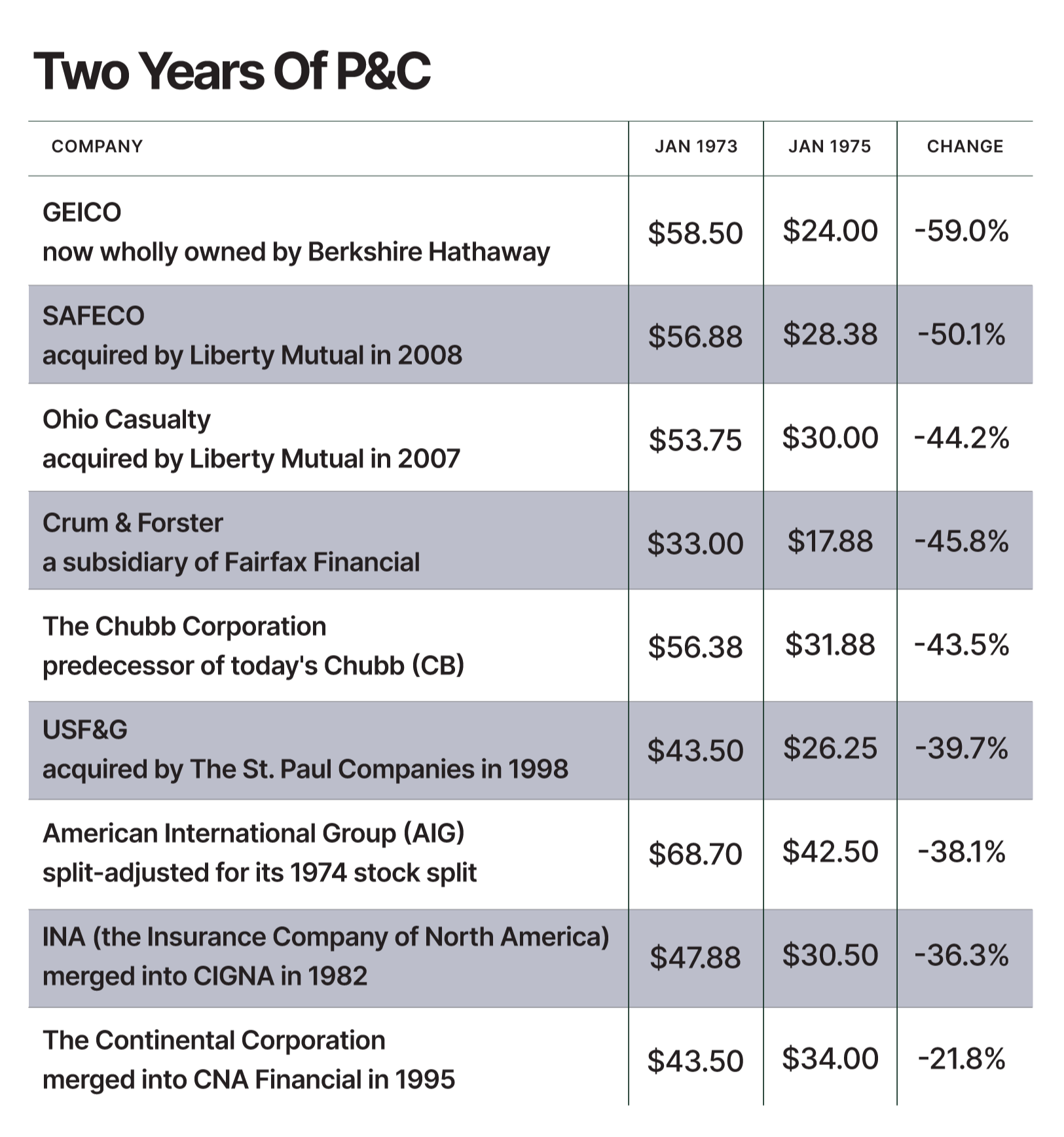
The average decline across those nine names was 42%. The median was 43.5%. The S&P 500 itself fell 41% – from 119.10 to 70.23 – over the same stretch.
P&C insurance, the industry investors buy for safety, fell in line with the broader market, and in several cases fell harder.
We left several well-known names out of that table on purpose. Aetna Life & Casualty, Travelers, CNA Financial, Old Republic International, General Reinsurance, and Kemper all traded through the same period, and all fell too, in some cases much further. CNA Financial dropped 85%, but CNA was carrying a large life and health insurance book and came within a step of insolvency in 1974, when Loews bought 83% of its stock in a rescue. Aetna and Travelers ran life insurance and group health divisions as large as their P&C operations. General Reinsurance wrote reinsurance, not primary policies.
For a conservative investor, our recommendation is simple: stand aside from the P&C insurance industry until interest rates find a ceiling.
For our own track record, we are selling our 25% P&C allocation (“Insurance”) inside Porter’s Permanent Portfolio, in full. The proceeds move into our cash holdings, whose target allocation rises from 25% to 50% of the portfolio. The Lindy stocks (“Equities”) and the gold-and-Bitcoin allocation remain at 25% each.
We acknowledge that this kind of tactical move is risky. Selling triggers taxes and opens us to another risk: selling too soon. I recognize the 10-year U.S. benchmark yield touched 5% in 2007 and again in 2023, and both times it reversed. If that happens a third time, we will look foolish holding half the portfolio in cash while stocks and bonds recover without us.
As always, I simply give you the information I would want if our roles were reversed. In my personal portfolio, I have established a $10 million short position in long-duration bonds. I’m using that to hedge my exposure to the stock market. I’m not suggesting that’s right for you. I’m only explaining that I have a substantial amount of capital at risk based on the very analysis that I’m giving you.
I see a slew of risks that our country hasn’t faced in 50 years: massive and growing deficits, an energy shock now running through the global bond market, and the automatic cost-of-living increases built into Social Security and other entitlement programs. Together they point toward double-digit inflation and a 10-year Treasury yield above 8%, not a retreat below 5%.
Note: This change applies to our own track record, not to every account built around this idea. The Porter & Company Porter Portfolio Index ETF (PCPP) that Tuttle Capital Management runs keeps its rules-based 25% allocation to each of its four sleeves. And your own allocation may not need to change either, depending on your tax situation, your time horizon, and how much of this risk you are already hedging elsewhere.
Our new target allocation, until rates stabilize, is 25% Lindy stocks (high-quality businesses with the pricing power to raise prices as fast as their costs rise), plus 25% gold and Bitcoin. The rest, 50% cash, sits ready so we can redeploy into high-quality stocks and bonds once it looks like the inflation tide is going to recede.
A 10-year Treasury yield at 5% and moving higher doesn’t break a good insurer’s underwriting. But it does change the price investors will pay for it.
Tell me what you think of today’s Journal: porterstansberrydirect@gmail.com
Good investing,
F. Porter Stansberry
Stevenson, Maryland
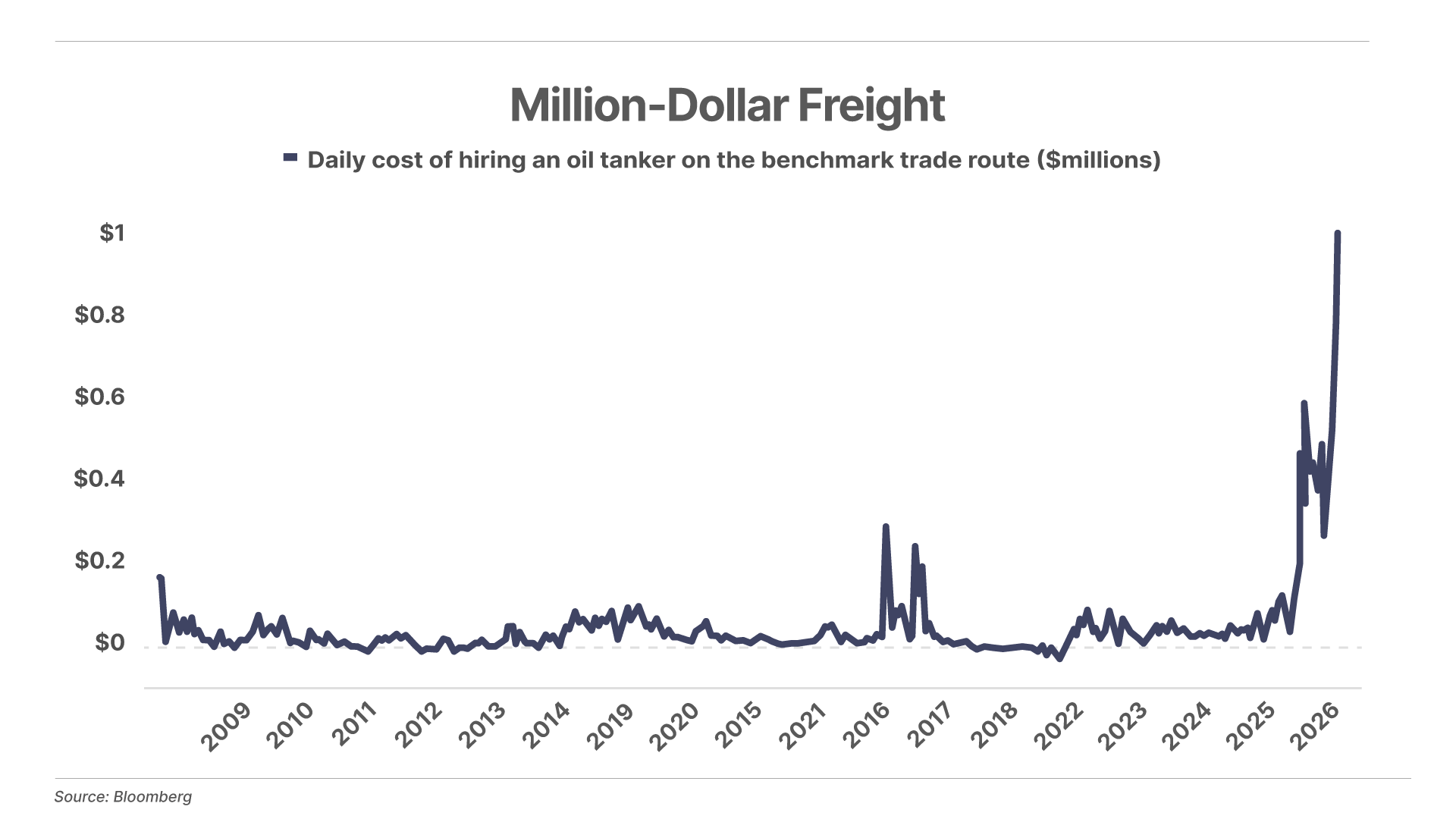
1. Oil tankers now cost more than $1 million a day to hire. The Baltic Exchange, the London body that publishes shipping’s benchmark prices, assessed a supertanker carrying crude oil from the Persian Gulf to China at $1.035 million a day on Monday, the first seven-figure reading in the index’s history. The same route set a record of about $424,000 a day when the Iran war began in late February, and before the war, shipbroker Clarksons expected these ships to average just $75,000 a day. Few owners will currently send a vessel through the Strait of Hormuz. Crude is instead ferried out to the Gulf of Oman and transferred ship-to-ship, and Houthi attacks in the Red Sea are forcing some tankers onto a detour around Africa that adds roughly 30 days to transit. Every extra day at sea removes a ship from the market.
2. Energy executives warn: “Crisis is here.” A growing chorus of energy veterans is sounding the alarm that the energy-supply crisis has officially arrived. This includes Chevron (CVX) CEO Mike Wirth, who noted at an energy conference on Friday that the short-term efforts to mitigate the supply crisis “have largely now played out.” This includes the depletion of strategic stockpiles around the world, which can no longer provide a buffer to offset a record supply deficit. The market is sending the same message, with oil prices now firmly above $100 per barrel and refined products like diesel trading above $200 per barrel.
3. Bond yields break out across the globe. The U.S. 10-year bond yield hit 5.04% overnight, reaching the highest level since 2007. Across the pond, the 10-year bond yields in the UK, France, and Germany have all hit their highest levels since 2009. And in Japan, the 10-year bond yield is now at 3% – the highest level since 1996. With government debts ballooning and a building energy crisis feeding into higher inflation, this will likely keep the upward pressure on borrowing costs globally.
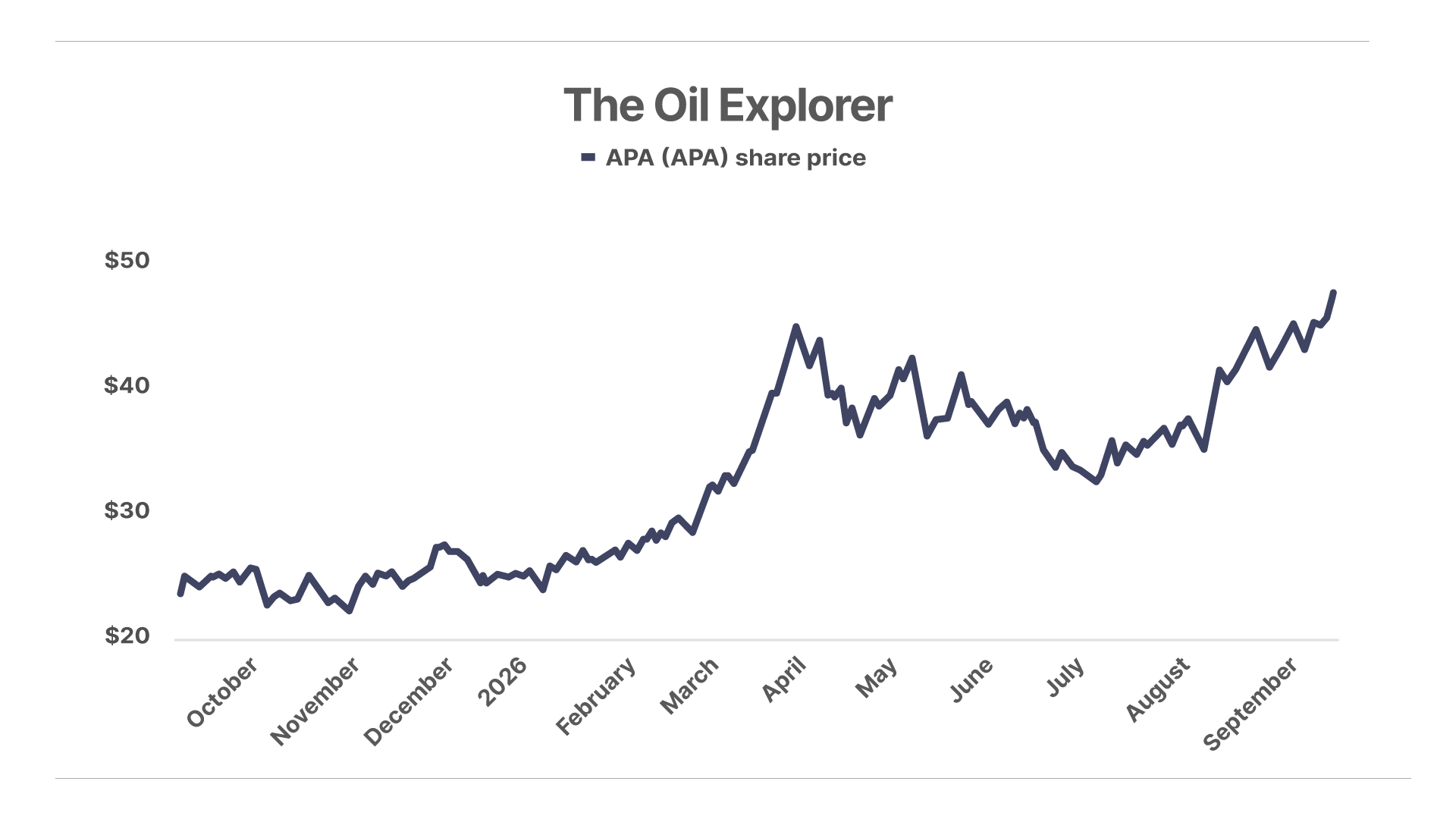
Shares of oil-exploration firm APA (APA) have soared 105% over the last year and 161% since we recommended them in Porter & Co’s Asymmetry, an advisory offered exclusively to Partner Pass members.
In yesterday’s Journal, Porter wrote that the rise of yields on 10-year Treasuries to 5% will cause inflation to break out – as a result, the Fed will face a choice past Fed Chair Paul Volcker never faced: it will have to choose between fighting inflation and keeping the Treasury solvent.
“The Seventies”
Jim H. writes:
I appreciate the ’70s history, as I lived through it, and the technical explanation that I can understand. Thanks.
“It’s Very Scary”
William S. writes:
Thank you for the advice. It’s very scary. I’ve been investing in gold shares with Garrett Goggin at Golden Portfolio, 40%. I have some in gold coins, 15%, and the rest in cash.
“Thank You So Much”
Thomas V. writes:
I always feel like I’ve learned something whenever I read your commentary. Thank you so much. I’ve been following your work since around 2006 or so and I feel blessed to have found you.