Issue #86, Volume #3


The Secret Behind Loudoun County, Virginia’s Wealth
Inside today's Daily Journal…
|
You have probably never heard of Richard Cantillon. And there’s a very real, and powerful reason why not: his ideas are dangerous to bankers.
John Law’s Mississippi Scheme (1720) was the first modern, fiat-driven, paper-money financial bubble. It crashed the French economy and wiped out most of the wealth of the French nobility.
Cantillon, working out of his Paris bank, was one of the most aggressive early buyers of Mississippi Company shares as they went from a few hundred livres in 1718 to roughly 10,000 livres by late 1719. Cantillon had two structural advantages most speculators didn’t. He had privileged access to the share-issuance machinery (he got shares first), and he lent money against shares as collateral, which both generated interest income and gave him critical information about the size and the stability of the speculative leverage in the market. He sold most of his Mississippi position into the late-1719 mania.
To maintain the price of the stock, John Law had to create enormous amounts of new bank notes. More bank notes meant the livre would, eventually, collapse against the British pound sterling. So as Cantillon was liquidating his clients’ collateral shares (as the margin loans were called in), he converted the heavily inflated French currency into sterling. When the livre crashed, the same nominal pile of money was suddenly worth a fortune in hard currency.
Cantillon wrote an intricately detailed account of the entire affair and circulated his notes among a close group of friends. He then retired in London. Or he tried to. All of the investors who’d gotten wiped out using his margin loans sued him for fraud and generally made his life miserable. In May 1734, Cantillon’s London townhouse burned down and his body was found in the wreckage. The coroner ruled it an accident. But there is compelling evidence Cantillon had faked his own death – he had been locked in bitter lawsuits with former clients trying to claw back his fortune – and appears to have sailed for Suriname under an assumed name and lived out his days there in obscurity.
After his real death, the notes he shared with friends were published as a book: Essai Sur La Nature Du Commerce En Général (Essay On The Nature Of Trade In General). It is the first complete work of modern economic theory – predating Adam Smith by almost 50 years. However, it wasn’t translated into English until 1931 – 221 years after his death.
What’s so dangerous about his ideas? They explain the power bankers have over an economy.
No one thinks carefully about what happens when a central bank buys assets (usually Treasury bonds). That new money doesn’t spread through the economy uniformly, like food coloring dropped into a glass of water. Cantillon knew this firsthand. New money, he observed, enters the economy at a specific point, through the hands of a specific set of people first. And those people, because they hold the new money before prices have adjusted higher, are able to profit enormously from the inflation that follows.
In Cantillon’s time, the point of entry was the royal mint. When a king needed money for a war, he ordered the mint to call in the old coins and restrike them with more copper and less silver. The first people to receive the new, debased coins were the royal contractors – the arms merchants, the shipbuilders, the grain suppliers, the army officers. They took their shiny new coins to market and bought steel, timber, wheat, and horses at the old prices. By the time the coins had circulated for a year or two, the country boys delivering wheat to the docks were being paid in coins worth 20% less. The wheat farmers and journeymen paid the full inflation. The royal contractors profited from it.
That is the Cantillon Effect. New money benefits its first recipients at the expense of its last recipients.
This is incredibly important to understand. You’re taught that inflation is an invisible tax. And that’s true – eventually. But the timing matters. Understood more completely, inflation is a transfer. Value is taken from the people farthest from the printing press and given to the people closest to it.
Today, the Federal Reserve does not mint coins. It creates new money electronically. New dollars enter the economy through the primary-dealer system – the 18 or so large banks authorized to transact directly with the Fed’s open-market desk. Those dealers do not lend the new dollars to young families trying to buy their first house. They lend to hedge funds, private-equity firms, and corporate treasurers, who use the money to buy stocks, investment properties, whole companies in leveraged buyouts, farmland, Manhattan office buildings, and Aspen ski chalets – all at yesterday’s prices, using tomorrow’s money.
But there is a second money spigot in this country, even closer to the printing press than Wall Street. It is the federal budget itself.
In fiscal year 1971 – the year President Richard Nixon closed the gold window – total federal outlays were $200.8 billion. In fiscal year 2025, total federal outlays were $7.04 trillion. That is a 35-fold increase in nominal dollars over 54 years, against a roughly four-fold growth in real GDP.
The federal government has been the single largest beneficiary of newly created dollars in the American economy. And you can actually see where those dollars went first. Just look at the map.
In 1971, Loudoun County, Virginia, was a rural dairy and horse-farming county on the Potomac River, west of Dulles Airport, with a population of about 37,000 and a non-descript median household income. In 2024, Loudoun County’s median household income was $177,457 – the highest of any county in the United States, for the 15th consecutive year.
Of the 15 richest counties in America today, five sit in the immediate gravitational orbit of the federal money spigot: Loudoun, Falls Church, Fairfax, and Arlington in Virginia, and Howard County in Maryland. There is no oil field in Loudoun County. There is no gold mine. There is no tech cluster of the Silicon Valley variety. There is no major research university. What there is, in Loudoun County, is a dense concentration of federal contractors, federal employees, federal consultants, and the lawyers and lobbyists who service them.
This is the geography of the Cantillon transfer.
You cannot stop the theft. You do not control the Federal Reserve. You do not control the Treasury. You do not control the federal contracting bureaucracy that built Loudoun County.
What you control is your own balance sheet.
And your balance sheet, if you want it to survive what is coming, has to be arranged so that you are positioned, relative to the next wave of money creation, the way the primary dealers and the contractors in Loudoun County are positioned. You cannot stop being the person from whom money is stolen at the macro level. But you can stop being that person at the personal level. You can move yourself up the Cantillon ladder, into the cohort that receives the new money rather than the cohort that pays for it.
If the government is going to run the printing press, borrow against sound collateral at long-term, fixed rates. Buy assets you know will appreciate when the printing press runs.
If you depend on their paper, you’ll be their slave. If you use their paper to buy high-quality assets, you’ll be a king.
In my new book, 2029: The End of America: Why the Age of Paper Money Is Ending And How to Survive the Coming Global Monetary Reset, I offer three distinct strategies for using leverage safely and effectively in the financial markets. And, the best way, right now, might be trees. To learn more, just read Chapter 8 starting on page 129.
Don’t forget, this week only, you can get a Kindle copy of the book for only $4.99 by clicking right here!
Tell me what you think of today’s Journal… good, bad, or anything in between: porterstansberrydirect@gmail.com
Good investing,
F. Porter Stansberry
Stevenson, Maryland
Presented by Brownstone Research
Introducing "Elon Musk's Day-One Retirement Plan"

What if you could compress a lifetime of wealth-building…
Ten… 20… even 30 years…
Into a single 24-hour window?
It sounds absurd.
But Elon Musk is about to make it a reality with something I'm calling…
"Day-One Retirement Plan." Click here to see the details.
Editor’s Note: Keep in mind, we only accept advertising from publishers we know to offer well-researched ideas vetted by a legal team, excellent customer service, and reasonable refund policies. Brownstone Research is one such partner. We do not, however, under any circumstances make any representations about their investment ideas or strategies, nor will we warrant them as equal to our own. We do recognize that the markets are tempestuous and, at times, ideas that we may not endorse prove valuable.
3 Things To Know Before We Go…
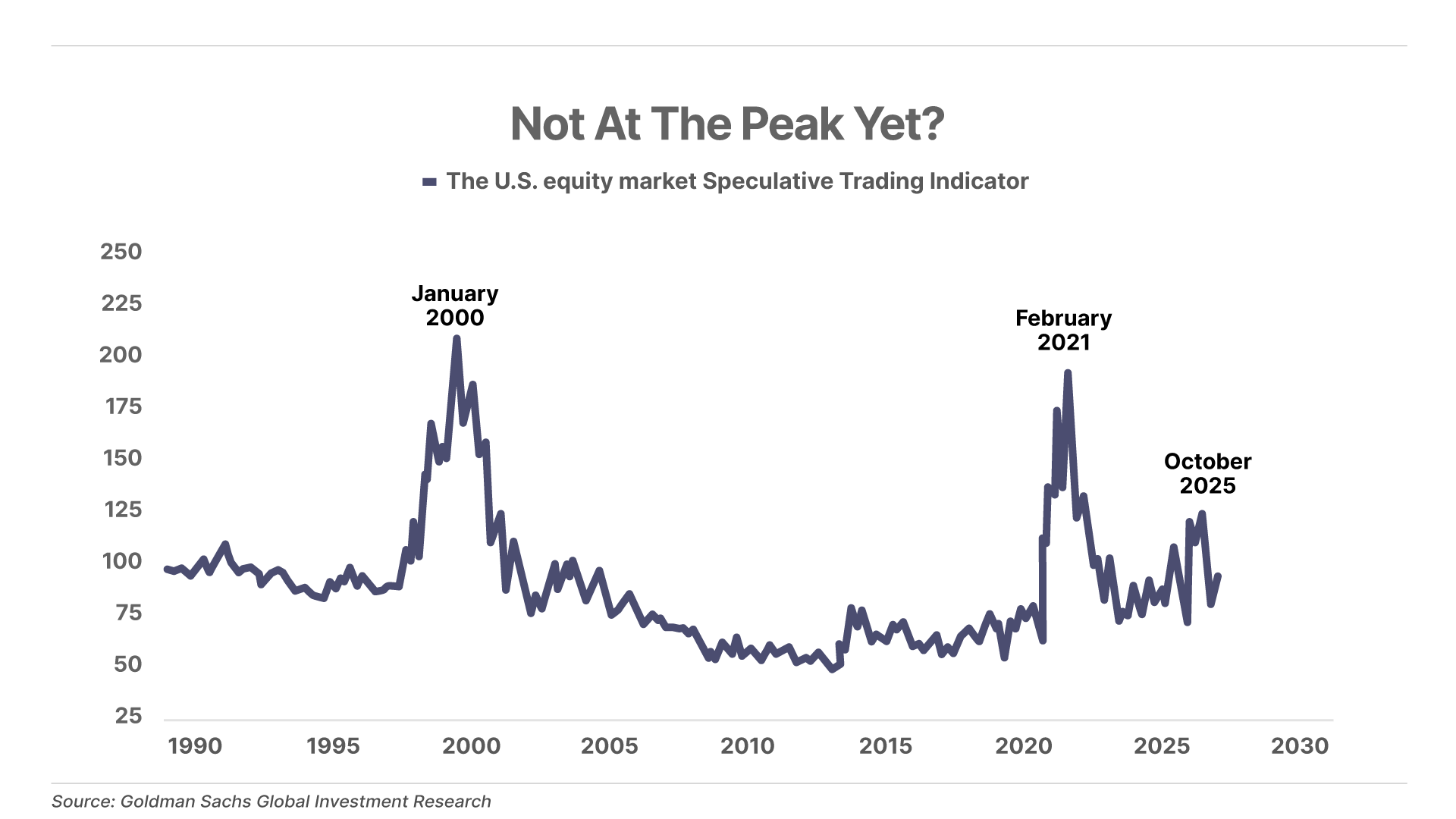
1. The AI “melt-up” could have further to run. Goldman Sachs' Speculative Trading Indicator – which tracks the share of trading volume flowing into the riskiest corners of the market – is currently well below levels that marked the end of previous market manias, including the 2000 dot-com bubble and the 2021 meme-stock frenzy. Froth is building, but history says speculation can run far hotter before it breaks.
2. U.S. home foreclosures are rising. Property-foreclosure filings surged 26% year-over-year in Q1 2026 to approximately 119,000 – the highest increase in six years, likely leading to more housing-market strain. If soaring insurance bills, property taxes, and HOA fees continue to climb, household budgets will stay squeezed and defaults will remain high... and foreclosures will continue.
3. Americans are draining their piggy banks to cover basic costs. This morning, the Bureau of Economic Analysis (“BEA”) reported that the U.S. personal savings rate collapsed to 2.6% in April, down from 5.5% a year ago. Meanwhile, Fidelity noted that 401(k) hardship withdrawals climbed to 2.5% in Q1 – extending a multi-year climb to the highest levels on record – while SecureSave, which runs employer-sponsored emergency accounts, said a record 11% of recent withdrawals were tied directly to transportation costs. Americans are now raiding their rainy-day funds just to fill up their tanks.
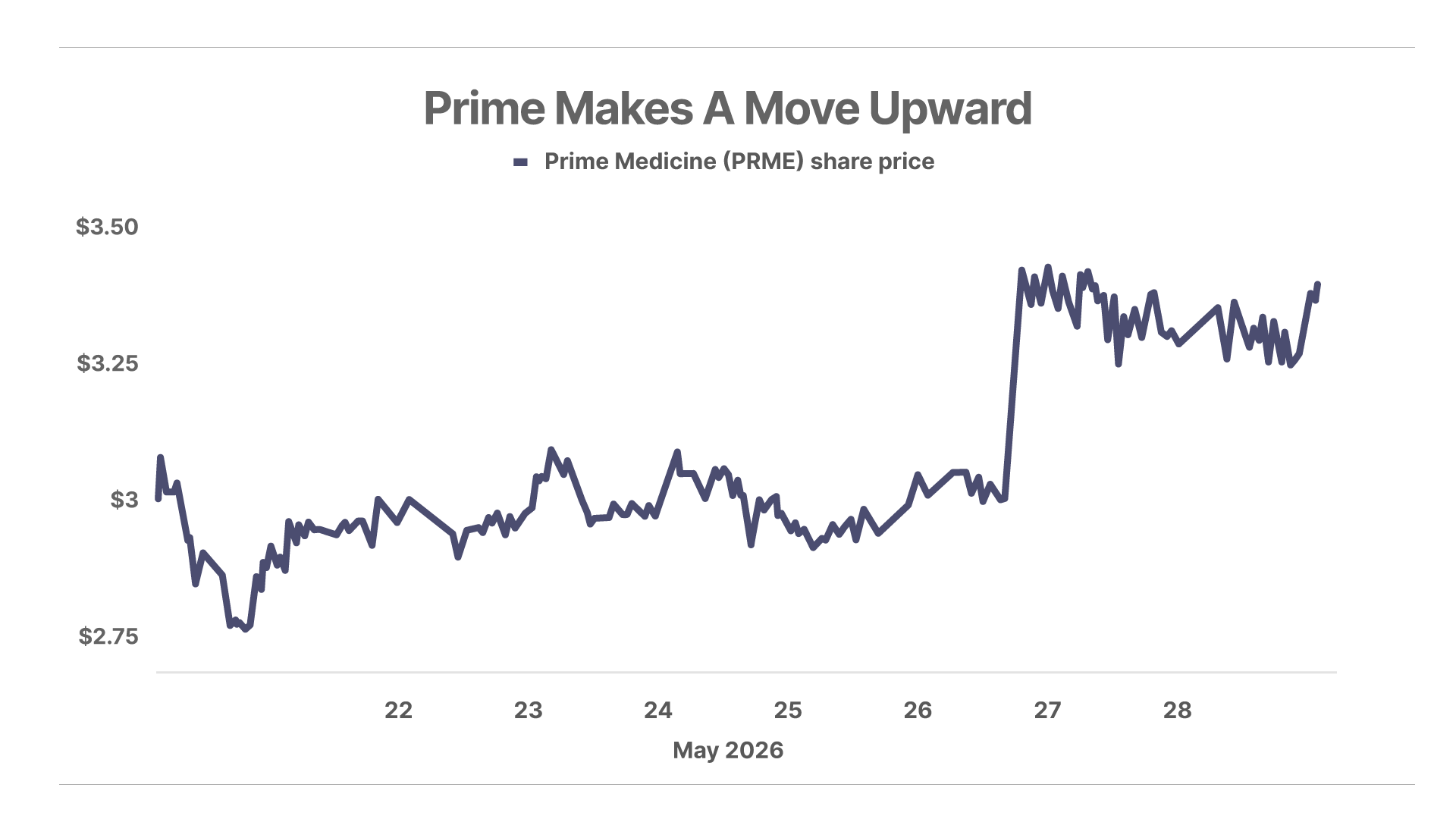
Chart Of The Day… Prime Medicine (PRME)
For months now, Tech Frontiers editor Erez Kalir has been saying that gene-editing company Prime Medicine (PRME) looks to be among the most important emerging players in what Erez calls the Era of Genetic Medicines. The market, it seems, is beginning to see what he has been calling “a steal” below $4 per share. Shares are up 20% for the week.
Mailbag
In yesterday’s Daily Journal “What The Crowd Isn’t Buying: Bitcoin,” Porter shared his pricing model for the leading crypto asset, indicating what he sees as a reasonable price for the digital asset. Readers share their thoughts and questions…
“Risk Of Quantum Computing Destroying Bitcoin”
Sherwin R. writes:
Porter, I have been hearing for some time about the risk of quantum computing at some point being able to break through the security of Bitcoin accounts, threatening their value. How does this factor into your view on the value of Bitcoin?
Also, just as an aside, I happen to be a fairly liberal Democrat, but I thought your Journal on black crime was fascinating and spot on (as was the critique of your reader’s son’s response).
Porter Comment: Quantum computing will, eventually, lead to changes in all forms of encryption. It does not play a role in my Bitcoin model.
“Bitcoin Is A Rip-off”
David A. writes:
Bitcoin is a total rip-off. The last Berkshire Hathaway vice chair Charlie Munger said it was the biggest scam that he had ever seen.
The fact that anybody with a brain would invest in something like Bitcoin is just beyond me. Self-made (created value). Nothing tangible but a coin with a value that society says it is worth. This entire story belongs in the file "You just can't make this stuff up." And nobody cares.
When the house of cards falls with Bitcoin, I want to be around to hear all of you provide answers.
Porter Comment: Bitcoin, like gold, is universally recognized proof of work and has many other qualities that make it a perfect form of money. Berkshire Hathaway, with its enormous insurance float, has long been one of America’s leading beneficiaries of the Cantillon Effect. It is no surprise then that Warren Buffett and Charlie Munger have always criticized gold and Bitcoin. Their ignorance (willful or otherwise) about these assets has led to woeful results for Berkshire’s investors, where gold could have (and should have) been used as a non-correlated reserve asset. Sound money is the enemy of the financier, which may explain their antipathy. If you’d like to learn more about Buffett’s other mistakes, you should read my book, Warren’s Mistakes.
“Bitcoin Valuation”
David F. writes:
Compelling argument.
But the issues I have are:
1. This mode of savings is outlawed by the government that is emerging as the world’s strongest financially and has the largest population. This prevents worldwide adoption that compares to anything remotely resembling gold.
2. It is much easier to steal and identify who has what. Criminals have often had their Bitcoin confiscated. It can be tracked if the wallet is big enough or if it’s run through a broker. Gold can be completely removed from the system indefinitely and then reemerge whenever the holder desires.
3. Quantum computing is not a joke. Anything on a computer can be attacked. Again, your gold can be almost unknown to anyone.
Yes, it’s harder to move around, but as the value increases exponentially in the coming years, a person could move $1,400,000 by just owning 20 lbs. Again, not ideal for ultra-high net-worth individuals, but still safer in my opinion than owning a wallet or a brokerage account.
Porter Comment: I’ve never sold any gold. As a reserve asset (aka, as collateral), it is the highest quality form of money in the world. Bitcoin, on the other hand, is the highest-quality money of zero maturity. At the right price, it is a very good alternative to 30-day Treasury bills.
Porter & Co. Market Snapshot
| Price | Yesterday's Return | Year-to-Date Return | |
|---|---|---|---|
| S&P 500 Index | $7,520.36 | 0.02% | 9.86% |
| Gold per ounce | $4,447.50 | 1.88% | 4.75% |
| Bitcoin | $74,344.70 | -1.03% | -15.92% |
| Oil (West Texas Intermediate) per barrel | $88.68 | 0.74% | 55.59% |
| Berkshire Hathaway (BRK) | $719,000.01 | -0.76% | -3.38% |
| Porter's Permanent Portfolio | - | -0.74% | -0.67% |
| The Better Than Berkshire Index | - | 2.71% | 5.52% |
| Yield | Yesterday's Change | Change Year-to-Date |
|
| U.S Treasury 30-Year Yield | 5.01% | -1 bps | 17 bps |
*A Complete Investor risk rating of 1 is defined as a "low risk, high allocation" security, while positions rated closer to a 5 are higher risk. Porter & Co.'s top-ranked positions include those rated either 1 or 2 in Complete Investor portfolio.
Porter & Co. Top Positions
| Publication | Ticker | Description | Total Return |
|---|---|---|---|
| Complete Investor | BWXT | BWX Technologies | 249% |
| Tech Frontiers | QURE | uniQure | 237% |
| Complete Investor | BTC/USD | Bitcoin | 175% |
| Tech Frontiers | SGMT | Sagimet Biosciences | 134% |
| Tech Frontiers | ROIV | Roivant Sciences | 131% |
| Tech Frontiers | QURE | uniQure | 131% |
| Complete Investor | PM | Philip Morris | 126% |
| Complete Investor | ARM | ARM Holdings | 119% |
| Tech Frontiers | TGTX | TG Therapeutics | 113% |
| Distressed Investing | PTON | Peloton Interactive | 108% |
Prices as of 4:00 pm ET May 27, 2026
Please note: The investments in our “Porter & Co. Top Positions” should not be considered current recommendations. These positions are the best performers across our publications – and the securities listed may (or may not) be above the current buy-up-to price. To learn more, visit the current recommendations page of the relevant service, here. To gain access or to learn more about our current recommendations, call our Customer Care team at 888-610-8895 or internationally at +1 443-815-4447.