Issue #112, Volume #3


Buying Bull Markets Early Is The Path To Wealth
Inside today’s Daily Journal…
|
Editor’s note: Porter’s 2029: The End of America is now available as an Audible book here, or to read from Amazon here.
Yesterday we looked up the skirts of a few fallen angels – our favorite kind.
Today I want to shift our greedy eyes in the opposite direction.
There’s a good reason to avoid investing in companies whose shares aren’t performing well: there’s usually a good reason. Many turnarounds don’t. Many companies that make big, strategic investments (like CoStar’s move into residential) later record big, strategic write-offs.
Alas, life is risk. For investors, pricing that risk is the most important.
One way to avoid risk is to focus only on businesses that are delivering outstanding results. Usually, these cost more because there’s less risk. But how can you know which stocks will continue to perform and are therefore worth paying up to own?
Thirty years ago, I had the incredible good fortune to meet a true investment legend, Chris Weber. Chris took the money he made mowing lawns as a kid in Phoenix in the early 1970s and successfully pyramided gold futures, as gold became legal to own again in 1975. Later, in the early 1980s, he did the same thing, but in the opposite trade, buying interest rate futures on the U.S. long bond.
In short, over about a decade, Chris built a large personal fortune with essentially two trades: long gold and then long U.S. Treasury bonds. Chris is one of the very few self-made people I know who has never had a real job (except mowing lawns!). He has a sixth sense for the markets and that’s all he’s ever needed.
When I met Chris in 1996, he taught me something I’ve never forgotten.
Porter, the only way to make the big money is to buy early into a bull market.
I then watched Chris invest early into the internet bull market and make a fortune as those stocks went parabolic in late 1999. I watched Chris buy gold stocks when gold began its bull market in 2001. He made a fortune in 2006-2007 when those stocks went parabolic.
I’ve never seen Chris be wrong about a major market move. He’s an extraordinary investor. (By the way, Chris writes a brilliant letter every two weeks. It’s a very “insider’s publication” – he never advertises, and, fair warning, it’s very idiosyncratic. He’s not really writing for his readers. He writes to organize his thoughts for his own investing.
Watching the big artificial intelligence (“AI”) trend develop over the last three years, it occurs to me that this technology investment trend will be the largest of my lifetime. It’s going to migrate from information technology into physical markets through robotics. And it’s going to play itself out in virtually every industry.
Investing in the companies that are developing AI and robotics is a multi-decade opportunity. And there will be plenty of booms and busts along the way. It isn’t possible to know today what kinds of new opportunities will emerge in the years ahead, just like in 1999 no one could have forecast that a company called Meta would become one of the best businesses ever created using something called social networking, because that service – and the technologies that created it – didn’t yet exist.
To find the companies that are involved in this new, massive economic trend you could, of course, read the financial news. You could subscribe to a newsletter like this one. (We first described this investment trend – we call it the Parallel Procession Revolution – in the summer of 2024.)
Or… you could use the technology itself to help find businesses whose results are clearly accelerating.
That’s what I did last week. I used AI to look at every possible U.S.-listed equity with a market cap larger than $3 billion and average daily dollar volume of at least $10 million. I’m looking for established businesses, not start-ups. And then I applied a standard growth and quality gate. I wanted to find companies with revenue and profit (net income) growing year-over-year. And then I applied another gate – a much harder test of quality growth. I only wanted companies that were not only growing profits but were also growing profitability. I want stocks that are not only participating in the AI revolution, but that are participating at scale. Meaning, as revenue and profits are growing, so are their margins and their returns on invested capital (“ROIC”). It is in these kinds of stocks that massive investor returns are possible.
I used AI to find all of the qualifying stocks, and then I ranked the top 60, scored on revenue growth + earnings growth + ROIC improvement. I then cut the selection to only 20 stocks by using an algorithm to optimize both pairwise correlation (we don’t want to own a single idea expressed 20 ways) and three-month price momentum. We’re not looking for “undiscovered” stocks. We’re not looking for fallen angels. We’re looking for the highest-quality, leading growth stocks.
I tested this strategy by using this screen and rebalancing quarterly in a backtest over the last decade. To limit turnover and to simulate how you’d manage such a portfolio (to minimize taxes and trading costs), I assumed that to enter the portfolio a stock would have to score in the top 20 but could remain in the portfolio as long as it was a top-40 stock.
In the backtest, this strategy doubled the market’s return (+24%) before trading costs. And it did so with only market-level volatility (beta: 1.03). But don’t get too excited – it’s a backtest. It shows how this strategy performs during a big bull market in stocks. There’s no guarantee that such conditions will exist over the next 10 years. The point of such a backtest isn’t to predict the future – it’s to confirm that this kind of a growth-stock investing approach works well in bull markets. And, no surprise, it does.
AI gives investors and analysts great new tools for finding stocks we might otherwise miss because it can quickly look at all the possible options and test those strategies quickly. It’s fascinating to consider if these tools will lead to better investment results, or if these advantages are quickly arbitraged away in a kind of AI investing arms race, which is what I’d expect.
In any case, here is the current uncorrelated growth portfolio using this growth + quality + momentum + low pairwise correlation strategy.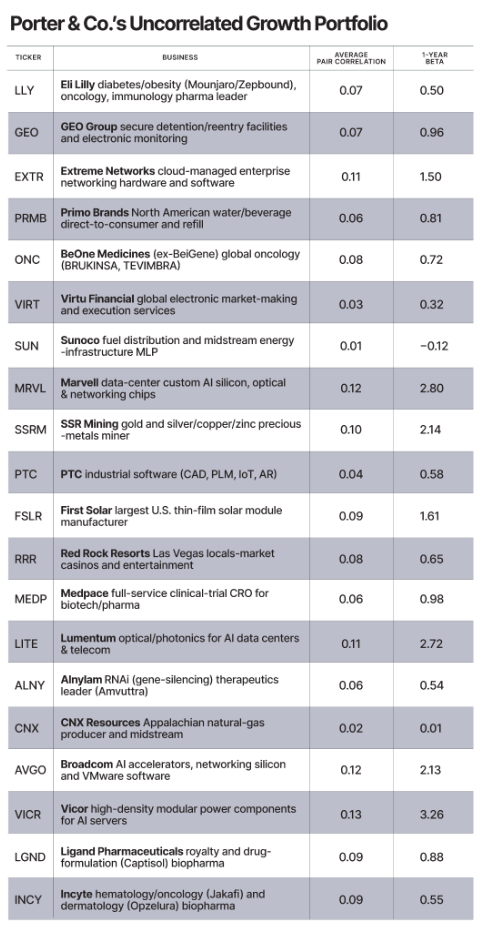
I hope you’ll think carefully about the impact of the low-pairwise-correlation part of this strategy. Overall, the average pairwise correlation is just 0.076. That very low correlation allows us to invest in highly volatile stocks, while keeping the volatility of the overall portfolio low.
We’re going to use this approach to build a proprietary Porter & Co. Non-Correlated Growth Stock Index, which we’ll update quarterly.
How Should You Use This Information?
I’d recommend looking at the list when we update it each quarter and seeing if there are any good businesses that you’ve never followed before that may be worth a closer look. That’s how our analysts will be using it too – as a screening tool for us, as a part of our research process.
The index will always look a little bit different than other kinds of growth indexes, because we’re adding a major factor by selecting from a pool of qualified candidates based on low pairwise correlation. That’s a step I haven’t seen any other research groups use, but I believe it’s one of the most important features to building a useful portfolio.
If you’re interested only in the growth names that are directly AI related, they are: Extreme Networks (EXTR), Marvell (MRVL), Lumentum (LITE), Broadcom (AVGO), and Vicor (VICR).
Tell me what you think of today’s Daily Journal: porterstansberrydirect@gmail.com
Good investing,
F. Porter Stansberry
Stevenson, Maryland

3 Things To Know Before We Go…
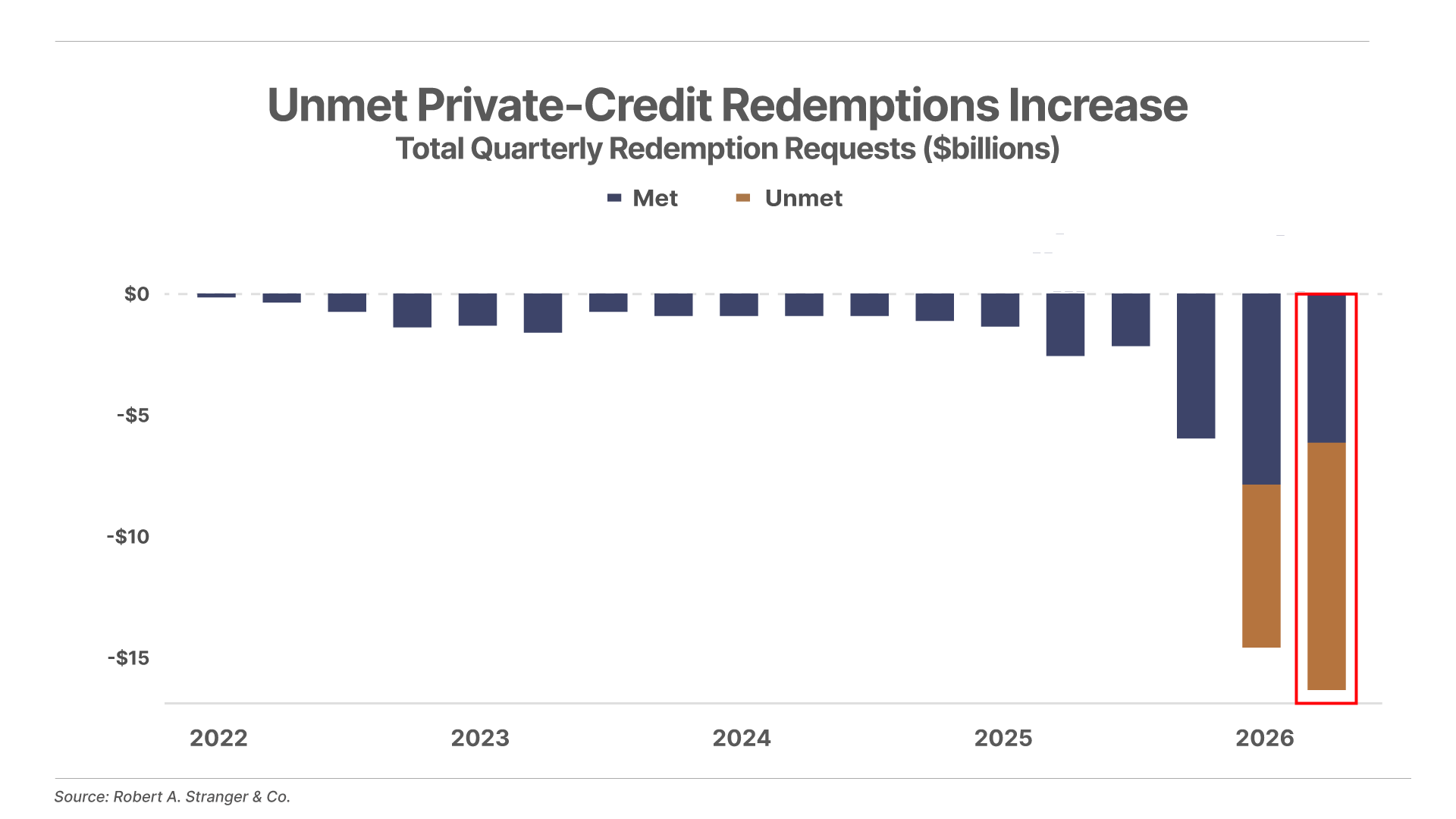
1. Private-credit redemptions grow. Investors requested $15.6 billion from private-credit funds in Q2, up from $13.9 billion in Q1, but managers returned just $5.9 billion – only 38% of requests, down from 53% in Q1, leaving the largest backlog on record. Blue Owl’s flagship fund remains the most-redeemed at 19% of shares, followed by Apollo at 16%, and Ares at 14%. Monthly inflows have collapsed 75% since January to just $500 million in May, an 18-month low. It’s the classic liquidity mismatch: redemptions spike as fresh capital dries up – exactly what Distressed Investing’s Marty Fridson warned about in a July 2025 Daily Journal.
2. Asset managers ditch the dollar… for gold. A recent survey indicates that foreign financial institutions managing over $10 trillion in reserve assets plan to reduce their U.S. dollar exposure in the next 12 to 24 months. In fact, the dollar is the only major currency expected to be sold. At the same time, 82% of central banks now hold physical gold, up from 71% last year. The world continues moving away from dollars into gold.
3. Beneath the Nasdaq-100’s near-record surface, a stealth bear market is spreading. About 48% of the large-cap-tech-focused index’s roughly 100 members now trade more than 20% below their trailing 252-day high. Meanwhile, the index itself is trading only about 4.5% below its June 3 all-time high.
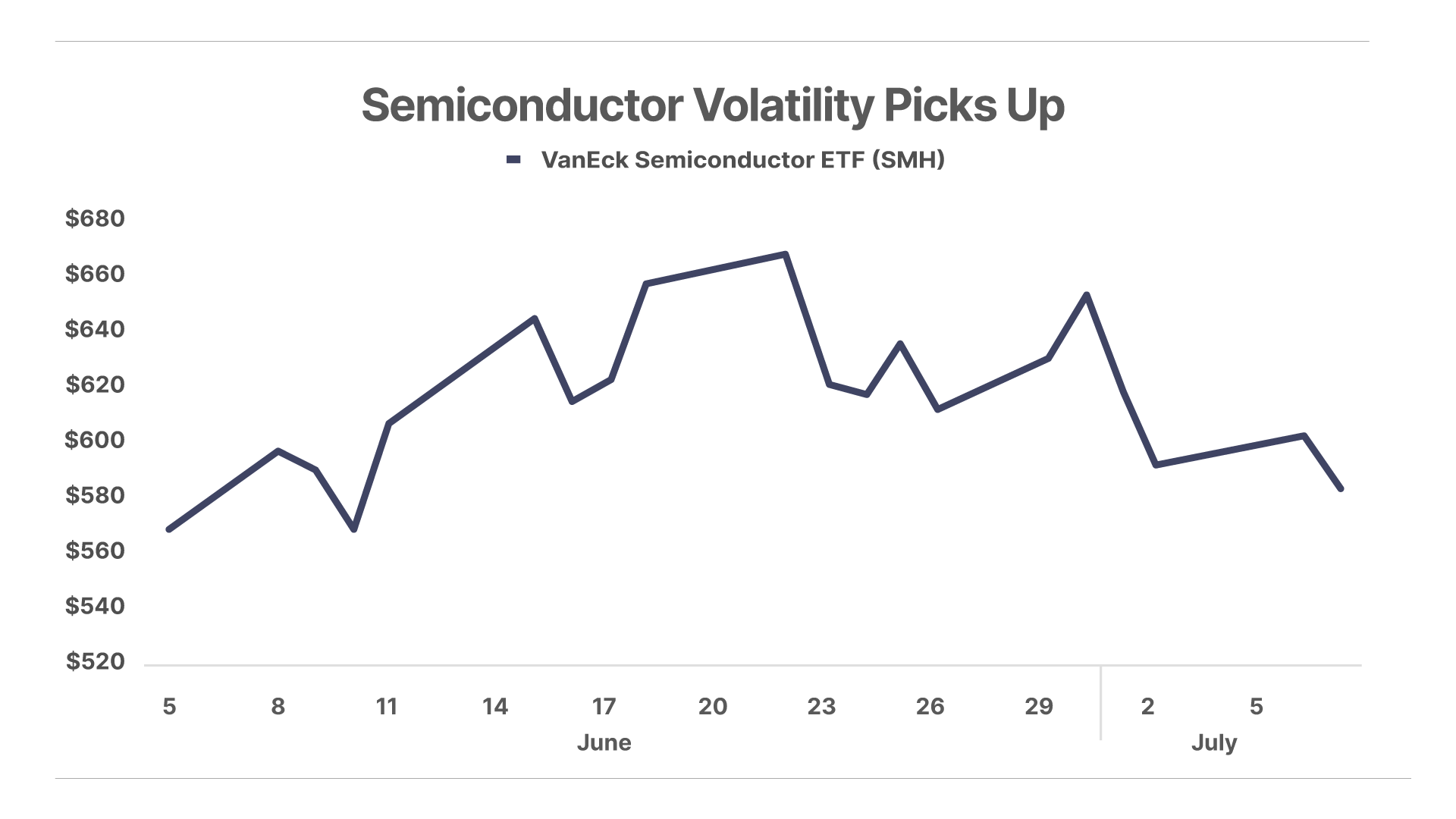
Chart Of The Day… The Leading Semiconductor ETF
Semiconductors are the best performing sector in the market this year, with the VanEck Semiconductor ETF (Nasdaq: SMH) up 62%. More recently, however, volatility has picked up as fears grow about a potential oversupply in compute capacity that could signal less demand for semiconductors. While the uptrend remains intact, elevated volatility can often signal the start of a trend change.
Mailbag
“Tell Us How You Know”
Matt D. writes:
Hi Porter,
Yesterday you asked: ‘Who’s right – the founder or the skeptics?
I’m betting on the founder. Ask me how I know…’
How do you know? Obviously anytime a founder or a CEO plops down large sums, they know something the rest of us don’t. Is there anything else?
Porter Comment: That was a cryptic reference to my own recent large insider buying at MarketWise (MKTW), a company I founded in 1999.
D.C. writes:
Great story on CoStar. I’m intrigued. Can you tell me more about your thoughts on this company and its founder? I recently read your book 2029: The End of America, and it was fabulous. Thank you for such insight!
“Curious About CoStar”
Paulie C. writes:
I recently subscribed to your suite at the Partner level.
Curious why you are so sure that CoStar is the fallen angel about to rise from the dead.
I’m actually in the institutional commercial real estate biz and have used CoStar before. I don’t think it will go out of business anytime soon but not sure the stock will see a full recovery either. From some of the real estate specialist general partners (“GP”) I work with, there’s a view that CoStar has very stale data. Some of the more forward-looking GPs build in-house data sets that give them nine to 12 months of advanced signals. Then, of course, the mega-GPs like Blackstone, KKR, etc., have been using AI (formerly called data science / analytics) built on top of some CoStar data. There’s also more and more consolidation in the commercial real estate space (read: fewer clients/subscriptions).
I agree there’s a certain stickiness with commercial real estate clients but unsure of retail / residential ones, so the forays into residential real estate, while it could inflect, may be a much more competitive, lower margin business.
I would love to hear your thoughts on CoStar and why you have such strong conviction in it.
Porter Comment: I wouldn’t say I have “such strong conviction.” I would say that it is an interesting example of a business most people (as you mention) believe will be threatened by AI, but where the company’s results are in fact growing stronger. If that continues, CoStar could be an outstanding investment. And judging by the founder’s purchases, he clearly believes the business can continue to grow. At its current price, I think the fears around the business are overblown, and I think the stock will outperform going forward.
“Thank You For The Work You Do”
Tim B. writes:
Thank you for the work that you do and the team you have assembled. I enjoy listening to the Roundtable discussions and I look forward to your Daily Journal essays the same way I used to look forward to your Friday Digest at Stansberry Research. My holiday weekend will be spent in-part applying the lessons from 2029: The End of America, specifically building a Weyerhaeuser price-to-book table so I can begin to understand where we are in the cycle you described.
I look forward to becoming a full Partner in the near future.
Porter Comment: Let me help with that. At the company’s current price (just under $23.50) it’s trading at a 61% discount to replacement cost ($60.61). That’s roughly the widest spread from replacement cost since the Plum Creek merger.
“Keeps On Giving”
David R. writes:
Today I ordered two more copies of 2029: The End of America, one for each of my daughter’s families. One of the best things parents can do for their children is to pass on knowledge that they believe to be true. And one of the worst things parents can do is have knowledge and not to share it with the family!
Having been raised in the 1980s and 1990s, I hope they can get beyond Chapter Four without dismissing the book’s insights.
Thank you.
Porter Comment: Chapter Four deals with the rise of Marxism in America and its legal basis, the judicial theory of “disparate impact.” These ideas first entered American jurisprudence in the Griggs Supreme Court decision (the Warren Court) and then were enshrined into law by the 1991 Civil Rights Act legislation. For reasons that aren’t clear to me, some people find my criticism of disparate impact laws “taboo,” as I deal frankly with what should be obvious to any adult: there are real differences between different groups of Americans, on average. Awarding benefits or advantages for any reason other than merit is the definition of Marxism (“to each according to their needs”). In America, people should have disparate outcomes based upon their talents, efforts, and ethics. There’s a world of difference between equal opportunities and equal outcomes. Opportunity is what it means to be an American. Equal outcome is a fantasy that has destroyed every nation where it has been promised. How these core ideas – that lie at the very foundation of what it means to be an American – have become unmentionable is a staggering indictment of modern society. I encourage everyone to read the book. And I welcome your feedback, especially about Chapter Four.
Porter & Co. Market Snapshot
| Price | Yesterday’s Return | Year-to-Date Return | |
|---|---|---|---|
| S&P 500 Index | $7,537.43 | 0.72% | 10.8% |
| Gold per ounce | $4,165.23 | -0.32% | -3.5% |
| Bitcoin | $63,791 | 1.76% | -27.6% |
| Oil (West Texas Intermediate) per barrel | $68.55 | 0.18% | 20.3% |
| Berkshire Hathaway (BRK) | $757,000.00 | -0.60% | 0.3% |
| Porter’s Permanent Portfolio | – | 0.41% | 1.5% |
| The Better Than Berkshire Index | – | 0.68% | 9.9% |
| Total Return | Annual Return | ||
| Porter & Co’s Top Ranked* | 36.7% | 17.3% | |
| Yield | Yesterday’s Change | Change Year-to-Date |
|
| U.S Treasury 30-Year Yield | 4.99% | 0 bps | 14 bps |
*A Complete Investor risk rating of 1 is defined as a “low risk, high allocation” security, while positions rated closer to a 5 are higher risk. Porter & Co.’s top-ranked positions include those rated either 1 or 2 in Complete Investor portfolio.
Porter & Co. Top Positions
| Publication | Ticker | Description | Total Return |
|---|---|---|---|
| Complete Investor | BWXT | BWX Technologies | 245% |
| Tech Frontiers | QURE | uniQure | 237% |
| Tech Frontiers | ROIV | Roivant Sciences | 157% |
| Tech Frontiers | TGTX | TG Therapeutics | 156% |
| Complete Investor | SKWD | Skyward Specialty Insurance | 144% |
| Tech Frontiers | SGMT | Sagimet Biosciences | 143% |
| Complete Investor | BTC/USD | Bitcoin | 137% |
| Complete Investor | ARM | ARM Holdings | 133% |
| Tech Frontiers | QURE | uniQure | 131% |
| Complete Investor | PM | Philip Morris | 130% |
Prices as of 4:00 pm ET July 6, 2026
Please note: The investments in our “Porter & Co. Top Positions” should not be considered current recommendations. These positions are the best performers across our publications – and the securities listed may (or may not) be above the current buy-up-to price. To learn more, visit the current recommendations page of the relevant service, here. To gain access or to learn more about our current recommendations, call our Customer Care team at 888-610-8895 or internationally at +1 443-815-4447.