Gambling And Prediction Markets Versus Investing In Stocks And Bonds
Inside Today’s Issue
Editor’s note: Today, Porter turns the Journal over to Porter & Co. analyst Martin Fridson, who through no luck of his own has compiled a list of Distressed Investing recommendations that are up 119% since March 2023, or 25.1% a year. Even more impressive, the combined Distressed Investing holdings carry a beta of 0.54 and posted a Sharpe ratio of 1.41 against the market’s 1.30. Much better than hoping for lucky sevens.
Prediction markets have been making news lately.
First off, there is convicted-and-commuted ex-Congressman George Santos, who has been banned for life from Kalshi’s prediction-market platform. Santos had bet on the proposition that he’d show up in person for President Donald Trump’s State of the Union Address this past February, suggesting in online posts that he would. The disgraced former member of Congress then raked in more than $17,000 by betting “No” and skipping the event.
The more important story was an August 28 federal court ruling that activity on prediction-market sites constitutes gambling. The Ninth Circuit U.S. Court of Appeals’ unanimous decision contradicted an earlier ruling by the Third Circuit Court. The Third Circuit upheld the industry’s position that contracts on sports events are swaps that fall under the sole jurisdiction of the Commodity Futures Trading Commission (“CFTC”).
On September 2, New Jersey Attorney General Jennifer Davenport petitioned the U.S. Supreme Court to resolve the conflict of jurisprudence. If the justices decide that companies such as Kalshi and Polymarket – the two leading online prediction markets where people buy and sell contracts based on the outcomes of future real-world events – are gambling sites, they’ll become subject to state regulation and, even more important, taxation.
Supreme Court majority opinions typically run 25-30 pages. I have no legal credentials, but if it were up to me, I wouldn’t need more than a single page to settle this question.
- If you go to a sports-betting site and wager a sum of money on which team will win the World Series, and you choose correctly, you’ll receive some multiple of the amount you wagered
- If you go to a prediction-market site and lay down a sum of money on whether an NBA player will score at least a certain number of points in a game, and you wind up being right, you’ll receive some multiple of the amount you wagered
True, the sports betting site will take a cut of your winnings, while the prediction market will instead charge you a fee. It’s a distinction without a difference. And unlike the financial instruments that their purveyors claim them to be, prediction market contracts aren’t linked to a security or a commodity, the way stock options and commodity futures are. They instead deal solely with events.
My verdict: If it looks like a duck, walks like a duck, and quacks like a duck, it’s gambling.
Looking At That Wild And Woolly Stock Market
So if risking your money in a prediction market isn’t substantively different from gambling, let’s move the analogy over to the stock market, which has sometimes been likened to a casino. Here’s an itemized comparison of the stock market to playing the roulette wheel, where players wager that a ball on a numbered spinning wheel will fall onto a specific number:
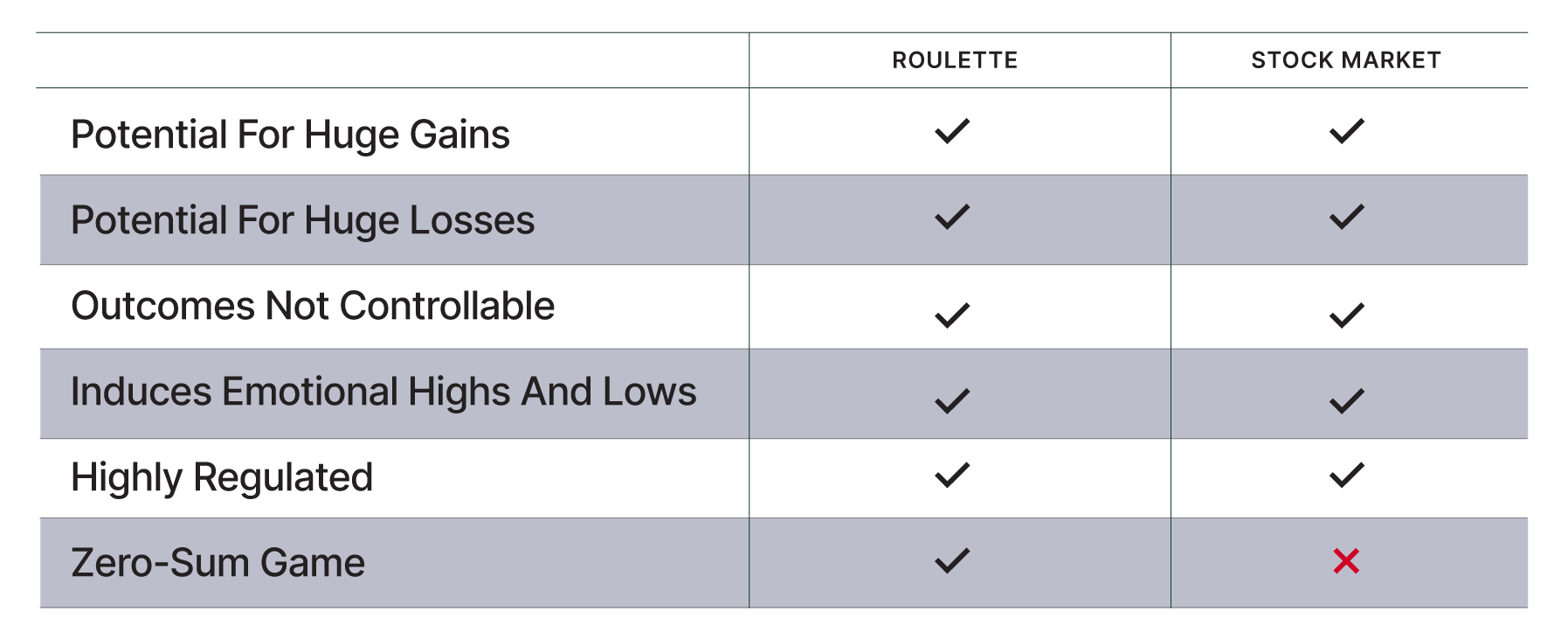
Despite all these similarities, the most important difference is that gambling is essentially a zero-sum game. If you’re rolling dice in the back alley with some buddies, anything you win will be a loss to the other crapshooters. The aggregate wealth of those involved won’t increase, no matter how long you stay at it.
Note that I qualify that zero-sum description (“essentially”), because it’s a different story if you gamble in a casino. There, the patrons’ aggregate wealth will decrease because the house’s payout on winning bets is less than you’d receive if it were calculated according to the true odds. For example, the roulette wheel contains the numbers 1-36 plus 0 and 00, for a total of 38 possible outcomes. But if you pick the winning number with a $10 bet, you receive only $350 plus the return of your $10 stake. A full payout would be $370 plus your $10 stake, but the casino keeps the difference as vigorish of about 5%. Some casino players can come out ahead, but as a group, the average casino gambler’s net worth goes down through gambling.
In the stock market, by contrast, participants’ wealth grows over time. That’s despite temporary selloffs and even total wipeouts of some stock buyers who get carried away with the valid notion that there’s no return without taking some risk.
Notwithstanding the recessions that occur from time to time and the fact that some companies go bust along the way, aggregate corporate earnings rise over the long run. The market puts different multiples on those earnings at different times, which adds to the price volatility. But corporate America’s total value, as reflected in stock averages, marches upward over the decades.
Another difference between the stock market and gambling is that corporations use the money that people exchange for their shares to expand their operations, creating jobs and adding to the gross domestic product (“GDP”) in the process. On the other hand, the money that gamblers wager merely changes hands, over and over again. To be clear, the vig that’s siphoned off by the casinos does pay employees’ wages and some of it may get plowed back into the business, but it’s inconsequential in scale.
Here’s one final factor to consider: Although gambling regulations vary by state, some states classify only games of chance as gambling. Slot machines invariably fall into that category but in some jurisdictions, poker is deemed a game of skill and is therefore exempt from gambling regulations.
Skill definitely plays a role in investing, even though many, if not most, investors lack any. Buying the winning lottery ticket when the jackpot reaches $1 billion is pure luck. But luck can’t account for the 66% annualized return, with no losing years, of the late Jim Simons’s Medallion Fund over the period 1988 to 2018.
In short, if you manage your stock portfolio intelligently, you’re investing for your future rather than gambling.
Tell us what you think of today’s Daily Journal: porterstansberrydirect@gmail.com
Martin Fridson
New York, New York

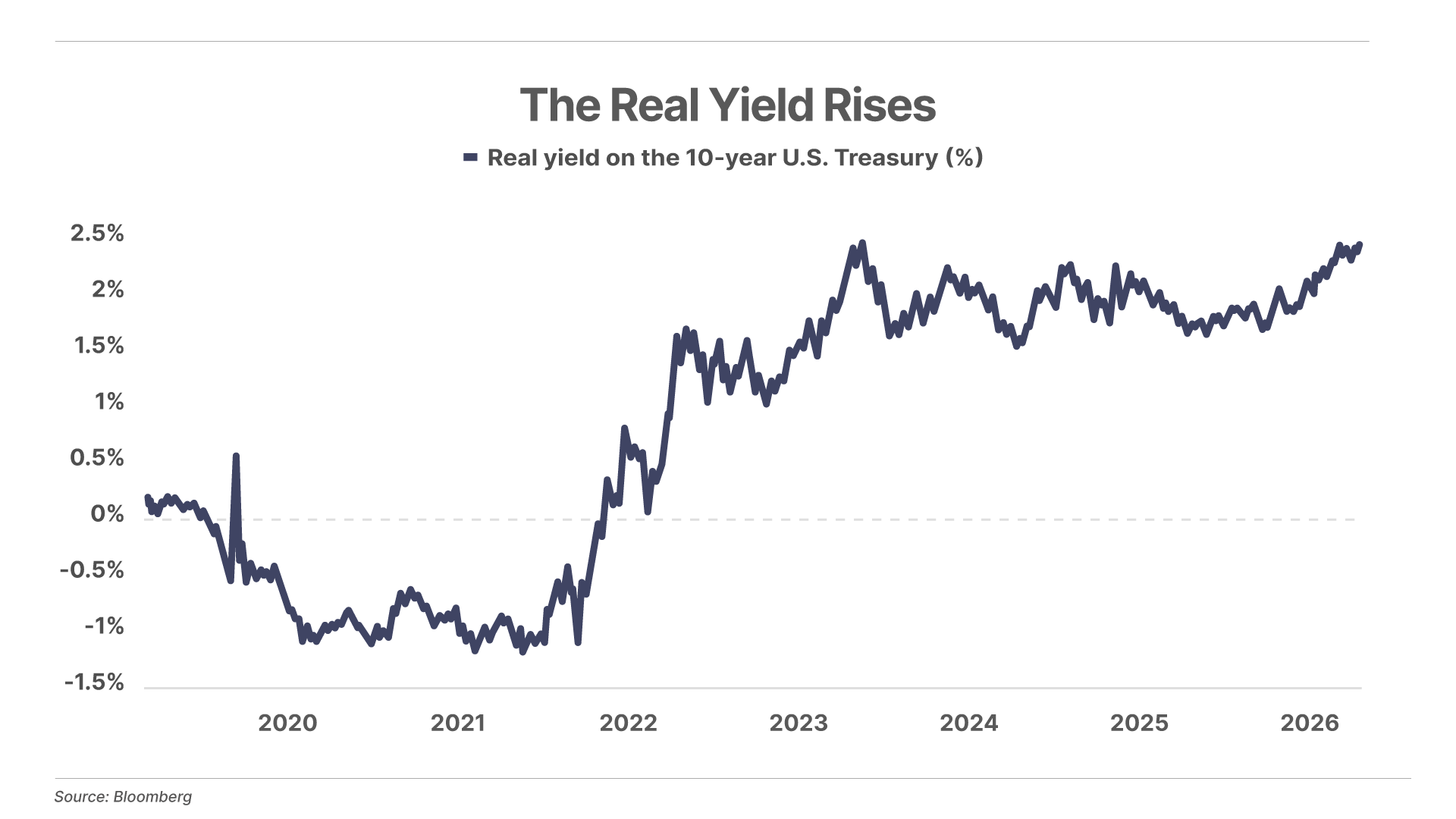
1. Real yields just hit their highest level since 2008. The 10-year Treasury inflation-protected security (“TIPS”) – a government bond whose principal adjusts with the consumer price index, so its yield is what an investor keeps after the government’s official inflation rate – traded above 2.52% this morning, to the highest level since the financial crisis. The nominal 10-year yield is near 4.90%, last seen in October 2023 and almost a full percentage point above where it sat in late February, before the war with Iran began. The Treasury Department is trying to stop it… On Wednesday, Secretary Scott Bessent said it would repurchase up to $6 billion of older 10- to 20-year notes per operation, triple its usual $2 billion cap, after telling markets three weeks ago the figure would “at least double.” But the bond market isn’t cooperating.
2. Wall Street lobbies for credit ratings inflation. Wall Street banks are pushing credit rating agencies to assign investment-grade ratings to OpenAI and Anthropic immediately following their impending initial public offerings (“IPO”), despite neither company being profitable or cash-flow positive. Such a move would open up the $12 trillion investment-grade corporate bond market to each company, making it easier for retirement accounts, pension funds, and insurance companies to buy their debt. The last time ratings agencies loosened their standards to inflate credit grades for speculative investments was during the mid-2000s mortgage bubble. What could go wrong?
3. Meta gets in on AI agents. On Tuesday, Meta (META) released Muse, a personal AI agent that performs routine tasks, including buying things online – operating from its own computer and using its own payment card. You talk to it the way you’d message a friend, either in the Muse app or through WhatsApp. It comes in three tiers: free, $20 per month, or $100 per month. Meta says it will carry no advertising.
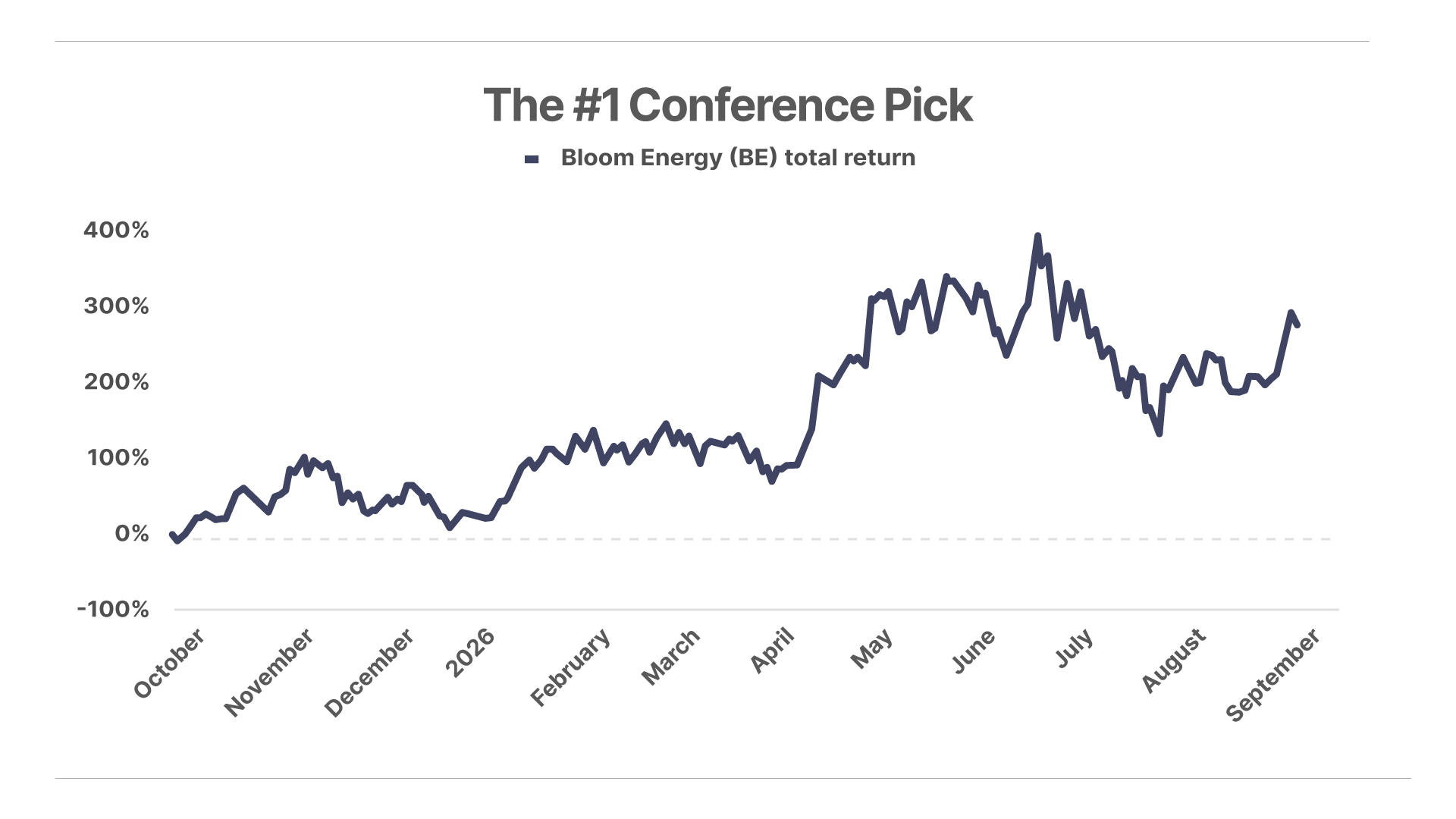
Shares of clean-energy tech firm Bloom Energy (BE) have soared nearly 300% since they were recommended live onstage at the 2025 Porter & Co. Annual Conference. To be among the first to receive our presenters’ highest-conviction ideas from this year’s conference – kicking off less than two weeks from today – click here now.
Yesterday, Porter connected the dots between the continued closure of the Strait of Hormuz because of the continuing war in Iran and the pending critical shortage of diesel – making the comparison to shortages of cotton during the U.S. Civil War.
“Big-Money Capitalism”
John F. writes:
I enjoy history. I enjoy history of big-money capitalism.
“Diesel Backup”
Michael G. writes:
Two other structural points of interest – 90% of global data centers are backed up with diesel generators. That fuel needs to be refreshed every four to six months. Secondly, Newscum regulated the only two diesel refineries in California out of business. So additional structural demand meets structural supply reduction. Hmmm, sounds like higher for longer to me.
“Influence My Investment Decisions”
John S. writes:
This was the most informative piece I have read this year. I’m going to re-read it a few times to prep for explaining the situation to serious-minded friends.
And it will certainly influence my investment choices. Thank you!
“Rare In The Investment Advisory World”
Griffith T. writes:
Excellent report. I especially liked your spelling out Trump’s many fraudulent claims. That’s a rarity in the investment advisory world. Keep up the truth speak.
“Fun To Read”
Lleyton T. writes:
I really enjoy the bits of history tied into your issues. I just turned 20, so my knowledge regarding history, and many other subjects, is quite minimal. However the examples you provide and the way you tie it into economic topics makes it fun to read, and makes the concepts easier to learn. Appreciate your writing.