Issue#121, Volume#3

Why “The End of America” Is Here, Part I
Inside Today’s Issue
People called it paranoia.
In my 2011 documentary The End of America, I predicted that central banks around the world would quietly reduce their Treasury holdings and buy gold. And that as the dollar’s reserve status began to erode, a great portion of the American middle class’s wealth would be wiped out without ever understanding what had happened to it.
I warned that ordinary people would face a bewildering reality: they would no longer be able to afford to buy a home, raise a family, or lead a normal American life – not even on two salaries.
In Q1 2026, a family earning the national median income of $106,800 needed 32% of its income to cover the mortgage on a median-priced home. The median home now costs roughly five times median household income. Since 2019, home prices have risen 53%, roughly twice the 24% increase to income.
Last week, the European Central Bank reported that at the end of 2025, gold accounted for 27% of the world’s official reserve assets, while U.S. Treasury securities accounted for only 22%. A year earlier, gold was 20% and Treasuries were 25%. The world’s central banks are quietly moving their savings out of America’s debt and into an asset no government can print.
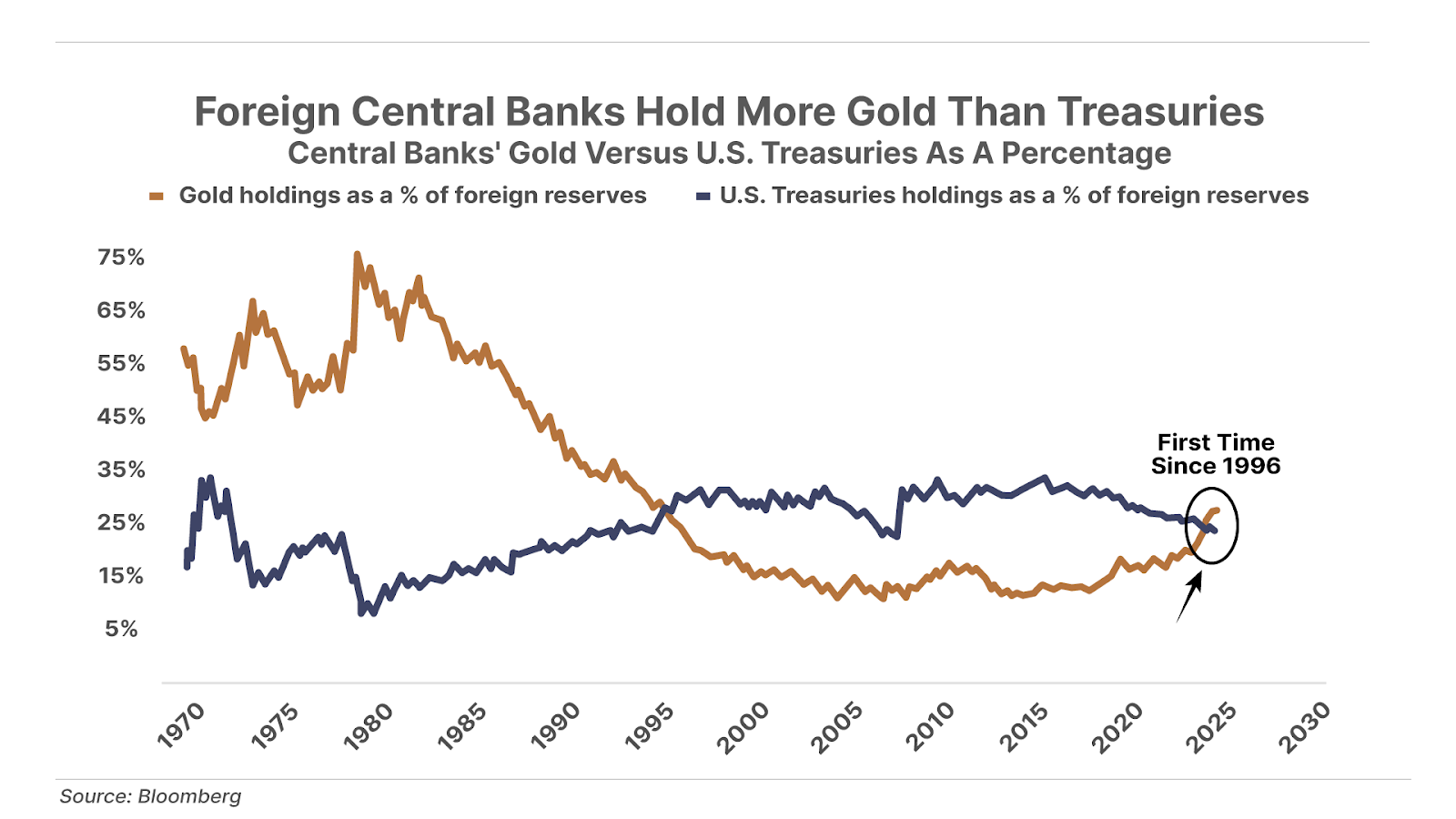
And yet, most Americans still do not understand how these two events are related.
As the world begins to abandon the U.S. bond market, our cost to borrow will continue to increase – the 30-year U.S. Treasury is now yielding above 5%, its highest level since 2007 – while the value of our money will continue to decline. But that’s not the real problem. The real problem is that our government’s ability to finance its debts is being destroyed. We are fast approaching the moment when Treasuries, across the entire yield curve, will be completely uninvestable – not because of the risk of default (a printing press can’t default), but because of a massive decline in purchasing power.
Central banks have bought more than 1,000 tonnes of gold a year for four straight years, double the pace of the prior decade. Poland’s central bank alone confirmed 82 tonnes of purchases in the first half of 2026, lifting its reserves past 632 tonnes. A decade ago, in 2016, Poland held about 103 tonnes. Today it holds more than 6x that and gold has gone from under 17% of its reserves to over 28%. The People’s Bank of China extended its buying streak to a 20th consecutive month. And in the World Gold Council’s 2026 survey, a record 45% of central banks said they intend to add to their own gold holdings within the year, while 74% said they expect the dollar’s share of global reserves to be lower five years from now. They no longer trust the United States to keep its promise about the dollar.
It isn’t hard to understand why they no longer trust the dollar. For the first time, the U.S. government is now spending more to service its debt than it spends on Medicare – $628 billion on interest against $588 billion on Medicare through the first seven months of the fiscal year. Annual interest is now running at $1.04 trillion, a 190% increase in six years. Interest now consumes 18.6% of all federal tax revenue before a single dollar goes to defense, healthcare, or to paving a road. The $1.04 trillion the U.S. now pays in interest per year is roughly the size of the entire federal budget as recently as 1988.
America now spends the entire Reagan-era government every year on nothing but the rent on past borrowing.
If your children or grandchildren can’t understand why they can’t afford anything, there’s your answer.
Tomorrow, I’m going to show you the road map from here.
This isn’t the first time an Anglo empire has collapsed under the weight of foreign wars and massive debts. Our cousins across the pond did all of this before we did, between 1913 and 1956.
And, I’ll show you what that means for us.
Good investing,
F. Porter Stansberry
Stevenson, Maryland
P.S. If you want to learn more, I urge you to read my new book 2029: The End of America, Why The Age Of Paper Money Is Ending And How To Survive The Coming Global Monetary Reset, available now at Amazon.
Tell me what you think of today’s Journal: porterstansberrydirect@gmail.com

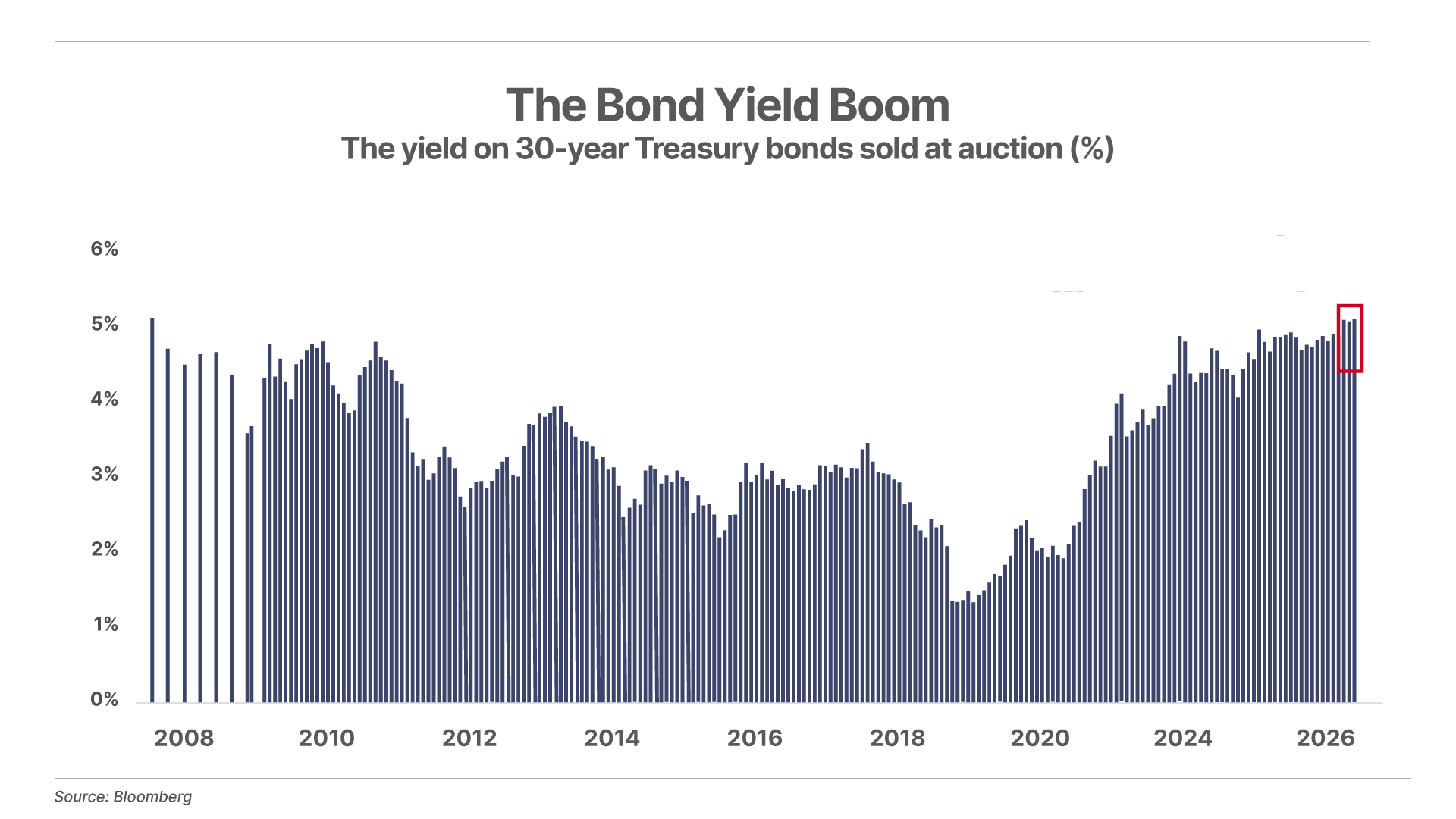
1. The U.S. government’s latest 30-year bond auction drew the highest yield since 2007. Earlier this month, the U.S. Treasury sold 30-year debt at 5.058%, the most it has paid since 2007 – the yield is now back above 5.00% in regular trading. In early 2022, the same debt was auctioned near 2.00%, meaning the government now pays more than twice as much to borrow for three decades. Yields are climbing as investors demand higher rates to absorb the swelling supply of Treasury debt, amid worries about inflation and future deficits. The AI boom is adding to the pressure: technology companies are borrowing heavily to build data centers, competing with the government for the same capital and pushing long-term borrowing costs higher.
2. The AI build-out is eating Big Tech’s free cash flow. Bank of America’s latest forecasts show hyperscaler free cash flow collapsing from a peak near $375 billion to just $19 billion in 2026 – and turning negative in 2027. The culprit: the artificial-intelligence (“AI”) capex arms race: data centers, chips, and power infrastructure are converting the world’s best business models – capital-light software companies with massive free cash flows – into industrial-scale spenders.
3. Oil inventories hit dangerously low levels. Total U.S. stockpiles of crude oil have fallen to just 43 days worth of consumption, the lowest level in 45 years. This comes as the war in Iran re-escalates, including a recent announcement from Iranian’s proxy militia – the Houthis of Yemen – of a maritime embargo against Saudi Arabia. This embargo threatens to disrupt 4.5 million barrels per day of Saudi oil exports flowing through the narrow Bab al-Mandab Strait. The risks of a significant oil supply crunch are rising.
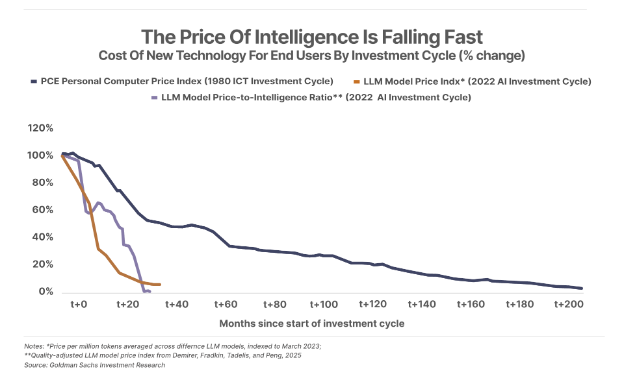
The price of AI computations, measured on a per-token basis, has dropped 95% in the last three years. That’s the same amount of price deflation that personal computers experienced over a 15-year period from 1980-1995, meaning the cost of intelligence is falling 5x faster than computer costs during the PC revolution.
Poll Results… Up Or Down For Nvidia (NVDA)
On Friday, we asked readers: “Has AI hit its top – will shares of Nvidia go up another 50% or down 50% over the next year?”
By a slight margin, most readers (55%) who took the survey believe NVDA shares will fall by more than 50% over the next year, versus 45% who think they will go up 50%.
In Friday’s Daily Journal, Porter wrote about the challenges and allure of investing in a stock-buying mania – from the South Sea Company in the 1700s, to the dot-com craze of 2000, to today’s AI boom.
“One Foot In The Grave…”
Nathan A. writes:
“Love this article, but have to admit I have one foot in the grave and one foot on a banana peel with 50% of my stocks in high growth (lots of AI picks and shovels) and 50% in value/stable companies. I also have two strong voices (yours included), telling me “the end is nigh” and two strong voices saying “earnings are working, stick with the trade until the trade changes.”
Ken K. writes:
“Great article. Yep… Some stories of my own.”
Porter & Co. Market Snapshot
Porter & Co. Top Positions
Please note: The investments in our “Porter & Co. Top Positions” should not be considered current recommendations. These positions are the best performers across our publications – and the securities listed may (or may not) be above the current buy-up-to price. To learn more, visit the current recommendations page of the relevant service, here| New Window. To gain access or to learn more about our current recommendations, call our Customer Care team at 888-610-8895 or internationally at +1 443-815-4447.