Issue#139, Volume#3


Never Fall In Love With The Story You Already Told
Inside Today’s Issue
Editor’s note: Today, Porter turns the Journal over to a friend of the firm from Ireland – Emmet Savage of MyWallSt. Last week, Emmet and Porter were paired on the back nine at the K Club in Straffen, in County Kildaire, and the conversation that followed is why Porter asked him to write today’s essay.
Here is Emmet now…
The K Club sits on 550 acres of Kildare parkland, about 25 minutes outside Dublin. The Ryder Cup was played there in 2006. It is, by any measure, one of the great golf courses in Europe, and it is not, generally, where you expect to have your view of the market rearranged.
But that’s what happened last Monday.
MyWallSt co-founder John Tyrrell and I were paired with Porter for a round that started as golf and ended as one of the more clarifying conversations I’ve had about markets in years. Somewhere around the 14th hole, the talk turned, as it tends to with Porter, to what the crowd is missing. And what the crowd is missing, we all agreed, is the same thing in two different guises.
The first: the market still hasn’t priced in what artificial intelligence (“AI”) is about to do to corporate profitability.
Everyone has an opinion on the stocks: the chipmakers, the hyperscalers, the trillion-dollar capex numbers.
Far fewer people are pricing in what happens on the other side of that spending, a wave of ordinary businesses (logistics companies, insurers, manufacturers, service firms) becoming dramatically more productive, with margins nobody has modeled yet.
The buildout gets the headlines but the productivity dividend is still sitting there, unpriced, for the businesses that will bank it.
That mismatch, hype concentrated in a handful of names while real advantage spreads far wider than the market has bothered to look, is exactly the kind of gap that makes fortunes for the investors who see it early.
Productivity is a simple idea at its core: getting more output from the same input. A logistics firm routes more shipments with the same fleet. An insurer processes claims in a fraction of the time. A manufacturer catches defects before they become recalls. A small accounting practice serves triple the clients without hiring triple the staff.
None of those businesses will ever be called an “AI stock.” But when a company’s output starts growing faster than its costs, that’s operating leverage, and operating leverage is one of the most reliable ways an ordinary business turns into an extraordinary one.
The first wave of the AI story was always going to be physical: chips, data centers, power, cooling, cabling. Goldman Sachs puts the AI infrastructure investment at somewhere between $5.5 trillion and $7.6 trillion between 2026 and 2030.
That kind of spending doesn’t happen out of sight… It shows up as higher input costs today, which is part of why the buildout has looked inflationary in the short run.
But that’s the cost of laying the foundation.
The second wave, the one where AI gets embedded into how millions of ordinary businesses actually operate, is the one that compounds. And it’s much harder to put a number on, which is exactly why the market keeps ignoring it.
We saw the same pattern with the internet. The companies that built the infrastructure got the early headlines. The bigger fortunes, over the following decade, were made in the businesses that used that infrastructure to reinvent retail, advertising, logistics, and media. AI should spread further still, because it isn’t just a new distribution channel. It’s a new input into almost every kind of work.
Prophet Is Already Ahead Of The Story
Porter has followed Prophet closely for a long time, and he didn’t need convincing about what it is: a systematic, data-driven model built and refined over almost 18 years, with no opinions, narratives, or attachment to stock stories. It simply identifies strong, steady-growth businesses using the same disciplined criteria, month after month, year after year, and rebalances into the strongest names the data can find.
What he said next stuck with me. In all his years evaluating investment processes, he couldn’t point to another system, anywhere, built with that kind of discipline sustained over that long a period.
The numbers back him up.
Prophet is up 33.03% in 2026 alone.
Over the last 12 months, it’s returned 42.04%.
Stretch the lens out and it gets almost hard to believe: up 176.34% over five years, up 589.37% over 10 years, and up an astounding 2,175.67% since inception.
That last number means a stake placed at Prophet‘s launch is worth more than 22x what was put in, not from one lucky trade, but from a model that has been right, rebalance after rebalance, for the better part of two decades.
Here’s the part that made the K Club golf conversation feel less like a coincidence and more like confirmation: look at what Prophet has been buying.
This month alone, the model added Comfort Systems USA (FIX), Dycom Industries (DY), Moog (MOG-A), and Vertiv Holdings (VRT), mechanical and electrical contractors, telecom infrastructure builders, precision engineering, and data-center power and cooling.
These are the businesses actually building the physical world that artificial intelligence (“AI”) runs on, the picks and shovels Porter & Co. has been writing about for two years. Prophet didn’t need a golf course conversation to find them. The data found them on its own, before most investors had even asked the question.
That’s the whole point of a system like this. It doesn’t need to be told the story.
It finds the story.
The System Doesn’t Fall In Love With A Stock
What the current portfolio doesn’t show you is how it got here, and that’s worth a look too, because it’s the honest part of the story.
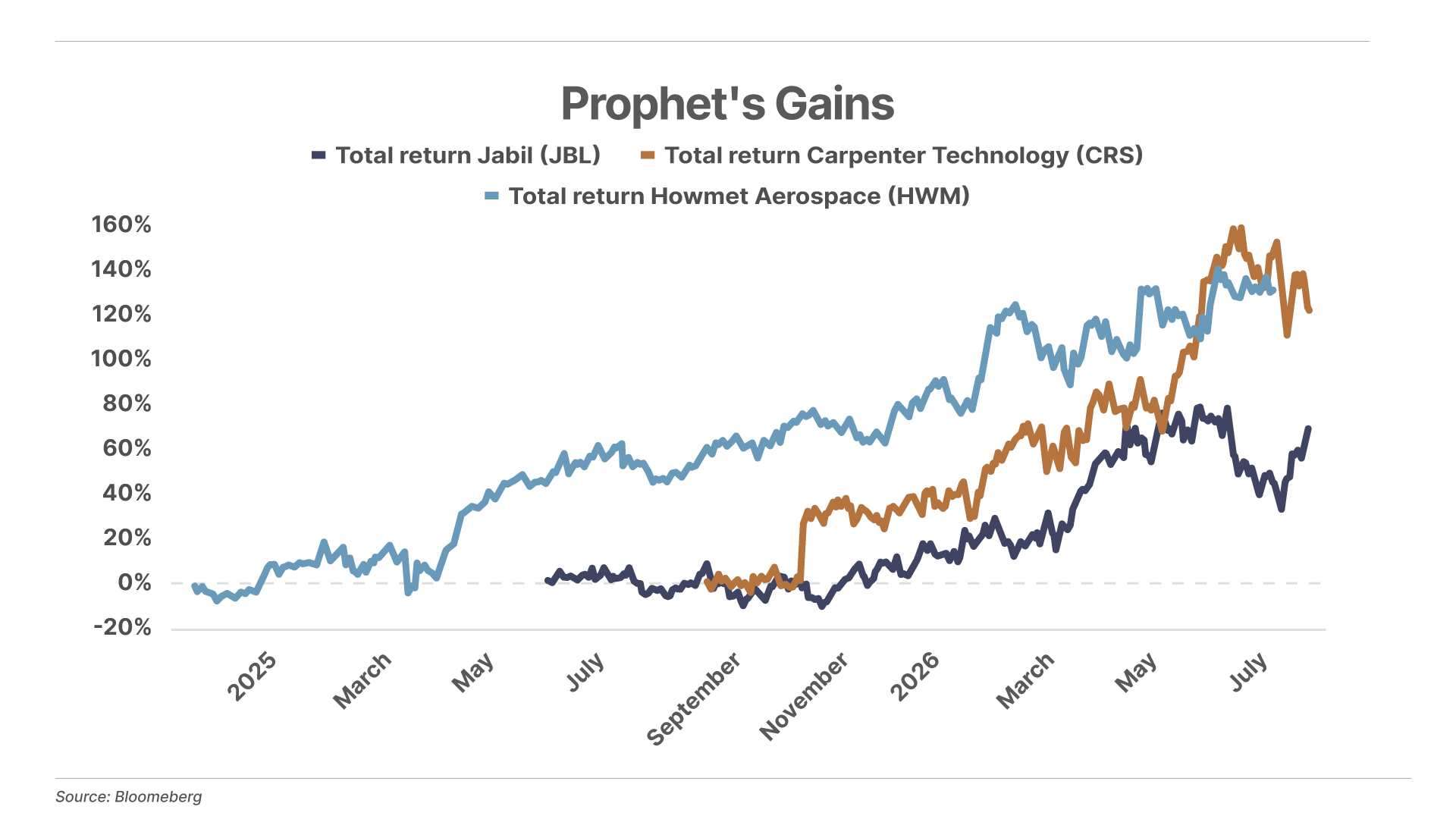
Jabil (JBL) has been held since June 2025 and is up 65.48%. Carpenter Technology (CRS), added in August 2025, has climbed 134.68%. When Prophet sold Howmet Aerospace (HWM) at its July rebalance, it closed out a position that had gained 130.27% over 588 days. Those are the kind of results a data-driven model is supposed to produce when it lets winners run.
But the same system also sold Powell Industries (POWL) this month at a 21.67% loss after just 29 days in the portfolio, and the current portfolio is still carrying a 20.87% loss in Nextpower (NXT).
Prophet doesn’t hide those. It doesn’t need to. A system built to find the strongest names in the market isn’t built to be right every time. It’s built to cut losers before they compound and let winners run until the data says otherwise, and over 17 years, that discipline is what has produced the numbers above.
That’s a different skill than picking the next big story. It’s the skill of never falling in love with the story you already picked.
The Next Decision Is Tomorrow
Prophet was last rebalanced on July 17. The next rebalance is tomorrow.
Every rebalance is the model doing, in real time, exactly what Porter and I talked about on that back nine: cutting what no longer earns its place and adding what the data says is strongest right now, with zero regard for what’s comfortable or popular.
As of this writing, we don’t know yet which names it will add or which it will cut. That’s the point. The next great beneficiary of the AI buildout may not look anything like an AI stock. It may be a contractor, a materials supplier, or a business nobody in the financial media is talking about yet.
The businesses profiting from the AI buildout are not limited to the handful of names everyone already owns. The market hasn’t caught up to that yet. But Prophet already has.
So, if you’ve not joined Prophet yet, consider doing it now.
The special offer we originally put together exclusively for Porter & Co. is open once again – just ahead of tomorrow’s rebalance – and if you join now you’ll be first to get all of Prophet’s new buy and sell alerts.
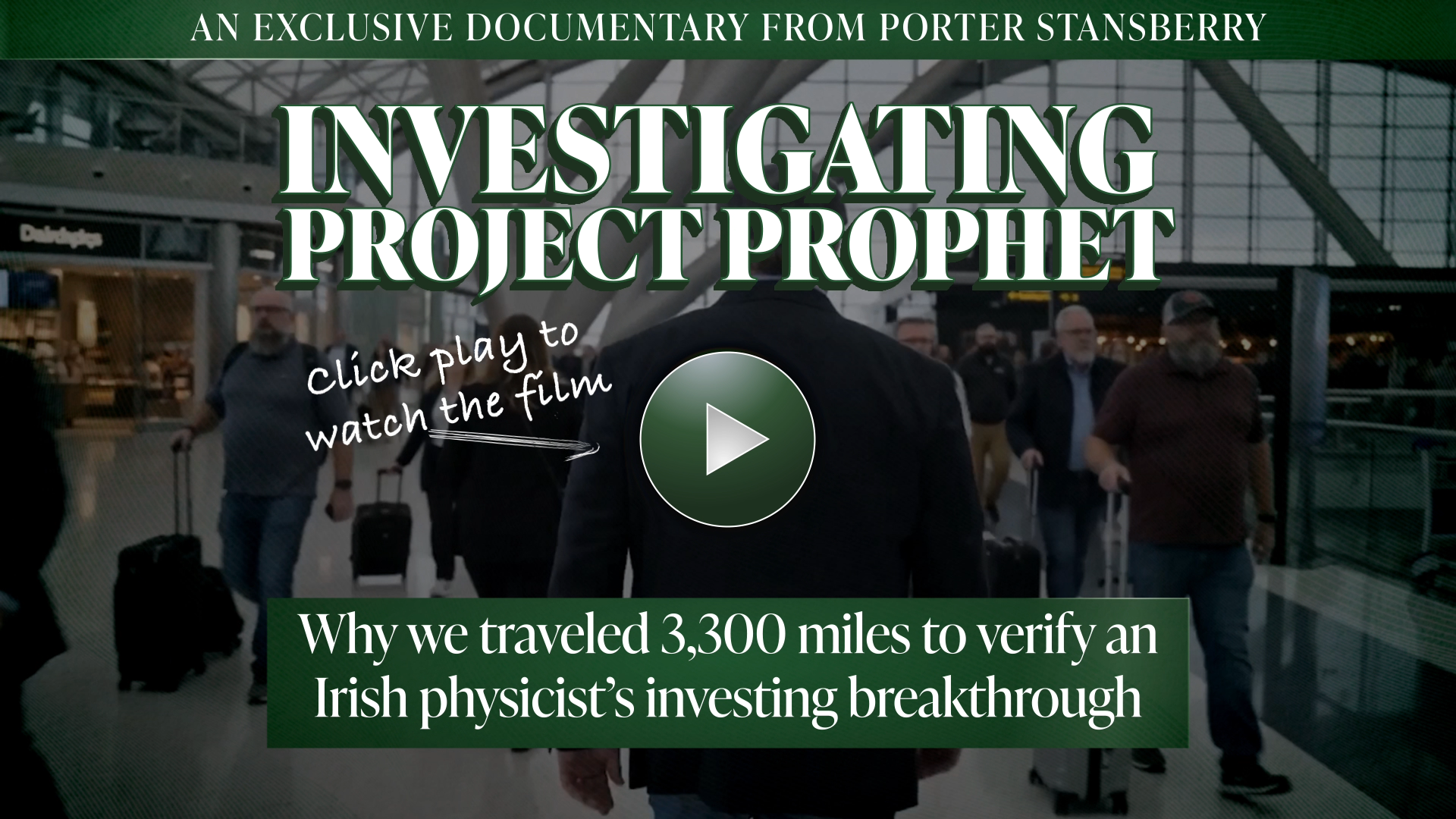
Everything you need is in my interview with Porter here.
Stay well.
With my best regards from Monkstown in Ireland,
Emmet Savage
Tell us what you think of today’s Daily Journal: porterstansberrydirect@gmail.com
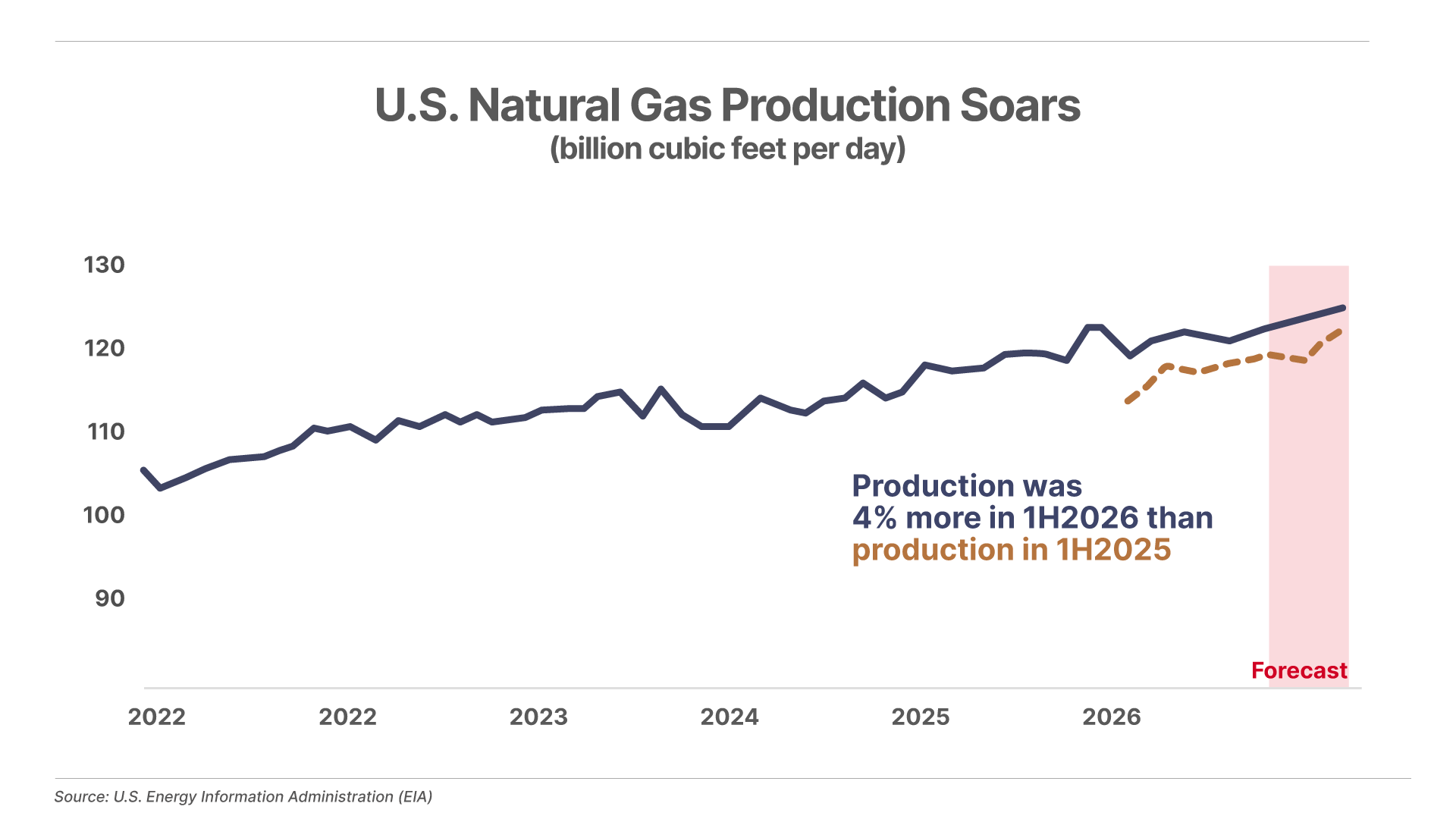
1. U.S. natural gas production is heading for another record year. The U.S. Energy Information Administration expects output to average 122.5 billion cubic feet per day in 2026, topping the 118.5 billion recorded in 2025 – a 3.4% gain, with most of the growth coming from the Permian Basin and Louisiana’s Haynesville field.
2. Washington is about to borrow at its highest long-term rate since 2001. The U.S. Treasury Department is scheduled to sell $25 billion of 30-year bonds this afternoon, and trading ahead of the sale points to a yield near 5.23% – up from 5.06% at July’s auction. Most of the recent move came after the Fed’s July 29 meeting, when three officials dissented in favor of raising rates, and Chair Kevin Warsh held steady. Short-term yields fell that day while 30-year yields jumped, with bond buyers signaling doubt about inflation’s returns to 2%.
3. Uber is coming for the school run. Bloomberg reported yesterday that code buried in Uber Technologies’ (UBER) latest app reveals a “tween” rides option in development for kids aged 10 to 12 – with trusted-adult contacts, PIN verification, and required grown-up handoffs at pickup. It’s not live yet, but the direction is clear: teen accounts launched in 2023 and have already scaled past 50 countries and tens of millions of trips. This is the Uber marketplace playbook – each new vertical converts another slice of daily life into Uber demand. The carpool your robotaxi will eventually drive is being onboarded now.
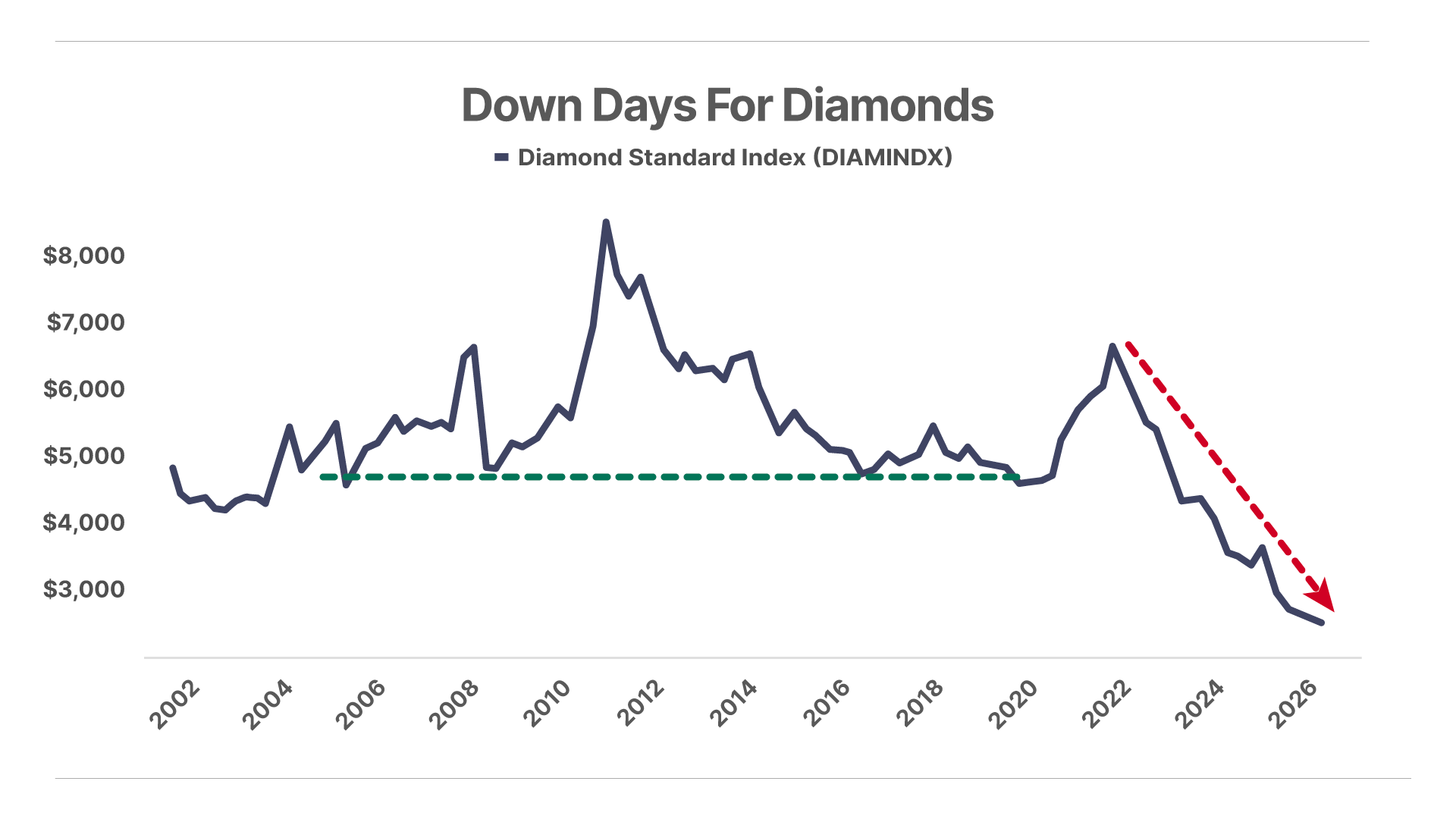
Diamond prices just hit a 21st-century low. The Diamond Standard Index (DIAMINDX) is down roughly 70% from its 2011 peak, gutted by lab-grown stones that are chemically identical to mined ones but cost a fraction to produce.
Yesterday, Porter continued his multi-part series on the massive infusion of capital going into funding the buildout of artificial intelligence infrastructure.
“P&C Insurance Will Be Needed”
David T. writes:
I was wondering about the massive amounts of P&C insurance that will be needed for all of the up and coming massive data center buildouts? I don’t hear anyone talking about this aspect of the money being spent on all of this buildout.
If what Trump says is true that there’s over $19 trillion in spending on new factories going on in the USA alone, this would seem to be a seismic growth for the P&C industry that has to be filled soon.
Similar to the thesis that Amrize (AMRZ) should be a big beneficiary of the huge buildout demands, the P&C industry is going to have to figure out how to spread their risks around and cover all of these data centers.
“Shining The Light”
Greg J. writes:
Thank you for shining the light on NVDA’s massive borrowing.
Porter & Co. Market Snapshot
Porter & Co. Top Positions
Please note: The investments in our “Porter & Co. Top Positions” should not be considered current recommendations. These positions are the best performers across our publications – and the securities listed may (or may not) be above the current buy-up-to price. To learn more, visit the current recommendations page of the relevant service, here| New Window. To gain access or to learn more about our current recommendations, call our Customer Care team at 888-610-8895 or internationally at +1 443-815-4447.