Sort Of… Here’s Why What He Said In 2005 Matters Today
Inside Today’s Issue
In the spring of 2005, Jeff Bezos mailed Amazon (AMZN) shareholders his 2004 annual letter. It was a description of CoreWeave’s (CRWV) business model. Bezos is so freakin’ smart he foresaw a time in the future that CoreWeave would build huge data centers – machines that would change everything about the economy and our daily lives…
Well, sort of.
Technically, Bezos was describing a hypothetical future business that developed teleportation machines. But just like CoreWeave’s incredible data centers, these machines were revolutionary, and consumer demand was endless. People were willing to spend heavily to travel instantly. Each trip sold for $1,000. Investors piled in.
One problem: just like Nvidia (NVDA) chips, the teleportation machine was expensive: $160 million. And exactly like Nvidia’s chips, teleportation required a lot of energy. The service cost $450 in energy and materials plus $50 in labor to operate. The biggest problem? Much like Nvidia’s chips, the teleportation machine only had a four-year useful life.
Bezos then explained, in precise detail, investing’s most notorious capital trap: a business model that can only fail because it cannot earn its cost of capital. To these businesses, booming revenue will not lead to success; it will accelerate failure.
Bezos ran through the numbers and explained why these businesses seem so appealing to investors… at first. In year one, the machine runs at full capacity: $100 million of revenue, 55% gross margin, $40 million of depreciation, $10 million of earnings. A 10% net margin on a new industry! Investors bid the stock up to 50x earnings.
The company sells more equity and buys more machines. And earnings compound at 100% a year over the next three years. But cash flow over the same four years is negative $530 million.
The economics are simple to understand: there is no growth rate at which it makes sense to operate the business. But that never occurs to most investors, who, upon seeing revenue soaring in a radically transformative new industry, continue to provide more capital.
On August 11, CoreWeave reported Q2 revenue of $2.575 billion, up 112%. It also reported a net loss of $626 million, depreciation of $1.393 billion, and interest expense of $640 million. The balance sheet carried $35.07 billion of debt against $5.02 billion of equity (7x leverage), plus $16.3 billion of capitalized leases and another $35.5 billion of payments due on leases that have not started yet. Count the leases, and the company is 17x leveraged.
Ironically, the CoreWeave bulls explain the company’s extreme debt by comparing it to Amazon!
CoreWeave’s investors explain that Amazon too lost money for years. And Amazon borrowed heavily. Amazon, they say, poured everything into infrastructure while the market called it lunacy – but it was exactly the infrastructure the world needed most! It paid off, in spades, ever since.
See no evil. Hear no evil. Apparently, they never read Jeff Bezos’ shareholder letter.
Here’s the reality. Bezos’s version of CoreWeave (his teleportation business) turned $160 million of equipment into $100 million of annual revenue. That’s 62 cents on the dollar – and the business was still hopeless. CoreWeave now has $46.7 billion of property and equipment against trailing revenue of $7.59 billion. That’s 16 cents on the dollar.
The question is not whether CoreWeave is the next Amazon. The question is whether CoreWeave is even as good a business as Bezos’ teleportation machine. In any case, there is no question that it will fail.
Why did Amazon succeed with a debt-funded, heavy investment strategy? Because the underlying business is incredibly capital efficient.
At the beginning, Amazon sold books. The customer’s credit card cleared the day the order shipped. But the publisher’s invoice didn’t come due until 60 days later. Inventory turned 18 times in 2003 and 16 times in 2004. Again, the CoreWeavers should read Bezos’ 2004 letter:
We have a cash generative operating cycle because we turn our inventory quickly, collecting payments from our customers before payments are due to suppliers.
Amazon always, even from day one, was extraordinarily efficient. By 1998, Amazon had reached a billion-dollar sales rate with only $30 million of inventory and $30 million of net plant and equipment. Six years later, on nearly $7 billion of sales, fixed assets were still only $246 million – just 4% of revenue.
CoreWeave’s fixed assets are 616% of revenue.
Amazon’s entire capital program from 1997 through 2005 – nine years covering the boom, the bust, and the recovery – only consumed $886 million of purchases of fixed assets. CoreWeave spent $14.1 billion in the first six months of this year.
That’s the difference between a supermodel and the winner of The Biggest Loser. It’s Gwyneth Paltrow versus Shallow Hal. There’s no business model that can afford that much capital. Not even a teleportation machine.
And, unlike the teleportation machine (and Amazon), CoreWeave doesn’t get paid upfront. CoreWeave has to build everything and maintain it first. In early August, CoreWeave’s $2.6 billion term loan repriced from 425 basis points over the Secured Overnight Financing Rate (“SOFR”) at launch to 550 at close, an all-in yield of 10.44%, with tighter covenants attached.
Amazon’s interest expense peaked in 2002 at $142.9 million, which was 3.6% of that year’s sales. CoreWeave paid $1.176 billion of net interest in the last six months against $4.653 billion of revenue. A quarter of every dollar the company bills belongs to a lender before a single chip has been depreciated.
The differences between the two businesses become most apparent when you look at cash earnings.
Amazon’s operating cash flow was negative while it was building out its national fulfillment centers:
- -$90.9 million in 1999
- -$130.4 million in 2000
- -$119.8 million in 2001
Three years of operating cash burn totaling $341 million, and $813 million after capital spending, all to build an untouchable company brand promise: next day delivery on virtually any retail item in the world.
And how did that pay off? Amazon began producing hundreds of millions in cash flow beginning in 2002:
- $174 million in 2002
- $392 million in 2003
- $567 million in 2004
- $733 million in 2005
Amazon started buying the debt in 2003. Interest expense fell from $142.9 million to $92 million while sales doubled between 2003 and 2005.
CoreWeave consumed $1.11 billion in 2023. In 2024, $5.95 billion. In 2025, $7.25 billion. In the first half of 2026 alone, $10.45 billion. That’s $24.8 billion of cash outflow against $11.9 billion of cumulative revenue since 2023. That’s $2.08 consumed for every $1 billed.
And guess what? The ratio widens every year. Why? Because while CoreWeavers claim the company’s massive cash consumption will lead, someday, to Amazon-like economics, what they actually own is the teleportation machine that Jeff Bezos shorted.
There’s a critical fundamental difference between where CoreWeave’s cash is going and where Amazon’s went. Amazon bought real estate and warehouses – assets that became much more affordable as they were utilized. Amazon’s fulfillment centers kept working while revenue tripled around them, which is why capital expenditures fell to $39 million in 2002 while sales grew 26%. The buildings did not become obsolete. They became more valuable, because the volume running through them rose and the cost per package fell.
A graphics processor does the opposite. CoreWeave depreciates its computing equipment over six years, having extended the life from five effective January 2023, a change that reduced expenses by $20 million and added $0.10 to that year’s earnings per share.
Nvidia now ships a new architecture every year. Blackwell arrived in 2025, Blackwell Ultra behind it, Rubin ramps in the back half of this year, Rubin Ultra is scheduled for 2027, and Feynman for 2028. Six generations of silicon will pass before the chips bought this quarter finish depreciating on CoreWeave’s books.
Famous Big Short fund manager Michael Burry put the industry’s understated depreciation at $176 billion across 2026 to 2028. Nvidia disputes it and points to A100 chips from 2020 still running at high utilization. What’s the truth? H100 capacity cleared near $8 per GPU-hour in 2023, fell to roughly $1.70 on one-year contracts by October 2025, recovered to $2.35 by March, and trades between $1.20 and $3.50 today. That’s 70% depreciation in three years. And looking forward, this math assumes that the rate of technological innovation remains constant. But in our lifetimes, about every 20 years there’s a complete technological revolution.
And then there’s the most important difference of all: Amazon’s most valuable asset doesn’t cost anything to maintain. It’s intangible.
In 1996 Amazon had 180,000 customer accounts and 46% of Q4 orders came from people who had bought before. In a single year it grew to 1.51 million accounts and had 58% repeat buyers! Absolutely amazing product/market fit. The next year (1998), it had 6.2 million customers and 64% repeat buyers. In 1999, 16.9 million customers and 73% repeat buyers.
Just imagine the lifetime value of these customers! And the cost of acquiring them had already been paid.
How to fully monetize this incredible asset? Subscriptions. In February 2005, Amazon launched its Prime subscription at $79 a year. Incredibly, 91% of first-year Prime members renew. So the price went up to $99, then $119, then $139. And none of the costs changed.
Amazon’s customer list is an asset that requires no capital to maintain, appreciates with use, absorbs price increases, and cannot be purchased by a competitor at any price.
That is what Amazon’s $800 million capital spend bought.
What is CoreWeave buying for $100 billion-plus?
CoreWeave’s best customer isn’t a wealthy family in a suburb that uses its products multiple times per day and would rather get rid of the family dog than give up being an Amazon Prime customer. CoreWeave’s best customer is the most notoriously vicious competitor in capitalism. Last year, 67% of CoreWeave’s revenue came from Microsoft (MSFT).
Going forward, CoreWeave will serve a murderers’ row of the world’s smartest and toughest tech companies – some of which are investor funded and Nvidia vendor funded. The named commitments are: Microsoft, Meta (META) at $35.2 billion, OpenAI at $6.5 billion, Jane Street at $6 billion, and Nvidia at $6.3 billion.
All of the GPUs in CoreWeave’s fleet are Nvidia’s. So… what do CoreWeave shareholders really own? NVIDIA is the dominant supplier and a major shareholder. Nvidia bought 22.9 million shares at $87.20 in January. Nvidia has also agreed to buy any capacity CoreWeave cannot sell to anyone else through April 2032.
Where have we seen this before? Lucent and Nortel ran the same arrangement into the ground in 2001.
Just ask yourself this simple question: Why doesn’t Nvidia just build the data centers? What’s the purpose of having CoreWeave (and its bagholders, I mean shareholders) stand between Nvidia and Microsoft?
Strip out the intermediaries, and the demand resolves to a handful of private companies burning capital at a rate no public market would tolerate. OpenAI generated $5.7 billion of revenue in Q1 against $3.7 billion of cash burn and a $9.3 billion operating loss. It has since committed roughly $300 billion to Oracle (ORCL), $250 billion to Azure, $138 billion to Amazon Web Services, and $22.4 billion to CoreWeave.
The hyperscalers funding these labs (with equity, debt, and lease guarantees) book the labs’ resulting spend as their own revenue and profit. Thus, the entire revenue base of these businesses is based on the expansion of their own balance sheets. That isn’t sustainable.
In June, the Bank for International Settlements warned against lending to these firms on this basis, saying the financing is opaque and “the same asset is pledged multiple times.” Moody’s counts $460 billion of direct hyperscaler debt and $1.2 trillion of off-balance-sheet lease commitments, with more than $820 billion of it tied to buildings that do not yet operate.
And there is no moat.
Amazon’s moat was its enormous installed user base, which allowed it to constantly scale new bolt-on businesses to produce incredible and profitable growth. What’s the moat around an AI model? There’s absolutely none. And you see that most clearly in the pricing.
Leading AI platform Anthropic’s flagship went from $15 to $5 between model generations. DeepSeek lists its fast model at 14 cents. No one has ever raised the price.
In April, S&P moved CoreWeave’s outlook to positive. The market doesn’t agree. On July 29, CoreWeave’s five-year credit default swaps blew past 855 basis points, which implies a coin flip on default within five years.
Then, of course, there are the usual cockroaches you find in businesses that primarily exist to extract value from investors. CoreWeave found material weaknesses in its internal controls while preparing the 2024 statements, concluded they still existed in 2025, and confirmed in this quarter’s report that, yep, they’re still there.
Investors keep pointing to CoreWeave’s massive backlog: $104 billion of revenue backlog.
There are two problems with that argument. First, there’s no evidence that any of that revenue will result in free cash flow. (That’s why Bezos shorted this kind of business in 2005.) And secondly, the entire ecosystem depends on unprecedented balance sheet expansions from a handful of companies, the most important of which aren’t profitable yet. OpenAI burned $3.7 billion in the last 90 days.
Amazon used borrowed money to acquire valuable customers and warehouses that got cheaper per package as volume rose. Debt never exceeded a single year’s sales. Interest never exceeded 4% of revenue. By 2003, the company was retiring debt out of its own cash flow.
CoreWeave carries 4.6x revenue in debt before the leases, pays a quarter of revenue in interest, and is buying six-year assets that face competition every 12 months with money that costs between 9% and 15%.
Bezos’ teleportation business had the option to stop buying machines. CoreWeave has already signed for $35.5 billion of leases that have not begun.
There’s no chance CoreWeave will ever earn its cost of capital. It’s a zero. And Jeff Bezos told you exactly why in 2005.
Tell me what you think of today’s Daily Journal: porterstansberrydirect@gmail.com
Good investing,
Porter Stansberry
Stevenson, Maryland

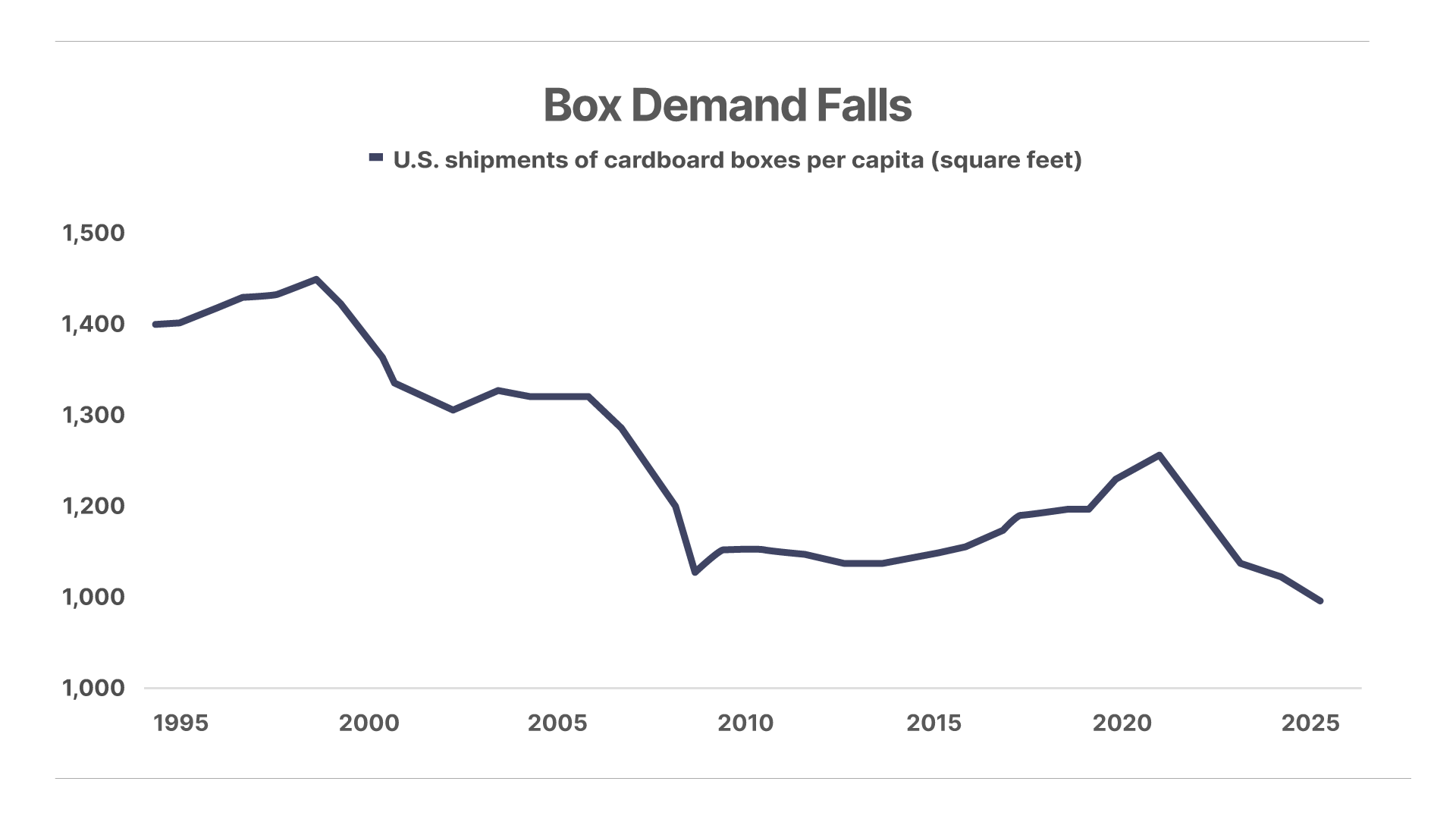
1. Cardboard boxes are a key leading indicator. When demand for them rises, it means there’s a big flow of purchased goods to fill those boxes and ship to customers. U.S. box shipments per capita just hit their lowest level in decades. Real goods demand is weaker than the consensus believes.
2. Global oil flows are recovering from the Iran War. The volume of oil exports through the Persian Gulf has recovered to around 15 million barrels per day (“b/d”), according to a recent analysis from Goldman Sachs. While that’s still about 7 million b/d less than before the Iran War, it’s well above the lowest levels of around 5 million b/d caused by the supply disruptions in early March. The combination of alternative pipeline flows and a partial resumption of traffic through the strategic Strait of Hormuz has helped the oil market recover from one of its biggest supply disruptions in history.
3. The U.S. and Venezuela announced a massive oil agreement on Friday. Washington will take a 55% stake in a joint venture with a private Venezuelan company holding a 100-year lease on 17 fields with 65 billion barrels of reserves – about 20% of the nation’s 300 billion barrels – plus the right to buy crude at production cost. Over the long term, the deal could add substantially to U.S.-controlled oil supply, but analysts say the fields will take years to produce, since most of the acreage is undeveloped or has deteriorated.
Last week, Porter produced a series of Daily Journal essays showing that Leopold Aschenbrenner’s Situational Awareness Fund lost $30 billion in one month because the young fund manager was wrong about AI killing software. Porter has been making the case for months now that companies like Complete Investor recommendation Salesforce (CRM) are utilizing AI to scale their own businesses – and the stock’s 40% performance in August confirms that thesis.
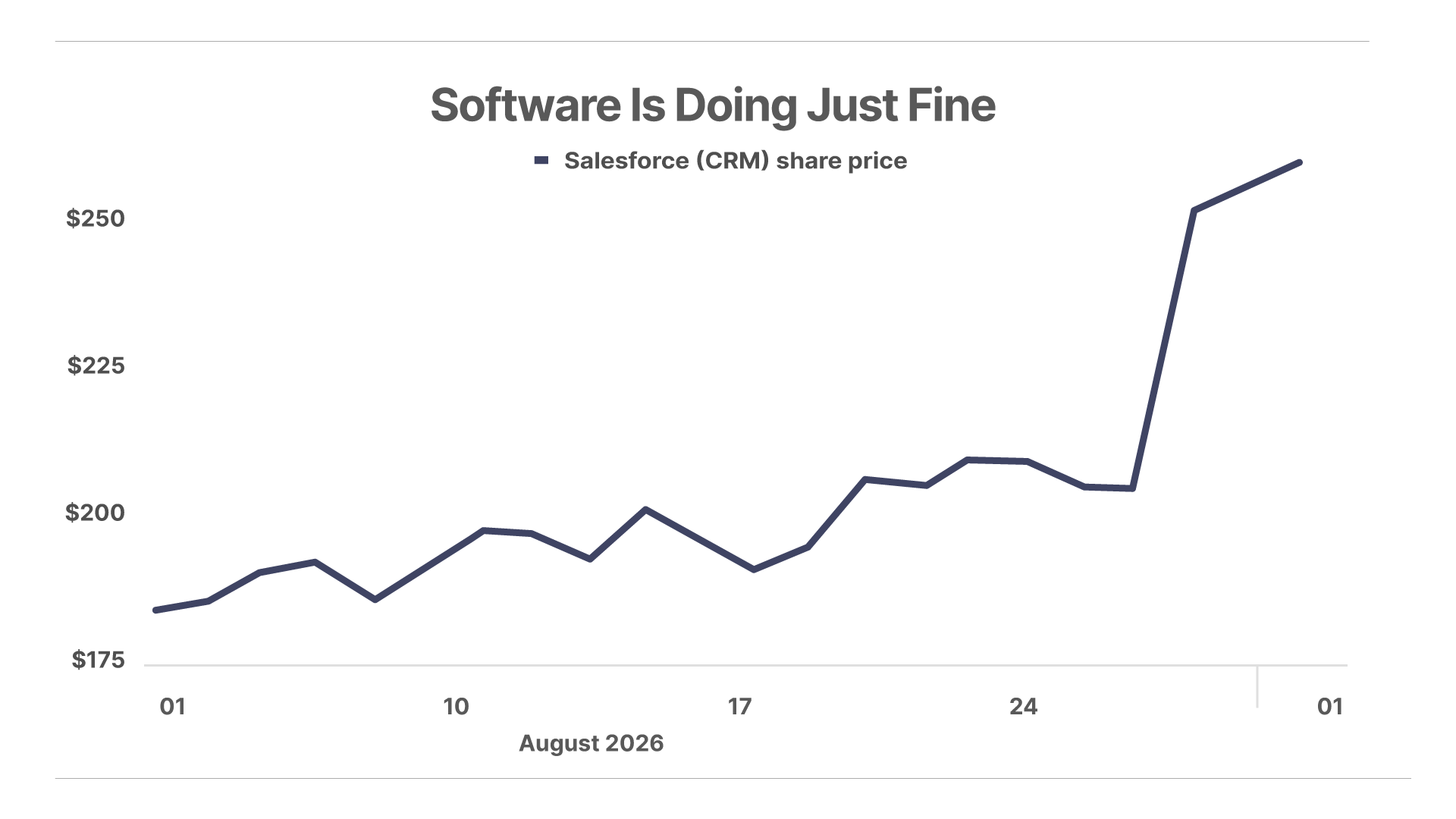
Last week, Porter presented a three-part series on Leopold Aschenbrenner’s Situational Awareness Fund and how it got the artificial intelligence (“AI”) investment all wrong.
“Invest In What I Know”
John B. writes:
Outstanding! Completely clears up for me what I felt in my bones and kept me on the sidelines of AI. Thank you very much and now I can go back to investing in what I know.
“Tiptoeing Through The Tulips”
Mike M. writes:
The AI bubble will be second to none. I have been there, seen and felt the internet bubble. Back then, CNBC broadcaster Mark Haines quoted other floor brokers singing, “We Are Tiptoeing Through The Tulips.” What a saying and song that more than ever came true. Great stories on the railroads. Please keep up the good reporting and predictions.
“Situational Awareness”
Louis M. writes:
Porter, well-written and well-researched and as a businessman, I totally agree with your conclusion on the overall market. And I agree again on your recent AI circular financing article.