His 4-To-1 Leverage Just Made His Convictions Worse
Inside Today’s Issue
Editor’s note: Today, Porter begins part one of a three-part series on the implosion of Leopold Aschenbrenner’s Situational Awareness fund – and the key reason behind its failure that everyone seems to be missing… We will publish the next Journal this week on Wednesday.
Leopold Aschenbrenner lost $30 billion (67%) in a month.
The consensus post-mortem – from The Wall Street Journal to comments on X – is that the young man who ran the Situational Awareness fund used 4-to-1 leverage on concentrated positions and got carried out. While that is true, it does not convey any useful information. Leverage is certainly the reason Leopold lost so much, so quickly. But it is not the reason he lost. Leverage is merely a magnifying glass. It doesn’t pass judgment.
The reason his fund was doomed was because he’s wrong. And no one, anywhere, has explained why Leopold Aschenbrenner was wrong.
On the morning of Thursday, July 30, before the opening bell, Aschenbrenner’s Situational Awareness sold its entire public stock portfolio – the long side and the short side together, roughly $16 billion of it – to Ken Griffin’s Citadel in a single block trade.
That night, Aschenbrenner wrote to his limited partners. Net performance for the month, unaudited: down 67%. Net performance for the year: still up 80%.
We let you down this month. We came closer to permanent capital impairment than is acceptable to us.
Six days earlier, on July 24, he had written a different letter. That one reported a 439% net return for the first half of 2026, described the selloff in artificial intelligence (“AI”) stocks as one of the best buying opportunities since early 2025, and invited his investors to wire more money starting August 1. It closed with a postscript:
At times we call out opportunities that seem like a particularly good time to add funds, if you have been waiting for one.
Assets that stood near $45 billion at the start of July finished the month around $10 billion, and roughly half of what remains is a single illiquid private stake in Anthropic.
Leopold is 25 years old. He graduated from Columbia University at 19, as valedictorian. He worked at the FTX Future Fund from February to November of 2022, then joined OpenAI’s Superalignment team, then was fired in April 2024. Two months after the firing, he published a 165-page essay called “Situational Awareness: The Decade Ahead,” raised $225 million from Patrick and John Collison, Nat Friedman and Daniel Gross, and started a hedge fund. He had never managed money before.
Situational Awareness was constructed to express exactly two convictions.
-
The physical build-out of AI – the chips, the memory, the power, the data centers, the neoclouds – was the trade of the decade. The fund’s disclosed long positions read like an inventory of the second derivative of the AI boom. Bloom Energy (BE), fuel cells for data centers. Sandisk (SNDK) and Micron Technology (MU), memory. CoreWeave (CRWV) and Nebius Group (NBIS), rented compute. IREN (IREN), Core Scientific, Applied Digital, Riot Platforms, CleanSpark, Bitfarms, Bitdeer – Bitcoin miners converting their substations into AI compute.
-
Application software was going to be destroyed by AI. Not disrupted. Obliterated.
Leo explained why on Dwarkesh Patel’s podcast, in June 2024:
I’m so bearish on the wrapper companies because they’re betting on stagnation. They’re betting that you have these intermediate models and it takes so much schlep to integrate them. I’m really bearish because we’re just going to sonic boom you. We’re going to get the unhobblings. We’re going to get the drop-in remote worker. Your stuff is not going to matter.
That was the whole thesis. Buy the compute. Short the stuff that runs on the compute.
By CNBC’s reporting, the short leg included Adobe (ADBE). A 13F does not disclose short stock. It does not disclose swaps. We only know about Adobe because reporters were told… but you can look at the tape and, when you do, it’s clear that Leo was short software in a major way.
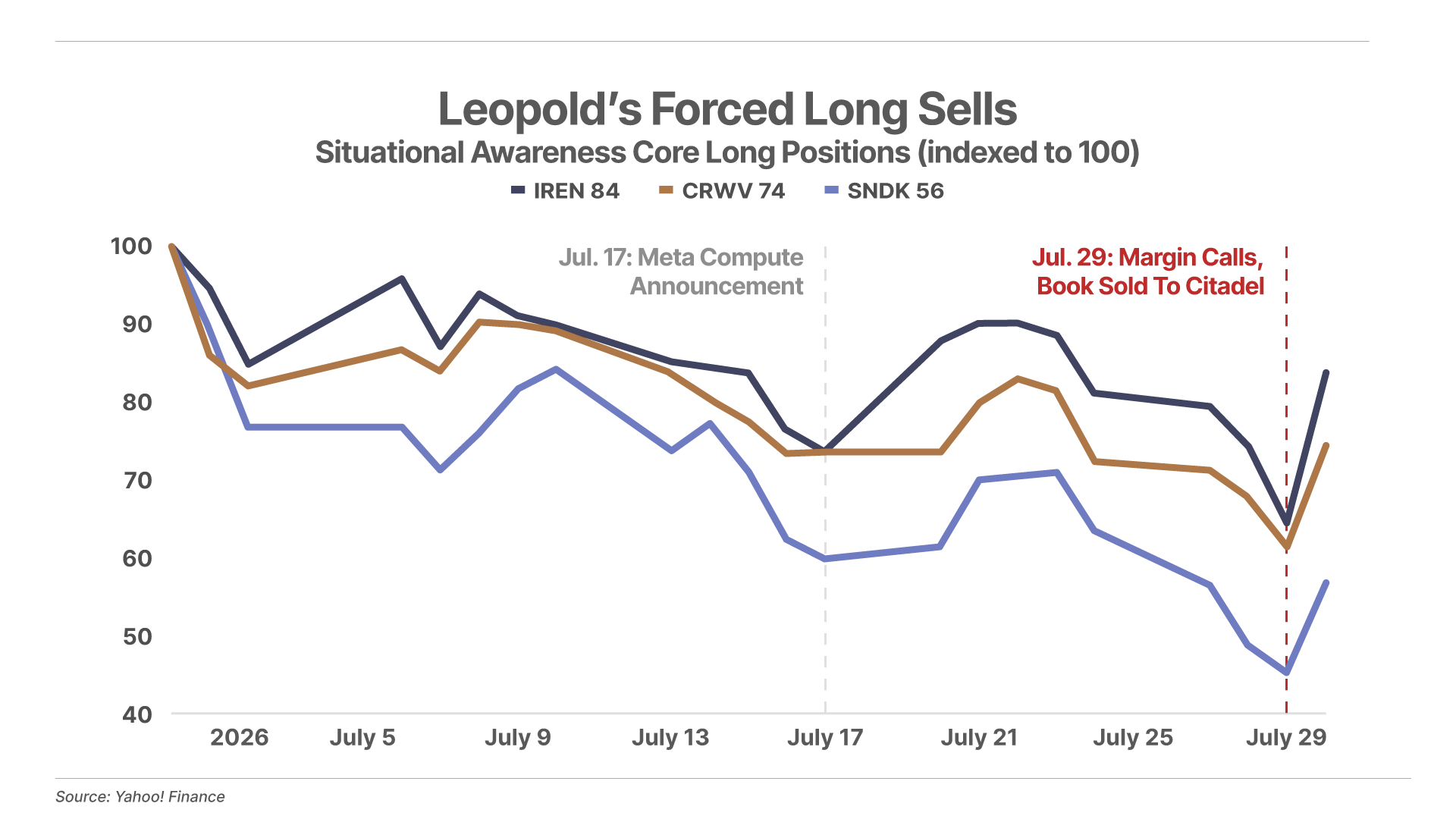
Between the June 30 close and the July 29 close – the last session before the block trade cleared his shorts – the two sides of his portfolio did this.
The longs:
- Sandisk: down 55.32%
- Nebius: down 46.33%
- Bloom Energy: down 45.90%
- CoreWeave: down 38.90%
- Micron: down 35.98%
- IREN: down 35.91%
The shorts, over the same 20 sessions:
- Workday (WDAY): up 37.24%
- Adobe (ADBE): up 28.49%
- Intuit (INTU): up 27.64%
- Salesforce (CRM): up 20.25%
- Veeva Systems (VEEV): up 17.15%
Over that same window, the Invesco QQQ Trust fell 10.14% and the SPDR S&P 500 ETF Trust fell 2.32%. Nvidia – the supposed epicenter of the AI trade – fell 5.04%, and finished the full month of July up 0.33%.
This was not an AI crash.
The S&P 500 stayed near its record throughout. This was a violent rotation out of the leveraged, capital-hungry, second-derivative end of the AI complex and into the profitable, cash-generating, asset-light end of it. Which is to say: the market rotated out of exactly what he owned and into exactly what he was short.
Then there is Microsoft (MSFT).
Microsoft closed at $390.54 on Wednesday, July 29. It closed at $451.10 on Thursday, July 30 – that is a gain of 15.51% in a single session on 110.2 million shares, against a July average of 37.1 million. Yes, Microsoft reported its fiscal Q4 after the close on July 29. But the results were nothing out of the ordinary. Revenue came in at $90.00 billion against an $87.62 billion consensus – a small 2.7% beat. Earnings were $4.74 per share against $4.21. It was a good quarter. Not a historic one. A 2.7% revenue beat does not add roughly $450 billion of market value to the most widely owned company on Earth in six and a half hours.
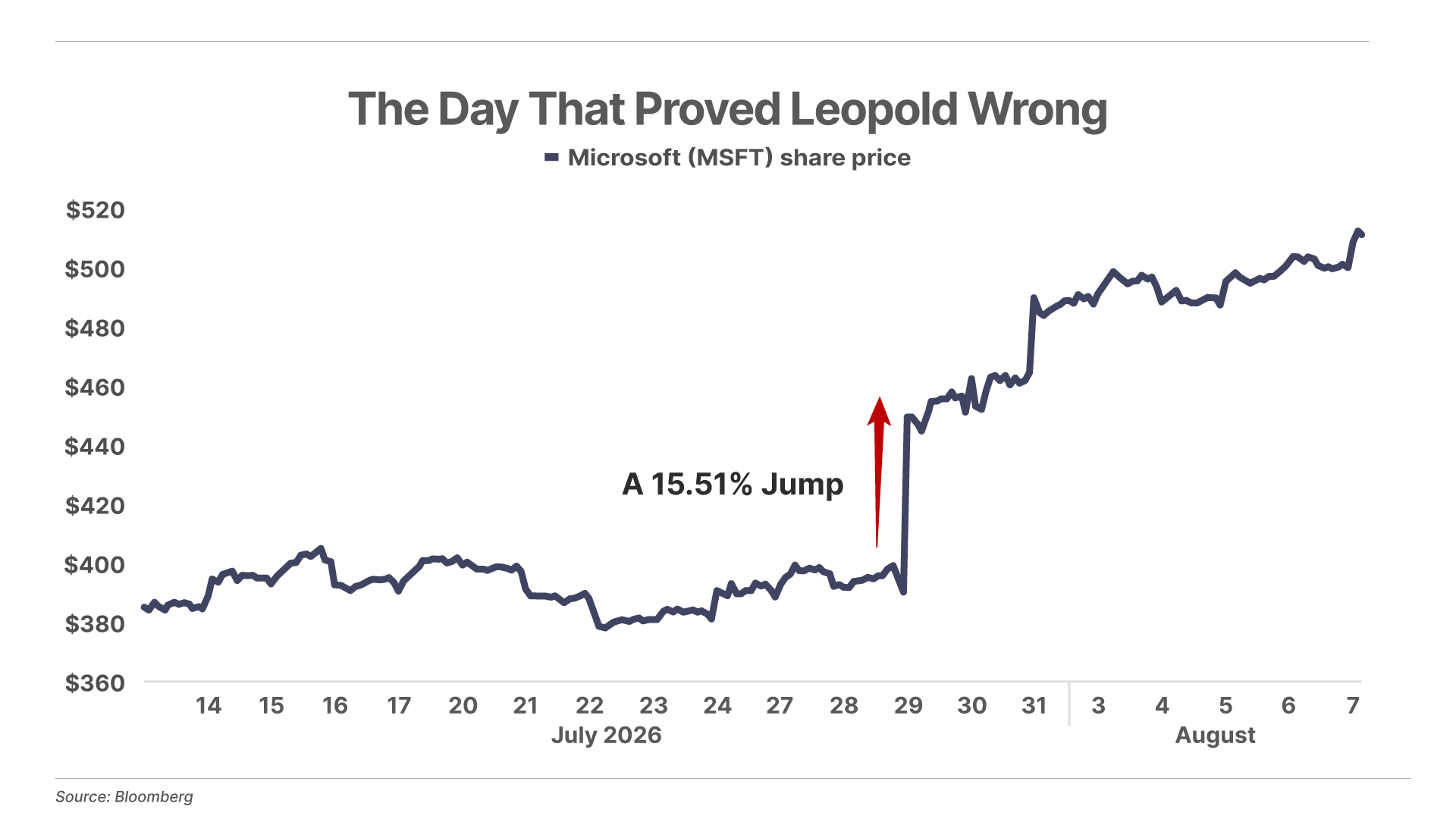
The reason Microsoft was up 15% is extremely important. Leo blew up quickly because of leverage. But he failed because he is simply wrong.
Aschenbrenner’s software thesis rests on a single premise: that a company selling enterprise software is selling the work the software performs. If a model can perform that work, the company is worth nothing.
That premise is what a very smart 25-year-old engineer believes. It is not what anyone who has ever run a business believes.
Nobody buys Microsoft because Microsoft writes the best code. They buy Microsoft because Microsoft is the rail everything else runs on. Active Directory is where your employee identities live. Excel is where your board deck’s numbers come from. Teams is where the compliance-recorded conversation happens. Azure holds a FedRAMP High authorization and Department of Defense Impact Level 5 clearance, which means a defense contractor cannot casually swap it out for something cheaper without re-clearing the entire stack with the government.
Veeva Systems runs the customer relationship management and regulatory document systems of the pharmaceutical industry. Nineteen of the top 20 biopharmaceutical companies use Veeva’s regulatory information management platform. Those systems are validated under GxP – the good-practice quality regulations that govern anything touching a drug – and 21 CFR Part 11, the Food And Drug Administration’s (“FDA”) rule for electronic records and signatures. Every major release is formally qualified. When an FDA inspector arrives, the audit trail in that system is the company’s defense.
You cannot replace that with a model that is very good at writing code. You would have to re-validate a decade of regulated records, in front of a regulator, on a system with no track record, to save a fee that rounds to nothing compared with the cost of building a new drug.
How small a fee? Veeva’s licensing runs somewhere between roughly $1,800 and $6,600 per sales representative per year. A fully loaded pharmaceutical sales rep costs the employer between $134,000 and $219,000 a year. The software is 1% to 5% of the cost of the person using it.
Microsoft raised the price of a Microsoft 365 E3 seat from $36 to $39 per user per month on July 1 of this year, and E5 from $57 to $60. Add Copilot at $30 and a fully loaded E5 seat costs $1,080 a year. Against a knowledge worker costing $120,000 all-in, that is roughly 1% of the employee.
This is the part the compute maximalists cannot see. These companies are not selling labor. They are selling the rails on which labor runs, at a price so far below the value created that the buyer never bothers to negotiate hard, and with switching costs so high that the buyer could not leave even if he wanted to.
Do people try to leave? Constantly. And they almost always fail. (Ask me how I know!)
Panorama Consulting Group tracked studies of enterprise resource planning replacements and found average cost overruns at 189% across industries. Gartner projects that by 2027, more than 70% of recently implemented ERP (enterprise resource planning) initiatives will fail to fully meet their original business goals. Ripping out a core enterprise system is one of the most reliably disastrous things a large company can attempt, and it was true before anyone had heard of a transformer model.
The incumbents are not being disintermediated by artificial intelligence. They are selling it!
Next, I’ll explain how Aschenbrenner went terribly wrong. He thought AI would eat the applications. Instead, the applications are selling AI as an upsell on top of a subscription the customer cannot afford to cancel.
Tell me what you think of today’s Daily Journal: porterstansberrydirect@gmail.com
Good investing,
F. Porter Stansberry
Stevenson, Maryland

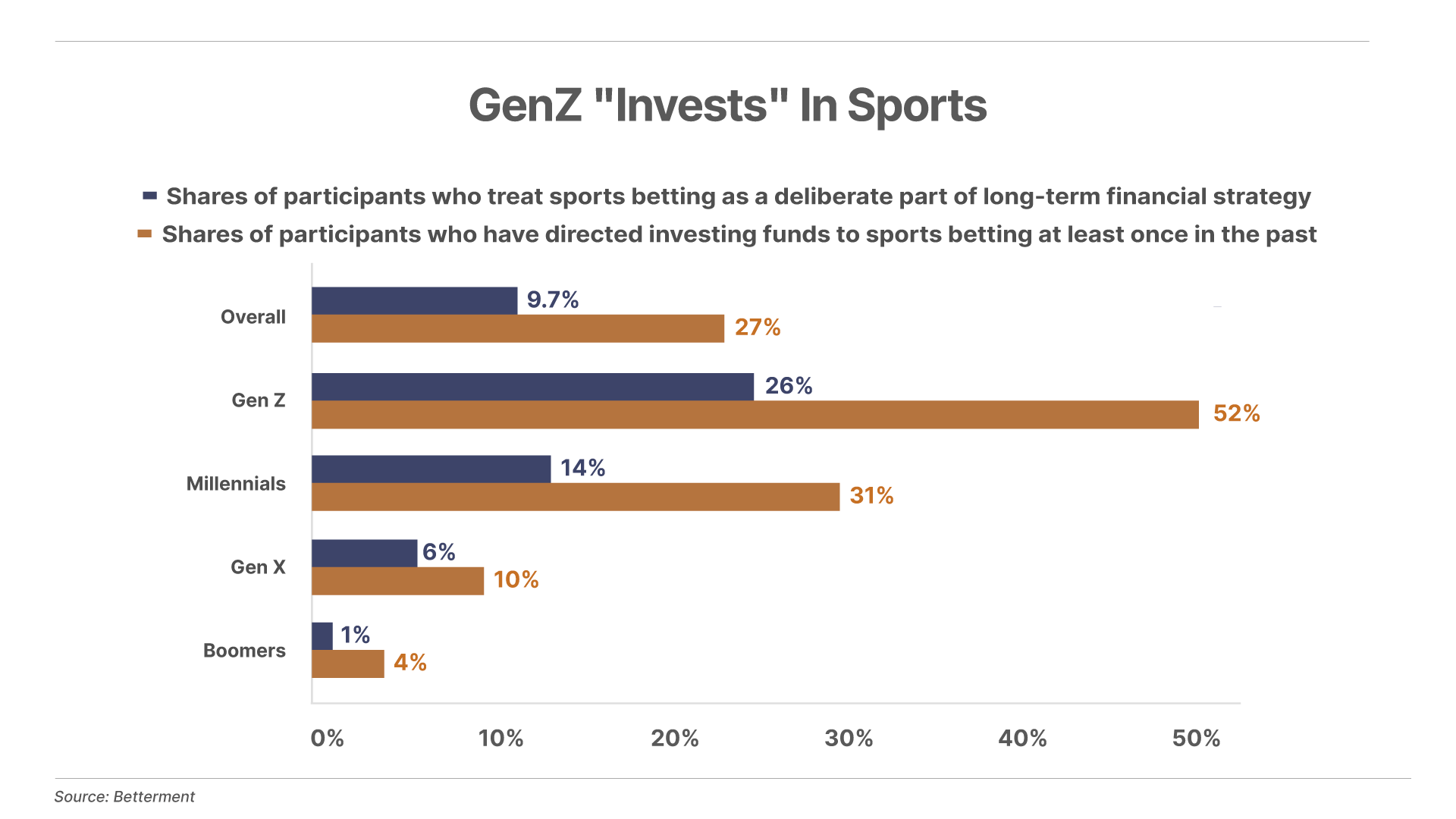
1. More than half of young investors have pulled money out of their portfolios to bet on sports. Betterment, an automated investing platform, surveyed 1,000 American retail investors in the spring. Among Gen Z respondents – born between 1997 and 2007 – 52% said they redirected money originally earmarked for investing into sports wagers over the past year, and 26% called sports betting a deliberate part of their long-term financial plan. What could go wrong?
2. American consumers are tapping the brakes. July retail sales fell 0.6% – the steepest monthly drop since May 2025 and well below the +0.1% consensus. The weakness was broad across non-store retailers, including Amazon (AMZN) where sales fell 2.2%, the second-largest decline since July 2021, while auto and parts sales dropped 1.8%. Most telling, control-group sales – the cleanest read on underlying demand that feeds directly into GDP – plunged 0.4%, the worst since January 2025. A stretched consumer is starting to show up in the data.
3. The federal government just posted its largest July deficit on record. The U.S. Treasury reported a $432 billion shortfall for the month – $334 billion of revenue versus $766 billion of spending. Interest on the debt cost $118 billion in July alone, $26 billion more than a year earlier, bringing the fiscal-year total to $1.17 trillion. That is more than the government spends on the entire military, and it is now running even with Medicare. Ten months into fiscal 2026, the deficit stands at $1.8 trillion. Every quarter-point move higher in Treasury yields adds tens of billions to that interest bill as old low-rate debt matures and gets refinanced. Washington cannot afford higher rates.
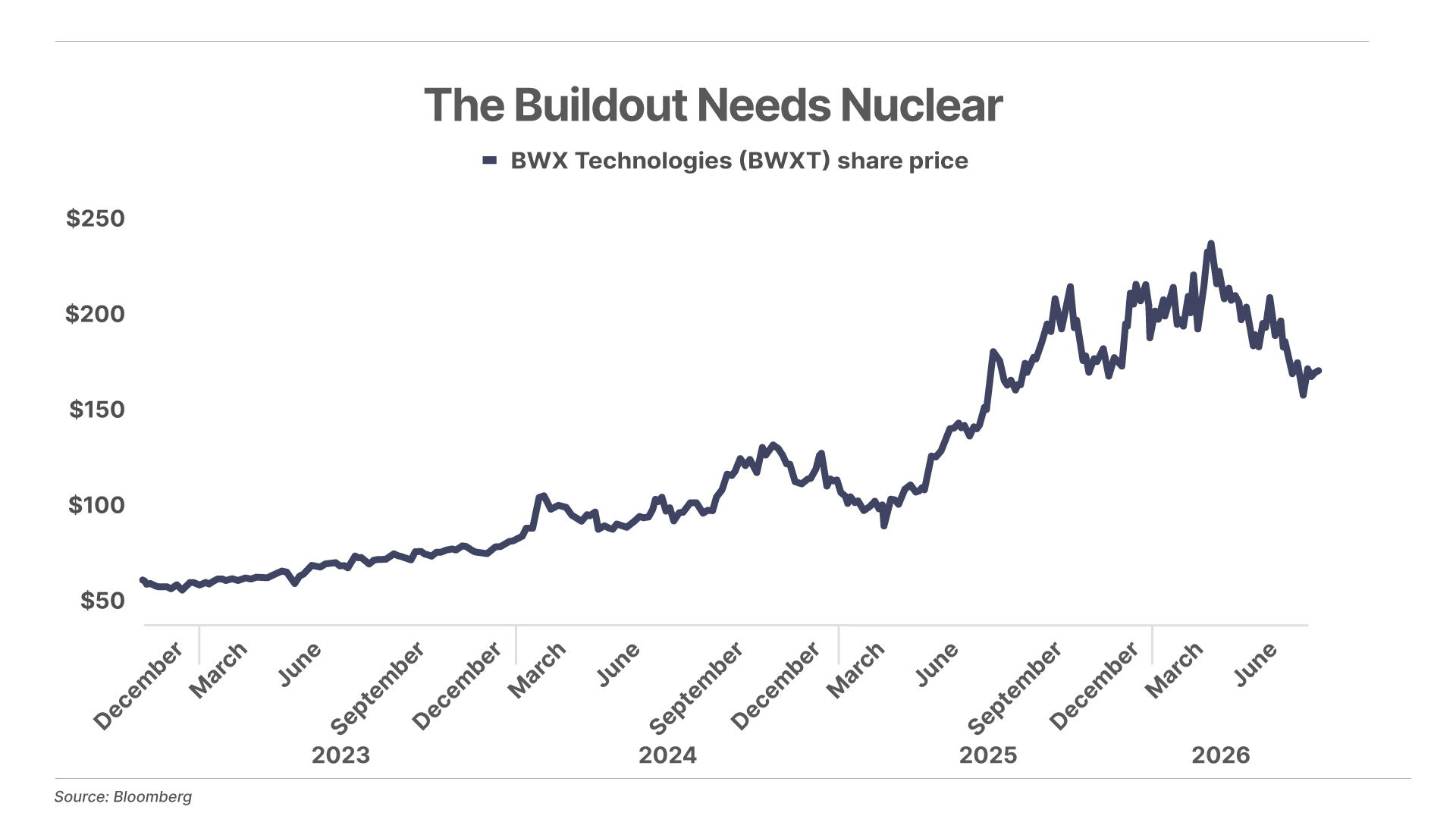
Nuclear-parts provider BWX Technologies (BWXT) has tripled from our 2022 recommendation in Complete Investor – providing the power that powers the AI buildout.