He Thought AI Would Eat These Application – But He Had It Backwards
Inside Today’s Issue
- Essay: Leopold’s Software Glitch
- Leopold Tops This List
- All Presidents Run Up Debt
- All-In On Tech Stocks
- Chart Of The Day… uniQure (QURE)
Editor’s note: Today, Porter delivers part two of a three-part series on the implosion of Leopold Aschenbrenner’s Situational Awareness fund – and the key reason behind its failure that everyone seems to be missing… The final installment of this three-part series will appear in the next Journal, on Friday.
Also note this brief update to Monday’s essay, when we reported that Intuit (INTU) was a stock that Leopold Aschenbrenner’s Situational Awareness fund had shorted. Yesterday, Intuit reported fiscal Q4 results and guided fiscal 2027 non-GAAP earnings to $22.88–$23.12 per share against a Wall Street consensus of $27.31. Some people on Wall Street believe (like Leopold) that this is more evidence of the “death of software.” We disagree.
What actually happened is far more banal: effective August 1, Intuit stopped stripping out share-based compensation from these adjusted numbers. CFO Sandeep Aujla said the 2027 guidance carries a $5.81 impact from stock-based compensation expenses. Ergo, when you add $5.81 back, the guidance midpoint is $28.81 per share, 5% above the $27.31 estimate.
Here’s another way to look at it. Intuit’s GAAP accounting requires no reconstruction. Aujla guided fiscal 2027 GAAP earnings per share to $20.12-$20.36, (growth of 22%-24%) against a $19.94 consensus. Those are not the numbers of a dying business.
Fiscal 2026 revenue grew 14% to $21.4 billion. Non-GAAP operating margin expanded 1.5 points to 41.7%. Q4 adjusted earnings came in at $4.03 per share against a $3.58 estimate. Mid-market revenue grew 39% with customers up 28%, and Intuit Enterprise Suite – the accounting and payroll package sold to companies too large for QuickBooks Online – passed $145 million in annualized revenue, 4x the prior year.
Microsoft (MSFT) passed 30 million paid Copilot seats in the June quarter, up from 15 million in January. Tech wizards like Leo Aschenbrenner hate Copilot – Microsoft’s artificial intelligence (“AI”) assistant. Just like they hated Windows ’97. And everything else Microsoft has ever built.
So what?
Accenture alone bought 740,000 Copilot seats. Bayer, Johnson & Johnson, Mercedes-Benz, and Roche have each deployed more than 90,000. Microsoft’s commercial remaining performance obligation – contracted revenue not yet recognized, which is the closest thing software has to a railroad’s signed freight contracts – stands at $678 billion, up 84% year over year!
Annual recurring revenue for Adobe’s (ADBE) AI-first passed $500 million in the quarter ended May 2026 and tripled year over year. Salesforce’s (CRM) Agentforce went from $800 million of annual recurring revenue in the January quarter to $1.2 billion by April, up 205%. Veeva Systems (VEEV) is giving its AI agents away free inside Vault CRM through 2030, which is the single most revealing data point in the set: Veeva does not need to monetize AI, because Veeva’s moat is the validated record, not the intelligence applied to it.
Aschenbrenner thought AI would eat the applications. Instead, the applications are selling AI as an upsell on top of a subscription the customer cannot afford to cancel – because it costs nothing compared to the value it delivers.
These software companies are computing tollbooths: they’re what enterprises pay to implement compute. And as compute gets cheaper, they will generate vastly more revenue, not less. The proof is sitting there in their earnings and cash flow: they’re riding on lower and lower cost of compute, which makes their business more and more efficient.
- Adobe: 36.6% operating margin, 35.6% return on invested capital (“ROIC”), capital expenditure of $179 million on $23.8 billion of revenue – 0.75% – and $9.85 billion of free cash flow (“FCF”)
- Veeva: 28.7% operating margin, 68.5% ROIC, a 44.3% FCF margin, and effectively no capex at all
- Salesforce: $41.5 billion of revenue, roughly $14.4 billion of FCF, capex of about 1.4% of revenue, and $72.4 billion of contracted backlog
- Intuit (INTU): $18.8 billion of revenue, roughly $6.1 billion of FCF, $124 million of capex
Veeva earns 68 cents a year on the dollar. And invests nothing in growing its business.
Adobe currently trades at about 11x trailing earnings. Salesforce at about 13x. Intuit at about 14x. These are the multiples of a dying industry applied to businesses converting a third to nearly half of every revenue dollar into free cash.
This enormous mispricing was manufactured by people who, like Aschenbrenner, believed these businesses were doomed. But they aren’t.
And that’s not all.
Aschenbrenner assumed that because a technology is transformative, the capital that builds it will earn its cost.
There is no relationship between those two things. In fact, it’s more likely not to be true.
Leo’s own essay contains the tell:
Over the past year, the talk of the town has shifted from $10 billion compute clusters to $100 billion clusters to trillion-dollar clusters. Every six months another zero is added to the boardroom plans.
He wrote that as a bull case. But it isn’t. That is a recipe for a financial disaster.
- Amazon (AMZN) spent $131.8 billion of capex in 2025 against $139.5 billion of operating cash flow. That is 94.5% of everything the business generated poured back into the ground, in a single year. Its 2026 capex guidance is $220 billion.
- Alphabet (GOOGL) spent $91.4 billion in 2025, 55.5% of operating cash flow, and guides to $195 billion to $205 billion this year
- Meta Platforms (META) spent $72.2 billion, 62.4% of operating cash flow, and guides to $125 billion to $145 billion
- Microsoft spent $115.9 billion in the fiscal year that just ended, against $182.9 billion of operating cash flow. Capex was 34.9% of revenue, up from 18.1% two years earlier. FCF fell to $67.0 billion from $74.1 billion in fiscal 2024, on revenue that grew by more than a third over the same span. Microsoft is running harder and generating less cash. That is what a huge capital cycle does even to the best business in the world.
- Moody’s (MCO) projects hyperscaler capex of $785 billion in 2026 and close to $1 trillion in 2027, funded in part by roughly $175 billion of debt issuance this year. Where will the money come from?
- Oracle (ORCL) had fiscal 2026 capex of $55.7 billion, FCF of negative $23.7 billion, capex at 82.6% of revenue, long-term debt up from $76.3 billion to $124.7 billion, and $248 billion of future data-center lease obligations not yet on the balance sheet
- CoreWeave (CRWV) had $5.13 billion of 2025 revenue, $14.9 billion of capex, negative $7.25 billion of FCF, net debt at 8.1x EBITDA, term loans at 11% to 15%, a weighted-average short-term borrowing rate of 12.3%, and a $1 billion private placement in April 2026 at 9.75%.
Meta’s Hyperion campus in Louisiana is financed through a special purpose vehicle in which Blue Owl Capital (OWL) holds 80% and Meta holds 20%, funded by $27.294 billion of senior secured notes at a 6.581% coupon maturing in 2049. The noteholders have no pledge on the physical data center. Their credit is Meta’s promise to pay rent starting in 2029, plus a residual value guarantee – that’s $27 billion of debt, secured by a lease, sitting off the balance sheet.
And like the EU’s finance minister explained two decades ago…
When it gets serious, you have to lie.
Microsoft extended server useful lives from three years to four, then to six, adding about $3.7 billion to fiscal 2023 operating income. Alphabet did the same, adding about $3.0 billion. Amazon added about $2.5 billion in 2024. Meta added $2.59 billion in 2025. Oracle added $573 million. Every one of those is a non-cash increase in reported profit produced by an assumption about how long a chip stays useful.
It’s a lie.
But not everyone is lying. Effective January 1, 2025, Amazon shortened the useful life of a subset of its servers and networking equipment from six years back to five, citing, in its own 10-K, “the increased pace of technology development, particularly in the area of artificial intelligence and machine learning.” That cost it $1.4 billion of additional depreciation and $1.0 billion of net income.
Amazon is the operator with the longest and hardest-won experience running data centers at scale, and Amazon is the one telling you the hardware wears out faster than the schedules assume.
Tell me what you think of today’s Daily Journal: porterstansberrydirect@gmail.com
Good investing,
F. Porter Stansberry
Stevenson, Maryland

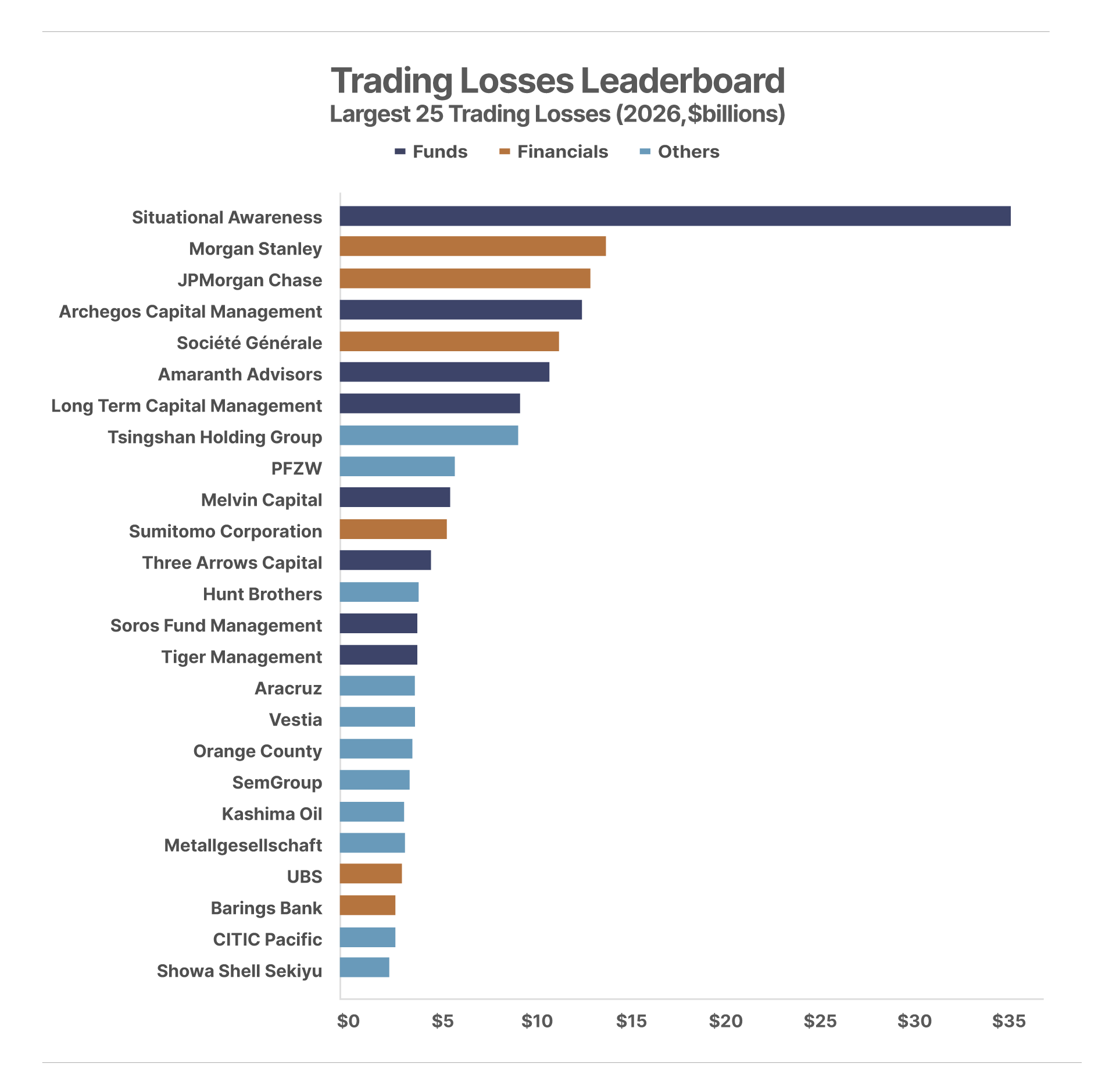
1. Leopold Aschenbrenner now sits atop the all-time list of trading losses. The Financial Times ranked the 25 largest trading losses in history. Situational Awareness – the AI-focused hedge fund featured above – takes first place with a $35 billion loss in July, roughly 2.5x the next name on the list, Morgan Stanley’s 2007 subprime mortgage blowup. Archegos, Long-Term Capital Management, and JPMorgan’s “London Whale” all rank further down. The fund held $45 billion at the start of July and about $10 billion by the end, after margin calls – lenders demanding more collateral against borrowed money – forced it to sell its entire public stock portfolio to Ken Griffin’s Citadel at below-market prices.
2. Different presidents, same printing press. M2 money supply has grown from $1.6 trillion at the end of President Jimmy Carter’s term to $23.2 trillion today – a 14x increase across nine administrations of both parties. National debt tells the same story: $1.2 trillion to $39.9 trillion, with $3.7 trillion added in just the first 19 months of the current term. Hard assets like gold, energy, and irreplaceable infrastructure are insurance against the one trend Washington has never broken.
3. A record year for technology stocks. Rampant enthusiasm for the AI revolution has sparked a record year of fund inflows into technology stocks. So far this year, investors are on track to pour a record $216 billion into technology funds, blowing away all previous records by over $100 billion. This has now become one of Wall Street’s most crowded trades.
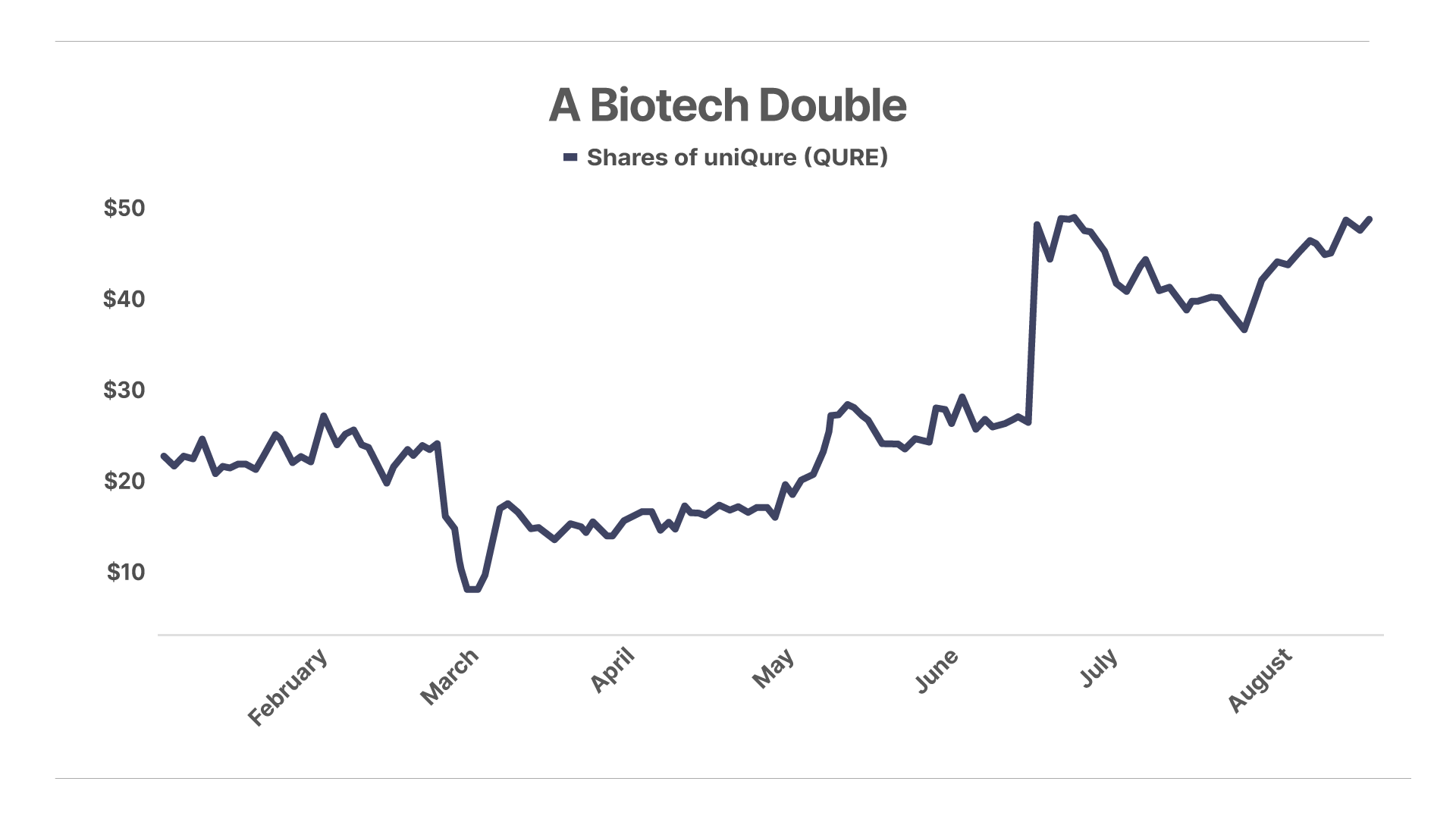
Shares of biotech firm uniQure (QURE) have risen more than 100% since being recommended in Porter & Co. Biotechnology for a second time in January – Porter will release his second report since revamping the newsletter on September 5.