Issue#123, Volume#3

The Moves (And Money) Made Between A Deal Announced And A Deal Done
Inside Today’s Issue
Editor’s note: Porter turned today’s Daily Journal over to Distressed Investing lead analyst Marty Fridson, who looks at the Paramount Skydance-Warner Bros. Discovery merger. The deal was recently halted by a federal judge, leading to another round of share-price fluctuations for both companies. Marty views the merger from the perspective of the traders who work the deal along its long path to success or failure.
Here’s Marty…
If anything moves markets, it’s the tortuous path of a big-time merger – as most recently seen with the ongoing attempt by media and entertainment conglomerate Paramount Skydance (PSKY) to acquire the much-large media giant Warner Bros. Discovery (WBD).
When I worked in bond research at Salomon Brothers from 1981 to 1984, I often interacted with traders involved in the high-stakes business of risk arbitrage, also known as merger arbitrage. We called these traders “arbs.” I’ve been intrigued by that specialty ever since, further fueled by the evolution of the government’s antitrust regulation along the way.
In merger arbitrage, the action begins when Company A (the Acquirer) bids to take over Company B (the Target). This typically occurs at a substantial premium to the Target’s prevailing stock price. The Target’s shares jump higher on the news, but not all the way up to the Acquirer’s bid price. Investors know there’s a chance that the deal will get blocked by the antitrust authorities. In such a situation, the Target’s share price would tumble back toward its pre-merger-talk level. The “arbs” aim to profit from the fluctuations in Target stock’s price in response to changing perceptions of the probability that the deal will ultimately be consummated.
The months-long attempt by Paramount to acquire Warner Bros. highlights several fascinating aspects of merger arbitration. Only a few days ago, the deal looked solidly on track after being waved through by the Department Of Justice’s (“DOJ”) antitrust division. For a bit of context, this merger entails the $10 billion Paramount Skydance gobbling up the much-larger Warner Bros. for $110 billion, making it one of the largest media mergers and the largest all-cash transaction in corporate history. It would combine the legacy film studios with extensive assets like HBO Max and CNN.
But two days ago, on July 20, the proposed transaction hit a speed bump. U.S. District Judge Araceli Martínez-Olguín ordered a 14-day pause on the deal. Shares of WBD dropped nearly 4% and shares of PSKY also declined, falling 2%.
The judge’s ruling came in response to a lawsuit filed by the attorneys general (“AG”) of 12 states, who claimed that further consolidation in the entertainment industry would lead to higher prices for consumers.
In antitrust cases, it all comes down to how the relevant market is defined. Objectors to the deal seek to define the market very narrowly, so that the combined companies will appear to have a dominant share of it. If the market is defined more broadly, as the Acquirer hopes, more competitors are thrust into the picture – and thus the Acquirer appears to have a less dominant share. In that case, the combined companies’ market share is consequently considered too small to pose any threat of monopolistic pricing.
True to form, the state AGs opposing the Paramount-Warner deal made the case for a narrow definition. It encompassed only these three categories: wide-release movies, “tentpoles” – these are big-budget films expected to be blockbusters – and basic cable channels. Under that narrow definition, it was determined that the Paramount-Warner combination would exceed the government’s industry concentration limit, as determined by the Herfindahl Hirschman Index (“HHI”) adopted in 1982.
Here’s a brief look at HHI. Instead of simply adding up the market shares of the top few firms in an industry, as antitrust enforcers did in earlier times, the HHI totals up the squares of all the competitors. For example, if a highly concentrated industry has five companies with market shares of 30%, 25%, 20%, 15%, and 10%, its HHI is…
900 (302) + 625 + 400 + 225 + 100 = 2,250
The score ranges from near zero in perfectly competitive markets up to 10,000 in a pure monopoly. The DOJ’s antitrust division and the Federal Trade Commission determined that if a merger raises the sum of all the squares of the key players in the market by more than 100 points, bringing it to over 1,800, then under present guidelines the deal will probably be ruled anticompetitive and not allowed.
But Paramount’s management has the right to challenge the AGs’ definition. No one knows what Paramount’s definition is at this point – it didn’t bother to file a brief in the AGs’ lawsuit. After all, the Justice Department gave the acquisition the green light without getting into those details. And President Donald Trump was widely seen as supporting the deal. Paramount CEO David Ellison is the son of Oracle (ORCL) co-founder Larry Ellison – who, it’s been widely reported, gave $45 million to a nonprofit organization that supported Trump’s 2024 election campaign.
We’ll have to see what argument Paramount’s lawyers come up with and how things go in court from this point. In the meantime, consider some interesting fallout from Judge Martínez-Olguín’s decision, namely, that previously mentioned 4% drop in Paramount’s share price.
Paramount’s shares face a really big downside if the deal dies, due to something that wasn’t yet a factor in my early 1980s Salomon Brothers days. Only in the late 1980s did breakup fees become significant in merger-and-acquisition (“M&A”) deals, as hostile takeovers became more common with the help of high-yield bond financing. (That’s something I was in the thick of.)
If the acquisition doesn’t ultimately happen, Paramount will have to pay a $7 billion penalty to Warner Bros – that’s equivalent to 73% of Paramount’s current market capitalization. And it’s on top of $2.8 billion that Paramount paid to Netflix (NFLX) for terminating its earlier agreement to purchase a big chunk of Warner’s operations. Even a delay beyond September 30 in closing the acquisition would whack Paramount’s pocketbook, to the tune of $650 million a quarter until Warner is finally signed, sealed, and delivered.
One last point: I don’t want to leave the impression that M&A activity triggers nothing more dramatic than the comparatively modest July 20 moves in Paramount and Warner shares. Look at how shares of both companies moved throughout the process…
- WBD jumped 29% on September 11, 2025, on initial reports that the company was a takeover target
- PSKY fell nearly 10% on December 5, 2025, when Warner announced its deal to sell part of itself to Netflix, seemingly knocking Paramount out of the picture
- PSKY rebounded by 9% in the very next session as the company made its initial bid for Warner Bros
- On February 26, 2026, Warner’s board deemed Paramount’s bid “superior” (to Netflix’s) and PSKY shares rose 10%
- The next day, the Acquirer and the Target signed a definitive agreement and PSKY soared 21%
No wonder those Salomon Brothers “arbs” were richly compensated back in the early 1980s. They had a lot of price risk, both up and down, to manage.
Martin Fridson
New York, New York
Tell us what you think of today’s Journal: porterstansberrydirect@gmail.com

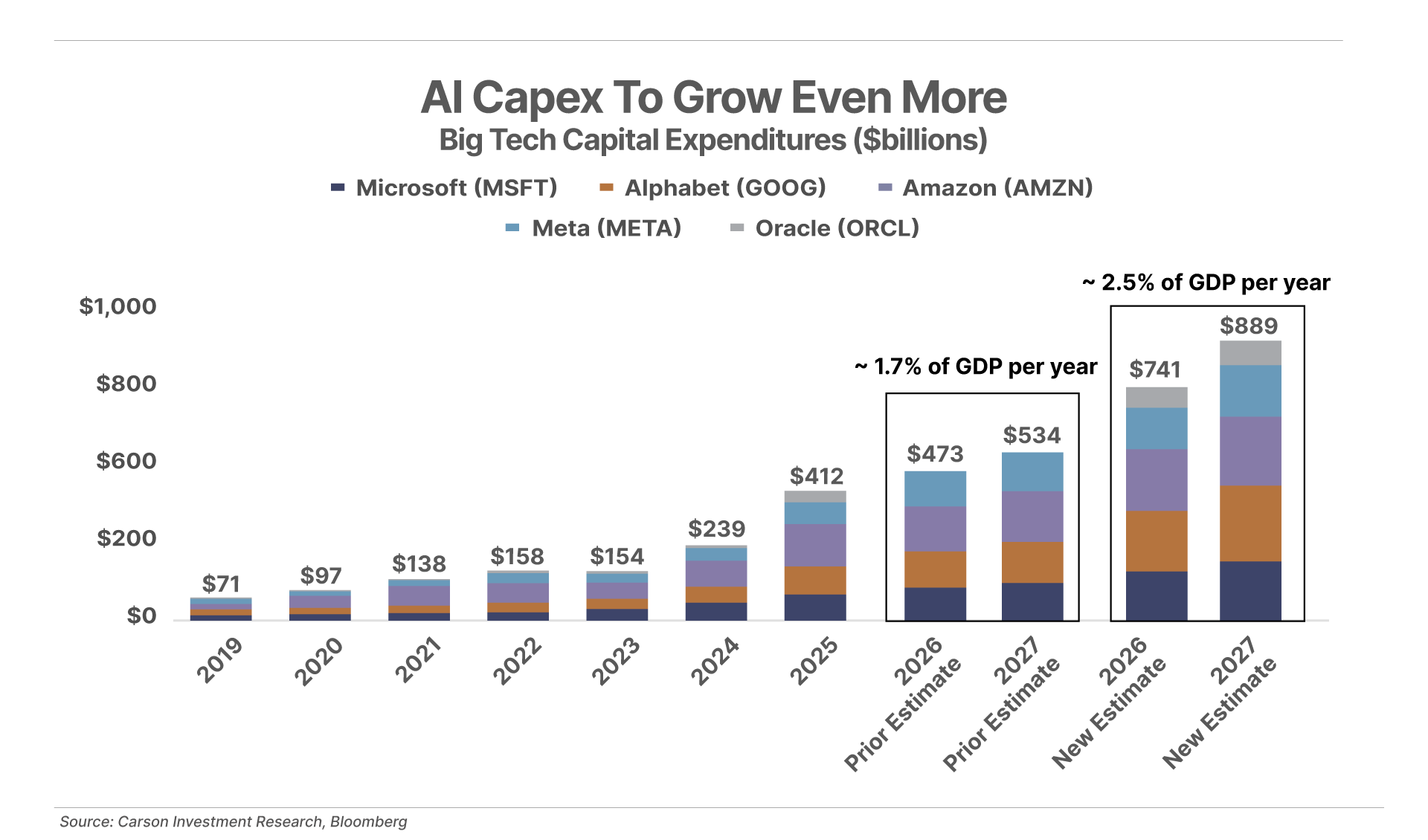
1. AI spending continues to rise. Microsoft (MSFT), Alphabet (GOOG), Amazon (AMZN), Meta Platforms (META), and Oracle (ORCL) are now projected to spend $741 billion on data centers and equipment in 2026 – 2.3% of U.S. economic output, versus just 0.3% in 2019. That’s an 80% jump from 2025 and $268 billion above the 2026 estimate at the end of last year. The 2027 estimate is now approaching $900 billion.
2. Chasing hot IPOs is not a winning strategy. Shares of Elon Musk’s rocket company SpaceX (SPCX) have fallen 45% from their June 16 peak and now trade below the $135 initial public offering (“IPO”) price – exactly the outcome we warned about in the June 5 Daily Journal. The bigger test is still ahead. Insiders can start selling two trading days after the August 4 earnings report – releasing up to 911.5 million shares, nearly double the 555.6 million sold in the IPO itself.
3. Wall Street’s bearish positioning has reached extreme levels. Short interest hit a record 9.0% of shares outstanding across all NYSE-listed stocks in late June – well above the 5.0% peak during the 2008 Financial Crisis and 6.0% during the 2020 pandemic. History says extreme bearish positioning is rarely rewarded. Shorts are borrowed selling that must eventually become forced buying, and at these levels, any positive catalyst could ignite a squeeze.
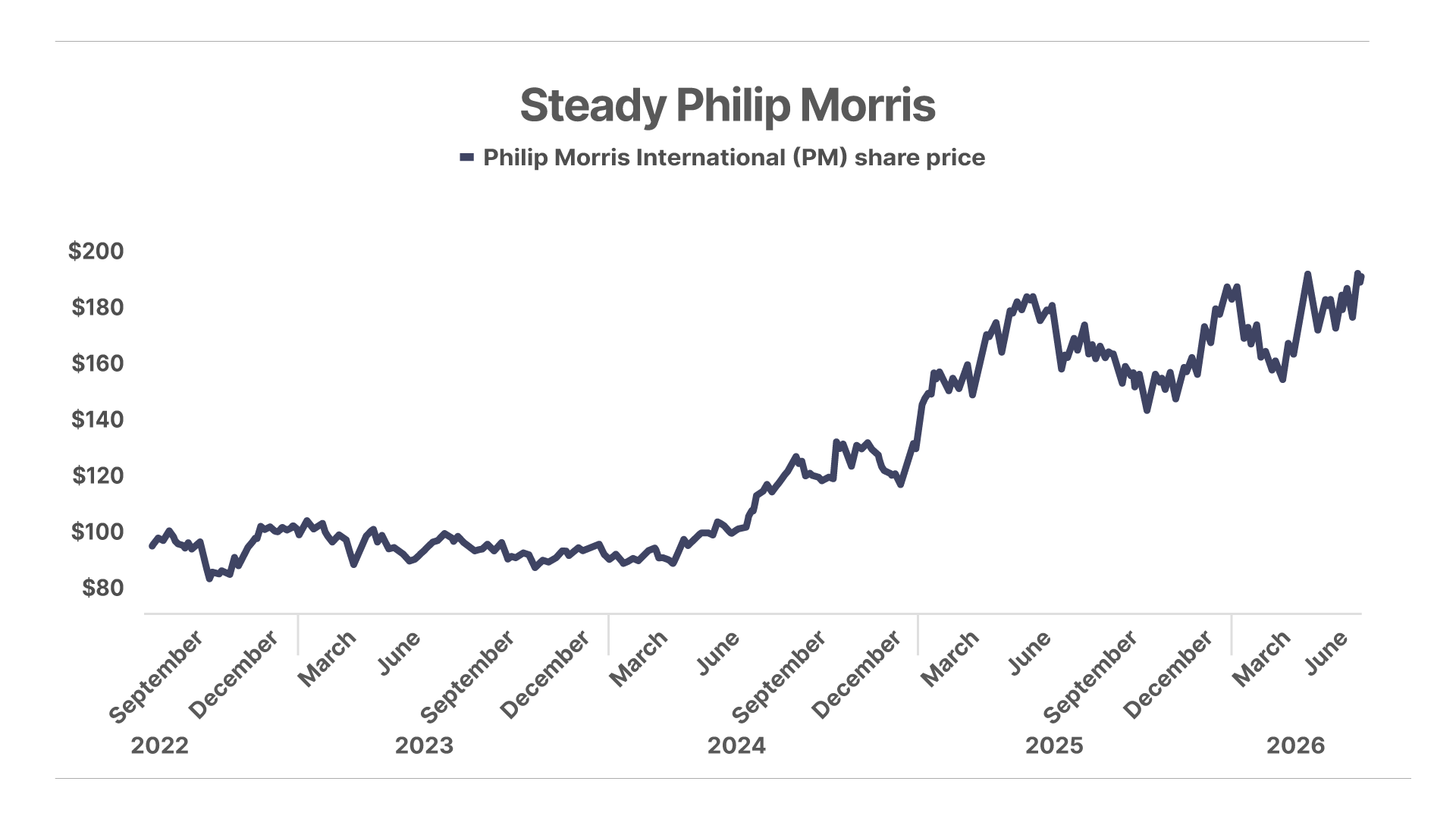
Philip Morris International (PM) crossed over $11 billion in quarterly sales for the first time ever with its latest Q2 results released today, up 10.4% year-on-year (“YOY”), while earnings per share increased 15% YOY to $2.20 – both numbers exceeding analyst estimates. The growth was driven by smoke-free products, with sales rising 14% YOY to reach a record 42% of total revenue. Shares rallied toward an all-time high and currently trade around $192, for a total return exceeding 140% since our Complete Investor recommendation in July 2022.
“You Touched A Nerve”
Patricia F. writes:
Why do you believe Hitler (or Himmler) murdered 6 million Jews? Where did that number come from?
The 1932 census of Europe was compiled and published in 1933 and it shows that the number of Jews in all the countries that the Germans subsequently occupied was 5,800,000 with the majority in Poland.
The next census of Europe happened 10 years after the war. In 1945 there was no counting of who all was imprisoned and who died. We can only rely on German records. But we don’t rely on German records. No, no, no. The Germans intended (we believe) to kill all the Jews and therefore they are guilty of killing all the Jews and that would be 6 million.
In my opinion, this is an enormous slander of Germany and it creates a precedent of genocide in the millions which gives Israel license to do the same.
You touched a nerve, Porter!
Grant G. writes:
You had me until you said Hitler killed 6 million jews, which has been completely debunked by many many people, just not the jews.
Porter Comment: I do not believe there’s any rational way to argue that the Nazi’s did not target all of Europe’s Jews and systematically imprison and then murder them. The historical record, including laws, contemporaneous publications, the Nazi’s own propaganda, Hitler’s own books, and official Nazi records contain a complete account. Likewise, we have the first-hand testimony of dozens of Nazis and other eyewitnesses to these atrocities. In fact, the Nazi’s own recordkeeping was horrifically precise. They give precise counts for specific operations, like the Höfle Telegram‘s 1,274,166 Jews killed by the end of 1942 in the four Operation Reinhard camps: Belzec 434,508, Treblinka 713,555, Sobibor 101,370, and Majdanek 24,733. The Korherr Report confirms that exact total for the General government camps and adds 145,301 for the Warthegau, plus 1,449,692 deported further east. The Einsatzgruppen operational reports tally at least 1,152,731 Jews shot in the occupied Soviet territories by late 1942. Rudolf Höss’s sworn affidavit estimates at least 2.5 million gassed and burned at Auschwitz plus another half million dead from starvation and disease. These figures add up to the roughly 6 million figure presented at Nuremberg.
It’s hard to believe that anyone would argue this didn’t happen. But… sadly… I’ve seen again and again that people will believe absolutely anything. I often feel like I’m trapped on a prison planet surrounded by the criminally insane.
Porter & Co. Market Snapshot
| Price | Yesterday’s Return | Year-to-Date Return | |
| S&P 500 Index | $7,509.20 | 0.89% | 10.4% |
| Gold per ounce | $4,076.99 | 1.69% | -4.7% |
| Bitcoin | $66,384 | 1.62% | -24.7% |
| Oil (West Texas Intermediate) per barrel | $84.34 | 2.33% | 52.2% |
| Berkshire Hathaway (BRK) | $733,526.00 | -0.36% | -2.8% |
| Porter’s Permanent Portfolio | – | 0.27% | 1.0% |
| The Better Than Berkshire Index | – | -0.71% | 7.6% |
| Total Return | Annual Return | ||
| Porter & Co’s Top Ranked* | 35.4% | 16.4% | |
| Yield | Yesterday’s Change | Change Year-to-Date |
|
| U.S Treasury 30-Year Yield | 5.13% | 2 bps | 29 bps |
| Prices as of 4:00 pm ET July 21, 2026 | bps = basis points (or 0.01%) | |||
| *A Complete Investor risk rating of 1 is defined as a “low risk, high allocation” security, while positions rated closer to a 5 are higher risk. Porter & Co.’s top-ranked positions include those rated either 1 or 2 in Complete Investor portfolio. | |||
Porter & Co. Top Positions
| Publication | Ticker | Description | Total Return |
| Tech Frontiers | QURE | uniQure | 237% |
| Complete Investor | BWXT | BWX Technologies | 204% |
| Tech Frontiers | ROIV | Roivant Sciences | 155% |
| Tech Frontiers | NUVB | Nuvation Bio | 153% |
| Tech Frontiers | TGTX | TG Therapeutics | 152% |
| Complete Investor | BTC/USD | Bitcoin | 146% |
| Complete Investor | SKWD | Skyward Specialty Insurance | 144% |
| Complete Investor | PM | Philip Morris | 134% |
| Tech Frontiers | QURE | uniQure | 131% |
| Tech Frontiers | SGMT | Sagimet Biosciences | 131% |
| Prices as of 4:00 pm ET July 21, 2026 | |||
Please note: The investments in our “Porter & Co. Top Positions” should not be considered current recommendations. These positions are the best performers across our publications – and the securities listed may (or may not) be above the current buy-up-to price. To learn more, visit the current recommendations page of the relevant service, here| New Window. To gain access or to learn more about our current recommendations, call our Customer Care team at 888-610-8895 or internationally at +1 443-815-4447.