Issue#129, Volume#3

Introducing Porter & Co. Biotechnology (Part Two Of Three)
Inside Today's Issue
Editor’s note: This is the second in a three-part series that Porter is delivering on Porter & Co. Biotechnology – a new advisory launching this Saturday, August 1. To get access to that first issue and all ongoing recommendations and portfolio updates, click here.
Yesterday I explained the paradox sitting at the center of the artificial intelligence (“AI”) boom.
America is building a new railroad – hundreds of billions of dollars a year poured into data centers. And like every railroad before it, it will destroy as much as it creates. As the cost of computing falls toward zero, every business model that depends on charging for computing stops working.
So the question for investors is not what AI will build. The most important question investors must answer today is: what industry that uses massive amounts of compute will AI not destroy?
Biotechnology. It is the only industry that can absorb unlimited computing power and still defend its prices, because the government hands a drug company a legal monopoly. The moat is the government.
So… the next question is… which new drugs will generate the greatest revenue? I told you yesterday, it’s drugs that deal effectively with obesity. But… heart disease is not far behind.
You probably think heart disease is a solved problem because you know about cholesterol. You know your doctor checks it. You know that if the number is high he puts you on a statin, and that statins work – they are one of the genuine triumphs of modern medicine, and they have saved millions of lives, probably including someone you love.
But there’s a lot more to this problem that isn’t solved – yet.
There might be a second kind of cholesterol particle in your blood. Your doctor has almost certainly never measured it. Over the entire decade from 2015 through 2024, fewer than 730,000 Americans were ever tested for it. It is called lipoprotein(a) – or Lp(a).
Picture an ordinary cholesterol particle. Now wrap a second, tangled protein around the outside of it – a protein that makes the particle sticky, inflammatory, and prone to helping blood clot. That is Lp(a). It does not merely clog the artery. It irritates the artery wall and then makes the clot that finishes the job.
And here is the part that ought to alarm you. Why does the disciplined 52-year-old – lean, active, statin-compliant, textbook numbers – drop dead in the driveway? Lp(a).
What can you do about it? Nothing.
Your Lp(a) level was set the day you were conceived. It is written in your genes. It does not move.
Diet does not lower it. Exercise does not lower it. Losing 40 pounds does not lower it. Statins do not lower it. You can do everything your doctor tells you, achieve perfect cholesterol numbers, run a marathon at 50 – and your Lp(a) will not change.
About one person in five carries a dangerous level of Lp(a) – that’s 65 million Americans and 1.5 billion people worldwide.
The risk is not subtle. If your Lp(a) is above 180, your danger of a heart attack is in the highest risk category. If you have already survived one heart attack and your level is above 100, you are more than twice as likely to have another – and if you are under 60, more than three times as likely. Among patients already taking a statin, with their cholesterol driven down to target level, high Lp(a) leaves 38% excess risk sitting there untouched.
For 60 years, doctors could measure Lp(a) and do nothing about it. There is still not one approved drug that lowers it. The only treatment that exists is to run the patient's blood through a filtration machine on a repeating schedule, at a cost of $50,000 to $150,000 a year.
So why has no one drugged it?
Because you cannot get at Lp(a) the way medicine normally works. Almost every drug you have ever taken is a blocker. It finds a finished protein doing damage and jams it. But Lp(a) is not a lock you can pick. To stop it you have to prevent the liver from building it in the first place – which means reaching inside the cell and destroying the instruction before the protein exists!
And that’s our Fourth (of my 11) Kingdom of Medicine: gene silencing.
Think of your DNA as the master blueprint locked in a vault. The cell never sends the blueprint to the factory floor. It sends a working copy – a paper work order called messenger RNA. The factory reads the work order and builds the protein.
Conventional drugs wait at the end of the line and smash the finished product. Gene silencing walks over to the factory floor and shreds the work order. No work order, no protein. And because one shredder handles thousands of copies, a single injection can keep a gene switched off for months.
Two American scientists, Andrew Fire and Craig Mello, discovered this mechanism in a worm in 1998. And finding that worm won the Nobel Prize for them eight years later. Gene silencing will become the biggest innovation in medicine since the invention of monoclonal antibodies. And this technology’s first great triumph will be Lp(a).
There are four companies in the final stretch, waiting for results from pivotal Phase III trials. The leader cuts Lp(a) by about 80% with a monthly injection. It’s enrolled 8,323 patients with established heart disease. When the study is complete, it will be the first to prove conclusively that lowering Lp(a) prevents heart attacks. The trial is expected to end later this year.
No, this will not be a one-drug only field. There are three other similar gene-silencing drugs in development. But, critically, none of them will finish their own pivotal trials until 2028 or beyond. And that means… the drug that’s first to market will have a huge advantage.
And there’s more.
In March of this year, the American College of Cardiology and the American Heart Association changed their recommendation around Lp(a). They now recommend every adult have Lp(a) measured at least once, and that the family members of anyone with a high reading be tested too.
That means a risk factor that fewer than one in a hundred American adults has ever been checked for is about to become a standard blood test – at almost the exact moment the first drug that treats it arrives.
So how big is this?
At their peak in 2006, every statin on Earth – Lipitor, Zocor, Crestor – sold $35.2 billion in a single year. That was the best-selling class of medicines in the history of the pharmaceutical business, and it was spread across more than 200 million patients. Work it out and the entire global statin industry earned about $176 per patient per year.
Repatha, a modern injected cholesterol drug, lists at $5,850 a year. That is 33 times as much revenue per patient.
Which means an Lp(a) drug needs 6 million patients to match the entire global statin class at its absolute peak.
Six million – out of 1.5 billion people who carry the risk… 4/10ths of 1%.
Or look only at America – 65 million Americans have elevated Lp(a)... 6 million of them is 9.3%. Statins, at their height, reached between 28% and 32% of the people eligible for them.
So the number that replicates the biggest drug class in the history of medicine requires less than a third of the penetration that statins achieved, in one country, while giving zero credit for Europe, zero for Asia, and zero for the second disease these drugs may treat – the calcified heart valve that today can only be replaced by a surgeon.
That’s why I believe these drugs will deliver $40 billion a year at maturity, which will arrive around 2030. Wall Street is modeling $4 billion to $10 billion per year.
Tomorrow, in the final letter before we launch, I am going to name the company we are recommending to open the Porter & Co. Biotechnology portfolio. It’s the leader in Lp(a) gene silencing.
Fair warning: it isn’t the company you think. The company that invented the leading drug is the wrong way to own it.
Please don't miss tomorrow's Journal.
And if you want to earn the largest gains of the compute revolution, subscribe to Porter & Co. Biotechnology.
Tell me what you think of today’s Journal: porterstansberrydirect@gmail.com
Good investing,
F. Porter Stansberry
Stevenson, Maryland
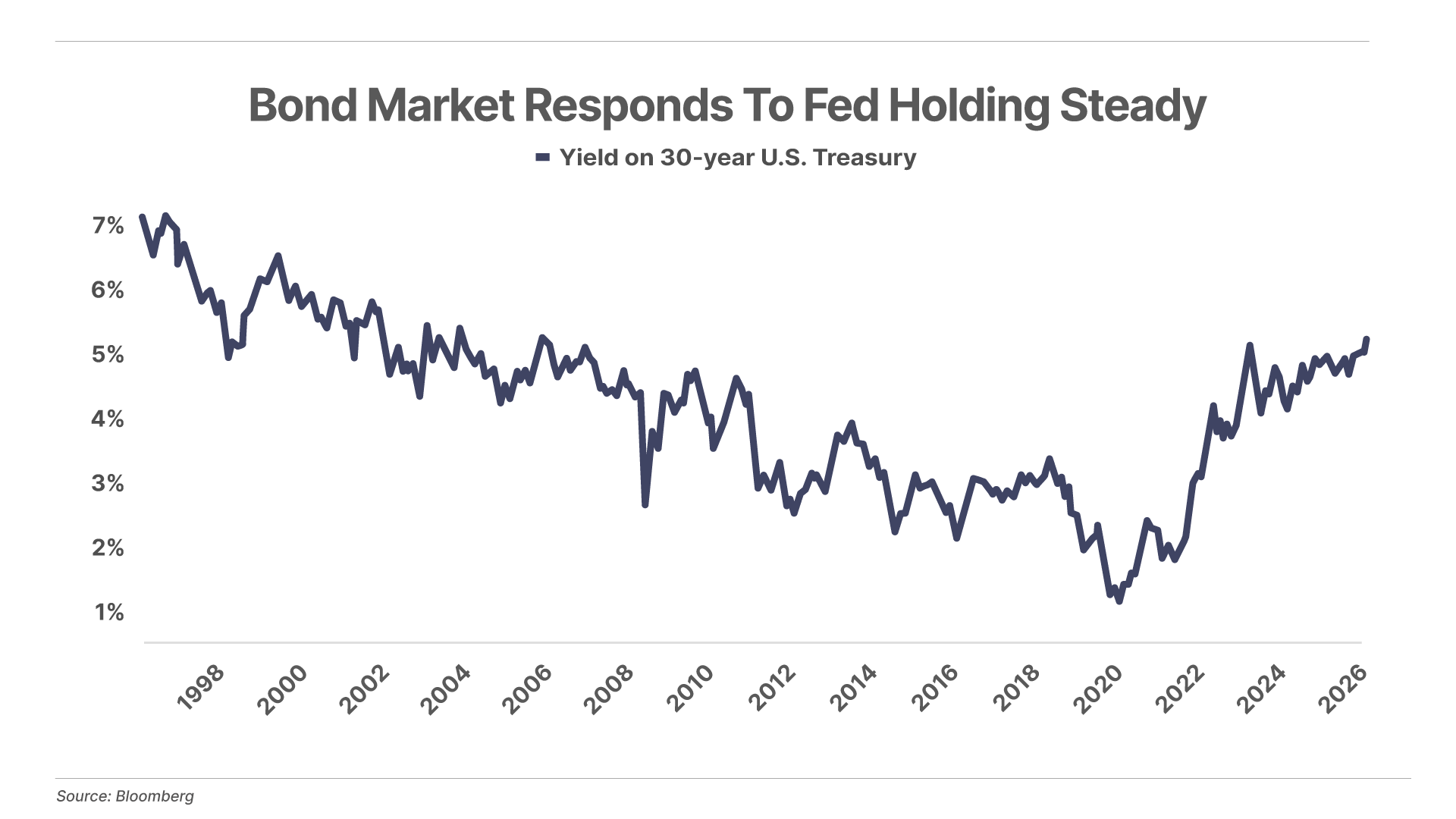
1. The bond market is taking matters into its own hands. The Federal Reserve held interest rates steady yesterday, with three members dissenting in favor of a hike. The bond market's response was immediate: the 10-year Treasury yield jumped seven basis points above 4.67%, and the 30-year (shown here) soared above 5.2% – its highest level since 2006. The message: if the central bank won't restrain inflation, rising yields will restrain the economy on its behalf. The Dow fell 2.2% – its worst day since April 2025 – with the S&P 500 down 1.5% and the Nasdaq off 1.7%.
2. Apple (AAPL) joins the $5 trillion club, but memory prices start to bite. With shares up 25% this year, the consumer electronics giant briefly crossed $5 trillion in market cap on Tuesday, making it the second company ever to do so after Nvidia (NVDA). Alphabet (GOOG), Amazon (AMZN), Meta Platforms (META), and Microsoft (MSFT) will spend more than $700 billion combined on capital projects in 2026 – mostly AI data centers and the chips inside them – while Apple's own capital spending is shrinking, and investors are paying up for the company’s capex discipline. However, that same buildout has driven memory chip prices sharply higher, causing Apple to raise iPad and Mac prices, and this week, it launched Apple Upgrade, allowing customers to lease increasingly costly iPhones starting at just $17.99 a month, with “buy now, pay later” Klarna carrying the credit risk.
3. British American Tobacco’s smoke-free transformation accelerates. In the company’s H2 2026 financial results published today, British American Tobacco (BTI) reported 7.9% earnings per share growth, led by its smoke-free portfolio where sales increased 18% year-on-year (“YOY”). The company now generates 20% of total revenue from smoke-free products. Its nicotine-pouch segment is the standout performer, with 66% YOY sales growth and significant market-share gains – ending June with 30% market share in the $5 billion U.S. nicotine pouch market… BTI shares are up 60% since our March 2025 recommendation in Complete Investor.
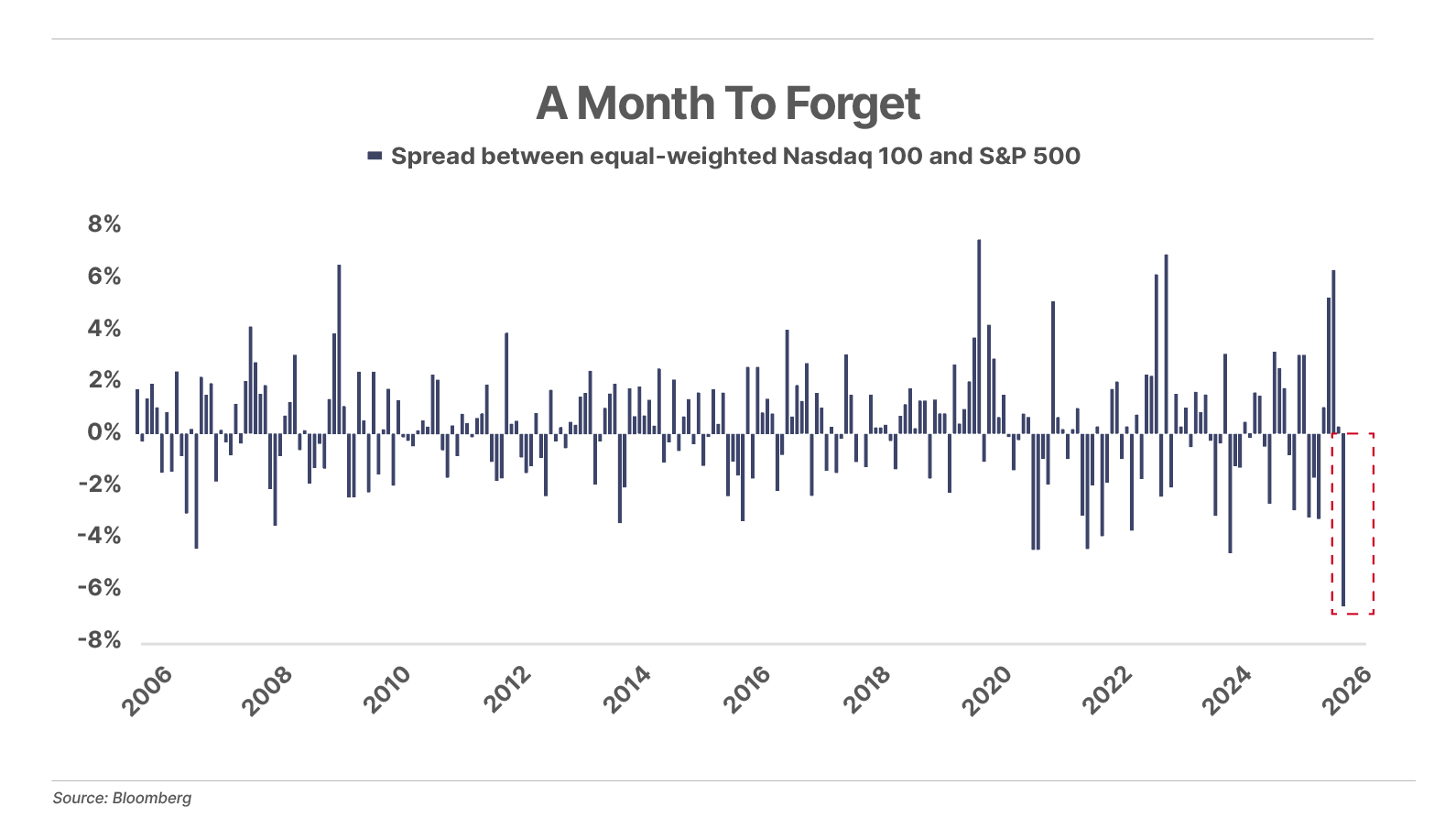
The average tech stock is on pace for its worst month ever relative to the average S&P 500 stock. The equal-weighted Nasdaq 100 is down 4.6% in July against a 2.2% gain for the equal-weighted S&P 500, which sits at a record high.
"In A Nutshell"
In yesterday’s Journal, Porter began the first of three essays explaining the re-focused investment strategy for Porter & Co. Biotechnology – launching this Saturday, August 1.
Willie B. writes:
Hi Porter,
I'm wondering if I've understood the main point correctly.
In a nutshell, are you saying that the 20-stock (11 "Kingdom") portfolio you'll be presenting to subscribers on Saturday is expected to be successful because it focuses on avoiding the roughly 10% of drugs and treatments that never receive FDA approval? In addition, do you believe AI will dramatically accelerate the process of getting new therapies through FDA approval compared with today's system – even with the current level of AI technology?
The reason I ask is that when I look at the prevalence of heart disease, obesity, and autoimmune diseases, just to name a few, the need for better treatments is growing at an alarming rate. It seems that any modality capable of effectively treating these and other major diseases would warrant a much faster approval process than what our current, antiquated FDA system provides.
Am I understanding your thesis correctly, or am I missing an important part of your investment rationale?
Thank you
Porter Comment: No, I’m afraid you didn’t quite get what I was trying to say.
In the first place, it’s more than 90% of drugs that begin clinical trials and never gain FDA approval (not 10%).
But, yes, the second part you got completely correct: I believe AI is going to transform the efficiency of drug development. I look forward to reporting to you about NVDA’s partnership with Eli Lilly. The idea is to model drug trials using computers and getting the models accurate enough to successfully predict if a new drug will work safely or not. This kind of breakthrough is coming and it’s going to take drug development from a 10-year process into a one-year process.
Regards,
Porter
"Congratulations"
Micheal T. writes:
To the man that seems to pack 20 hours of productive work into a single day: Congratulations.
When I recommended you and your services to a friend, I described you as a renaissance man. Nobody is known to me to have a better sense of the pulse of America. This is the best idea ever. I was early to the much anticipated biotech discovery cycle a couple of years ago, and was bitterly disappointed, primarily by sponsorship with mixed motives. Herein, I have no such doubts and look forward to the initial offering.
Thank you for your efforts to bring the rest of us along with you on this valuable journey!
Porter Comment: Thank you, Michael. I’ll do my best.
"Exceptional Intellect"
Richard B. writes:
I believe your vision on the state of affairs is ever improving and amazing. Simply said, you have exceptional intellectual and creative powers. I have followed you for years – your brain’s neural pathways must still be organizing in ways that allow for the continuous improvement of cognitive ability, originality, and transformative thinking… wisdom. You are not the same man (brain) of years past.
Your fan
Porter Comment: Richard —
Thank you… I think?
I’m fairly certain I’m the same man. But I appreciate the sentiment. I’m definitely enjoying my work more than ever before. Having my own firm has eliminated some of the constraints and the frictions… I tap dance to work now.
Porter
Kevin O. writes:
Hi Porter, I currently subscribe to your Best Buys and am extremely excited for this biotech portfolio. I believe the biotech boom we are going to go through is my best chance at a wealthy retirement. I will strongly have to consider a subscription to it once it launches. I’m in lockstep with you about biotech and AI. If you ask me the only thing AI will ever do that drastically improves our lives is biology. It’s basically what it’s designed for in my opinion.
Porter Comment: You are correct. Even if you can’t take a subscription, at least buy the Biotech ETFs when they’re down 20%-30% from their highs.
Porter
Dr. Daniel J. writes:
I am really looking forward to your upcoming issue. Going back 25 years, you have often hit it out of the park with biotech. I love learning about what’s out there. The 20-names thing scares me. That’s a fire hose. Many are closely correlated. Many are not derisked. I have a little clinical sense since I’ve been practicing over 30 years. They all make sense but it’s a lot.
Porter Comment: Daniel –
Thanks for your note.
Twenty, as you say, may not be enough to distribute the risk across early stage drug developers. But that isn’t how I’m going to build the portfolio, as you’ll see. What I’ve learned from Dave Lashmet over, as you mention, more than 25 years is that the best science wins. That’s determined in clinical trials and by the chemistry behind each modality. You’ll see a big focus on platforms that are de-risked because they are well-proven. You’ll also see a “barbell” approach where half of the portfolio are “tollbooths” and have drug developers.
Regards,
Porter
"Fantastic News!"
John B. writes:
Hi Porter,
Fantastic news on biotech! I think I am one of your original Partners and think the world of you.
Keep up your great work. Erez is a loss but I have 1,000% confidence in you.
All the best
Mary L. writes:
I can’t wait to see the next one.
"Your Zeal Is Impressive"
Gary M. writes:
The Complete Investor has now introduced The Cocksure Clinician. I look forward to the breakthroughs that are bound to be ahead and am quite happy with being a Partner in this endeavor. Your zeal is impressive.
Porter Comment: Lol !
Love it.
We’ll see!
Porter
Porter & Co. Market Snapshot
| Price | Yesterday's Return | Year-to-Date Return | |
| S&P 500 Index | $7,316.15 | -1.52% | 7.6% |
| Gold per ounce | $4,067.56 | 0.94% | -5.7% |
| Bitcoin | $63,445 | -0.62% | -26.0% |
| Oil (West Texas Intermediate) per barrel | $84.46 | 5.52% | 45.6% |
| Berkshire Hathaway (BRK) | $763,167.00 | -0.63% | 1.1% |
| Porter's Permanent Portfolio | - | -0.99% | 2.0% |
| The Better Than Berkshire Index | - | -0.28% | 10.0% |
| Total Return | Annual Return | ||
| Porter & Co's Top Ranked* | 37.1% | 16.7% | |
| Yield | Yesterday's Change | Change Year-to-Date |
|
| U.S Treasury 30-Year Yield | 5.2% | 11 bps | 36 bps |
| Prices as of 4:00 pm ET July 29, 2026 | bps = basis points (or 0.01%) | |||
| *A Complete Investor risk rating of 1 is defined as a "low risk, high allocation" security, while positions rated closer to a 5 are higher risk. Porter & Co.'s top-ranked positions include those rated either 1 or 2 in Complete Investor portfolio. | |||
Porter & Co. Top Positions
| Publication | Ticker | Description | Total Return |
| Tech Frontiers | QURE | uniQure | 237% |
| Complete Investor | BWXT | BWX Technologies | 177% |
| Biotechnology | NUVB | Nuvation Bio | 159% |
| Complete Investor | SKWD | Skyward Specialty Insurance | 154% |
| Biotechnology | TGTX | TG Therapeutics | 151% |
| Biotechnology | ROIV | Roivant Sciences | 145% |
| Complete Investor | PM | Philip Morris | 145% |
| Complete Investor | BTC/USD | Bitcoin | 137% |
| Tech Frontiers | QURE | uniQure | 131% |
| Biotechnology | SGMT | Sagimet Biosciences | 130% |
| Prices as of 4:00 pm ET July 29, 2026 | |||
Please note: The investments in our “Porter & Co. Top Positions” should not be considered current recommendations. These positions are the best performers across our publications – and the securities listed may (or may not) be above the current buy-up-to price. To learn more, visit the current recommendations page of the relevant service, here| New Window. To gain access or to learn more about our current recommendations, call our Customer Care team at 888-610-8895 or internationally at +1 443-815-4447.