Investing Is Ultimately An Exercise In Consequence Management
Inside Today’s Issue
- Essay: Making Money With Burnham’s Laws
- Fear Is Winning Out
- Little Housing Demand
- Russell 3000 Losers
- Chart Of The Day… Brazil
- Today’s Mailbag
Editor’s note: Today, Porter turns the Journal over to editorial director Geoffrey Morris, who adapts lessons from a political philosopher into investment wisdom.
Who says A must say B…
Post-cold-war political philosopher James Burnham created his own list of “laws” – as political theory and as a guide to a moral life. Burnham’s Laws also have a very real-world application in investing. I’ll focus on one of those laws – “Who says A must say B” – but first here are some of Burnham’s other laws.
- “Just as good as… isn’t”: “It’s just as good as a Macintosh.” No, it’s not.
- “You cannot invest in retrospect”: Essentially, past performance is no guarantee of future success. Take lessons from the past – but only that. Don’t bank on them.
- “Wherever there is prohibition, there’s a bootlegger”: needs no further explanation.
- “You can’t divorce yourself”: You are you for your entire life. Make the best of that person.
- “Every member must pay his dues”: And increasingly in today’s world, they don’t.
- “If there’s no alternative, there’s no problem”: One of my favorites, which gets me through many situations…
Who Says A Must Say B…
A common cause of an investment gone wrong is rarely from a lack of data. It is usually a failure of logic, or better yet, intellectual infidelity – embracing an attractive premise while flatly refusing to accept its necessary consequences.
In a political context, Burnham’s “who says A must say B” meant that if you commit to a core principle (“A”), you are intellectually bound to accept the logical conclusions and actions (“B”) that naturally flow from it. Tariffs will raise revenue and encourage buying American (“A”). Consumers will have fewer options for the goods they want and have to pay more for them (“B”).
When applied to investing, Burnham’s Law – first published in National Review magazine in the 1980s – transforms from a political tool into a ruthless, foundational law. It strips away emotions and forces an investor to confront a cold reality. To succeed over a long horizon, one must not only have the courage to say A. One must have the discipline to say B.
Risk And Reward The most fundamental application of Burnham’s Law occurs at the trade-off between risk and reward. Modern portfolio theory explicitly states that risk and return are inextricably linked. Yet the natural inclination of the average investor is to seek maximum upside with minimal downside.
Consider the equity investor who seeks “A”: market-beating, double-digit annual returns. Conclusion B requires the willingness to tolerate severe volatility and multi-year drawdowns. When the market experiences a cyclical correction and a portfolio drops 20%, the undisciplined investor panics, liquidates their holdings, and banks a loss. This failure occurs because the investor wanted to say A but refused to say B. They welcomed the abstract concept of wealth compounding but rejected the painful, real-world volatility required to achieve it.
Now, take the hyper-conservative investor whose Premise A prioritizes capital preservation above all else. The inescapable Conclusion B is the acceptance that inflation will systematically erode their purchasing power, and their real, inflation-adjusted return over decades will sit safely at zero. They cannot later complain that they are unable to retire comfortably due to a lack of wealth accumulation. By choosing the safety of cash, they have signed up for long-term stagnation. Burnham’s Law eliminates the delusion of the financial free lunch.
External Pressures In macro investing, asset prices do not move in isolation. They are tethered together by a web of structural and economic relationships. When the macro environment shifts, it triggers a domino effect where certain secondary outcomes are virtually guaranteed.
When a central bank alters course, it establishes a new Premise A. An investor who establishes a thesis that inflation will remain high must realize that interest rates will stay higher for longer too. A higher-for-longer regime means that profit margins for debt-heavy, small-cap stocks will shrink. Bond prices will drop, and regional banking balance sheets will face renewed duration stress. An investor cannot logically hold a “higher-for-longer” macro view while remaining exposed to highly leveraged, unprofitable growth companies that rely on cheap refinancing. The two positions are structurally incompatible.
We see the opposite of this when the Fed slashes rates to rescue sluggish economic growth. If you accept this Premise A, you must say B: yields on money-market funds and cash equivalents will rapidly decline. Capital will be aggressively forced out of safe havens and back into riskier asset classes. By applying Burnham’s Law to macro trends, investors can stop viewing market developments as isolated shocks and start viewing them as logical continuations of an established chain.
Keeping Management Honest Burnham’s Law serves as a reality check on promotional corporate bologna. Executive leadership teams routinely issue grand, sweeping press releases promising a new era of corporate transformation, but their financial statements often tell a completely different story.
When a company announces an aggressive pivot to become a high-growth technology innovator (Premise A), Burnham’s Law demands a shift in capital allocation (Conclusion B). To pursue high-tech growth, a company must spend more: capex and research and development (“R&D”) budgets must skyrocket. As a result, near-term free cash flow will shrink, and management must cut dividend payouts to preserve liquidity. If management claims it is transitioning into a hyper-growth tech company while simultaneously increasing their dividend and cutting R&D to hit short-term earnings targets, they are refusing to say B. A principled investor should steer clear.
The law applies equally to defensive companies. If a business establishes itself as an ultra-stable, defensive cash cow (Premise A), it must accept that its top-line revenue growth will flatline (Conclusion B). Furthermore, its valuation multiple will shrink because the market will no longer price it as a growth asset. Management cannot chase speculative, expensive acquisitions to manufacture growth without destroying the very defensive stability that attracted its core investors in the first place.
The Two Sides Of Leverage Finally, Burnham’s Law applies to risk management and capital preservation. There are many brilliant fund managers who blew up their portfolios not because their initial ideas were wrong, but because they ignored the structural mathematics of risk.
If an investor decides to apply leverage to amplify their potential gains (Premise A), they need to recognize the dark side of the operational math (Conclusion B). A minor, standard 10% market correction will trigger margin calls and wipe them out. One cannot utilize leverage for its explosive upside while pretending the explosive downside can be managed away through hope or luck.
Similarly, if an investor runs an ultra-concentrated portfolio consisting of only three top stock ideas (Premise A), they have completely forfeited the protection of diversification. They must fully accept idiosyncratic corporate risk (Conclusion B).
Investing is ultimately an exercise in consequence management. Every asset purchased, every macro thesis adopted, and every risk parameter set is a declaration of Premise A. And true investment mastery is having the intellectual honesty to fully embrace Conclusion B before there’s no alternative to a problem – and only one way out.
Tell us what you think of today’s Daily Journal: porterstansberrydirect@gmail.com
Geoffrey Morris
Ridgefield, Connecticut

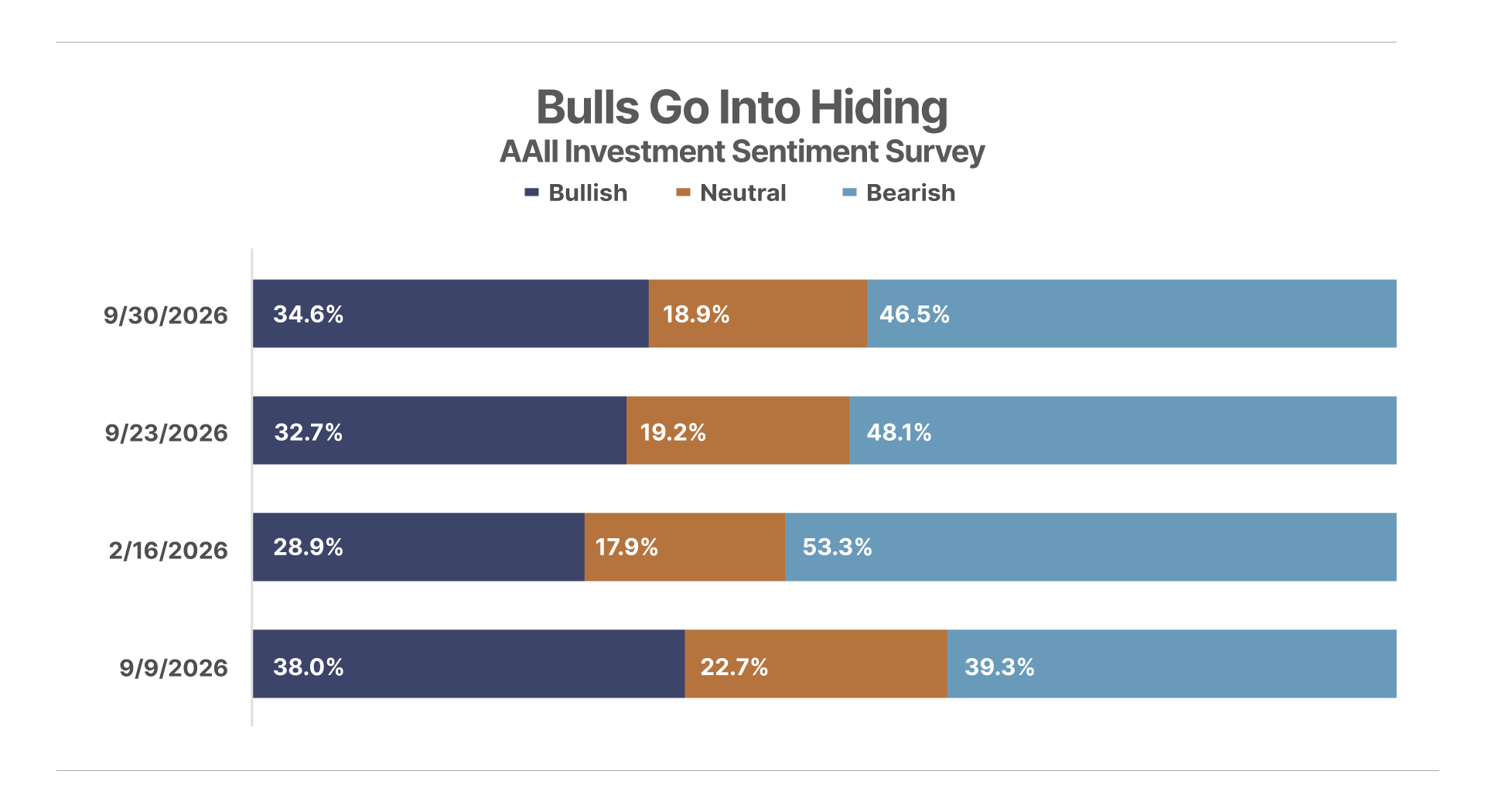
1. Individual investors are unusually gloomy as stocks trade near record highs. For the third straight week, more than 45% of respondents to the American Association of Individual Investors (“AAII”) weekly survey said they expect stocks to fall over the next six months, the first such streak since the peak of the Iran War this spring. The survey’s long-term “bear” average is 31.5%. CNN’s Fear & Greed Index, which combines seven market measures into a score from 0 to 100, ended last week at 28, just above the 25 cutoff for “extreme fear.” Yet the S&P 500 closed Friday less than 1% below its August 13 peak, and the tech-dominant Nasdaq 100 closed at an all-time high.
2. Housing demand at crisis levels. The National Association of Realtors pending home sales index hit 71.2 in August – below the lowest level reached during the 2008 mortgage crisis. Contract signings for new homes have dropped 45% since 2020, as mortgage rates have jumped from 3% to over 7% over the same period. America’s housing market remains frozen.
3. More than half of the Russell 3000 is already in a bear market. Since June 1, 54% of the index’s stocks have fallen 20% or more from their high, and 29% have dropped at least 30%. The index itself is down only 2.5% – but 96% of semiconductor names are down 20% or more. Software is down 77%, technology hardware at 68%. This is a rotation out of the AI complex, and the stocks on the wrong side of it are already in a bear market.
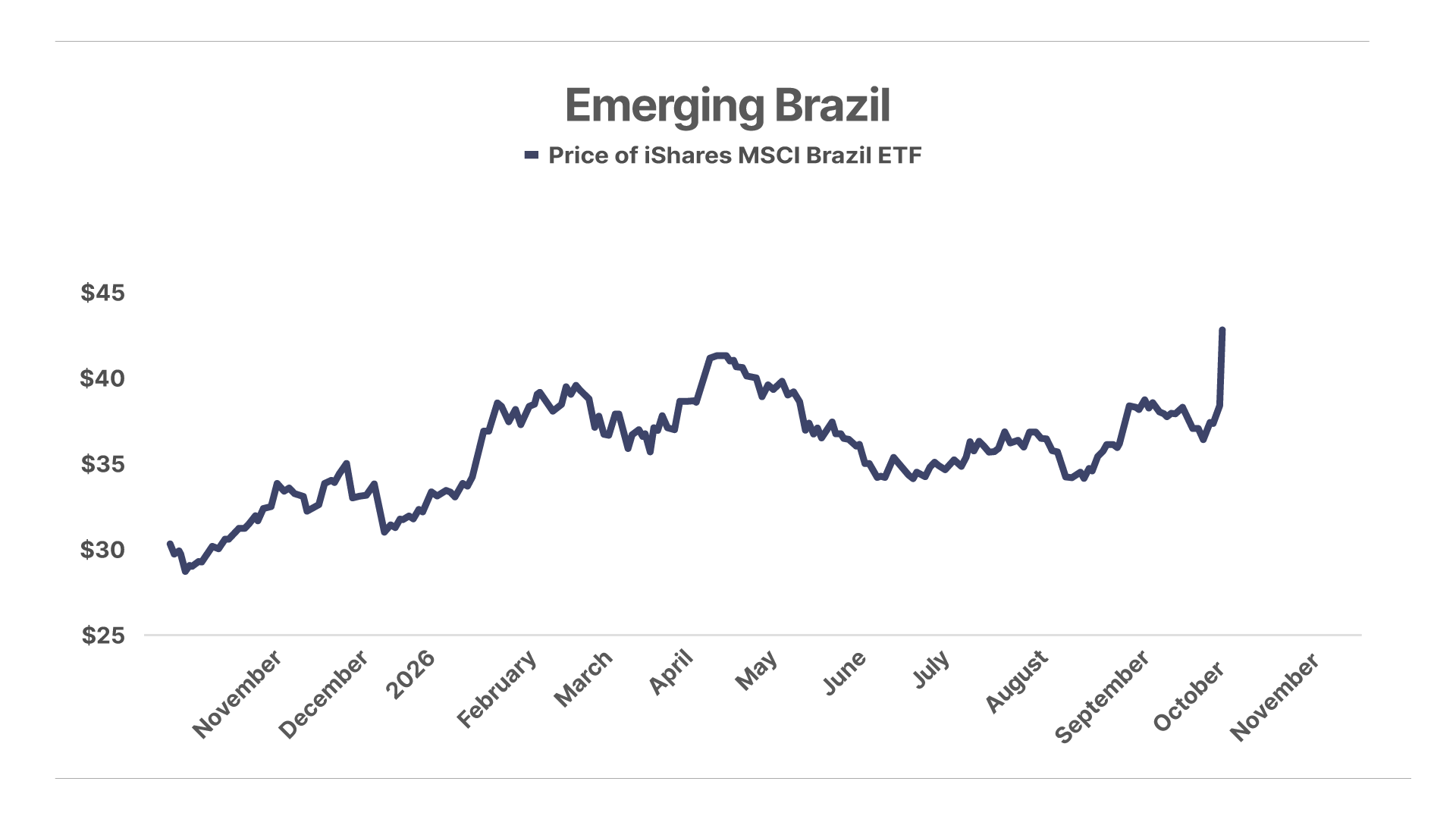
The iShares MSCI Brazil ETF (EWZ) – which holds Brazil’s largest companies – rallied 13% this morning, on pace for its best day since March 2020, after right-wing Senator Flávio Bolsonaro unexpectedly beat President Luiz Inácio Lula da Silva 47% to 45% in Sunday’s first-round presidential vote. Brazilian stocks were trading at a dirt-cheap 8x next year’s expected earnings ahead of the election, so one surprise was enough to move prices sharply. Some of the best values in global stocks sit in emerging markets that few U.S. investors follow.
“How To Buy A Bond”
Doug D. writes:
I purchased the Big Five Report. I like the recommendations.
Unlike a normal recommendation there is no buy-up-to price – the entire purpose of this report is to possibly entice people like myself to purchase other Porter & Co. products. One product that I have always been interested in is Porter & Co.’s Distressed Investing. I saw that convertible bond is the final recommendation in the Big Five Report. I have never bought a bond in my investing career.
There are no instructions on how to place the order. If you have instructions on how to place this order that you can forward that would be helpful. If not then we are both missing out. I am not going to place a trade that I don’t know how to do, and Porter & Co. will not be getting me as a subscriber to Distressed Investing.
Thanks for reading and understanding.