This Health-Focused Company Continues Its Impressive Turnaround

Three New Acquisitions Likely To Supercharge Profits And Share Price
Arsenic. Toads. Snail slime. Volcano ash.
Nothing, mais rien, could kill the Glug Bug.
Not even a whole class of schoolboys urinating on the same spot twice a day.
It was 1863, and a mysterious insect – a tiny aphid called phylloxera – had attacked the roots of France’s sacred grapevines, turning vineyards yellow and then brown in a deadly blight that reminded vintners of tuberculosis. The Great French Wine Blight spread across the country from the Atlantic to the Mediterranean coasts, leaving the center of the global wine industry dying on the vine.No one knew where phylloxera had come from. Parisian scientists theorized it had hitched a ride over from America and burrowed into the garden of an unsuspecting farmer in the Rhône valley. From there, it chewed its way across the best vineyards of France, proving, as a Punch cartoon sadly put it, that the bug was “a true gourmet.”
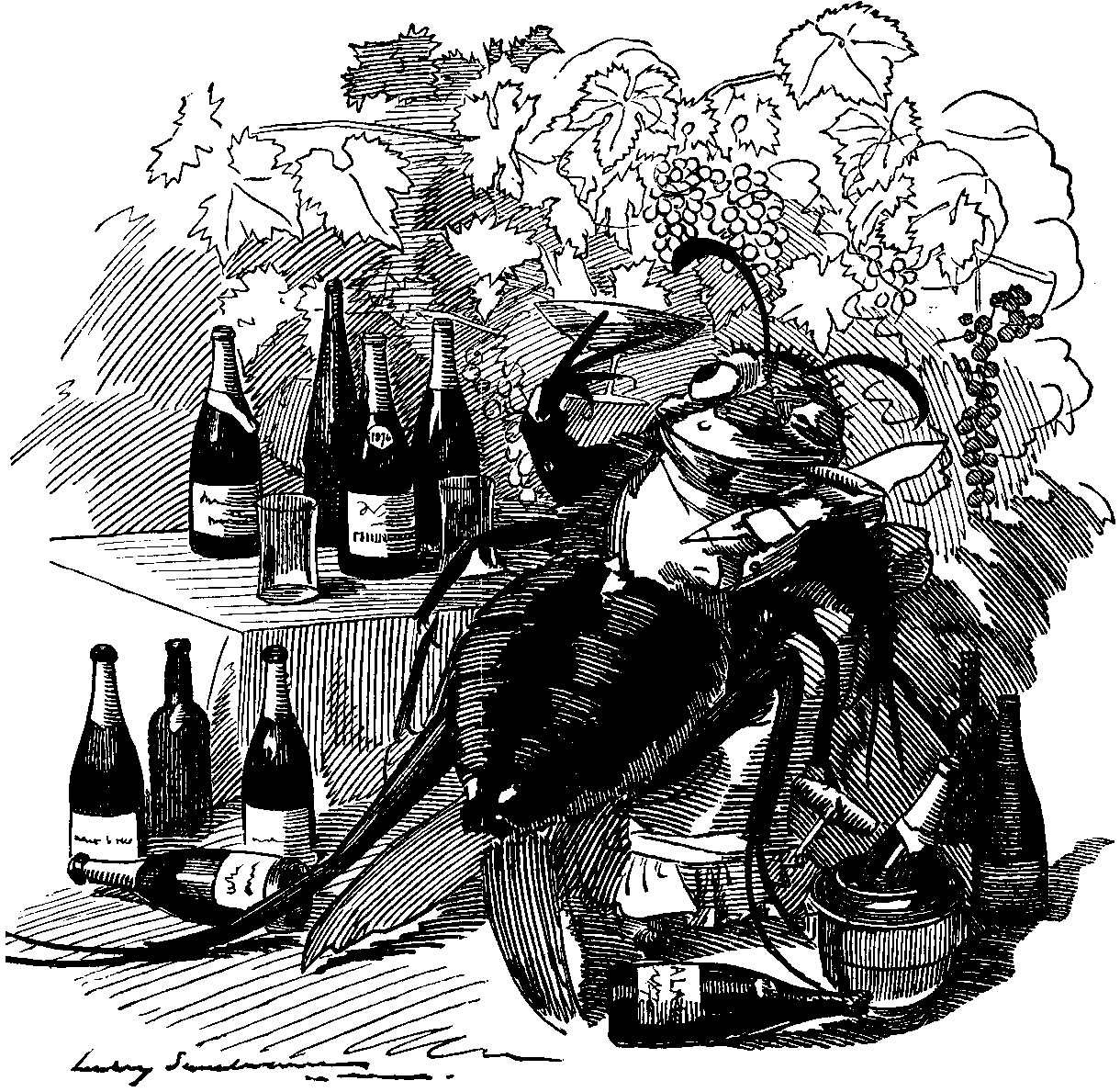
Like the dinosaurs in Jurassic Park, the aphid had evolved to reproduce via virgin birth – making the supply of the little beasties virtually limitless. And – despite poison, pests, and urine – it was impossible to kill...
By the 1870s, the Glug Bug, as U.S. headlines called the vin-loving vermin, had all but drained France dry, with over 40% (2.5 million acres) of French vineyards destroyed and another 1.5 million acres withering away. Out-of-work vineyard owners decamped en masse to California, Argentina, and Chile.
Smarting from a sharp 10-billion-franc kick in the economy, the French government put up a 300,000-franc reward ($1 million in today’s money) for anyone who could eradicate the pest.
Enter wine grower Leo Laliman, enticed by the francs, and offering a solution no one had tried yet: grafting.
Grafting – piecing one plant onto another so they grow from the same root – is a time-honored husbandry technique with records dating back to the ancient Greeks. (Sometimes they were a little iffy on how the procedure worked, with Plutarch and Virgil claiming that you could mix totally unrelated plants like pears and olives together to create “chimeras.”) The general principle is this: that you could “edit” a living organism to optimize its performance.
Laliman noted that American grapevines were, for some reason, immune to phylloxera. Unfortunately, the grapes from vines there were unsuitable to the fine French palate – sommeliers referred to the taste as “pissat de renard,” fox piss.
But the delicate French vines could be spliced into the hardy American root – thereby foiling the root-eating phylloxera, or so Monsieur Laliman hoped.
His hopes became reality. Using 17 boxcars full of donated American rootstock – for which the generous American grower later received the French Legion of Honor medal – French vintners began grafting, and discovered, to their joy, that the hybrid plants were immune to the buggy blight. (Mercifully, they didn’t taste like fox piss, either.) The “Great Reconstitution” of the wine industry had begun: by the 1890s, production recovered almost completely from pre-bug lows.
Phylloxera never truly went away – the Glug Bug still lurks in vineyards around the world, mutating and waiting. (For that reason, the 300,000-franc reward remains unclaimed – bonne chance.) But French vines, grafted into American roots, have far outpaced the reach of the deadly aphid: today, the global wine industry is a $330 billion business, with nearly a fifth of those grapes grown in France.
Without grafting, we likely wouldn’t have much fine French wine today.
We probably wouldn’t have biohacking, either…
Physician, Hack Thyself
Thanks to its success against the French wine blight, grafting moved from a small-farming technique into a globally recognized science, with its first comprehensive how-to manual, Charles Baltet’s The Art Of Grafting And Budding, released in 1879.
Today, while grafting continues in its original form worldwide, its immediate high-tech heir is CRISPR, a revolutionary gene-editing technique for plants, that’s projected to grow into about $13 billion market by 2030. Along the way, starting in the late 1980s, a loose network of San Francisco hippies and Silicon Valley computer nerds realized that you could apply the same “plug and play” principle to humans...
They called it “biohacking” or “DIY biology,” and the idea was this: Just as horticulturists spliced bits of plants into other plants – you could improve your body’s health and performance by making subtle tweaks to your own organism. These ranged from simple diet and lifestyle fixes, like Dave Asprey’s famous yak-butter-infused Bulletproof Coffee, to more drastic interventions like cyborg-style implants and DIY gene splicing.
Biohacking moved out of garage labs and hit the mainstream in the 2000s, as venture capitalists like Peter Thiel (who’s weirdly interested in extending his youth via “teenage blood transfusions”) took notice. Today, biohacking is a $25 billion global industry, with backers like Thiel and Elon Musk funding sci-fi-sounding projects that aim to edit out disease and edit in longevity – and, in the case of hardcore biohacking entrepreneur Serge Faguet, allow him to “live for millions of years and explore other planets.”
Setting aside the more unserious practitioners, though, it’s worth remembering that biohacking is rooted in a millennia-old practice of tweaking biology to achieve measurably better results... and (channeling Cole Porter) if bugs do it, plants do it, there’s no reason humans can’t do it.
In this month’s issue, we are recommending shares in a wellness company whose bonds have already made us 27%. As has happened four other times, company shares have followed in the bond’s footsteps – and its turnaround is in large part due to the company’s recent purchase of three promising biohacking-related startups. In a way, you could say this business has biohacked itself.
The Stock Follows The Bond Higher
This content is only available for paid members.
If you are interested in joining Porter & Co. either click the button below now or call our Customer Care team at 888-610-8895.