Issue#132, Volume#3

SpaceX Came Back To Earth Right On Schedule
Inside Today’s Issue
Editor’s note: Today’s Porter turns the Journal over to Porter & Co. analyst Jared Simons, who’s been watching the explosion of IPOs – the most recent being Elon Musk’s SpaceX.
They call him “Mr. IPO.” You may not know the name, but Wall Street does.
Jay Ritter has spent more than four decades at the University of Florida’s Warrington College of Business building the definitive database on initial public offerings (“IPO”) – more than 8,500 companies tracked, updated weekly, cited by serious journalists and regulators who touch the new-issue market. When investment banks go to size up a hot deal, they quote his work.
In the spring of 2020, I was a finance student at UofF studying his work. And for the cost of tuition, I got his playbook – his research, his data, his framework – that investors pay billions in hard-earning lessons to learn.
The hallmark example – and the one that towered over the rest – was the Facebook IPO in May 2012.
It was the most anticipated IPO of its era – the biggest tech offering in history at the time. Facebook (then FB) raised $16 billion at a $104 billion valuation, about 25x trailing sales. A multiple that looks quaint next to SpaceX’s $85.7 billion raised at $1.75 trillion – roughly 90x. Facebook was a generational company, a product used by a billion people, priced at $38 a share. Retail investors begged their brokers for shares. CNBC ran a countdown clock.
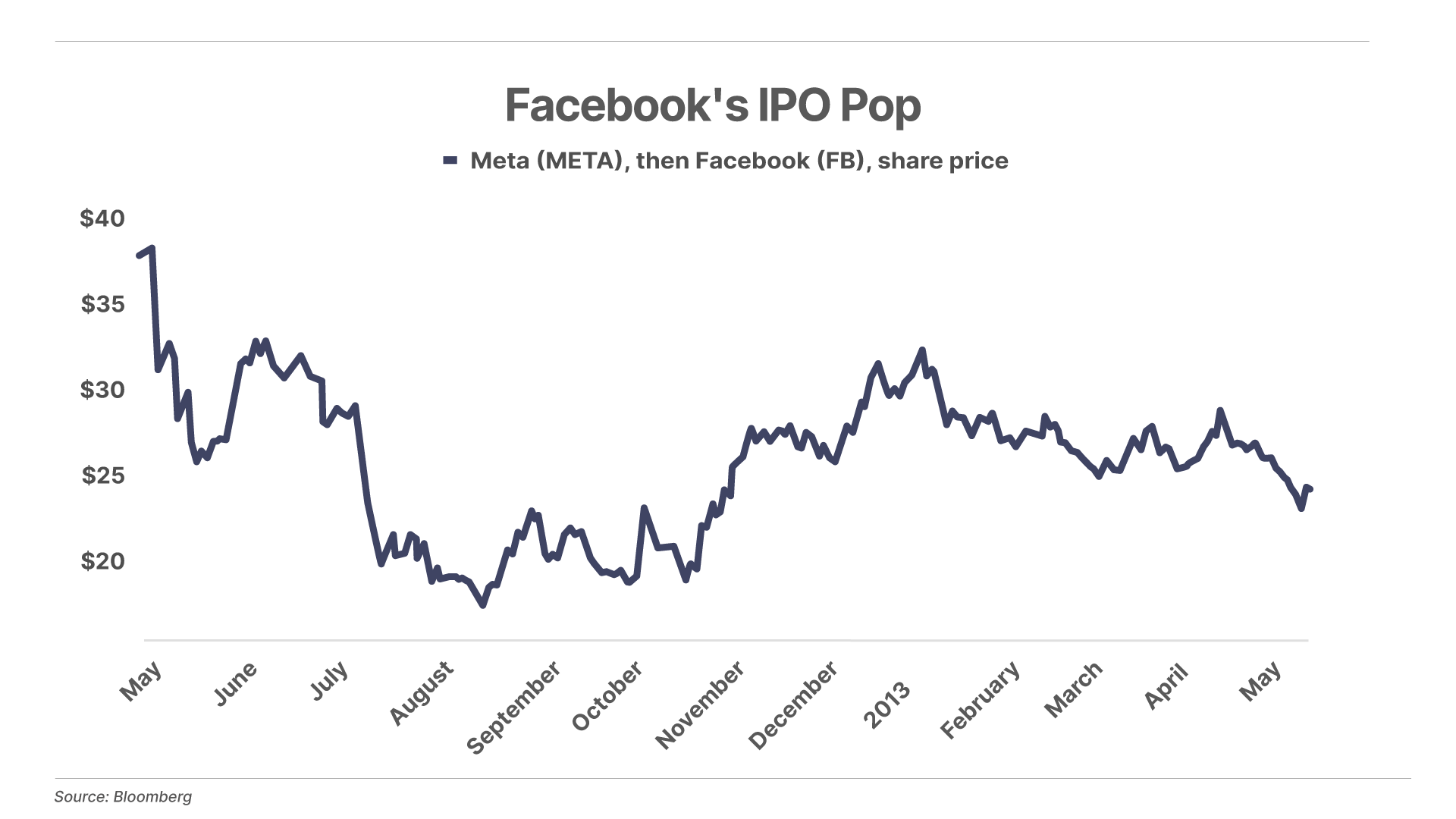
Four months later, the stock was $17.55 – down 54% from its day-one high.
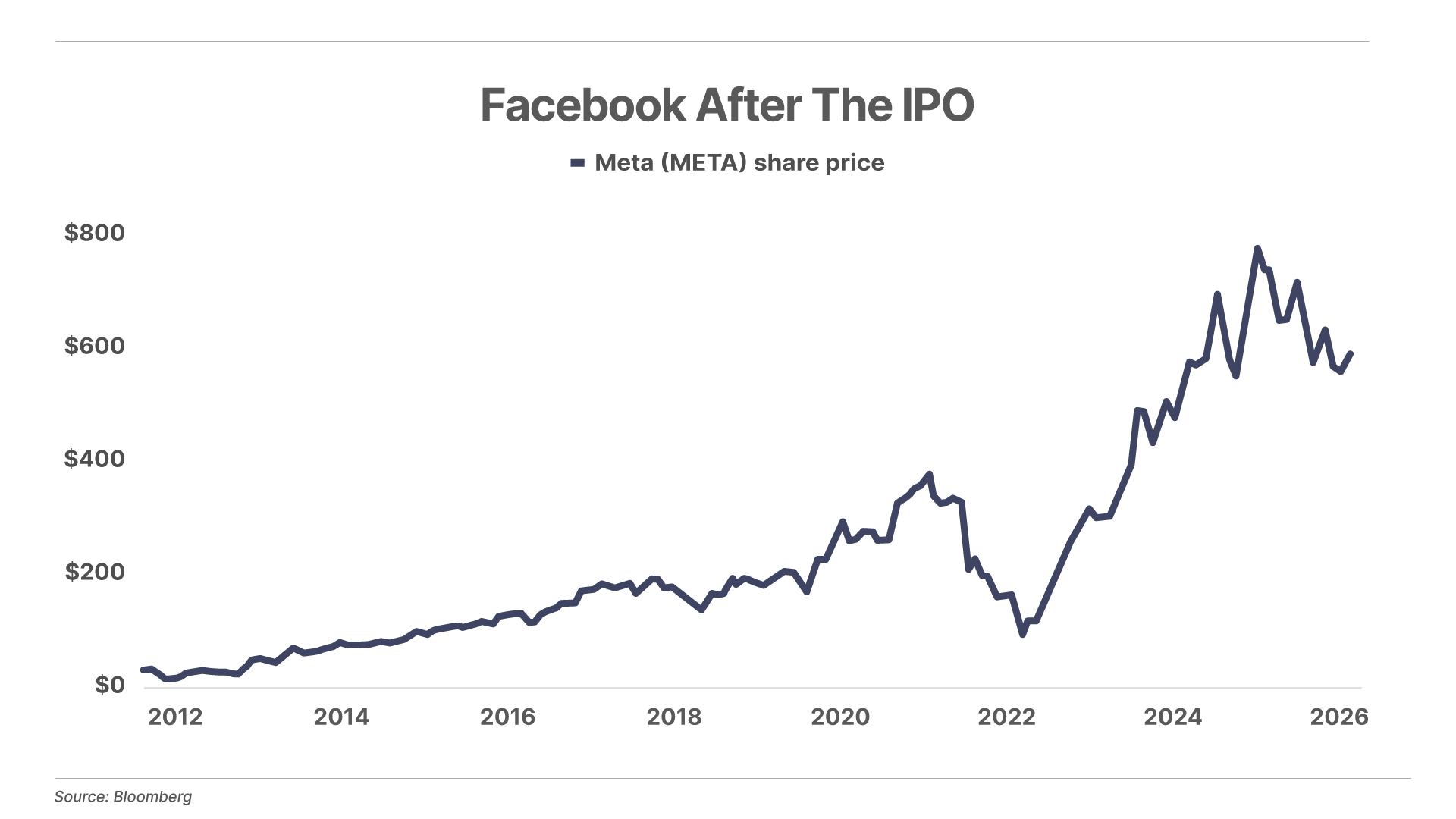
It took 15 months for anyone who bought that IPO to break even. And here’s the part of the lesson that should not be forgotten: Facebook was one of the greatest businesses ever created. The bulls were right about everything – the product, the moat, the future. And those who bought on the first day still got burned. Being right about the company did not protect them from the price they paid for it.
Look what it’s done since then…
Ritter’s research boils down to two laws:
- The IPO “pop” isn’t for you. New issues jump 15% to 20% on average from the offer price on day one. That’s real money – but it’s left on the table for the institutions who received allocations at the offer. By the time you can click “buy,” the discount has already been collected by somebody else.
- After the pop, IPOs systematically disappoint. Ritter’s landmark 1991 study found that investors who bought at the first-day close and held for three to five years trailed established companies by roughly three percentage points a year. Why? Because companies don’t go public when their shares are cheap. They go public when their industry is euphoric, and valuations are richest – what Ritter referred to as the “window of opportunity.” You are buying at the moment of maximum optimism, from sellers who know it.
About 18 months after I finished the course in the spring of 2020, the market staged the greatest live demonstration of Ritter’s framework I could have imagined: the 2021 IPO boom. Coinbase Global (COIN). Robinhood Markets (HOOD). Rivian Automotive (RIVN). Record issuance, record valuations, record hype – the widest “window of opportunity” in two decades. After their IPOs…
- Robinhood declined 90% in its first year
- Rivian fell 88%
- Coinbase fell 57%
- Lyft – an earlier vintage, but same story – dropped 79%
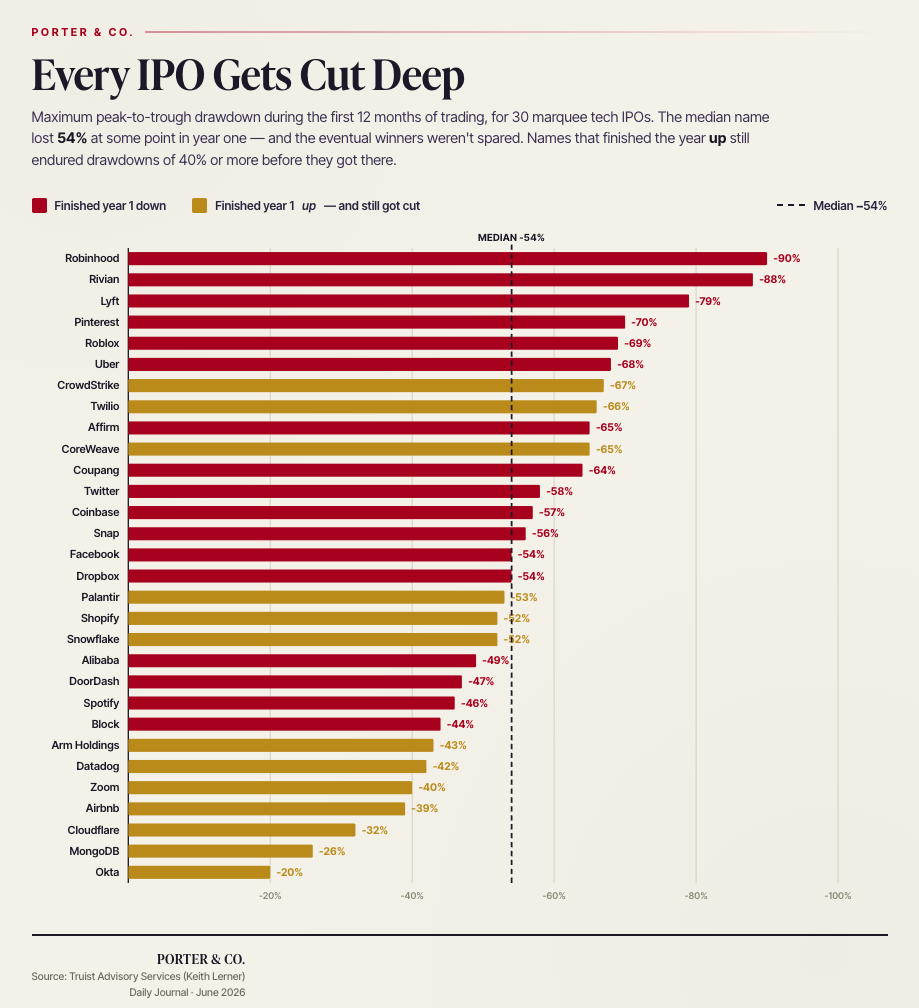
This isn’t an anomaly – it’s the norm. Truist Chief Investment Officer Keith Lerner recently ran the numbers on 30 of the most celebrated tech IPOs of the modern era, as seen above. The median stock fell 54% from its peak at some point during its first year of trading. The average fell 55%. The winners weren’t spared either – Palantir Technologies (PLTR) finished its first year up 153% after a 53% collapse. At the one-week mark, 57% of these names were sitting on gains. By month 12, only 43% were.
Circle Internet (CRCL) – the company behind the USDC stablecoin, and the most hyped listing of last summer – is another prime example. Circle priced its June 2025 IPO at $31. It closed its first day around $83, a pop that made the allocated funds a fortune overnight (law one).
Euphoria then carried the stock north of $230. Today, a year later, it trades around $60 – 75% below that high (law two).
And note the detail that should stop you cold: Circle still trades at roughly double its offer price. The business delivered. The insiders who got $31 stock are up huge. The only people destroyed were the ones who bought the excitement.
Which brings us to the latest rocket ship.
On June 5 – a week before Space Exploration Technologies (SPCX), aka SpaceX, went public – we wrote in the Daily Journal:
Like Musk’s rockets, SpaceX shares will likely start with a burst and return to Earth, ready to fly again.
Here’s what happened next. SpaceX priced the largest IPO in history at $135 a share, opened at $150 on June 12, and soared to $225.64 within four days. Then gravity took effect. By mid-July, the stock fell below its $135 offer price. Today, SpaceX trades around $115 per share – more than $1.1 trillion of market value has evaporated from the June peak, one of the largest market-cap wipeouts ever recorded.
After six weeks, both of Ritter’s laws played out right on schedule.
And the IPO season is just kicking off, with two leading artificial intelligence players in the starting lineup.
OpenAI is reportedly steering toward a listing later this year or early 2027
Anthropic filed confidentially in June at a valuation near $1 trillion, eyeing October
The hype for each will make SpaceX’s countdown clock look quaint – and the framework will not change, because the sellers’ incentives will not change.
None of this suggests SpaceX, OpenAI, or Anthropic are bad businesses. Facebook wasn’t a bad business. The jury is still out on Circle. But the price you’re offered in the opening frenzy is almost never the price you’ll be offered six to 12 months later – and SpaceX is no different.
Mr. IPO taught me that lesson six years ago. The market just paid $1.75 trillion for the same education.
Let the crowd buy the pop. We’ll wait to buy the disappointment – and at a price we are willing to pay. Even after the latest drawdown, SpaceX still trades at 80x sales.
Tell us what you think of today’s Daily Journal: porterstansberrydirect@gmail.com
Jared Simons
Miami Beach, Florida
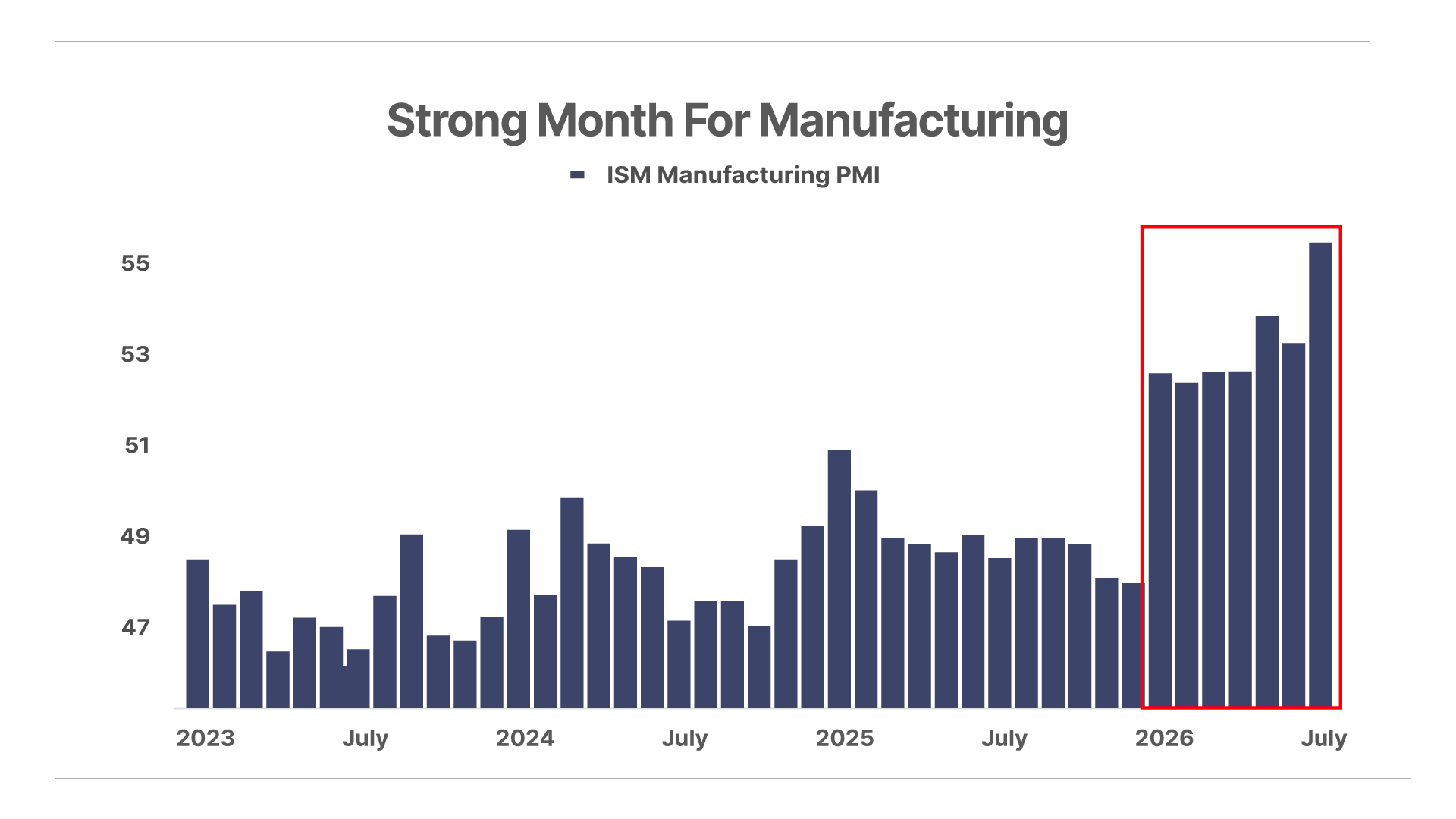
1. U.S. factory activity hit a four-year high in July. The ISM Manufacturing Purchasing Manager’s Index (“PMI”) jumped to 55.6, representing the strongest expansion since May 2022. The survey’s production gauge rose 6.3 points to 58.5 – the largest July increase since 1951 – while factory payrolls also grew for the first time since September 2023.
2. Historically low oil inventories. The disruption in oil supplies from the Iran War has taken 2.6 billion barrels of oil off the market, pushing inventories to historically low levels. In the U.S., the strategic petroleum reserve has dropped to 305 million barrels, the lowest level since 1983. Saudi Aramco CEO Amin Nasser estimates that restocking depleted inventories will take 18 months, assuming a refilling rate of 2.1 million barrels per day once global supply chains are normalized.
3. While Washington defends its bonds, central banks buy gold. Central banks bought 289 tonnes of gold in Q2 – a record for any Q2, and up 62% from a year ago. Further encouraging gold buying: As we reported yesterday, to support the yen, the U.S. loaned Japan up to $60 billion a day against its $1.14 trillion in Treasury bonds rather than having Japan sell them. When the system’s largest foreign creditor can’t sell without rocking global markets, you understand why 74% of reserve managers plan to cut dollar holdings over the next five years.
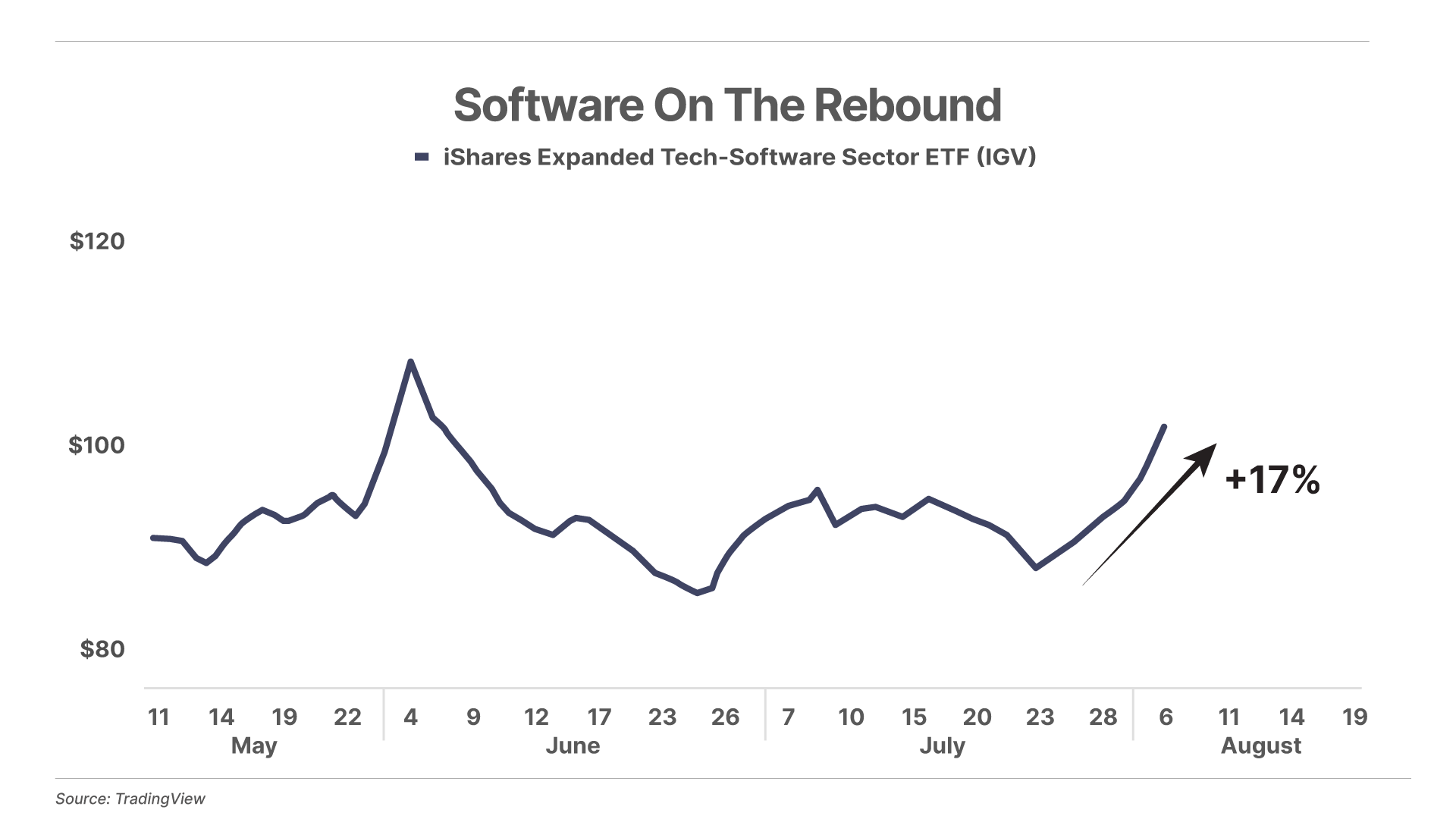
After starting the year as the worst-performing sector in the market, software stocks have regained their footing, fueled by strong recoveries in companies like Salesforce (CRM), Adobe (ADBE), Palantir Technologies (PLTR), and Microsoft (MSFT). The iShares Expanded Tech-Software Sector ETF (IGV) is up 17% in the last two weeks.
Yesterday, Distressed Investing analyst Martin Fridson shared a Journal essay about U.S. government debt – focusing on a comment made by President Donald Trump that the country is “under-levered” because we have so many natural resources to borrow against.
“Thank You, Martin”
Kathy D. writes:
Excellent, concise, and easy-to-understand explanation of our debt situation. Thank you, Martin. It’s no wonder the younger generations feel hopeless.
“Seems Very Lucid”
Ken L. writes:
Marty – that’s an excellent essay.
I’ve read Ray Dalio about the business and debt cycles. Seems very lucid.
I’m hoping that some smart guy with good experience will step up to the plate and mitigate things. Maybe Jamie Dimon or Dalio.
“Gold Standard”
Ted T. writes:
It’s easy to read between the lines that Mr. Fridson is no fan of DJT. President Trump operates under the burdens of the Swamp that were handed to him. Yes, he sometimes says things that are tongue in cheek to blow the minds of his enemies. If Mr. Fridson wants to point fingers, how about pointing to the person who took us off the gold standard?
“Yosemite”
Carl L. writes:
I’m putting in a bid on Yosemite.
Porter & Co. Market Snapshot
| Price | Yesterday’s Return | Year-to-Date Return | |
| S&P 500 Index | $7,600.50 | 1.48% | 11.8% |
| Gold per ounce | $4,054.33 | -0.51% | -5.9% |
| Bitcoin | $63,742 | 0.50% | -27.1% |
| Oil (West Texas Intermediate) per barrel | $80.34 | -5.41% | 32.34% |
| Berkshire Hathaway (BRK) | $768,250.00 | 0.22% | 1.8% |
| Porter’s Permanent Portfolio | – | 0.40% | 1.1% |
| The Better Than Berkshire Index | – | 0.46% | 8.8% |
| Total Return | Annual Return | ||
| Porter & Co’s Top Ranked* | 35.3% | 16.7% | |
| Yield | Yesterday’s Change | Change Year-to-Date |
|
| U.S Treasury 30-Year Yield | 5.23% | -4 bps | 38 bps |
| Prices as of 4:00 pm ET August 3, 2026 | bps = basis points (or 0.01%) | |||
| *A Complete Investor risk rating of 1 is defined as a “low risk, high allocation” security, while positions rated closer to a 5 are higher risk. Porter & Co.’s top-ranked positions include those rated either 1 or 2 in Complete Investor portfolio. | |||
Porter & Co. Top Positions
| Publication | Ticker | Description | Total Return |
| Biotechnology | QURE | uniQure | 237% |
| Complete Investor | BWXT | BWX Technologies | 205% |
| Biotechnology | ROIV | Roivant Sciences | 147% |
| Complete Investor | SKWD | Skyward Specialty Insurance | 147% |
| Biotechnology | NUVB | Nuvation Bio | 143% |
| Complete Investor | BTC/USD | Bitcoin | 135% |
| Complete Investor | PM | Philip Morris | 133% |
| Biotechnology | SGMT | Sagimet Biosciences | 132% |
| Biotechnology | TGTX | TG Therapeutics | 131% |
| Biotechnology | QURE | uniQure | 131% |
| Prices as of 4:00 pm ET August 3, 2026 | |||
Please note: The investments in our “Porter & Co. Top Positions” should not be considered current recommendations. These positions are the best performers across our publications – and the securities listed may (or may not) be above the current buy-up-to price. To learn more, visit the current recommendations page of the relevant service, here| New Window. To gain access or to learn more about our current recommendations, call our Customer Care team at 888-610-8895 or internationally at +1 443-815-4447.