The Most Important Event For Markets Since The Global Financial Crisis
On June 18, 1815, as the Battle of Waterloo reached its violent conclusion, a young banker stood waiting – not on the battlefield, but in London.
The banker had built something no government possessed: a private intelligence network that could move information faster than armies could move it. While the British public waited days for official word of Napoleon’s fate, the enterprising young man knew the outcome within hours. He knew that Wellington had prevailed. And more importantly, he knew what it meant: the end of a generation of war, the rise of British financial dominance, and the beginning of a new global order anchored in London.
The young man’s name was Nathan Rothschild.
The story – often told, sometimes embellished – goes that Rothschild walked into the London bond market and began quietly selling British consols, creating the illusion that Britain had lost at Waterloo. Panic followed. Prices collapsed. And then, once fear had reached its peak, Rothschild reversed course, buying aggressively at distressed levels before news of victory became public.
Whether every detail of this legend is true is beside the point. What matters is the principle: great fortunes are made not merely by predicting events, but by understanding how those events reshape the system that comes next.
The Duke Of Wellington’s victory over Napoleon at Waterloo did not just end a war. It marked the beginning of a century of British financial supremacy.
We are living through a moment like that now.
The Iran War is not simply a geopolitical conflict that will soon pass and recede into memory as another news item. It’s a systemic shock – as consequential as the COVID-19 pandemic and the 2008-09 Global Financial Crisis were, albeit with different consequences. The war has already fundamentally changed the global flow of energy, fragmented the world’s supply chains, publicly challenged the petrodollar order… and it stands poised to reshape the architecture of global power. Like Waterloo, its ultimate significance will not be measured by the battles fought, but by the new world it ushers in.
For investors willing to see and study that world early, the opportunity will be extraordinary. For those who insist it’s business as usual, the crisis will create massive portfolio risk. Of course, I want you to be on the right side of this divide.
From my earliest acquaintance and friendship with Porter, I’ve always been struck by the commitment that has guided his work – to give readers the advice he’d want if shoes were reversed. That seems like a good variation of the Golden Rule.
So this month’s issue of Tech Frontiers will be a little different than usual. Instead of focusing on a single new investment idea, I want to share with you why I believe the Iran War is so important… walk you through how it’s affected my own and my family’s asset allocation… and share the investments I’m making in my own personal account, as well as the key themes and names I’m watching carefully as a result of this seismic shift.
Along the way, we will be recommending two additions to the Tech Frontiers list of recommendations as hedges, and we’ll also be introducing a New World Order watchlist.
A Supply Shock That Goes Far Beyond Oil
As everyone who has glimpsed at the news knows, the Iran War has caused the closure of the Strait of Hormuz, the strategic entrance to the Persian Gulf through which about 20% of the world’s oil transits. But as we’ll see, the Strait is a bottleneck for a lot besides oil. To understand the magnitude of the economic disruption barreling our way like a once-in-a-century tsunami, we need to familiarize ourselves with what the Strait’s closure has choked off – and what role these commodities play in making modern civilization function. We’ll cover five essentials:
-
Oil
-
Natural Gas
-
Fertilizers
-
Helium
-
The Petrodollar
Let’s begin…
-
Oil
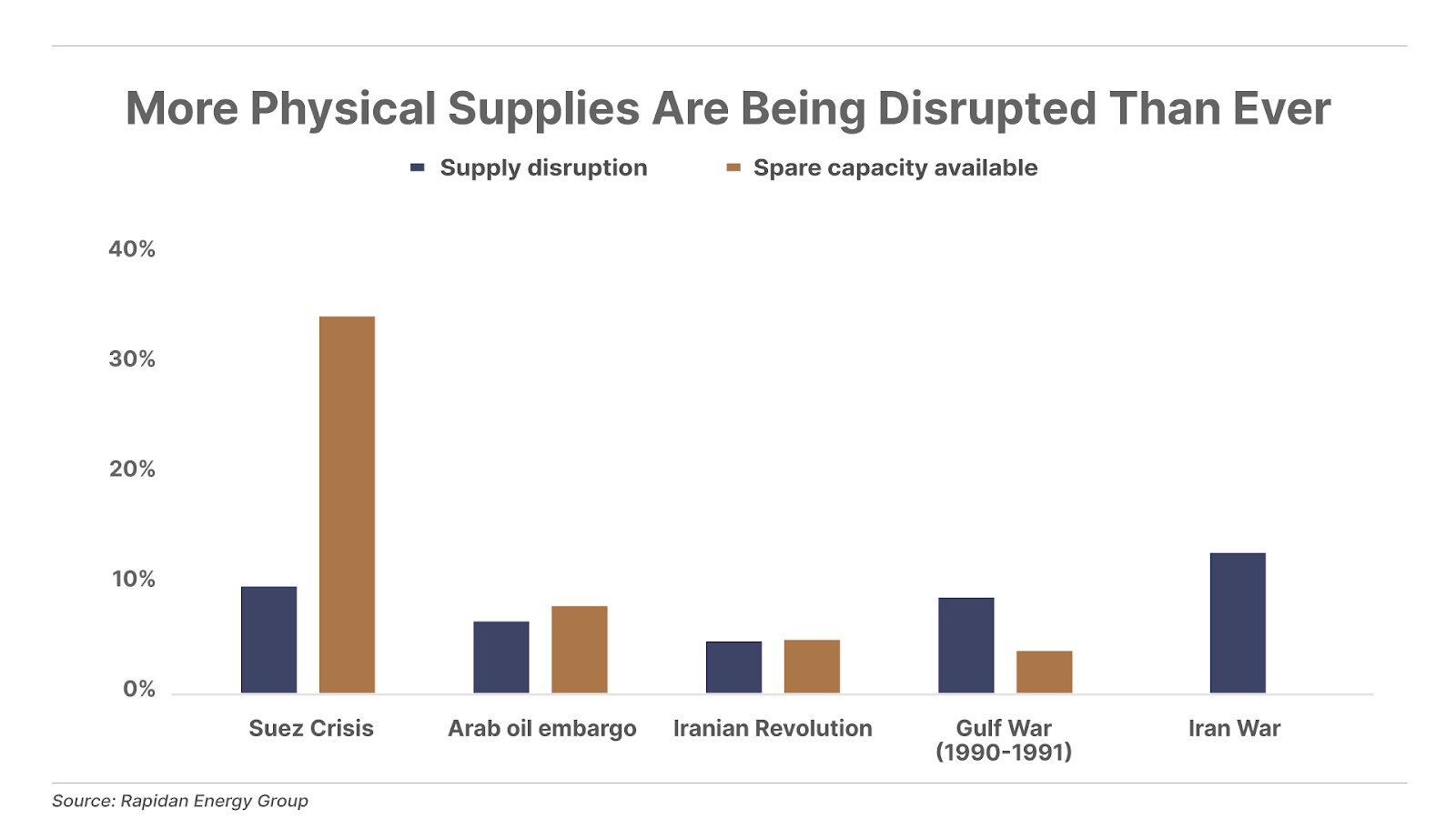
Let’s start with the most obvious one, oil. Even without knowing when it will end, the current closure of the Strait of Hormuz is in important ways the largest disruption to global oil supply in history. A brief history of prior oil shocks is clarifying:
-
In 1956, when the Suez Crisis choked off European oil flows, roughly 2 million barrels per day were disrupted – material, but ultimately reroutable
-
In 1973, the Arab Oil Embargo removed closer to 4 million to 5 million barrels per day, roughly 7% to 9% of global oil supply at the time, catalyzing a quadrupling of oil prices from a low base and the birth of modern energy geopolitics
-
In 1979, the Iranian Revolution triggered a similar-scale supply shock, though one driven by internal collapse rather than coordinated restriction
By contrast, the current Hormuz closure has put nearly 20 million barrels per day at risk, nearly one-fifth of today’s global consumption. It’s true that the realized impact is not the full 20 million barrels. Iran is permitting shadow-fleet tankers aligned with China and other allies to transit Hormuz. And Saudi Arabia is using its East-West pipeline to reroute crude to ports on the Red Sea. However, these workarounds are still leaving an estimated 17 million barrels per day trapped in the Persian Gulf with no egress to global markets.
Furthermore, measuring the disruption purely in terms of barrels per day removed from supply misses an important nuance: Crude oil isn’t a uniform commodity – and Iran’s Light crude falls into the sweet spot for many global refiners. Substituting Iranian Light crude with, say, U.S. shale or Venezuelan heavy forces many refineries around the world to run less efficiently, if they can accommodate these substitute grades at all. The practical impact is that crucial refined products such as diesel and jet fuel suffer from a double whammy: an oil supply shock that dominos into refining inefficiencies due to the specific type of oil that’s in short supply. Prices tell the story: Even here in the U.S., where shale oil is plentiful, diesel prices are up 45% since the start of the Iran War while jet fuel prices have nearly doubled.
Diesel fuel powers much of the U.S. (and global) economy – all these parts of the economy rely heavily on diesel:
-
tractors and combines that operate farms
-
heavy equipment that drives construction
-
the trucking, freight, and railroads that transport physical goods
-
mining and oilfield services
-
shipping and inland waterways transport
-
last-mile delivery and logistics
-
backup power generation across sectors such as health care
The nearly 50% price inflation in diesel fuel will bring some of these machines to a standstill as their operation becomes uneconomic, while causing a quantum jump in end-prices to consumers for others.
-
Gas
If oil is the most visible shock from the Hormuz closure, natural gas is the system failure hiding in plain sight.
The Strait of Hormuz is not only an oil corridor, it’s also the primary export route for the single most important gas basin on Earth. Beneath the Persian Gulf lies the South Pars-North Dome field, a reservoir shared by both the nations of Qatar and Iran that contains nearly one-fifth of the world’s discovered natural gas. Over the past three decades, with a cumulative capital expenditure of $200 billion to 300 billion, Qatar has transformed its side of this field into the backbone of global liquefied natural gas (“LNG”) supply. Qatar’s Ras Laffan Industrial City, fed by gas from the South Pars field, serves as the largest gas liquefaction complex in the world. Roughly one-fifth of globally traded LNG originates here, and every cargo from it must pass through Hormuz.
Because the globe’s major sources of natural gas are more geographically concentrated than its sources of oil, and because gas is far more complex to transport, gas is far less fungible than oil. Put differently, natural gas is locked into the infrastructure that renders it usable. LNG must be liquified at cryogenic temperatures, transported in specialized vessels, and re-gasified at destination terminals. Unlike Saudi Arabia with its East-West oil pipeline, which enables the Kingdom to re-route some of its oil away from Hormuz to the Red Sea, Qatar has no meaningful rerouting options for its LNG. When Hormuz shuts, Qatari gas does not detour – it stops.
But the disruption has already gone beyond transport to strike the underlying production capacity. On March 18 and March 19, Iranian missiles hit two of Qatar’s 14 LNG trains (a liquefication unit at a natural gas plant) at Ras Laffan – Trains 4 and 6 – setting them ablaze and causing severe damage. The incapacitation of these two trains removes approximately 12.8 million tonnes per annum of LNG from global supply, or 17% of Qatar’s total output. QatarEnergy’s CEO has indicated that these trains will likely be offline for three to five years.
Here’s why his estimate may prove to be too optimistic: LNG trains are built around highly specialized cryogenic equipment, most critically, brazed aluminum heat exchangers (“BAHX”). These units cannot be repaired in the field after kinetic damage but instead must be replaced entirely. There are exactly five companies in the world – Linde in Germany, Chart Industries in the U.S., Alfa Laval in Sweden, and Kobe Steel and Sumitomo Precision Products in Japan – that fabricate these massive, specialized components.
All five manufacturers are currently back-ordered approximately 24 to 48 months as they strive to meet pre-existing demand for the largest LNG buildout in history. The end-to-end lead time once a new BAHX order reaches the front of the queue is 18 to 36 months. The upshot: QatarEnergy is likely looking at a four-year to five-year delivery wait for its BAHX replacements, and that’s assuming no further delays to global supply. And if the replacements are delivered in four to five years, it will take still longer for the two trains at Ras Laffan to resume full operational production.
Let’s briefly assess the economic consequences of all this.
The first and most important point is that this gas shock is not evenly distributed. It lands hardest where dependence is greatest – Europe. The continent has, over the past three decades, systematically dismantled the very energy foundation it once built in response to the 1970s oil shocks. Europe shuttered its nuclear capacity, curtailed its natural gas production, and allowed its dependence on energy imports to rise to extraordinary levels. Today, Europe imports a shocking 80% of its hydrocarbon consumption, up from 30% in the 1990s. The continent is about to pay the price for this folly.
Europe’s energy system functioned – barely – so long as global trade remained frictionless and suppliers reliable. But Europe’s dependence on imported gas has left it exposed without a margin of safety for its critical industries. German chemical producers, steel mills, ceramics manufacturers, and glassmakers built their competitiveness on cheap, reliable gas flows (in Germany’s case, principally from Russia, well before Russia’s war with Ukraine). Remove that foundation, and the consequence is not merely higher prices – it’s the destruction of Europe’s industrial base.
We are already witnessing this dynamic in slow motion. Energy-intensive industries that cannot pass through input costs at competitive prices simply shut down or relocate. What European politicians have window-dressed for decades as a movement toward green energy “efficiency” is revealing itself, under stress, as something else entirely: de-industrialization, or the disappearance of Europe’s advanced industrial capabilities. The Hormuz gas shock accelerates this process. For Europe, the consequences will likely be stagnation or recession, rising inflation, and a prolonged structural squeeze between declining industrial output and rising import dependence.
While Europe is ground zero for structural gas vulnerability, Asia is the epicenter of acute stress.
Asia accounts for roughly 90% of Middle Eastern LNG demand, and the loss of Qatar’s supply represents a direct hit to the region’s energy system. The response so far is telling: countries in Asia are not substituting seamlessly. They are scrambling. Coal plants are being restarted. Consumption is being curtailed. Industrial output is being rationed.
The burden again falls unevenly. Wealthier economies such as Japan and South Korea can bid for marginal LNG cargoes on the spot market at significantly higher prices. They can also partially offset lost LNG by switching to coal-fired generation – but here, too, the switch isn’t seamless and comes with disruption as well as higher costs. Asia’s poorer economies, such as the Philippines and Vietnam, face a harsher choice: pay unaffordable prices for gas or shut down demand. Many Southeast Asian economies are already making that choice through curtailment, shutting or slowing factories and rationing power consumption. In these economies, the Hormuz crisis is going to crush economic growth.
Because natural gas sits at the center of so many industrial processes, the second-order effects of the Hormuz gas shock propagate through global supply chains with surprising speed. Industries that rely on continuous, high-temperature processes – such as steel, chemicals, and glass – cannot easily throttle production. When gas supply tightens, they shut down. That shutdown removes inputs for downstream industries across borders. A ceramics plant in India closes. A construction project in Southeast Asia slows. A crucial chemical intermediate disappears from a European supply chain.
In a global economy built on just-in-time logistics, these disruptions compound. What begins as an energy shortage becomes a manufacturing slowdown, which becomes a trade contraction, which ultimately chokes global growth. The result is not a localized crisis, but a synchronized drag on economic activity around the world. We will surely feel it here in the United States even as we are better positioned than Europe or Asia.
-
Fertilizers
For some parts of the world, the closure of the Strait of Hormuz will jeopardize not only economic growth but also human survival. The transmission mechanism for this existential risk is fertilizers.
The modern agriculture that feeds the world’s 8.3 billion people rests on three primary nutrient inputs: nitrogen, phosphorus, and potassium – commonly referred to as “NPK.” Each plays a distinct biological role. Nitrogen (“N”) drives plant growth and yield, phosphorus (“P”) supports root development and energy transfer, and potassium (“K”) regulates water balance and disease resistance. Remove any one of the three, and crop yields decline. Remove nitrogen, and they collapse.
Of these three, nitrogen is by far the most important – and the most vulnerable.
Nitrogen fertilizer is produced through the Haber–Bosch process, which synthesizes ammonia from atmospheric nitrogen using hydrogen derived almost entirely from natural gas. This makes natural gas not merely an input into fertilizer production, but its primary feedstock and energy source simultaneously. In practical terms, when natural gas supply suffers a chokepoint at scale, nitrogen fertilizer production shuts down almost immediately. There is no substitute input, no scalable alternative pathway.
To paraphrase leading energy economist Vaclav Smil, the world does not just burn natural gas – it eats it.
This is why the Hormuz shock is so consequential.
The Persian Gulf is not only a major energy hub – it’s also one of the world’s dominant centers for the production of nitrogen fertilizers, and especially the workhorse molecules ammonia and urea. Qatar, Saudi Arabia, Oman, the UAE, and pre-war Iran collectively accounted for over 30% of global ammonia exports and over 45% of seaborne urea exports before the war. In other words, the Hormuz closure has not created a modest bottleneck in global nitrogen supply. Instead, it has severed access to somewhere between one-third and one-half of globally traded nitrogen fertilizers. That is an unprecedented curtailment.
Not surprisingly, prices have already responded violently. In the U.S., the New Orleans barge price for urea jumped from $465 per ton on February 27 to over $645 at the end of March, a 40% increase in one month. Retail anhydrous ammonia prices have surged 30% over the same period. And these are the price spikes here in the U.S., where we are insulated from the full effects of the Hormuz closure due to North American supply. In Southeast Asia, urea prices have exploded over 55% above pre-war levels.
We’ve covered nitrogen – the “N” in the NPK equation. Now let’s turn to phosphorus.
Phosphate fertilizers are not made from natural gas in the same direct way as nitrogen fertilizers. But they do depend on sulfuric acid, the key chemical input that helps convert mined phosphate rock into plant-available fertilizer. And sulfuric acid, in turn, is made from elemental sulfur – much of which is recovered as a byproduct of sour oil and gas refining in the Persian Gulf. This means that the Hormuz closure is not only a nitrogen shock, but also a sulfur shock and in turn a phosphorus shock. Nearly half of the global sulfur trade is tied directly or indirectly to the affected region. Countries far outside the Persian Gulf region depend on Gulf-sourced sulfur to drive their phosphorus production – for instance, Morocco’s OCP, the world’s largest phosphate exporter, which imports 3.7 million tonnes of Gulf sulfur annually.
This is how a localized disruption becomes a global food problem.
The consequences of the Hormuz closure for agriculture are not linear – they’re both nonlinear and time-sensitive. Farmers do not apply fertilizer continuously. They apply it at specific moments in the planting cycle. Miss that window, and the yield loss gets locked in. A shipment of urea that arrives in July does not help a field that needed nitrogen in April. Unlike oil or even industrial inputs, fertilizer cannot be stockpiled easily at the farm level or substituted after the fact. The biology does not allow it.
The Hormuz fertilizer supply disruption is well on its way to creating a bona-fide food crisis in many parts of the world, which will affect billions of people. The U.S. is blessed to have one of the most robust, resilient agricultural economies on Earth. We should nonetheless anticipate that the jump in global fertilizer prices will drive our grocery bills meaningfully higher – and put even further economic strain on U.S. farmers already under acute duress from the Trump administration’s tariff policies.
-
Helium
The hyperscalers' – Alphabet, Microsoft, Amazon, Meta, Oracle – artificial-intelligence (“AI”) buildout that has driven America’s economic growth, and the stock market’s, over the past years may seem far removed from Hormuz. It’s not – and the crucial connection is helium.
Unlike oil, helium is not produced because the world goes looking for it directly. Instead, it’s extracted as a byproduct from a narrow subset of natural gas fields whose chemistry happens to contain enough helium to make recovery economical. That makes helium vulnerable to chokepoints in gas infrastructure. And here again, the Persian Gulf sits far closer to the center of the story than most investors or policymakers have appreciated.
Qatar produced roughly 63 million cubic meters of helium in 2025, or about a third of global supply, with the gas purified and liquefied at Ras Laffan from the very same stream that feeds the LNG trains. When those trains stop, helium production stops too. There is no separate helium industry standing beside LNG to keep operating independently. It’s the same molecule stream, processed through the same industrial node.
This is why the helium shock has moved so abruptly from an obscure industrial concern to a global strategic problem. The missile damage at Ras Laffan directly impaired associated helium output, while the Hormuz closure has trapped roughly 200 specialized cryogenic ISO containers in or near the Gulf – about one-third of the world’s transport fleet for liquid helium. What’s worse, liquid helium begins to boil off after roughly 35 to 48 days. Once that clock runs down, the gas is vented and lost. So the helium stranded in those 200 containers isn’t conventional inventory, but inventory with a short half-life, permanently lost if Hormuz remains closed for even a few more weeks.
Helium matters because it’s one of the few molecules in modern industry for which there is effectively no substitute. Its thermal conductivity is roughly six times that of nitrogen, making it indispensable for cooling silicon wafers during high-precision plasma etching and other heat-sensitive fabrication steps. Its atomic size makes it uniquely suited for leak detection in the vacuum systems that dominate advanced chip fabs. And its inertness makes it the only viable carrier gas for several deposition processes at leading-edge nodes. Put bluntly: the semiconductor industry can route around a lot of things. It cannot route around its need for helium.
This matters most acutely for memory chips, which are at the heart of the AI buildout.
Samsung and SK Hynix dominate global DRAM and, more importantly, the high-bandwidth memory (“HBM”) chips that sit beside Nvidia’s accelerators and power nearly every frontier AI training cluster. HBM is not just another memory product, but a core part of the hardware architecture that makes modern AI possible. It’s also extraordinarily wafer-intensive, requiring multiple times the fabrication throughput of conventional memory.
DRAM manufacturing was already unable to meet demand from AI hyperscalers before the Hormuz closure, which is why DRAM prices have increased nearly 200% over the past 12 months leading up to the Iran War. Add a helium chokepoint, and the result is not simply higher prices, but instead lower output at precisely the point in the semiconductor stack where the AI buildout finds itself most constrained.
The supply chain effects domino quickly.
Every advanced AI system depends on a tightly coordinated chain: logic chips from Taiwan Semiconductor Manufacturing or Samsung, memory from SK Hynix or Micron, advanced packaging, and final deployment into hyperscale data centers. Helium sits upstream of all of it. When helium supply tightens, yields fall, defect rates rise, and throughput slows. The helium shortage does not only raise input cost, it also reduces the output of the world’s most important digital factories.
And this is where the supply shock reaches the broader economy.
The hyperscalers have committed hundreds of billions of dollars to AI infrastructure. These investments assume that hardware arrives on schedule. If helium scarcity slows wafer throughput or constrains memory production, the bottleneck flows directly into deployment timelines. Capex does not disappear. It becomes less productive. Spending rises while output lags, and expected returns are pushed further into the future.
There is an irony here: The same Persian Gulf gas system whose disruption is inflating energy costs and threatening food supply is also constraining the molecular input required to build the hardware of the AI age. The $4 trillion AI buildout rests, in part, on a byproduct of a single gas basin in Qatar. A molecule few people have thought about prior to the Iran War becomes the hidden constraint on one of the largest capital spending booms in history.
-
The Petrodollar
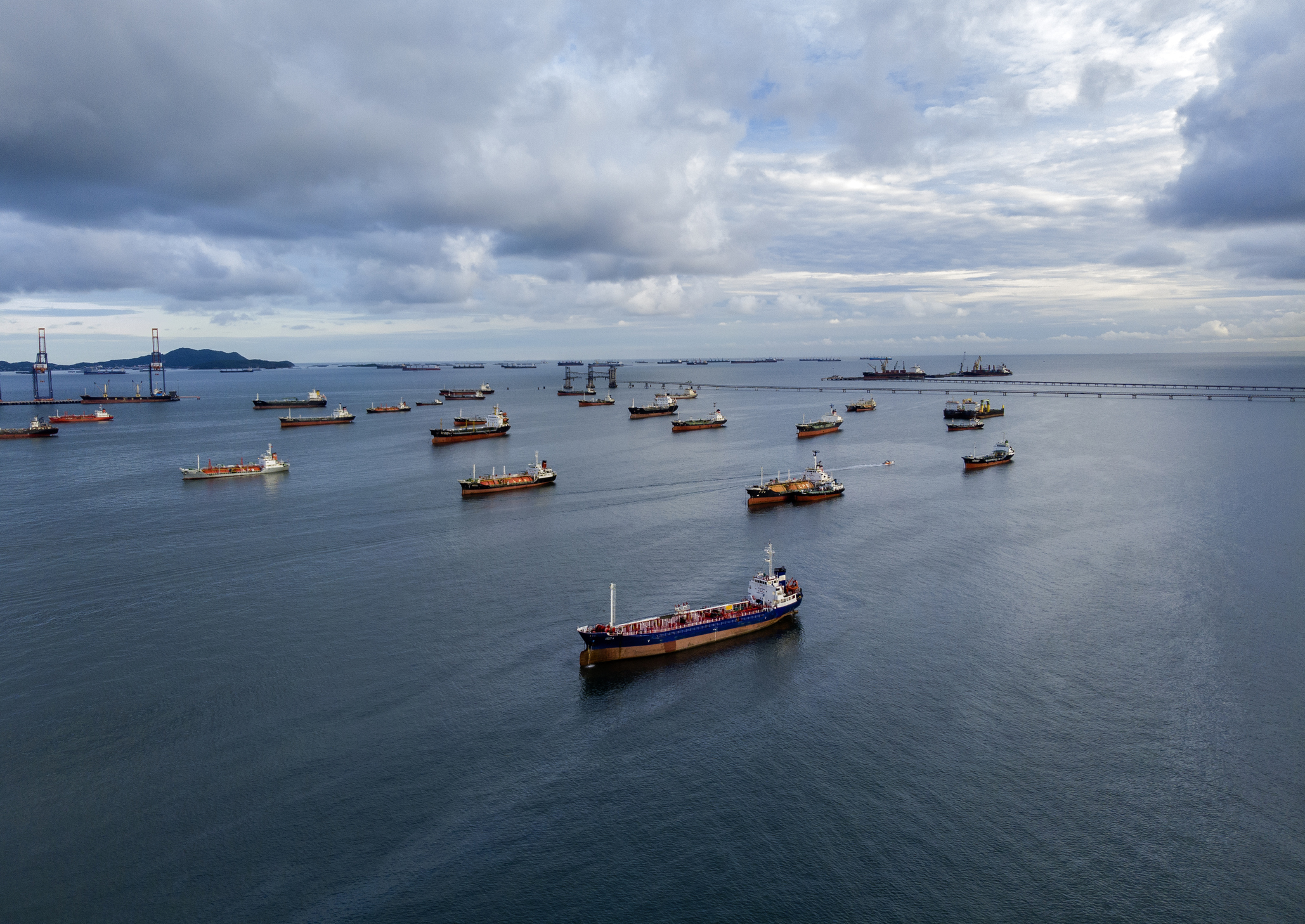
So far, we’ve covered the ways in which the Hormuz closure has disrupted access to some of the essential commodities on which modern civilization runs – oil, natural gas, fertilizers, helium. The blockage in the global flow of these essential commodities is literally visible to the naked eye. You can see it by Googling a satellite image or photograph of tankers stranded on either side of the Strait. But the Hormuz closure has also blocked the flow of an intangible, invisible stream whose disruption is arguably a deeper threat to America’s long-term security: the petrodollar.
Let me explain…
In 1974, U.S. Secretary of State Henry Kissinger and Treasury Secretary William E. Simon quietly closed what is arguably the most consequential deal in modern financial history. The terms of the deal were simple: the U.S. would guarantee Saudi Arabia’s security with military protection and advanced equipment for Saudi oil fields. In exchange, Saudi Arabia would price its oil exports exclusively in U.S. dollars and reinvest a significant part of its oil revenues in U.S. Treasuries. The Kingdom of Saudi Arabia was the undisputed leader of OPEC – so when it priced oil exclusively in dollars, other OPEC nations followed.
Kissinger and Simon’s 1974 deal with the Saudis gave birth to the petrodollar system, which has been an invisible foundation of the global monetary order for five decades. I recently wrote about the significance of this system for Porter’s Daily Journal – if you missed the piece, I think it’s worth reading.
The upshot is that Saudi’s 1974 decision to price oil in dollars, and its secret agreement with the U.S. to reinvest a big chunk of the proceeds into Treasuries, created something extraordinary: structural, inescapable demand for the U.S. dollar at massive scale. The system reinforced itself through a self-perpetuating loop:
Demand for oil → Demand for dollars → Demand for Treasuries → Lower U.S. borrowing costs → More U.S. spending → More demand for oil → More demand for dollars
At its peak, the petrodollar system generated over $2 trillion per year of forced demand for dollars. This demand, in turn, has allowed the United States to do something no other country in history has ever done as successfully: spend beyond our means, indefinitely.
As the Fed printed dollars to finance deficits run by the U.S. Treasury, Americans haven’t had to suffer anything close to the full inflationary cost – it’s been significantly absorbed by the rest of the world, because the world has needed dollars.
This ability for the U.S. to print dollars for its own benefit but have the rest of the world absorb the inflation is exactly what former French Finance Minister Valery Giscard d’Estaing infamously called America’s “exorbitant privilege”... and what former U.S. Treasury Secretary John Connally meant when he tartly remarked to European leaders, “The dollar is our currency, but it’s your problem.”
Cracks in the foundation of the petrodollar system have been developing for a couple of decades now. China under President Xi Jinping has been working concertedly to undermine the dollar’s prominence by delivering trillions in infrastructure projects to emerging economies, and pricing strategic resources such as rare earth metals and batteries, in China’s own currency the yuan (also known as the remnimbi, or “RMB”). Saudi Arabia itself recently abandoned pricing oil exclusively in dollars in part because its largest customer today is none other than China – which prefers to pay in yuan. Finally, the G7’s 2022 decision to freeze $300 billion in Russian central bank reserve assets at the behest of the United States as punishment for Russia’s invasion of Ukraine set off a scramble among central banks around the world to swap their $6.8 trillion in dollar reserves for something that can’t be frozen as easily – namely, gold.
But none of these prior challenges to the petrodollar system are as frontal, glaring, and symbolically as well as practically threatening as what is unfolding now due to Iran’s Hormuz closure.
The reason is simple: On the one hand, dollar-denominated oil flows through the Strait have collapsed. Despite the fact that over the past month, the U.S. military has –
-
Successfully flown over 6,000 combat sorties
-
Struck more than 12,300 targets inside Iran
-
Sunk Iran’s entire conventional Navy
-
Obliterated Iran’s air defenses such that ancient U.S. B-52 bombers fly unobstructed over Tehran
-
Decapitated Iran’s senior leadership, including the Ayatollah
Dollar-based oil flows in the Persian Gulf are still completely halted. The insurance market for tankers carrying dollar-denominated oil collapsed entirely upon the outbreak of hostilities… then re-started with coverage prices ratchetting up from 0.15% to 0.25% of vessel value to 5%, a 20x to 33x price increase.
The reason the coverage has re-priced? America’s $13 billion Gerald R. Ford class aircraft carriers – of which we’ve now deployed three to the Gulf – can’t protect dollar-based tanker traffic from lethal attack by $50,000 Iranian drone swarms or the Islamic Republican Guard Corps’ (“IRGC”) similarly inexpensive “mosquito fleet” speedboats bearing Molotov cocktails. I previously wrote about the asymmetric threat posed to the U.S. by these types of weapons, and our failure to prepare adequately for them, in a Porter & Co. Daily Journal piece published this past August.
But while dollar-based hydrocarbon flows through the Strait have collapsed, another form of traffic is flourishing: Chinese yuan-based traffic, loaded into shadow-fleet tankers aligned with Beijing and operating outside the Western insurance and settlement system. These cargoes are not hypothetical – they are moving today, settled not through the traditional payment system SWIFT, but through China’s CIPS payment system, and priced in RMB rather than dollars.
And critically, they are not moving in spite of the chaos in the Strait – they are moving because of a new order emerging within it. Iran’s IRGC has, in effect, stepped into the vacuum left by the collapse of Western insurance markets and created its own system of passage. Tankers willing to transact outside the dollar system are being offered safe transit under IRGC “protection” – for a reported fee of roughly $2 million per vessel, payable in yuan. In other words, the Strait has not simply closed, Instead, it has been re-priced, re-routed, and re-denominated.
The result is a bifurcation of the global energy system.
On one side sits a blocked, dollar-denominated system, backed by America’s military power but paralyzed by insurance, legal, and financial constraints. On the other sits a functioning, yuan-denominated system, backed by an invisible, unspoken alliance between China and Iran, simple economic incentives, alternative settlement rails, and a willingness to operate outside the Western financial architecture.
This is the real strategic shock: For the first time in half a century, there is a live, real-world demonstration that global energy trade can clear without the dollar – not in theory, not in pilot programs, but at scale, under conditions of crisis. And once that proof exists, it cannot be unproven. Nations that were previously content to operate within the petrodollar system now have both the incentive and the template to diversify away from it – not all at once, but incrementally, transaction by transaction, reserve by reserve.
The implications are profound.
The petrodollar system was never about oil. It was about forcing global demand for dollars and recycling that demand into U.S. Treasuries, anchoring America’s ability to run persistent deficits at low cost. If a meaningful share of global energy trade begins to migrate, even at the margin, into RMB or other non-dollar systems, that recycling mechanism weakens. And if it weakens, the United States faces a future in which it must increasingly finance its deficits domestically, at higher interest rates, with fewer external buyers to absorb the supply.
Bringing It All Back To “Money Time”
In my days working for Julian Robertson at Tiger Management, we had an expression: “Let’s bring this conversation back to Money Time.” By which we meant: What are the implications of this discussion for our list of recommendations? And even more specifically: How do we translate this discussion into actionable decisions to buy, sell, or hold? So – let’s bring the conversation back to Money Time.
Asset Allocation
The single most important decision investors need to make at this moment is to think through their asset allocation – the major categories that they’re holding in their portfolio. Asset allocation decisions should be tailored to individual circumstances and risk tolerance. Nonetheless, in the spirit of following Porter’s maxim to share with you the advice I’d want if our shoes were reversed, here is the asset allocation I’ve moved toward myself and am recommending to family:
-
Cash and short-term Treasury bills: 50%
-
Energy and fertilizers: 20%
-
Gold and precious metals: 10% - 15%
-
Other post-Iran beneficiaries: 10%
-
Tech and biotech: 5% - 10%
Let’s walk through each of these categories.
Cash And Short-Term Treasuries
The 50% allocation to cash and short-term Treasuries reflects my belief that we are entering the most dangerous period for the global economy and markets since the COVID-19 pandemic, and before then the 2008-09 Global Financial Crisis. The Iran War is, of course, a different kind of disruption than either of these prior upheavals. But I think its economic and market impact will be similar in scale – and potentially longer in duration, if we frame duration as how long we’ll experience the consequences of the event. Put bluntly, I think the Hormuz closure is likely to reshape foundational aspects of the global economy permanently, in ways that will play out for years and even decades to come.
Perhaps the single most important axiom I’ve learned in navigating economic and market crises is: “Position yourself to play offense.”
Positioning yourself to play offense means having enough liquid cash on hand so that you can comfortably and aggressively buy when everyone else has to sell. It means having enough liquid cash to buy when, as Baron Rothschild famously suggested, there’s “blood in the streets.” And it means proactively avoiding a situation where your own risk exposure heading into a crisis is too large, and you are turned into a forced seller amid a drawdown in your portfolio.
Some subscribers may read this advice and think: “But Erez – my portfolio has already experienced a drawdown. Is it too late for me to sell?”
My answer is: The S&P 500 is down 4.3% since February 27, while the Nasdaq Composite Index is down 3.5%. It may well be that individual components of your portfolio have declined more significantly. Several Tech Frontiers holdings experienced a larger drawdown than the main indexes over the past month: for example, my favorite holding, Sagimet Biosciences (Nasdaq: SGMT), declined 8.3%. I would still suggest that what we’ve experienced over the past month in markets is a minor squall compared to the typhoon that’s headed our way over the balance of 2026. It’s not too late to position yourself to play offense by raising cash, if you’ve not yet done so.
The most compelling reason to be proactive about raising cash is this: The biggest profits an investor can make in a lifetime – the generational-wealth type gains – happen in a bear market, when it’s possible to buy marquee assets for pennies on the dollar. If you bought stocks in the first half of 2009 or in March and April of 2020, when markets bottomed in the Global Financial Crisis and the COVID-19 pandemic, you already know exactly what I’m talking about. I anticipate we will have a similar buying opportunity ahead of us in 2026 or 2027 – and I want you to be ready to take advantage of it with me.
Energy And Fertilizers
Energy and fertilizers stocks have already had a big move since the Iran War began. The XLE, which is the energy sector’s flagship ETF, has gained 6% over the month. Oil supermajor ExxonMobil (XOM) has gained 5% over the period. Meanwhile, U.S. LNG disrupter Venture Global (VG) is up an eye-popping 51% since the end of February, while CF Industries – the world’s largest supplier of nitrogen fertilizers – has gained 28%.
While we may see short-term pullbacks based on headlines, I think the gains for leading energy and fertilizer players are just getting started. Let me explain why…
First, no matter what declarations of victory U.S. President Donald Trump may post to Truth Social, the combined threat of asymmetric attacks on tankers by Iran and the 20x+ re-pricing of vessel insurance continues to keep the Strait of Hormuz closed to traffic that declines to pay the IRGC’s yuan-denominated “toll.” I think it may take much longer than the market currently anticipates for the U.S. to restore the prior system of free passage through the Strait, if it’s even possible for the U.S. to do so at all. And if we can’t restore free passage – if, in other words, the IRGC succeeds in turning the Strait into a semi-permanent toll booth – we are looking at a long-term, structural re-pricing of each of the four essential commodities we’ve discussed in this issue (oil, natural gas, fertilizers, and helium) at much higher levels.
Second, I don’t believe the market has accurately priced the duration of the current disruption to global energy and fertilizer supplies even if the Strait were magically and miraculously re-opened tomorrow. As we’ve seen, the two LNG trains damaged at Qatar’s Ras Laffan are likely to take a minimum of four to five years to restore. The helium currently sitting in 200 specialized containers on vessels stranded on the wrong side of the Strait – collectively, 30% of global seaborne helium – will burn off in a matter of weeks, potentially disrupting the global helium market for months longer. And of course, the fertilizer system operates on a biological clock, not a financial one. Nitrogen that isn’t applied this planting season isn’t deferred – it’s lost. Farmers don’t make up missed applications later. They plant less, apply less, and harvest less. The curtailment of nitrogen and phosphate supply we are seeing today will therefore transmit directly into lower crop yields over the next six to 12 months, creating a global food crisis that will almost certainly re-price essential fertilizers higher going forward.
Overall, the market appears to be pricing the Iran War as a spot disruption, a temporary dislocation in commodity flows that will normalize once the shooting stops and diplomacy prevails. But what we’re actually witnessing is something very different: a multi-year impairment of physical supply chains across energy, fertilizers, and critical industrial gases – and a long-term risk premium that will now be added to the pricing of these essential commodities as sovereign nations, as well as large corporations, pay up to ensure access to the most secure sources of global supply.
In the brave new world we’ve entered, what looks today like a sharp move higher in energy and fertilizer equities will likely, in hindsight, prove to be only the first leg of a much larger upward repricing – one driven not by sentiment or headlines, but by the slow, grinding reality that molecules we once took for granted are no longer moving freely through the global system.
If you agree with me, that leaves the question: How do you express this view in your portfolio? Let me start by saying – I can’t think of anyone who has done a finer job making the case to own the “winners” in energy and fertilizers infrastructure, both before and at the very start of the Iran War, than Porter has. I’ve been an admirer of Porter’s research, writing, and judgment from the very first piece of his that I read – his watershed issue for Stansberry’s Investment Advisory in 2008, titled “Freddie Mac And Fannie Mae Are Going To Zero.” I think the work he’s published for Porter & Co. on Venture Global (VG), ExxonMobil (XOM), and above all in the Daily Journal at the very start of the Iran War, are some of the most exceptional investment calls he’s made in his storied career.
In my own investment portfolio, I’ve chosen to make two companies the foundations of my asset allocation to energy and fertilizers – both of which we’ll be adding to the Tech Frontiers list of recommendations as hedges.
 Subscribe to Erez Kalir’s Tech Frontiers to unlock the rest of this issue and more.
Become a Tech Frontiers subscriber today to get instant access to the rest of this issue and other valuable subscriber-only content.
A Tech Frontiers subscription gets you:
-
Monthly Issues – a detailed analysis on a new recommendation plus ongoing updates on the existing list of recommendations
-
Special Reports – Covering the three biggest trends impacting investing and society as a whole: AI, biotech, and the blockchain. As these three “tsunamis” collide, Erez believes we’ll see exponential breakthroughs that could make fortunes for early investors
-
Buy / Sell Alerts – instant notifications when any recommended stock makes a major move worthy of your attention
-
And more…
Use the link below today and lock in our lowest rate → 60% off the usual annual rate.
This content is only available for paid members. If you are interested in joining Porter & Co. either click the button below now or call our Customer Care team at 888-610-8895.