 Editor’s Note: On Tuesdays we turn the spotlight outside of Porter & Co. to bring you exclusive access to the research, the thinking, and the investment ideas of the analysts who Porter follows.
When Porter finds investment ideas of high value from an analyst who isn’t part of the Porter & Co. family, we will send them to you.
These are analysts Porter has known and followed for years, if not decades, whose ideas and insights have withstood the test of time, and who have helped Porter make better, more profitable investments.
Below, you’ll find a guest essay from Matt Milner, the founder and Chief Investment Officer at Crowdability on why the pre-IPO opportunity in SpaceX could just be getting started.
*Disclaimer: Porter & Co. may receive compensation, referral fees, or other benefits if you purchase products or services mentioned in this email.
SpaceX: January 2026 Spotlight
I started telling my readers about Elon Musk’s SpaceX in 2014.
At the time, it was valued at about $10 billion. For a private startup, especially back in 2014, a multi-billion-dollar valuation like this was outrageously high.
But as you’ve probably heard from Porter: Never. Bet. Against. Elon.
Over the years, SpaceX became more and more successful — and more and more valuable. Its valuation grew from $10 billion, to $50 billion, to $200 billion. And still, it hadn’t gone public.
So in early 2025, Porter asked me to write a series of articles for you. He wanted you to understand that you could invest in SpaceX before it went public. And for those who were interested, he wanted me to reveal how to do it, step-by-step.
When Porter introduced me to you, he wrote:
As you know, this is not the type of investment approach I usually take. It’s speculative, it’s high risk, and it’s not for everyone. But I also know that the chance to get a stake of SpaceX — before its IPO — is something that many of you would want to know about.
Well, here we are in 2026. SpaceX is now valued at $800 billion. And it recently announced that it’s targeting an IPO this year that will value it at $1.5 trillion.
To make a long story short, anyone who followed me and Porter into SpaceX has already done very well. Depending on when they got their shares, investors could be sitting on unrealized — or even realized — gains of 2x, 5x, even 80x or more.
The thing is, the SpaceX story isn’t over yet. Let me explain.
Never. Bet. Against. Elon.
Elon had a rough start to 2025.
Activists were gathering outside Tesla showrooms, protesting his activities on behalf of the U.S. federal government. They were angry that his Department of Government Efficiency was aiming to slash U.S. spending.
Then he had a blow-up with President Trump. It looked like Elon’s status as “First Buddy” would end — and all those government contracts for his companies would end, too.
But as we’ve learned over the years — never bet against Elon.
That’s why, even after the blow-up, I wasn’t surprised to see SpaceX land new government contracts, including a $2 billion deal related to Trump’s “Golden Dome” missile-defense project.
But it wasn’t just rockets that were keeping SpaceX in the news…
SpaceX: Three Companies In One
For most casual observers, SpaceX is synonymous with rockets. Makes sense. It’s become the go-to company to launch anything into space.
And just look at its revenue growth:
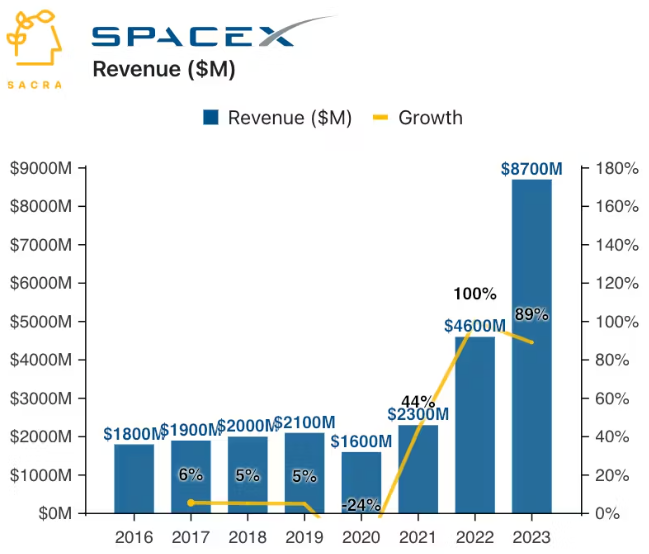
This chart shows its revenues through 2023. As you can see, it’s growing fast — and it’s continuing to grow fast.
Now check out this chart from Morgan Stanley.
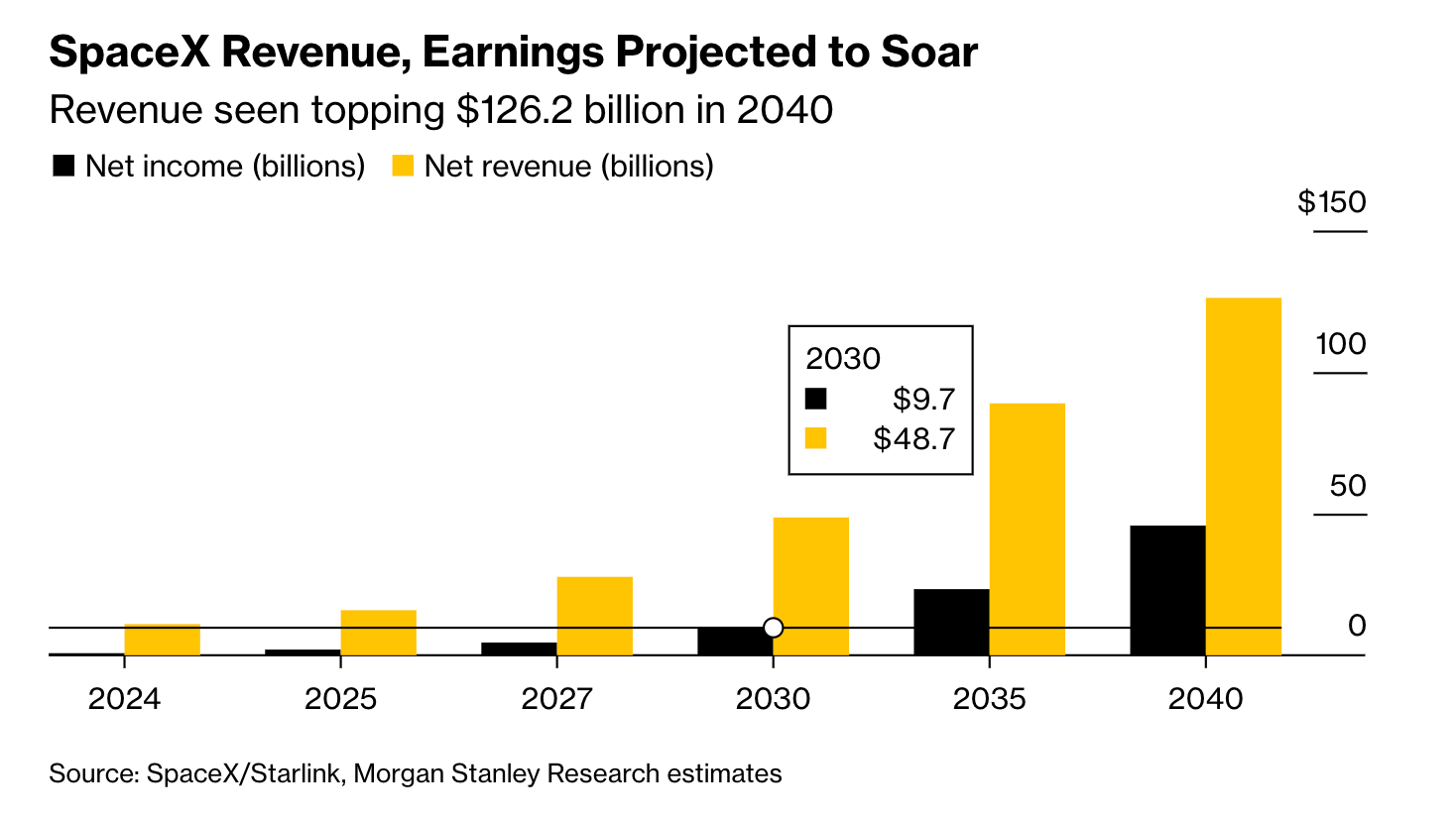
As you can see, SpaceX’s 2024 revenues reached $11 billion, and its 2025 revenues were expected to reach $15.9 billion. Meanwhile, its 2026 revenues are expected to hit somewhere north of $20 billion, and by 2040, they’re expected to climb to more than $100 billion.
The thing is, these revenues aren’t just coming from SpaceX’s rocket business. The company also has a second business: Starlink, a space-based internet service.
Space-industry analysts call Starlink “nothing short of mindblowing.” Here’s how it works. Every time Elon launches one of his rockets, even if it’s on behalf of NASA, he stows away satellites for Starlink on board. As the rocket enters space, dozens of these refrigerator-sized Starlink satellites break off and are deployed.
These satellites can beam the internet down to Earth, even to the most remote jungles and mountain tops. That means anyone, no matter where they live, can use Elon’s internet service.
As of January 2026, Starlink had signed up more than 9 million customers in 150 countries. That’s up from 7 million customers in August 2025, and 8 million in November 2025.
Just imagine how much SpaceX could be worth when much of the world ditches its slow, unreliable internet, and starts using Elon’s Starlink. The company is already landing contracts with major governments, airlines, and more recently, smartphone makers. In fact, Starlink expects to be able to provide service for smartphone users in 2027.
This explains why Starlink could generate literally billions of dollars in cash flow for SpaceX, year after year.
But now it looks like SpaceX might also be exploring a third business: space-based data centers.
If you’ve been following the news lately, you might know that data centers have suddenly become central to everything. They sit at the intersection of Artificial Intelligence, energy, geopolitics, and economic growth — and they’ve turned into a critical asset.
The biggest driver for data centers is AI. Modern AI data centers can require hundreds of megawatts, which is comparable to the needs of a small city. Local grids can’t support new builds like this. And utilities can take years to approve new generation and transmission.
According to the International Energy Agency, by 2030, electricity consumption at U.S. data centers is projected to more than double as compared to last year. According to Bloomberg, tech giants including Microsoft and Meta are planning to spend a combined $500 billion to lease data centers over the next several years. Oracle alone has committed to spend $248 billion, and over the next eight years, OpenAI has committed to spend $1.4 trillion.
This is why you might be reading about data centers colocating with nuclear plants, as well as data-center deals involving dedicated gas turbines and small modular reactors (SMRs).
And this explains why, from an economic and investment perspective, data centers are one of the best assets in the world. Data centers feature such characteristics as:
-
Long-term contracts from 10 to 20 years
-
Investment-grade tenants including Big Tech
-
Inflation-linked pricing
-
High switching-costs
-
Scarcity due to power constraints
These characteristics explain why private equity is pouring into the opportunity, why infrastructure funds are pivoting toward “digital infrastructure,” and why data centers are being valued more like monopolistic utilities than real estate.
It also explains why Elon’s SpaceX is jumping into this sector.
Here are the top 5 reasons why building space-based data centers might make so much sense — in general, and specifically for Elon.
1. Nearly Unlimited Solar Power
Power and cooling are the two biggest operating costs for AI data centers.
But in orbit, solar panels get continuous, unobstructed sunlight. This dramatically reduces one of Earth-based data centers’ biggest constraints: energy cost and grid capacity. Furthermore, cooling can be done with radiative cooling into space, rather than with energy-hungry chillers.
2. Reduced Terrestrial Constraints
Space-based data centers avoid challenges such as land acquisition, zoning fights, local grid bottlenecks, and water usage, which is a growing political issue for AI data centers. This is particularly relevant as AI workloads explode and Earth-based infrastructure strains.
3. Ultra-Low Latency
For space-native or global applications — for example, satellite networks, Earth observation, defense & intelligence, global financial or communications routing — orbital compute can be faster. Why? Because it enables computing to take place where the data is already.
4. Strategic And Defense Advantages
This is a big driver. Space-based data centers are physically harder to attack or sabotage, potentially sovereign and jurisdiction-agnostic, and attractive for military, intelligence, and national security workloads. This alone could justify early deployments — even if the economics are marginal at first.
5. Starship Changes The Math
Historically, the idea of space-based data centers was impractical because launch costs were prohibitive. But SpaceX’s Starship can change the math. It has massive payload capacity, it’s reusable, and marginal launch-cost drops dramatically.
Congratulations On A Winning Trade
As you just learned, SpaceX is set to earn massive revenues from its two — and with space-based data centers, perhaps its three — business units. And anyone who’s following Elon, even with just a small investment, could potentially make enormous profits.
As mentioned earlier, investing in pre-IPO opportunities isn’t the type of approach that Porter usually takes. As he says, “It’s speculative, it’s high risk, and it’s not for everyone.”
That being said, if you took advantage of the information we shared with you last year about investing in SpaceX, congratulations on your winning trade!
But in case you missed out, let me quickly mention the next trade I’m recommending.
Here’s Our Next Trade
The next pre-IPO opportunity I’m sharing with my readers is in Artificial Intelligence (AI).
Given the endless capital that’s coming into AI, this sector has become a gold rush. And in a gold rush, you can either mine for gold, or you can sell picks and shovels to the miners.
For example, in the internet gold rush, you could have “mined for gold” by investing in Pets.com, or you could have “sold picks and shovels” by investing in Cisco (CSCO). In the end, you’d have lost all your money on Pets.com — and meanwhile, Cisco soon became the #1 most valuable company in the market. It was the Nvidia of its time.
My current recommendation is a picks and shovels play in AI — and it’s a big one.
-
It’s already bringing in $500 million in annualized revenues.
-
It’s already backed not just by Nvidia, but by InQTel, the venture-capital fund created by the CIA. One of the last pre-IPO companies backed by InQTel was Palantir (PLTR) — and at this point, InQTel has made an estimated 2,000x its money on it.
-
It’s already hired bankers to take it public this year. And for pre-IPO investors who get in now, the potential profits could be extraordinary.
Just like with SpaceX, I’ve discovered a way that qualified investors can buy its pre-IPO shares. If you’re interested in learning more, I put together a quick video for you.
Porter and I hope you enjoy it.
Happy investing,
Matt Milner