Giving The People What They Want
Editor’s note: This is Porter & Co.’s Best Buys, which we release to paid subscribers on the fourth Saturday of each month… If you’re not yet a subscriber to Best Buys, to access the full paid issue and our previous Best Buys, please click here.
In 1768, Clément de Laverdy buried 175,000 pounds of grain in his backyard and then retired from public office.
At the same time, a young conspiracy theorist named Jean Charles Guillaume Le Prévôt de Beaumont stuck a heavy package of “evidence” in the mail to the French government. Between schizoid rantings about “pirates” and “vampires,” he claimed that Laverdy and his respectable, Royalty-backed granary were deliberately hoarding grain to drive up flour prices. The “Famine Plot,” he called it.
The Royal police promptly tossed the wingnut in the Bastille, where he’d stay for the next couple of decades.
Meanwhile, Laverdy enjoyed a leisurely country retirement in his Seine-et-Oise château.
A quarter century later, their paths would cross again at the base of the guillotine.
It was the Great Terror – the height of the French Revolution, led by the charismatic and utterly crazy Maximilien Robespierre. Patrician heads were rolling at an incredible clip of about 40 a day. Into the wicker basket tumbled the noggins of King Louis XVI, Queen Marie Antoinette, countless courtiers and nobles, and the worst offenders of all: grain hoarders.
It was really grain that started the Revolution in the first place...
According to the Physiocrats, the trendy economists of the day, agricultural land was the only true form of wealth, since it was the gift that could keep on giving.
In a familiar Power Law equation, a small number of aristocrats (the nobles, known as the “First Estate,” and the clergy, the “Second Estate”) owned almost all of the land. The First and Second Estates sold grain, bought porcelain and pearls, and drove up goods prices sharply, all while racking up immense national debt.
The unlucky “Third Estate” (the commoners, 98% of the population) farmed the nobles’ fields without wages, and paid heavy rent, taxes, and tithes for the privilege of living on the estate. The peasants handed over giant shares of the yearly grain harvest (metayage) to the lords, who then sold it back to the serfs at a 50% markup.
Sometimes, the seigneurs would just keep the grain, and then ship it off to other countries or regions where the price was tastier.
Sans grain, the poor folks cut their flour with plaster of Paris. (As Marie Antoinette did not say: “Let them eat cake.” As Ayn Rand did say: “Don’t be one of them.”) During plaster years, the Third Estate starved – then rebelled.
The Guerre des Farines, or Flour War of 1774, saw over 300 riots across Paris where starving peasants seized bread shipments, burned down bakeries that charged high prices, and posted “seditious” notes on the walls reading “We don’t have a king, for the king is a grain merchant.” Quelle horreur!
About 25,000 royal troops eventually put down the rebellion and strung up a couple of the protestors as an example. Parliament issued an edict lowering grain prices and, by 1775, the Flour War had been brushed aside. But tensions continued to rise until the Third Estate banded together, overthrew the monarchy, and started curing people’s migraines... permanently.
One of the casualties was Clément de Laverdy, who was dragged out of retirement. Someone had dug up his secret pit of hidden grain – and someone else had seen members of his company throwing sacks of flour into the river. Now he was stuck with a two-hour “trial” that would end with one of two verdicts: “Not Guilty” or “Off With His Head.”
It was Le Prévôt de Beaumont – liberated from the Bastille by the revolutionaries – who clinched Laverdy’s fate. Wild-eyed and crazy-looking as ever, he leaped into the court and read out his package of “evidence” for “The Famine Plot” once again.
This time, everyone listened. The verdict was “Off With His Head.” As for Le Prévôt, he received reparations for his years in prison, paid out of Laverdy’s ill-gotten wealth.
Le Prévôt’s was one of the few happy endings. The new French Republic proved to be psychotically unstable – next came a couple of centuries of anarchy, dictatorships, war, debt, and hyperinflation.
The havoc was not a surprise to one person: a French-Irishman who predicted it all, and then went to bed with a lit candle... some folks say on purpose.
The Cantillon Effect
In pre-Revolution France, there were two divergent economies going on at once: a booming grain trade for the rich... and a hidden recession for the poor.
And hidden recessions always lead to a collapse... as Richard Cantillon knew well.
Known as the Father of Modern Economics, the secretive Cantillon made 20 million livres – and quite a few enemies – betting against the biggest bubble of the time, the Mississippi Company. He’d noticed the vast influx of speculative paper chasing the giant trading company and knew the good times couldn’t last. He pulled a Big Short, pissed off a lot of people, and spent time in jail.
In 1734, he “died” (or did he?) in a house fire, disfigured by severe candle burns. His cook, who police assumed must have set the blaze and bolted, was never seen again.
Curiously, Cantillon’s single written work, Essay On The Nature Of Trade In General, wasn’t published until some 20 years after his “death.” Distributed widely across Europe, Essay laid out the foundational principle of the “Invisible Hand” of the markets decades before Adam Smith fleshed out the concept in Wealth of Nations.
The book also articulated the Cantillon Effect, arguably his most important contribution to economics...
Drawing on his first-hand experience with bubbles, Cantillon observed that “new” money doesn’t enter the economy all at once. First, it goes to the “King” – the government, the rich people, the high spenders. Then, after the nobles have diluted its value and inflated the price of goods, the “new” money drifts outward to the commoners, who then get a bunch of worthless paper to spend.
In this way, two wildly divergent economies often take shape: an upwards trajectory for those closest to the “King”... and a stealth recession for the commoners. In modern parlance, we call this a “K-shaped economy” – and it’s been showing up, over and over again, for thousands of years of history, long before Richard Cantillon cooked someone to a crisp in his nightcap.
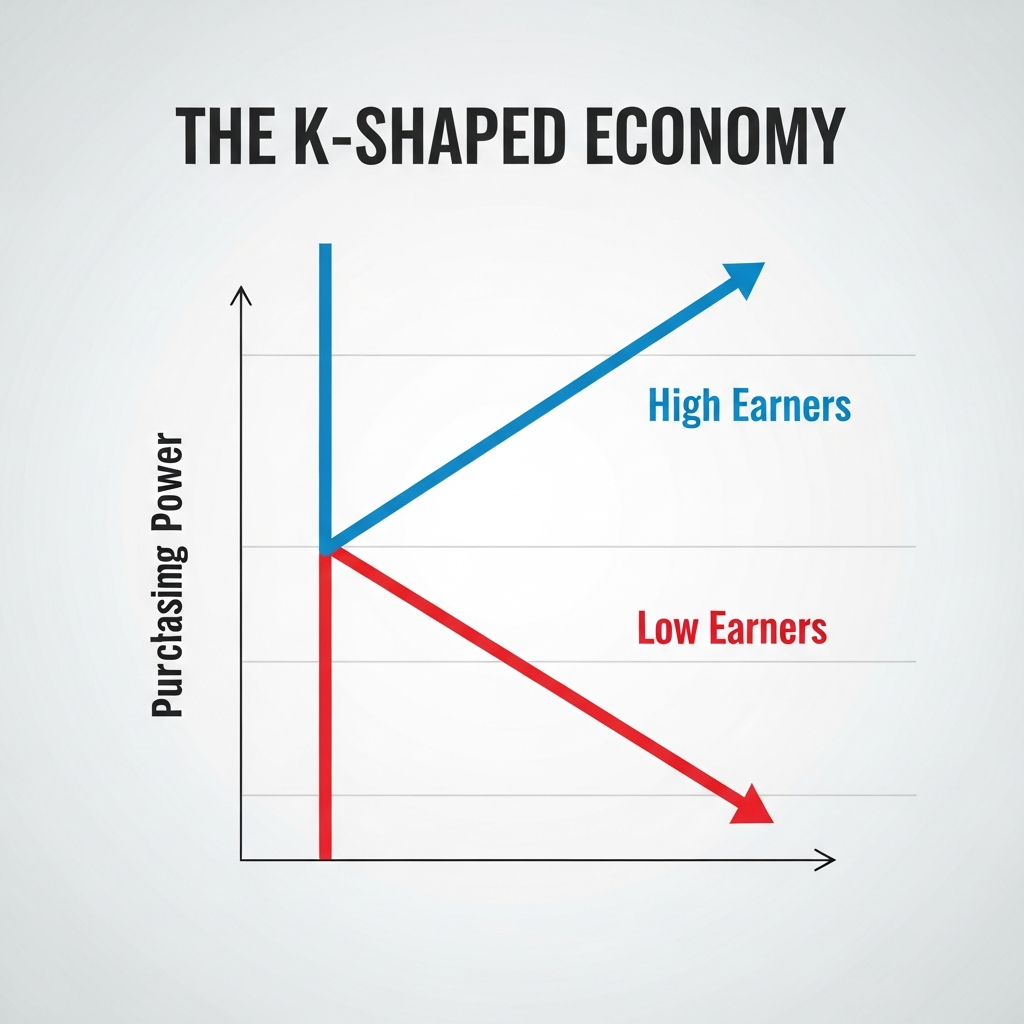
It appeared in ancient Rome before its fall... in the Han dynasty before the Yellow Turban Rebellion... in France before the Revolution... in the U.S. before the Great Depression... and, again, in the U.S. right now.
The K always precedes a financial or social collapse. The one we’re preparing for now is the End of America.
Why You Should Get Old, If You Haven’t Yet
The sequence, as Cantillon laid it out, goes like this...
A stream of new wealth enters the economy. In his Essay, he envisioned it as a newly discovered gold mine... but it could also be an influx of grain, as in the French economy... or, more sinisterly, a load of clipped Roman denarii laced with copper... or a few trillion dollars of modern-era QE (quantitative easing).
Whatever that money is initially “worth,” its value and purchasing power get squeezed out of it by the powerful men closest to the mine, the land, the printing press. (They spend it, Cantillon observes, on “servants and meat pies,” driving up prices across the board.) Then the lower-class folks are left with worthless money and a hidden recession.
With debasement of currency comes debauchment of society... as we’ve written many times before.
Eventually, Cantillon says, the hidden part of the recession comes out into the open. It becomes too expensive to produce domestic goods, so the King starts paying foreign countries for exports instead. Ultimately, there is no more money for anyone in the country because all the wealth has gone overseas. (Sound familiar?) And the country’s economy collapses.
Right now, we’re dealing with a K-shape in the American economy.
Cantillon’s “kings” are stock market investors who are closest to the trillions of dollars of “new” money being pumped into our economy. Anyone invested in the market has enjoyed a tremendous uplift in their wealth and spending power, and those who don't are seeing inflation eat away at their wages and purchasing power.
The clearest example of this is simply looking at the change in net worth by age, because as you would expect, the older people hold most of the wealth and investable assets. (This is why you should get old, if you haven’t yet.)
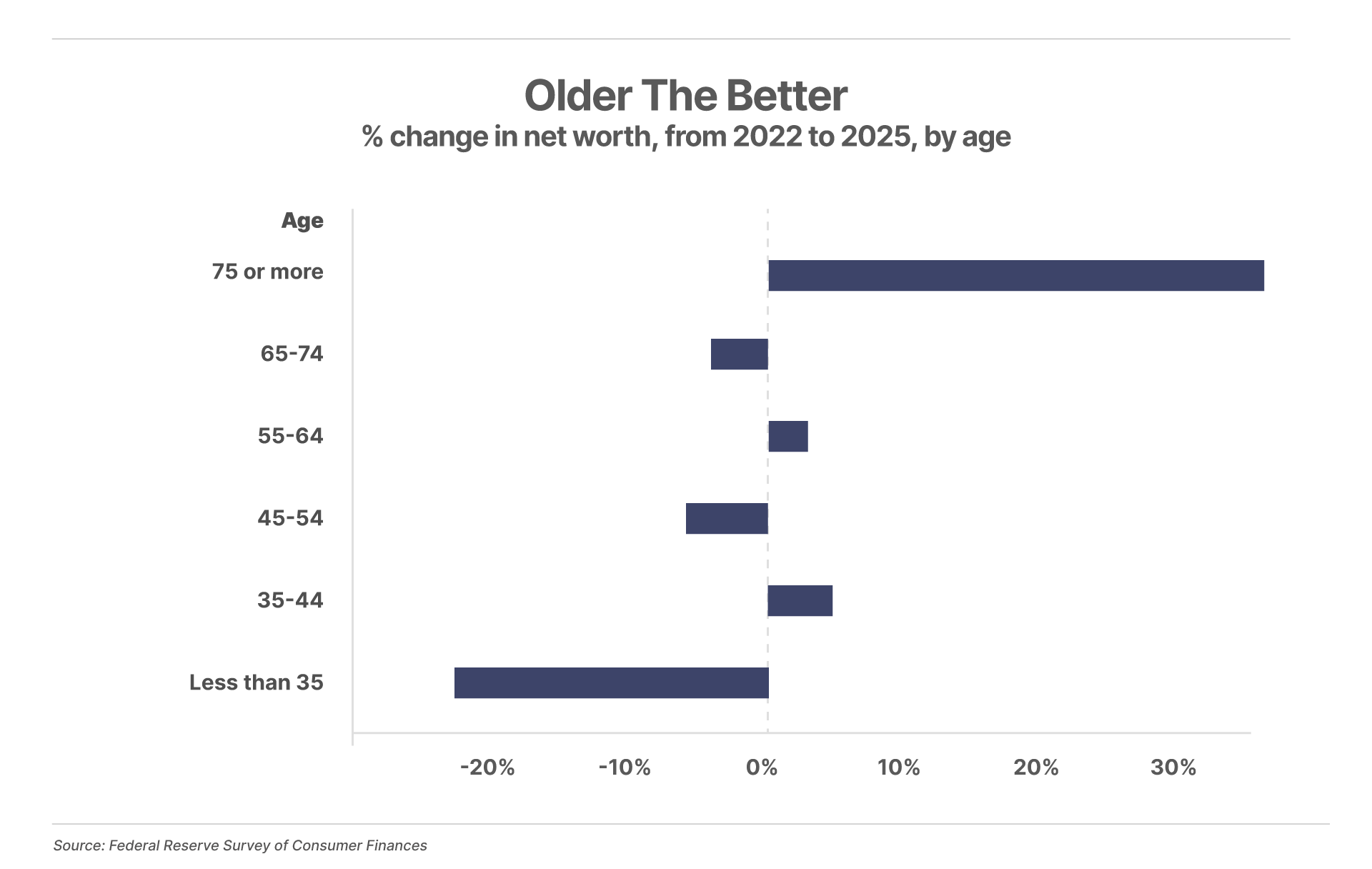
The same monetary inflation that's driving up asset prices for the wealthy is crushing the bottom 90% of consumers who don't own assets... the inflation is simply eating away at their paychecks each month, causing declines in real income.
As a result, we're seeing weakness across the majority of consumer-related stocks, along with other indicators like political unrest (the big focus on the upcoming elections is "affordability", etc.) and consumer sentiment levels typically only seen during recessions:
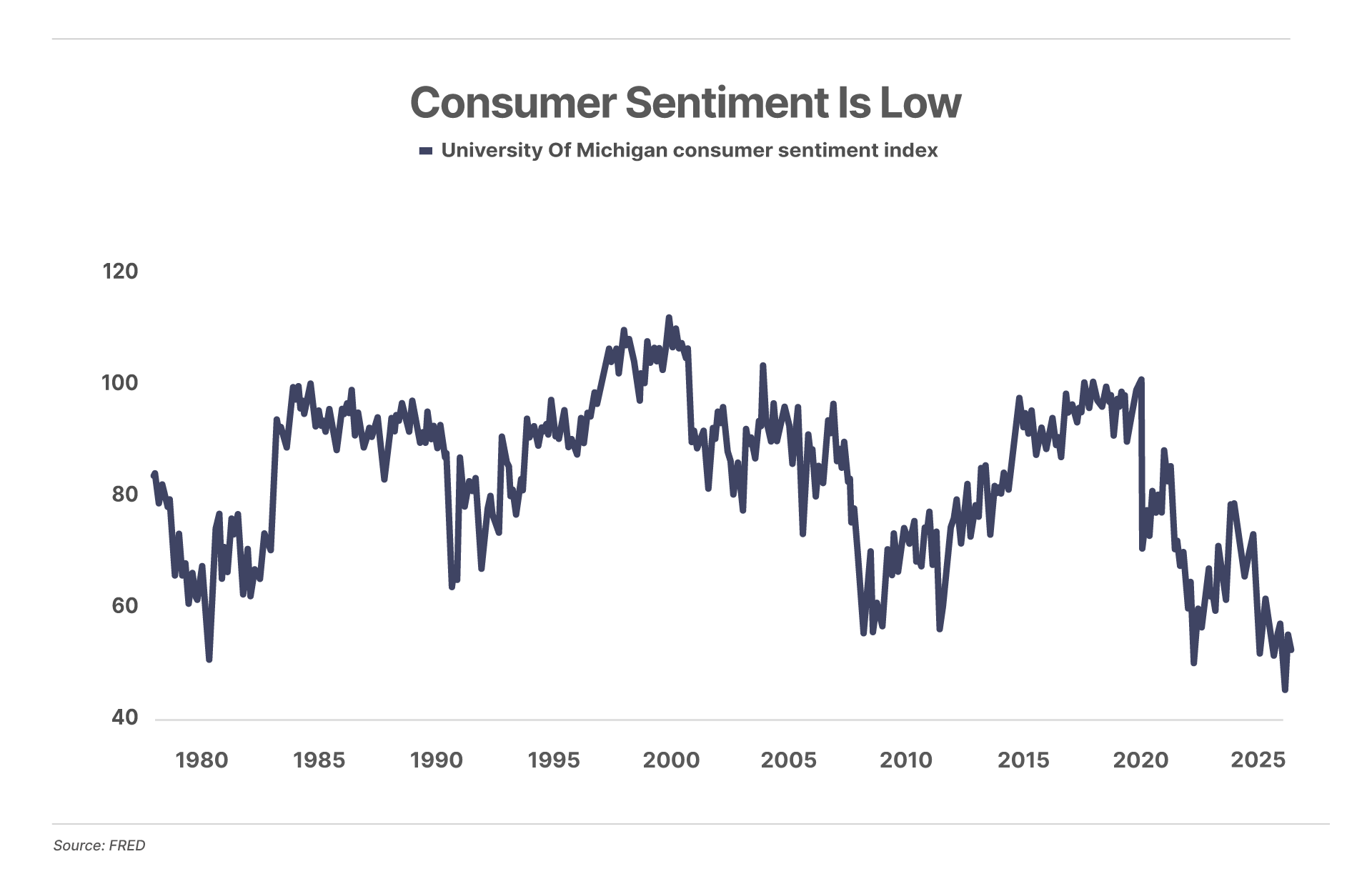
Only a few, extremely strong consumer stocks right now have been able to buck the hidden recession. In this issue of Best Buys, we recommend two of those outliers.
Subscribe to Porter & Co.’s Best Buys to unlock the rest of this issue and more.
Become a Best Buys subscriber today to get instant access to the rest of this issue.
On the fourth Saturday of every month, Porter Stansberry and his entire editorial team release their top-3 open recommendations across all our research. Pulling from all our research services, our team looks for the stocks or bonds that are absolute “no-brainers” based on their current prices and what’s happening right now in the markets.
Each monthly issue of our Best Buys includes a summary of our original investing thesis behind each recommendation along with our reasoning on why we think now is the perfect time to start a new position or add to your existing position.
Instead of subscribing to Complete Investor ($2,000 per year), Biotechnology ($5,000 per year), and Distressed Investing ($5,000 per year), you can get the best recommendations from each service for just $59 per month.
Even better, use the link below today and lock in our lowest price – a discount of more than 20% off the usual monthly rate.