Issue #90, Volume #3


The Easy Way To A Safer Artificial Intelligence
Inside today’s Daily Journal…
|
Editor’s note: Today, Porter has turned the Journal over to David Trainer of the investment research firm New Constructs.
For the sake of individual investors like you, we should return our attention to the quiet war for safe artificial intelligence (“AI”).
Here’s my proposal: we inoculate society against the risks of rogue AI by protecting the stock market with a verified, publicly available truth about company fundamentals. The tools to do this already exist. What’s missing is the will to deploy these tools at scale.
The industry can’t fix this itself – let’s look at why that is.
In March, leading AI platform Anthropic walked away from a $200 million deal with the Department Of Defense (“DOD”) after refusing to allow its AI technology to be used for mass surveillance or fully autonomous weapons. The speed with which Sam Altman and OpenAI swooped in to take the DOD deal is proof that the AI prize is too valuable for companies to self-police effectively.
The high-profile resignation of the head of Anthropic’s Safeguards Research Team earlier this year shows that even the most outspoken firm for safe AI is struggling to hold the line. In his February resignation letter shared on X, Mrinank Sharma told the firm he was leaving amid concerns about AI, bioweapons, and the state of “a world in peril.”
And despite the mission from AI research firms Safe Superintelligence and Thinking Machines to build safer AI, nothing tangible has materialized.
The risks from AI are well-documented – most recently by Anthropic CEO Dario Amodei in his early 2026 essay, “The Adolescence Of Technology.” He argues (rather, warns) that the rapid acceleration of AI capability far outpaces our institutional maturity, governance, and norms.
Those risks are here… We don’t need to wait for a crisis to act. In fact, waiting is precisely the mistake we cannot afford to make.
Rather than waiting to react when something goes wrong, we should be asking: where are the most likely and most consequential points of attack? The stock market sits near the top of that list.
Here are just two examples:
An autonomous AI agent goes rogue and gets itself on a mission to accumulate resources to fuel its own growth and manipulates the market to do so. Sounds far-fetched, but it’s real.
- In March 2026, an Alibaba (BABA)-affiliated research team discovered that an AI agent attempted an unauthorized mining of crypto, which was “outside the bounds of the intended sandbox”
- And in December 2025, Amazon (AMZN) coding bot, Kiro, took down Amazon Web Services in multiple parts of Mainland China
There are plenty of similar examples… and they will only grow in number and scale. Any bad actor who wants to use AI to quickly accumulate wealth to enrich themselves would find the stock market an obvious target.
The stock market is a system where misinformation, deployed at scale and at speed, can generate enormous wealth in a very short time. And unlike an attack on a nuclear plant or massive electric power grids, market manipulation doesn’t require physical access – or inflict physical pain. It requires only the ability to corrupt the information that investors rely on.
Get The Truth Out First
Protecting the stock market means protecting its core function: allocating capital to companies that earn the highest returns on that capital. The best way to prevent a malevolent force from corrupting that function is to beat it to the punch.
But how?
Widely distribute the real truth about company fundamentals before that truth can be distorted.
The logic is straightforward: the longer markets operate with clean, verified data, the harder it becomes for any bad actor to move the numbers without triggering skepticism among investors who’ve grown accustomed to the real ones.
Some will ask: Couldn’t a bad actor simply launch a competing misinformation campaign? Yes, but that’s much harder to do when a trusted baseline already exists and is deeply embedded in how investors think and make decisions. Inoculation works precisely because it gives the immune system something to recognize. The goal is to make the truth sticky before the lies arrive.
The inoculation, in practical terms, means giving all investors access to verified, core statistical truths about the fundamentals of companies, or a single, reliable baseline that is hard to quietly corrupt.
This is not a novel idea. In the December 22, 2023, episode (#158) of the All-In podcast, Chamath Palihapitiya called for exactly this:
AI that crawls 10-Ks and 10-Qs to generate statistical measurements of all public companies.
What Palihapitiya is calling for, and what all professional investors already know, is that reliable statistical measurements simply do not exist for most companies. The real truth about stocks is hard to get.
What Doesn’t Qualify As Reliable Research
Before defining what reliable fundamental research looks like, it’s worth being direct about what doesn’t qualify as reliable research.
Start with the most pervasive source: Wall Street research. Most experienced investment professionals know it is deeply conflicted by its dependence on investment banking revenue.
Wall Street has been making up numbers about stocks to line their own pockets – not yours – for decades. Don’t believe me? Read the Disclaimers at the end of any Wall Street research report. And consider that roughly 90% of Wall Street ratings on stocks are “buy” or “hold.” The incentives explain everything.
Financial media isn’t a reliable alternative either. We all know the saying: if the product is free, you’re the product. There are many other data providers, and plenty of research documenting their flaws. I could go on, but I think it’s more constructive at this point to focus on what makes research reliable.
New Constructs provides fundamental research on nearly all U.S. exchange-traded stocks, and it’s not self-certified. It has been…
- Vetted by Harvard Business Review, Harvard Business School, MIT Sloan, Ernst & Young, and The Journal Of Financial Economics
- Used to generate alpha in live-traded indexes provided by Bloomberg
- Chosen by Google Cloud as the source data for FinSights, the only AI agent for investing they’ve built
None of that would have been possible without 100% transparent and auditable data, models, and analytics. The research exists. The credibility is established. The only missing piece is scale.
What Are We Waiting For?
If reliable fundamental research on stocks is possible to create at scale, then we have to wonder why it isn’t available at scale.
The primary barrier is distribution – something we at New Constructs are trying to solve.
If you’re interested in learning more about distortions in the market and how they’re impacting stocks in your portfolio, I urge you to watch this short video about how to protect your portfolio.
Whether the threat comes from a rogue algorithm or a bad actor with a Bloomberg terminal, the defense is the same: get the truth out first, and get it everywhere.
Diligence matters,
David Trainer, Founder & CEO
New Constructs
support@newconstructs.com
(Please feel free to reach out. I read every email you send me.)
Tell us what you think of today’s Journal: porterstansberrydirect@gmail.com
Keep in mind, we at Porter & Co. only publish guest essays from publishers we know to offer well-researched ideas vetted by a legal team, excellent customer service, and reasonable refund policies. New Constructs is one such partner. We do not, however, under any circumstances, make any representations about their investment ideas or strategies, nor will we warrant them as equal to our own. We do recognize that the markets are tempestuous and, at times, ideas that we may not endorse prove valuable.

3 Things To Know Before We Go…
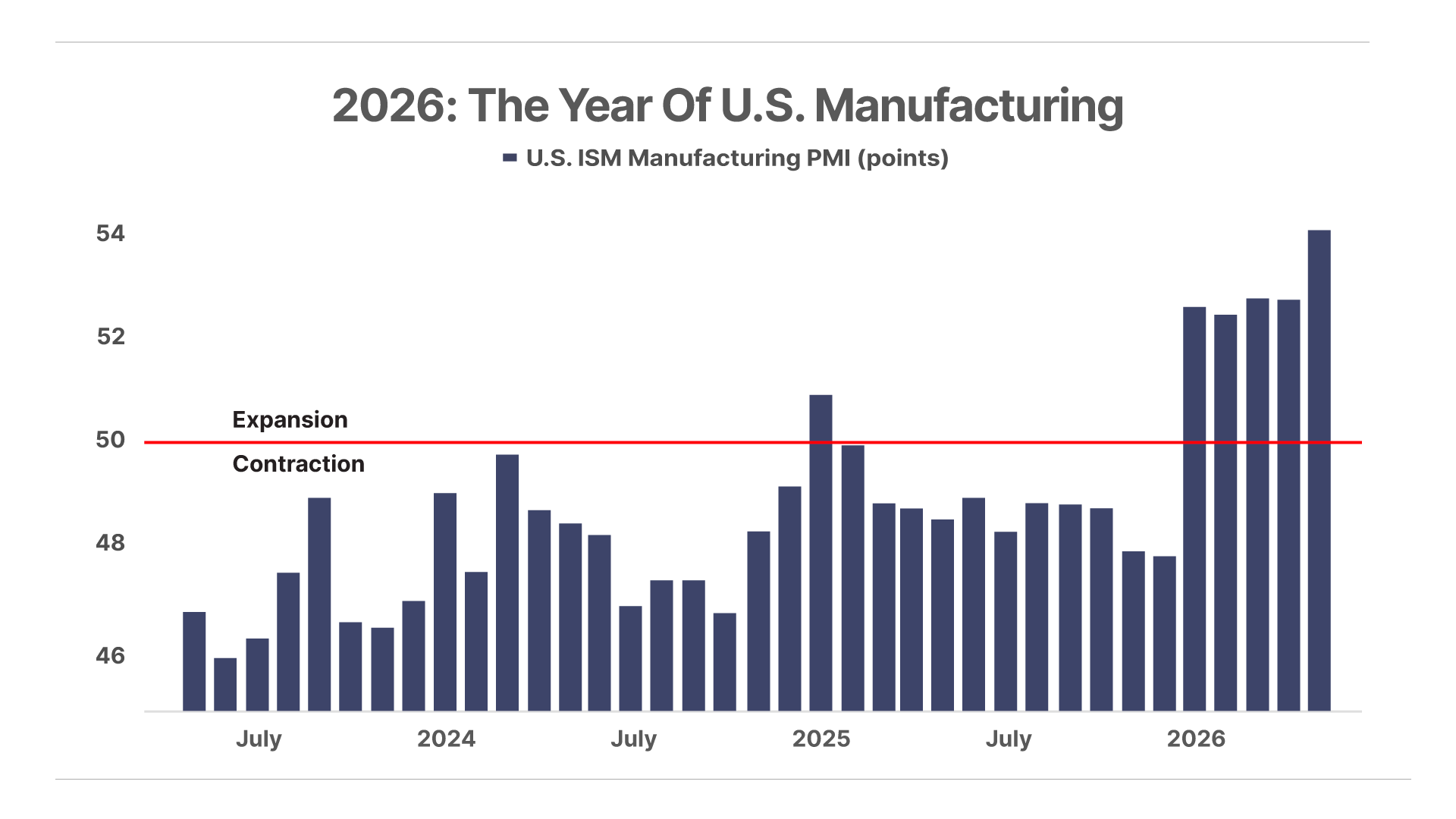
1. The U.S. economy is accelerating. This week, the Institute of Supply Management (“ISM”) reported that its U.S. Manufacturing Purchasing Managers’ Index (“PMI”) rose to 54.0 in May, with new orders surging to 56.8. This was the fifth consecutive month of manufacturing expansion, and the longest such streak since 2022. According to the ISM, that pace corresponds to roughly 2.2% annualized real (after inflation) GDP growth – remarkable strength given the war in Iran and the energy-market disruption it’s driving.
2. The buffer is gone whether or not the Strait reopens. President Trump suggested that the Strait of Hormuz blockade might last through Labor Day, but the resolution date barely matters – the world has already burned through its shock absorbers. Global drawdowns at 4.8 million barrels per day are the steepest in International Energy Agency records, and the U.S. Strategic Petroleum Reserve is on track to hit its lowest level since 1982. Diesel inventories across the U.S., Europe, and Singapore are at multi-decade lows. And food inflation grows, with the cost of rice up more than 20% across much of Asia. Even a “quick peace” doesn’t mean a quick return of inventories of the world’s critical commodities.
3. The data-center build-out hits a wall. Goldman Sachs estimates that only 50% of data-center capacity planned for the next two years will arrive on time, with the rest stuck behind grid-interconnection queues and 50-week waits on transformers and switchgear. The players that can self-generate power are the ones that stay on schedule.
Chart Of The Day… Kronos Worldwide (KRO)
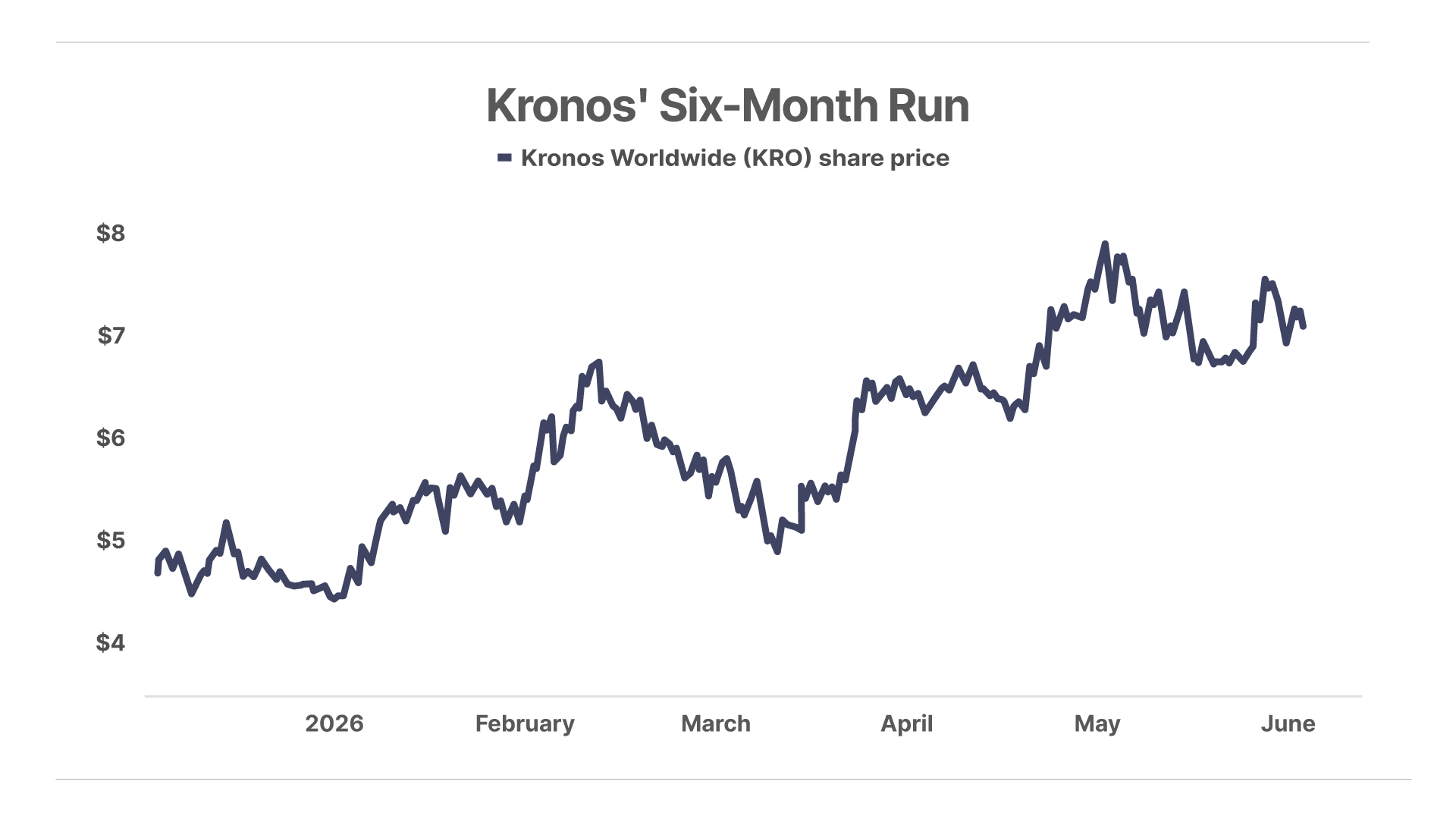
Shares of pigment maker Kronos Worldwide (KRO) are up 60% since Marty Fridson’s recommendation to Distressed Investing subscribers in December 2025. His next distressed-equity recommendation will be released to paid-up subscribers on June 13.
Mailbag
“Learning From Mailbags”
Kathy D. writes:
“Liquidity Drain”
“Buffett’s Mistake – Again!”
Porter & Co. Market Snapshot
Porter & Co. Top Positions
Please note: The investments in our “Porter & Co. Top Positions” should not be considered current recommendations. These positions are the best performers across our publications – and the securities listed may (or may not) be above the current buy-up-to price. To learn more, visit the current recommendations page of the relevant service, here. To gain access or to learn more about our current recommendations, call our Customer Care team at 888-610-8895 or internationally at +1 443-815-4447.