
A COVID-Era Darling That Is Re-Positioned For Profitability
This is a free preview of Porter & Co.’s Distressed Investing. In the full issue, analyst Marty Fridson details a COVID-era company that nearly went bust but that is now poised to soar higher again. To get the full issue, click here.
This is Porter & Co.’s Distressed Investing. In addition to the full equity recommendation below, editor Marty Fridson and his team provide a market analysis and a review of the recommended list of Distressed Investing holdings.
This fitness outfit cut the fat
And profit’s up a heap,
But even after all of that,
The stock is too darn cheap.
- Martin Fridson
If you ride the perfect wave and don’t capture it on video, then the ride didn’t happen…
In 2002, surfer and entrepreneur Nick Woodman was having an epic day on a surf trip in Australia. If only he could share it with friends, he thought.
He wanted an up-close, high-quality photo of himself riding the waves, but there was no consumer-friendly camera that could withstand the ocean’s elements. Only a professional photographer could get the shots, but that was expensive, cumbersome, and out of a surfer’s control.
Woodman, in his early 20s and fresh off two failed startups, decided to solve the problem himself.
He returned home, moved back in with his parents, and began his relentless pursuit to create a video camera that would do what he envisioned. He spent long days tinkering in his room, using a drill press and sewing machine to fashion prototypes. He initially envisioned a wrist strap for a 35mm disposable camera.
His mission was for people to "go professional" with their photos, capturing action shots that previously required expensive professional equipment and expertise.
He called it a GoPro…

The initial funds for his venture came from an unlikely source: selling beaded belts and seashell necklaces out of his 1982 Volkswagen bus along the California coast.
The first GoPro, the HERO 35mm, was a success – a simple, rugged camera that attached to a user's wrist. But the true revolution came in 2006 with the digital HERO camera, capable of recording 10-second video clips. Woodman wasn't just selling a camera – he was selling an identity and a platform for self-expression.
He intuitively understood that the true value of the camera wasn't just the device, but the content it generated. Early adopters – surfers, skaters, skiers, and adrenaline junkies – became the company's best marketers, sharing breathtaking, first-person footage that went viral on the nascent YouTube platform.
GoPro’s growth was explosive. The company perfectly timed the rise of social media and the democratization of content creation. By 2012, with the launch of the HERO3, the cameras were smaller, more powerful, and could shoot professional-quality video. The company’s revenue soared, hitting $985 million in 2013. When Woodman rang the bell for GoPro’s initial public offering (“IPO”) in 2014, shares opened at $24, quickly rising to over $86 a few months later, valuing the company at nearly $11 billion.
The rags-to-riches story of a surfer becoming a tech billionaire cemented Woodman as a Silicon Valley icon.
But the peak was fleeting. The company, like many fast-growing hardware firms, struggled to maintain its blistering pace. The core issue was the “one-trick pony” problem: people bought a GoPro for a specific trip or event, but the replacement cycle was slow. Worse, the smartphone was rapidly improving, adding durability and video quality that began to encroach on GoPro's territory.
Woodman’s response was a classic case of chasing growth at any cost. He expanded into software, media, and a massive, ambitious project: drones. The Karma drone, launched in 2016, was meant to be the company's next billion-dollar product. Instead, it was a debacle. A software glitch caused the drones to fall out of the sky, forcing a massive, embarrassing recall just weeks after launch. That same year, the HERO5 camera sales were disappointing, and the media division, which was supposed to turn user content into a revenue stream, never materialized. Revenue plummeted, the company posted massive losses, and the stock crashed, eventually falling below $5 a share.
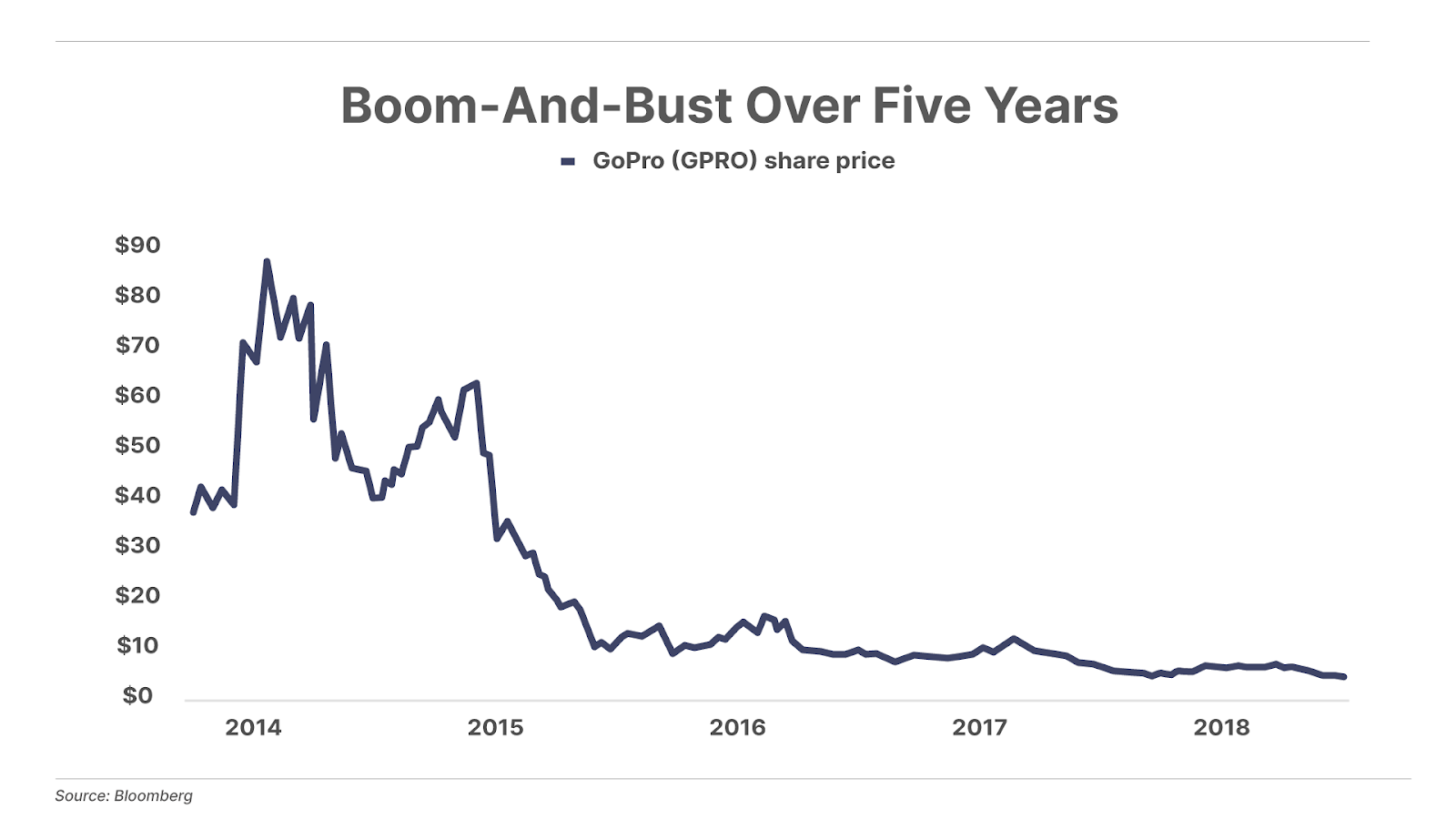
Facing bankruptcy, Woodman had to make painful, drastic cuts. He scrapped the media arm, laid off hundreds of employees, and shut down internal divisions. He stopped chasing the dream of becoming a content company and returned to the core, capital efficient business: making the best, most durable action cameras.
The recovery was slow and steady. Woodman learned to focus on profitable sales over unit volume, leaning into the high-end market where smartphones still couldn't compete. The key was the subscription model, GoPro’s Quik app, which offered unlimited cloud storage and editing tools. This generated recurring revenue, provided a direct relationship with the customer, and stabilized the business.
By 2020, GoPro had its first profitable holiday quarter in years. The company had cut the fat, focused on its niche, and built a sustainable, smaller-but-smarter business model. The surfer who loved capturing the perfect wave had finally gotten his ride.
The story of Nick Woodman and GoPro is similar to that of the company whose stock we are re-recommending this month. It’s a boom-and-bust story with a passionate founder and a loyal following – which has now found its feet once again and is on a nice path of profitability.
Going Back For Seconds
This content is only available for paid members. If you are interested in joining Porter & Co. either click the button below now or call our Customer Care team at 888-610-8895.