
The High-Potential Royalty Company No One Knows About
This is the free version of Complete Investor, which provides analysis and insights. Paid subscribers get access to the full issue, including investment recommendations with buy-up-to prices and more. Click here for details.
It was a slow fire, starting from the feet up.
Jacques de Molay – the last Grand Master of the Knights Templar – had plenty of time for a few last words as he began to roast for his alleged heresy.
He chose a curse.
King Philip! Before the year is out, I call you to appear before the tribunal of God to receive your just punishment! Accursed! Accursed! All accursed till the 13th generation of your race!
King Philip IV of France, who’d sentenced de Molay to the stake, didn’t care about the curse. He’d just gotten rid of his massive debts to the Templars by wiping out their entire Order. He felt fine.
He’d continue to feel fine for exactly eight more months.
There was always something a little uncanny – maybe even supernatural – about the Knights Templar. Commissioned as a royal order in 1188 to supply manpower and funds to the Crusades, they were a secretive mix between monks, knights, and bankers who’d taken a strict vow of poverty but were also, somehow, very rich.
From their headquarters on the fabled Temple Mount in Jerusalem, the Knights Templar operated a network of over a thousand “preceptories,” walled fortresses with treasure in the vaults and high-yielding mini-farms in their courtyards. Tax-exempt by papal decree – and allowed to collect tithes, to boot – they deployed funds across Europe and the Holy Land to wherever they were needed most.
As the closest thing to a secure banking network that medieval England had, the Knights loaned money. Lots and lots of money.
And they charged interest... which they were not supposed to do.
Today, usury (defined as charging any amount of interest on a loan) is a largely forgotten sin. But in the Middle Ages, according to the Catholic Church, it was well-nigh unpardonable.
Supposedly, interest was sinful because it was too easy: you hadn’t earned it by the sweat of your brow, as the Book of Genesis instructs. (The Parable of the Talents, where Jesus tells his servants to loan out their money and bring in a hefty return, was generally glossed over.) Clergy described usury as even worse than prostitution, because hookers actually did work and earned an honest penny.
In practical terms, popes felt alarmed by the rise in power of a growing secular merchant class who could (in theory) generate endless wealth without giving any to the Church.
So a series of increasingly hysterical church councils in the 1100s denounced usury as “ferocious” and “oppressive” and decreed that usurers were to be excommunicated for life and buried outside the cemetery, like lepers. After death, their troubles continued: they were stuck in hell with moneybags hanging around their necks.
(As a side note, the ban on usury wasn’t just an excuse to run Jewish moneylenders out of town, as later history books have often claimed: Spanish and Lombardy lenders were persecuted with equal fervor.)
The Knights Templar – as good Catholics, operating under the auspices of the Church – would never openly charge interest. What they did instead was rack up “handling fees” that, just coincidentally, amounted to the standard 10% to 12% interest rate moneylenders usually charged.
This meant there was much more money in the medieval banking system than the official books acknowledged. There was money that changed hands in the sight of God and everybody (functionally, M2), and then there was under-the-table interest (“fees”) that accrued.
The Knights Templar took all this shadow money and sat on it. By 1300, their moveable wealth alone was estimated at 150,000 gold florins (some $30 million, an astronomical sum for the time). In the blunt words of Aristotle, not a fan of interest, they were “breeding money” to make more and more money. And that, in itself, was unnatural.
Eventually, the money screwed the Knights.
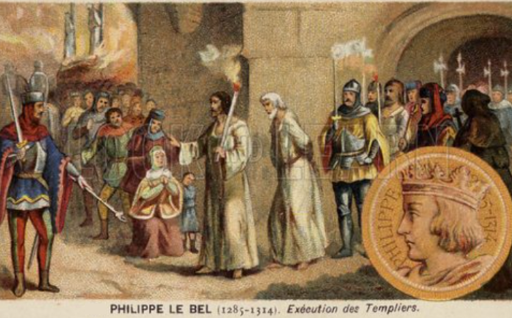
In 1299, King Philip IV borrowed a little too much from the Knights Templar, at that steep 10% “handling fee” rate. After an expensive Flemish war and a large dowry for his sister, he’d found himself deep in the red. He knew the armed Knights Templar weren’t afraid to show up at your house if you defaulted, either.
Rather than pay up, Philip decided to destroy the entire Templar order. On Friday the 13th, 1307, (the origin of Friday the 13th as an unlucky day!), he ordered mass arrest and imprisonment of all the Knights Templar on grounds of blasphemy and obscenity.
The secrecy of the Templar order worked against them. Accused of various offenses – giving each other “obscene kisses” as an initiation rite, conducting unholy Masses, and worshiping a mummified goat’s head – they couldn’t offer much proof to the contrary. After a five-year-long inquisition, the group was officially disbanded, its fortunes turned over to the Royal Treasury, and 54 of the leading Knights burned at the stake.
Jacques de Molay, it seemed, didn’t die without some revenge.
Just eight months after Molay’s curse at the stake, King Philip was killed by a stroke while hunting. His oldest son, who took the throne, then died unexpectedly, too. The same thing happened to his other sons, who each assumed the crown and then died childless.
Within 14 years of Molay’s death, Philip’s entire royal family, the 300-year-old House of Capet, had collapsed.
The Knights Templar, though, lived on in popular imagination, with their wealth, mystique, and abrupt end providing plenty of fodder for Dan Brown novels. (Today, the Freemasons claim that their secret initiation rituals were handed down directly from Jacques de Molay shortly before his death at the stake.)
And the shadow network they created – that clever “usury-free” loan system – lived on, too...
Improving On The Templar
With the destruction of the Templar order, a banking void sprang up across Europe. Popes, kings, and nobles still needed secure money transfers, letters of credit, and, yes, loans – and so a group of Florentine bankers, who’d been watching the Knights closely, took up the mantle. The Peruzzi and the Bardi families stepped up as serious international bankers in the early 1300s, followed by the Medici in the 1400s. They all loaned money in front of God and everybody – and all worked behind the scenes to stash away church-proof interest in plain sight.
The Florentines’ best usury-hiding trick (perfected by the Medici) was an improvement on the Templar “handling fees.” They worked out a bills-of-exchange system, where you could send your money to be changed into another country’s currency. The money would stay long enough in the other country for its value to fluctuate just a bit, and coincidentally, the difference, which you pocketed, was about 10%.
Their other innovation was that the Medici kept track of their transactions, using a new system called double-entry bookkeeping that logged credits and debits on opposite sides of the pages. This meant that the Medici knew the exact amount of money that was in the system at any given time – both the “official” money and the “shadow” money – which gave them a tremendous edge in predicting where capital would flow next.
Not surprisingly, the Medici, like the Knights Templar, became fabulously rich. Eventually, they even became the official bank of the Catholic Church, who didn’t mind pocketing a chunk of definitely-not-sinful, definitely-not-usurious exchange fees. (Usury, by the way, remained on the books as an official sin until 1917!)
For many centuries, in fact, this is how the famous banking houses of the world operated... the Medici, the Rothschilds, the Fuggers. They all tracked the amount of credit in the system, kept this information a very closely guarded secret, and used it to predict future asset prices, such as real estate and commodities, currency exchange rates, and, most importantly, gold.
Interest isn’t a sin anymore and the amount of credit in the system is thankfully no longer a secret. But the information in the “shadow market” of credit is still as valuable for us as it was for the Knights Templar... if we know what to look for.
As we detailed recently, money supply – M2, M3 – only captures a fraction of total dollar-system leverage. It counts cash, checking accounts, savings accounts, and some short-term instruments. But it misses the vast ocean of credit that sits outside the banking system’s deposit base: the $39 trillion in federal government debt, the trillions in corporate bonds held by pension funds and insurance companies, the $14 trillion in offshore dollar-denominated loans and bonds extended to borrowers in Brazil, Europe, and Asia.
None of that shows up in M2. But all of these invisible dollars represent claims on future production, promises that will need to be honored, rolled over, or inflated away.
Gold prices respond to the total stock of dollar-denominated promises, not just the narrow money supply. When you measure credit instead of money, you capture the full weight of the dollar system – every mortgage, every Treasury bond, every eurodollar loan. That is what gold is really pricing: the sheer mass of dollar obligations relative to the one asset that cannot be diluted.
Our proprietary global credit database, which tracks the total amount of dollar-denominated credit in the world, is telling us that credit growth has reached unprecedented (and possibly unsustainable) levels – which, in turn, is driving gold’s price even higher than the standard Austrian model would predict. In fact, we at Porter & Co. predict gold prices will easily double over the next three years.
For that reason, we are adding the world’s fastest-growing precious metals royalty and streaming company as this month’s recommendation. The four-year-old company’s portfolio includes more than 25 assets spanning gold, silver, copper, nickel, zinc, and uranium. Roughly 85% of expected 2026 revenue is tied to gold and silver.
Looking To Become Royalty Royalty
 Subscribe to Porter Stansberry’s Complete Investor to unlock the rest of this issue and more.
Become a Complete Investor subscriber today to get instant access to the rest of this issue and other valuable subscriber-only content.
A Complete Investor subscription gets you:
-
Monthly Issues – a detailed analysis on a new recommendation plus ongoing updates on the existing list of recommendations
-
Special Reports – deep-dive analyses covering every major market-moving trend, such as artificial intelligence and other breakthrough technologies. Plus, why property & casualty insurance stocks are a must-own, the best ways to invest in energy and commodities.
-
Buy / Sell Alerts – instant notifications when any stock in our recommended list makes a major move worthy of your attention.
-
Monthly Roundtable – listen in to this exclusive podcast as Porter and his editorial team discuss the markets, the open recommendations, and the strategies subscribers can use to maximize their returns
-
Custom Investment Indexes - such as the Better Than Berkshire Index, a systematic approach to building your own Berkshire Hathaway holdings using superior companies, and The Lindy Index, the top-40 companies that have been compounding returns for at least 50 years, to name just two
-
Porter’s Permanent Portfolio – a fully balanced portfolio with 25% allocated to bond-like investments, 25% in the world’s best businesses, 25% in hard assets, and 25% in cash-like investments. Despite having half the risk of the market, this portfolio has consistently outperformed the S&P since inception
-
And more…
Click here to lock in our lowest available rate --> a savings of $575 off the usual annual rate.
This content is only available for paid members.
If you are interested in joining Porter & Co. either click the button below now or call our Customer Care team at 888-610-8895.