Why America Is Heading For 100-Year Financial Reckoning
Inside Today’s Issue
You’ve watched Washington spend the last 50 years buying votes.
Every year, it promised more, mostly in retirement and medical benefits. But… the government never paid for this largesse. It simply borrowed more and more.
Remember the debt ceiling? All a lie.
Fifty years ago, in 1976, the federal government spent $372 billion. In the fiscal year that ended on September 30, it spent $7.4 trillion: 20 times more. Even after inflation, Washington spends three times more than it did when Gerald Ford was president.
Has your life gotten 3x better? Or only 3x more expensive?
In 1976, the public held $477 billion of federal debt, equal to about 27% of the economy. Today, the public holds $32.8 trillion of federal debt: 69 times as much, and more than the entire output of the U.S. economy over the past year.
Who will pay for all this debt? Not the average voter.
In 2022 (the latest year of available data), the top 20% of households paid 88% of all federal income taxes. Said another way, about 20% of America pays for virtually all of government.
And here’s the worst part: the bottom 40% paid less than nothing. “Refundable tax credits” are checks the IRS mails to people whose credits exceed the tax they owe. In 2022, the IRS gave the poorest fifth of households an average income tax rate of minus 10%.
And that’s only part of the problem.
The real problem is the enormous entitlements that have been promised to seniors. In total, federal, state, and local governments are paying individuals $5.1 trillion a year in Social Security, Medicare, Medicaid, and other benefits. Meanwhile, the entire federal income tax raised $2.84 trillion in fiscal 2026.
You might notice that our deficit (~$2 trillion) is more or less the difference between those two numbers. That’s because our federal government has slowly become an enormous socialist redistribution scheme. In fact, in 2022, 53% of counties in the United States got at least 25% of their personal income from government transfers. In other words, in more than half of the counties in the nation, the federal government is the largest individual source of income. That share was 10% in 2000, and under 1% in 1970.
Who pays? Only about two Americans in 10.
I know many of you believe that’s “your” money. The Social Security Administration even sends you “statements” that show the “benefit” you’ve earned. But it’s all a lie. The money you paid into the system was never invested. It went directly into the general fund at the Treasury and went right back out the door to pay other beneficiaries. Social Security is a state-administered Ponzi scheme. And if you don’t believe me, go read Flemming v Nestor (1960).
The Supreme Court ruled on the matter: Social Security payroll taxes are merely a tax, like any other. And you have zero right to any benefit.
And here’s the only fact that matters: Social Security has paid out more than it collects in taxes every year since 2010. It will run out of money in 2029.
The Social Security trustees report that the retirement trust fund’s reserves drop below one full year of benefits during 2028. By the start of 2029, the fund will hold only 82% of one year’s checks, which fails the trustees’ own test of short-range financial adequacy. After that, incoming taxes cover only 78% of promised benefits, and the law does not let Social Security pay out more than it takes in.
That is a 22% cut. If you are the average retiree, collecting $2,107 a month next year, you lose about $464 a month in 2029.
Medicare is in the same place. Its hospital fund starts paying out more than all of its income next year, and it is empty in the spring of 2033.
That means, someone is going to have to pay a lot more. But who?
Here’s the crazy part: instead of working to shore up these programs, our government is making the problem much worse. It’s been accelerating the collapse of these benefits by narrowing the tax base even more. The 2025 tax law gave most Americans 65 or older an extra $6,000 deduction. Washington sold it as “no tax on Social Security.” As a result, 51.4 million seniors (88% of those collecting Social Security) owe no income tax at all.
Democrats, who just won control of Congress, have bills to wipe out federal income tax on the first $46,000 of a single worker’s income, or on the first $75,000 a married couple earns. And for the young, there is a House bill to mail every American aged 18 to 24 a $500 check every month.
Our government can’t pay its bills right now. But our leaders continue to narrow the tax base, putting more of its fiscal obligations onto the backs of a shockingly small cohort of Americans.
What happens when they quit paying?
If you tax me at over 50% of my wages, I have a huge incentive to either not work or to work outside the legal economy. When taxes are unreasonable or deeply unfair, they’re ignored. And when the law isn’t just, it corrodes the entire society. It also leads to radical politics, violence, and eventually to civil war.
Our country was founded on the idea of “no taxation without representation.” Our society won’t survive a political system where 80% survive by enslaving 20%.
My book, 2029: The End Of America, walks through the choices we face.
The government can’t default. That would destroy the banking system and put us into a 20-year depression.
It can’t cut spending, because the 80% of voters who gain from spending are never going to lose an election to the 20% who must pay.
And so… the outcome is obvious: the government is going to inflate. They will print the money to pay the bills. But… this time it won’t be so easy. Inflation shrinks the real value of the debt, but it raises the real cost of the benefits at the same pace. Every January, Social Security checks rise automatically with inflation. In 2027, the increase is 3.6% – the largest since 2023.
The other problem is even worse. Most of our federal debt is extremely short duration. Washington has $7.1 trillion of Treasury bills outstanding. When interest rates rise, those bills roll over at the new rate within months. Interest on the debt cost $1.14 trillion last fiscal year, up 11%. We now spend more on interest than on our entire military.
This kind of math is what creates a “doom loop.” There’s no way to stop the spending. There’s no way to finance it, without printing trillions. But the printing that’s driving costs vastly higher… is pushing spending even higher.
And inflation is already rising. You can see it at the gas pump: energy prices rose 20.4% over the year to September. Consumer prices overall rose 3.7%. Wholesale prices, what businesses pay before they mark goods up for you, rose 6.4%.
The Federal Reserve raised rates in September, its first increase in more than three years. Traders now put the odds of another hike in December above 70%. Every hike raises the cost of rolling over $7 trillion of bills.
The Fed can fight inflation and blow up the Treasury’s interest bill, or it can protect the Treasury and let prices run. It cannot do both.
What will the government do?
Since last December, the Fed has been printing money to buy Treasury bills again. It calls these purchases “reserve management.” Its holdings of Treasury securities have grown by about $390 billion this year. If the government was serious about fighting inflation, would it be printing half a trillion dollars a year…?
I expect consumer prices to be rising at 6% a year or more by the time the next president takes the oath in January 2029. So who will pay for Social Security as its benefits ratchet higher and higher with inflation?
When the retirement fund runs dry, Washington has three choices: cut every check by 22%, massively raise taxes on 27 million households, or renege on its promises.
It’s going to renege.
If you’re under 60 years old, my best advice is to plan on never receiving anything from Social Security or Medicare.
That means, you’re going to have to create your own Social Security. How? You must own something Washington can’t print. You must own something that can’t be means-test away. And you have to own something that’s utterly reliable, that will grow no matter what happens in the world.
What To Do About The Coming Social Security Collapse
I don’t want a Social Security check. I don’t trust the government. And I know they’re going to do everything they can to exploit me and my family. So I must be prepared for what’s coming. I want trees.
Weyerhaeuser (WY) is the largest private owner of timberland in the United States. It owns 9.7 million acres, controls another 649,000 under long-term contracts, and runs 33 mills. It is, more or less, the timber business in America.
Timber protects you from inflation for a reason no bond can match: it grows. A pine plantation adds wood every year, whether lumber sells for a high price or a low one. When prices are bad, Weyerhaeuser leaves the trees standing, and its inventory gets bigger and more valuable while it waits.
That’s why timber has done its best work when inflation was at its worst. From 1973 through 1981, when consumer prices rose 9.2% a year, timberland returned 17.1% a year.
Right now, the stock is suffering. Mortgage rates are back over 7%, and record diesel prices are raising the cost of hauling logs. But the trees don’t care. They’re still growing.
Different trees grow at different rates, which makes it easy to value what Weyerhaeuser owns. Last month, Weyerhaeuser agreed to sell 81,000 acres in Arkansas (southern pine) for $146 million: about $1,800 an acre. Last year it sold 28,000 acres in Oregon (Douglas fir) for $190 million, about $6,800 an acre.
To generate a reasonable book value for the company, we can value every Southern acre it owns at the Arkansas price. We’ll value its Western acres at $5,500, a conservative discount to the Oregon sale. We’ll count only the land it owns outright, and we’ll give its 33 mills and its real estate business a value of zero. We’ll subtract $5 billion to cover the company’s debt. Do all of that and you get about $28 a share. At $21, you are buying the trees for roughly a quarter less than Weyerhaeuser’s own discount sale price, and you get the 33 mills for free.
Management sees the same gap. It told investors on October 30 that buying back its own shares is “a particularly attractive opportunity right now” and that it will buy more of them this quarter.
Yes, gold preserves wealth. It’s very important to own some as we enter this crisis. But trees will grow your wealth. They’re even more important to own, if you need to finance your own retirement after Social Security collapses.
I explain my entire system for investing in trees in my book. There’s an easy way to finance the purchase so that you can almost double your returns, when you buy at the right time. Get your copy of 2029: The End Of America: Why The Age Of Paper Money Is Ending And How To Survive The Coming Global Monetary Reset, on Amazon.
Tell me what you think of today’s Daily Journal: porterstansberrydirect@gmail.com
Good investing,
F. Porter Stansberry
Stevenson, Maryland

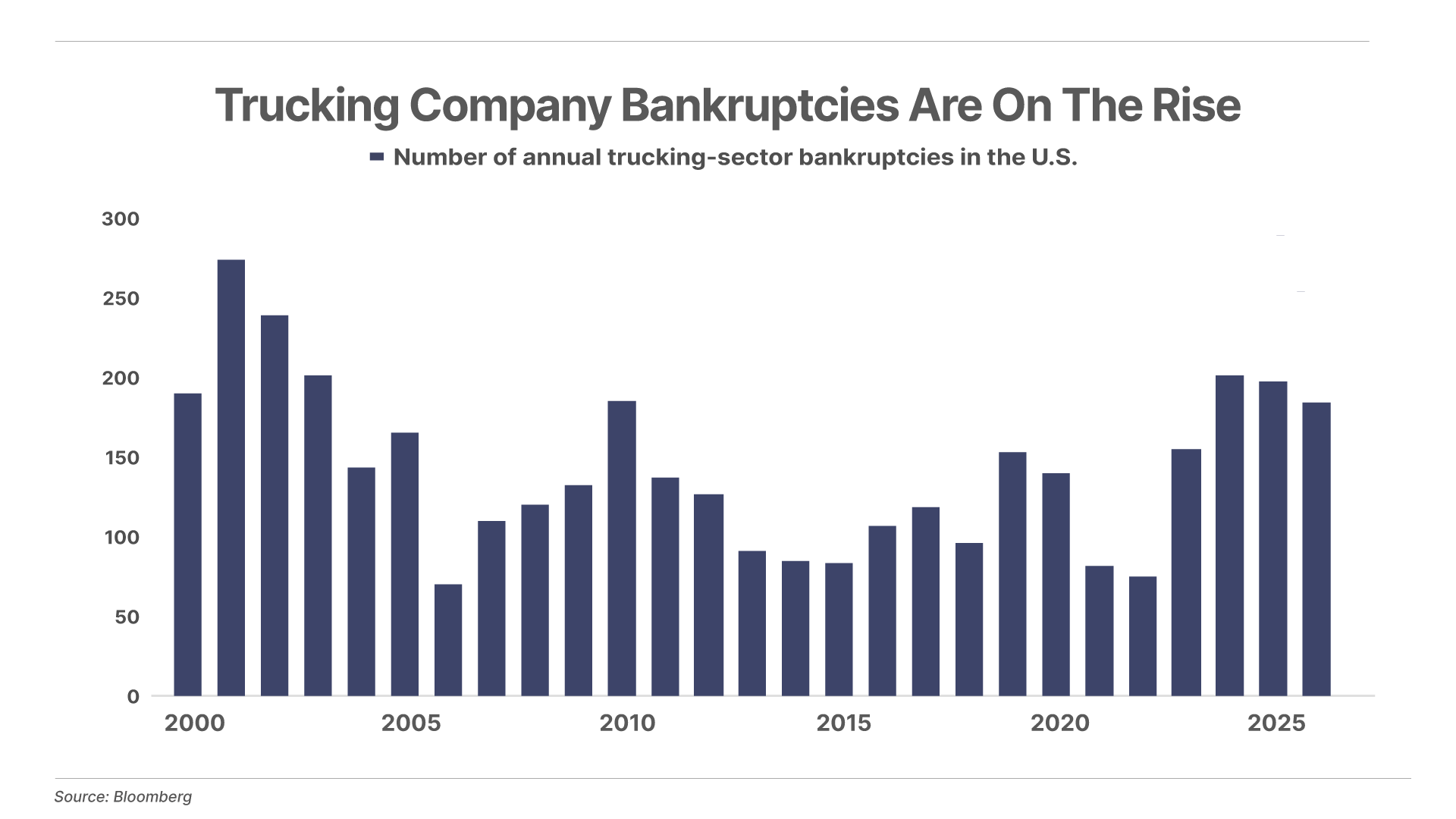
1. Trucking bankruptcies are rising – 221 U.S. trucking companies have filed for bankruptcy in 2026. That is the third straight year above 220 filings, after fewer than 100 in each of 2021 and 2022. Demand is soft, with about two-thirds of small carriers (20 or fewer trucks) reporting flat or lower revenue. Costs are up with diesel prices near record highs, rising insurance premiums, and higher rates on equipment loans. Roughly 40% of small operators expect to be out of the business within six months.
2. McDonald’s picks Uber over DoorDash for app delivery orders. Under a multi-year deal announced Monday, Uber Technologies (UBER) becomes the preferred delivery service for orders placed in the McDonald’s (MCD) app across 14 countries, including the U.S., Canada, and the UK. Until now, McDonald’s split those orders between Uber and DoorDash. The two Complete Investor recommendations will also link their rewards programs. McDonald’s restaurants sell more than $20 billion a year through delivery.
3. Record hedge-fund selling of AI stocks has often signaled a bottom. Goldman Sachs tracks the trades of hedge funds that use it as their broker. In the 20 trading days through November 5, those funds sold, on net, AI stocks equal to about 9% of their total positions in the group. That is the most since Goldman began tracking in late 2021. Earlier waves of heavy selling came near important market lows in March 2022, June 2022, October 2023, August 2024, and April 2025.
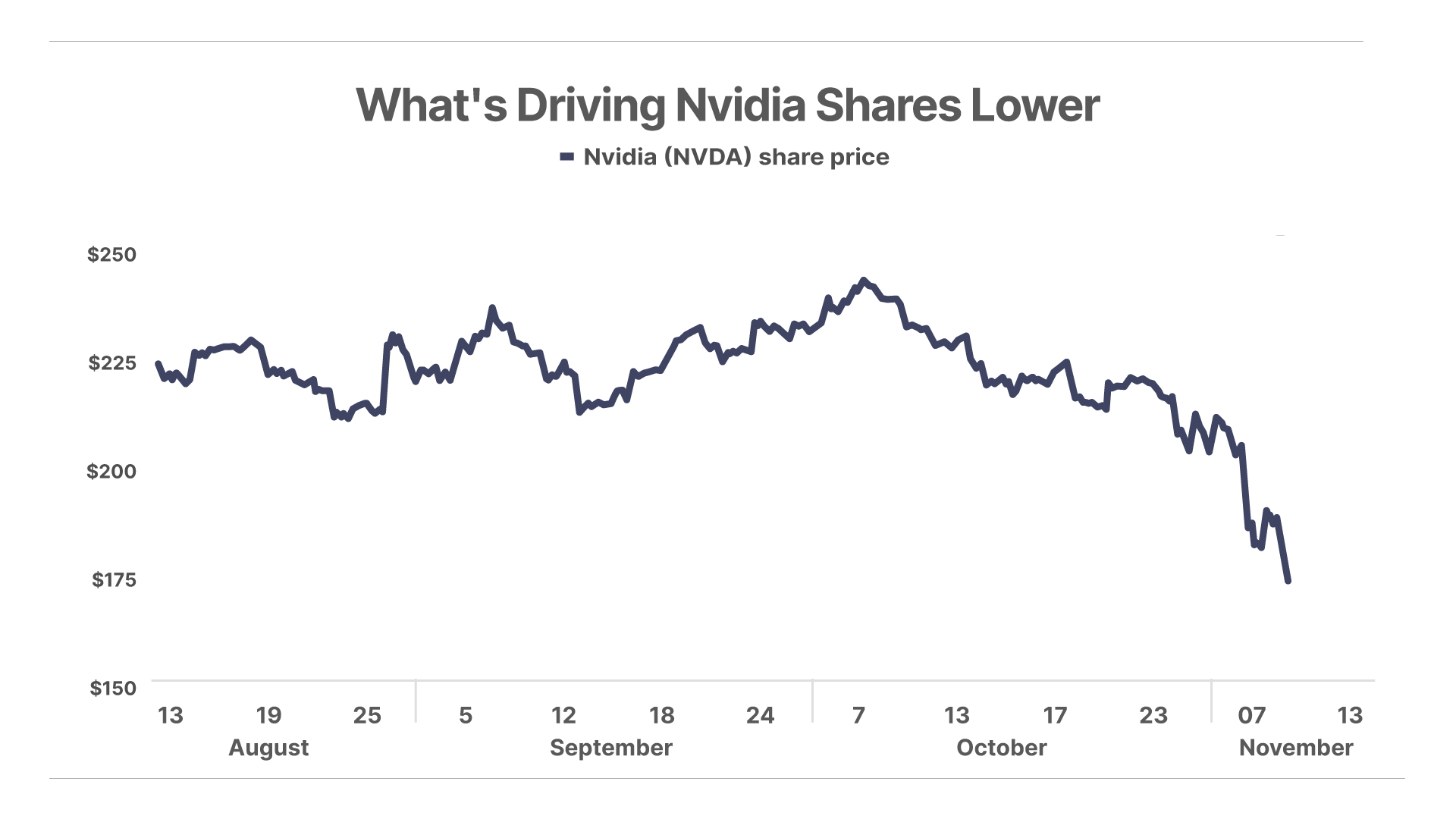
Nvidia (NVDA) shares fell as much as 8.8% this morning after CEO Jensen Huang admitted to an affair. The Financial Times reported Friday that U.S. intelligence believes he had a romantic relationship with Alice Huang (no relation), a former executive at Nvidia customer Megaspeed whom officials suspect of spying for China, a claim Beijing denies. Nvidia’s board has opened an independent investigation, and at its low, the drop erased almost $400 billion in market value.
“Only Learning…”
Von R. writes:
I must say you’re a quite intelligent person and very successful, but when you say something like “there’s no such thing as teaching, only learning,” it is about the stupidest thing I’ve ever heard.
You can’t learn something unless it was taught to you. Newton‘s third law of physics says: for every action there’s an equal and opposite reaction.
If I go to college and read a book or pursue a career, I learned something, but somebody had to teach it to me. It just doesn’t come into my brain through osmosis.
Porter & Co. Comment: Yes, but one must be willing to absorb it. You can give people the best financial advice, strategies, or market data in the world, but it will have zero impact if they are not ready or willing to put it to work.
Porter & Co. Market Snapshot |
Through Friday, November 6, 2026 close |
| Markets |
| Index or asset | Last | 1-Day | YTD | 1-Year |
|---|---|---|---|---|
|
S&P 500
Total return
|
735.29 | +0.31% | +8.7% | +10.9% |
|
Gold
Front-month futures
|
$4,074.90 | −0.94% | −6.1% | +2.1% |
|
Bitcoin
4 pm ET print
|
$75,758.00 | −0.43% | −13.5% | −24.9% |
|
Crude oil
WTI, per barrel
|
$90.83 | +0.34% | +58.2% | +52.8% |
|
Berkshire Hathaway
NYSE: BRK-A
|
$856,612.00 | −0.01% | +13.5% | +15.8% |
| U.S. Treasury yields |
| Maturity | Yield | 1-Day | YTD | 1-Year |
|---|---|---|---|---|
|
2-Year
|
4.51% | +5 bps | +104 bps | +94 bps |
|
10-Year
|
4.86% | +2 bps | +68 bps | +75 bps |
|
30-Year
|
5.26% | +1 bps | +42 bps | +57 bps |
| Porter & Co. strategies |
| Strategy | 1-Day | YTD | Since start | Per year |
|---|---|---|---|---|
|
Porter’s Permanent Portfolio
Since September 25, 2024
|
−0.69% | +6.7% | +34.6% | +15.1% |
|
Better Than Berkshire Index
Since May 16, 2025
|
−1.28% | +2.3% | +2.6% | +1.8% |
|
Porter & Co. Top Ranked*
Since July 14, 2022
|
−0.68% | +3.5% | +29.5% | +9.9% |
Porter & Co. Top Positions |
Through Friday, November 6, 2026 close |
| # | Position | Total return |
|---|---|---|
| 1 |
Roivant Sciences ROIV
Biotechnology
|
+240% |
| 2 |
Roivant Sciences ROIV
Complete Investor
|
+236% |
| 3 |
TG Therapeutics TGTX
Biotechnology
|
+218% |
| 4 |
Bitcoin BTC/USD
Complete Investor
|
+180% |
| 5 |
Skyward Specialty Insurance SKWD
Complete Investor
|
+150% |
| 6 |
APA Corporation APA
Porter & Co. Asymmetry
|
+150% |
| 7 |
Philip Morris PM
Complete Investor
|
+147% |
| 8 |
W.R. Berkley WRB
Complete Investor
|
+121% |
| 9 |
BWX Technologies BWXT
Complete Investor
|
+112% |
| 10 |
Chubb CB
Complete Investor
|
+97% |