How The Retailer Lost The Customer Who Made It Profitable
Inside Today’s Issue
Last September, I explained why I think Target (TGT) will end up in bankruptcy within five to seven years. Since then the stock is up 85% – which in the minds of most readers will surely lead to the conclusion that I am wrong. But am I?
Here’s my thesis.
Target was the premier retail shopping experience for roughly two decades. The “Target run” was a weekend habit for many middle-class and upper-middle-class consumers. Target combined outstanding retailing with competitive prices, which won it a higher operating margin than other retailers. Those profits powered its constant expansion and brand marketing, which created a valuable national brand. For a very long time, this was more than good enough to hold off competitive threats from Costco Wholesale (COST), Walmart (WMT), and Amazon (AMZN). But, at the heart of Target’s success was an elevated, in-person shopping experience.
Then COVID happened.
Consumers’ shopping habits changed… dramatically. Upper-middle-class customers stopped coming to the store, at first because of masks and now because delivery apps save so much time. Additionally, in many areas, Target’s stores became rundown and filled with both low-class employees and low-class customers. As traffic fell, margins collapsed.
The shopping app trend continues: DoorDash grew revenue 35.6% in its June quarter, to $4.45 billion from $3.28 billion. Instacart grew 14.1%, to $1.04 billion from $914 million. The affluent household now pays a fee to avoid going to Target.
Target lost the customer who made it profitable.
Key stats from Target’s fiscal 2021 peak to its lows in fiscal 2025:
- Revenue: $106.0 billion to $104.8 billion, down 1.2% in nominal dollars across four years of inflation
- Operating income: $8.95 billion to $5.12 billion, down 42.8%
- Operating margin: 8.4% to 4.9%
- Diluted earnings per share: $14.10 to $8.13, down 42.3%
- Free cash flow after capital spending: $5.08 billion to $2.83 billion
The company’s product mix also demonstrates this key demographic shift in its customer base. Since 2022 (full fiscal year 2022 vs fiscal year 2026):
- Home furnishing and décor: $20.3 billion to $15.6 billion, down 22.9%
- Hardlines: $18.6 billion to $15.8 billion, down 15.1%
- Apparel and accessories: $17.9 billion to $15.7 billion, down 12.2%
- Food and beverage: $20.3 billion to $24.1 billion, up 18.9%
Target replaced its highest-margin customers with people looking for cheap groceries.
But that’s not what today’s headlines claim. The company reports that operating margins have soared – jumping from 5.2% to 9.6% in the latest quarter.
When I saw those headlines, I laughed. There’s no way to increase operating margins when you’re in the middle of a turnaround that requires you to vastly improve the shopping experience while lowering prices. Target is spending heavily to improve its stores and it’s lowering its prices. How could margins improve?
Target received $994 million of refunds on tariffs last quarter. Getting a billion dollars certainly helps! The company chose to book this income as a reduction of cost of sales. Cost of goods sold therefore fell 1.7% while sales rose 5.3%, in part because of inflation.
The increase in operating margins was not brilliant merchandising. It was a one-time windfall and an accountant with a valuable imagination.
Target’s headline result was: 33.7% gross margin, up from 29.0% a year ago; a 9.6% operating margin against last year’s 5.2%.
What were the numbers, absent the one-time windfall?
Let me show you the 2Q results from 2024 and 2025. (Fiscal 2025’s Q2 was the liquidation quarter, when Target cleared excess inventory and cancelled orders. It’s not indicative of the company’s normal business. Fiscal 2024’s Q2 is the last one that ran normally.)
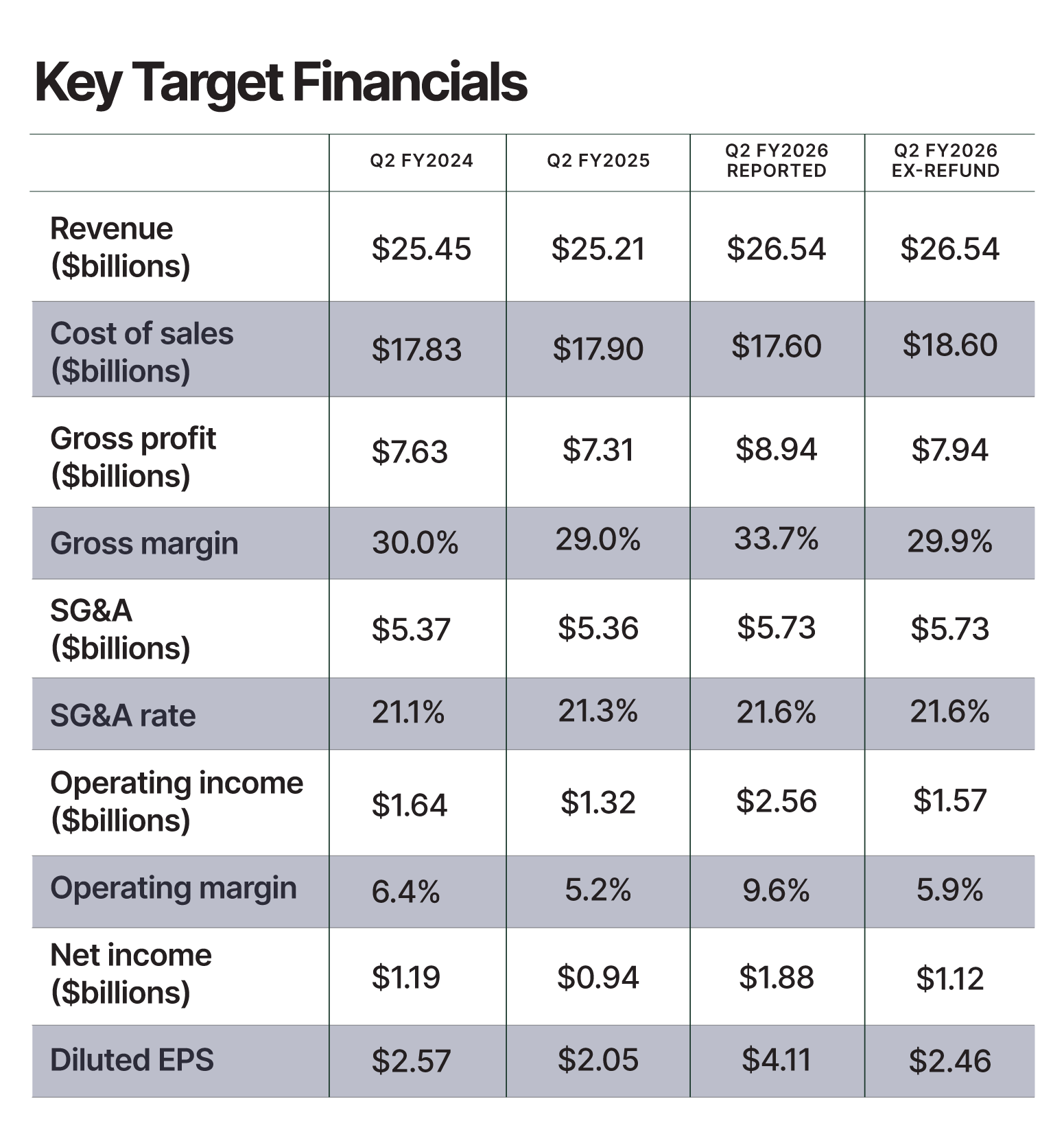
Target has a new chief executive, an “acceleration office,” 30 new stores, 130 remodels, and price cuts on more than 10,000 items. What’s changed? After two years, costs continue to grow – Selling, General, And Administrative (“SG&A”) is now 21.6% of revenue – and profits continue to fall – operating margin is 5.9% down from 6.4%, net income is $1.12 billion down from $1.19 billion.
Target went from 1,926 stores and 243.3 million square feet to 1,995 stores and 250.5 million square feet, while merchandise sales per square foot fell from $430 to $410, down 4.6% before inflation – 69 additional stores produced less sales per foot.
Another sign of brand decline: credit card profit sharing, the fee Target collects on its co-branded card, fell from $710 million to $522 million. Fewer affluent cardholders spending on credit.
Target has seen a 3.6% traffic increase. Two quarters of rising traffic is evidence that something is changing. The numbers tell me it’s more people responding to Target’s discounting because gross margin and operating margin continue to decline (compared to a real baseline, not a liquidation quarter).
Target is buying traffic with lower prices. It has reduced prices on more than 10,000 items in the last year. Average transaction price was flat this quarter and fell 0.4% for the full fiscal year, despite inflation above 3%.
Target is completing its conversion into a discount chain — more customers, cheaper carts, thinner margins, and a store experience that pushes the remaining affluent shopper toward an app.
Competing on price means competing with Walmart, which has far greater scale, and Costco, which competes with less markup, and Dollar General, which has lower cost per square foot.
Target carries the cost structure of a lifestyle retailer and the assortment of a discounter. That’s the Kmart strategy. And it doesn’t work.
There’s one wildcard that could enable Target to continue to tread water for longer than I expect.
Target sells advertising (Roundel) to its vendors. The incremental cost of those advertising dollars is close to zero. It also has Target Plus – a third-party marketplace where Target books a commission. And Circle 360 is the paid membership program at Target. Management reported Roundel gross billings were up nearly 20%, Target Plus merchandise volume was up more than 40%, and Circle 360 membership revenue up over 40%.
Target discloses advertising revenue in its annual filings:
- Fiscal 2023: $404 million
- Fiscal 2025: $649 million
- Fiscal 2026: $915 million
These are impressive numbers. But advertising is only 0.87% of total revenue.
To add one percentage point of operating margin, Target needs $1.05 billion of incremental operating profit. Advertising would have to more than double, at zero incremental cost, to recover a single point of the three and a half points of operating margin lost since fiscal 2021.
It’s a very important part of its business and it’s something that Kmart didn’t have. Is it enough to save the business? I don’t think so.
Capital spending is up 30% this year to $5 billion for the year. Target continues to invest heavily into its core retail business even though it continues to report falling sales per square foot. Shareholders are funding a bet that remodeled stores attract a customer who has already installed a shopping app and won’t go Target again. That strategy isn’t working: Target has added 69 stores over the last four years. And sales per square foot continue to fall.
Frankly, I think these decisions and the management’s handling of the tariff refund accounting show they’re delusional. But if you doubt me, just consider that they are also saying Target will resume repurchasing its own shares in the back half of this year.
Operating cash flow over the last 12 months was $8.72 billion. Remove the $994 million refund and it is $7.73 billion. Spend the promised $5 billion of capital and pay the $2.07 billion dividend, and $661 million remains for the entire year.
What Target must do is rebuild its brand, its merchandising, and its shopping experience to recapture its core, high-margin user. So far it hasn’t found that formula. And with so much competition from Costco, Amazon, Walmart, and Dollar General I don’t believe that’s possible.
Tell me what you think of today’s Daily Journal: porterstansberrydirect@gmail.com
Good investing,
F. Porter Stansberry
Stevenson, Maryland
P.S. For 50 years, market predictions offered up at The New Orleans Investment Conference have become market reality. This year, Porter has been invited to address the prestigious event, taking place October 28 to October 31. To learn more about the legendary conference and to attend, follow this link…
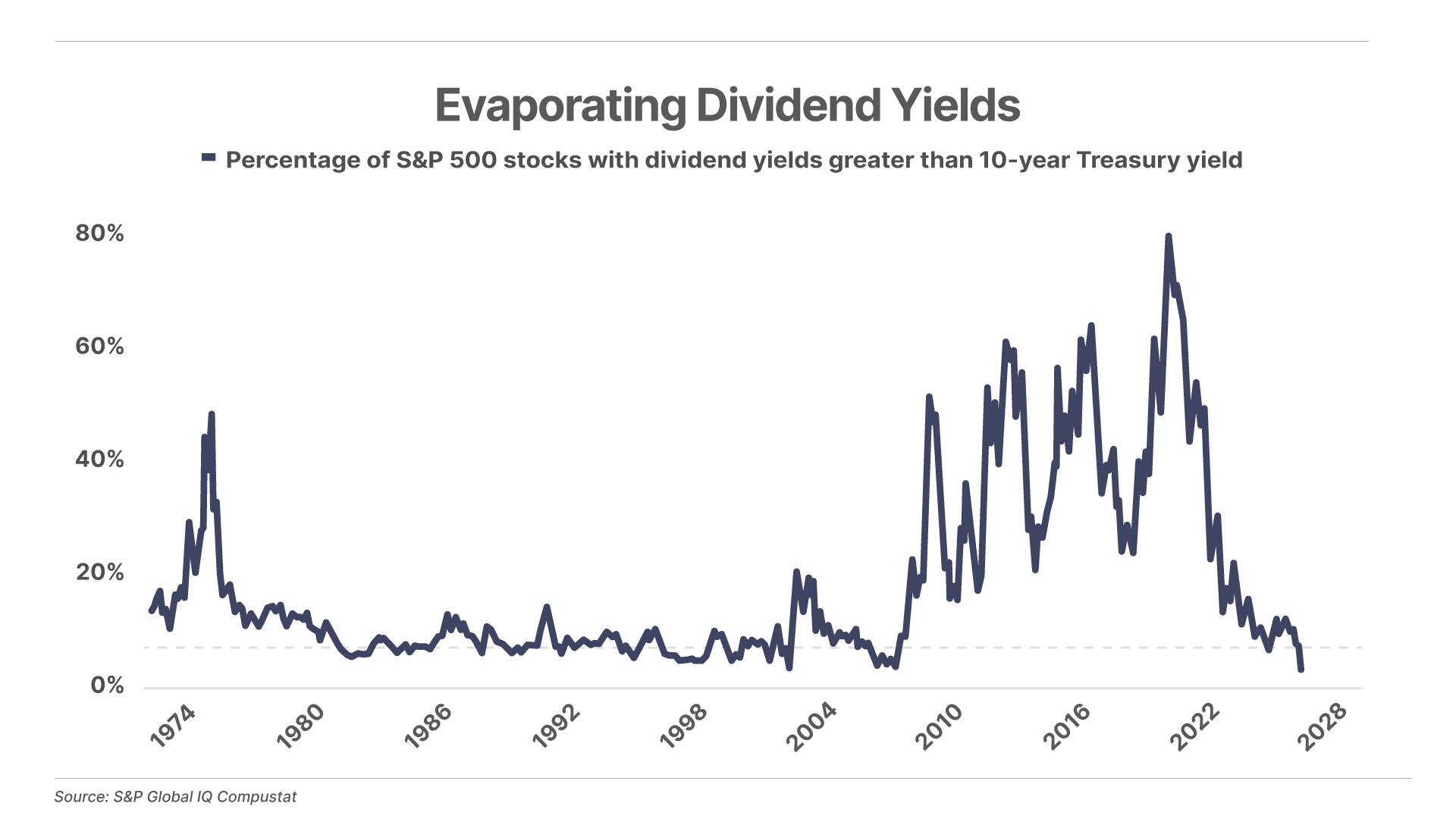
1. Stock dividends can no longer compete with Treasury bonds. In July 2016, 63.4% of S&P 500 companies paid a dividend yield above the 10-year Treasury note – meaning a shareholder collected more annual income per dollar invested than a government bond paid. That was the highest level since the data began in 1972, excluding the brief COVID crash. A decade later, that figure is 3.85%, the lowest since May 2007 – just 19 companies out of 500. Both sides of the comparison moved: the 10-year yield finished July at 4.75% versus 1.46% 10 years earlier, while the S&P 500’s own dividend yield was cut roughly in half, to about 1%, as index weight shifted toward technology companies that return cash through buybacks (or not at all).
2. Walmart earnings signal more consumer stress. Walmart (WMT) reported its weakest same-store-sales growth since 2020 in its Q2 results this morning, at 2.6%, significantly undershooting the 3.7% analyst estimates, sending shares 10% lower. Management cited stretched consumer budgets as the cause of sluggish demand, and this comes after U.S. retail sales unexpectedly dropped 0.6% in July. It also follows the poor July payrolls report that showed U.S. jobs declining by 23,000 for the month. The signs of a widespread consumer slowdown are mounting.
3. The Treasury’s bond-market rescue has already faded. At 8:20 am ET Wednesday, the 10-year Treasury yield was 4.68%. Minutes later, the U.S. Treasury announced it would at least double its “liquidity support” buybacks in the 10-to-30-year part of the market – from $2 billion per operation to at least $4 billion – starting September 9. The 10-year fell to 4.64%, and the 30-year dropped nine basis points to 5.19%, a day after touching its highest level since 2007. By this morning, the 10-year was at 4.71%, above where it started, and the 30-year yield had erased its entire decline. The arithmetic explains why. A buyback creates no new money: Treasury repurchases older bonds using cash raised by selling new debt, mostly short-term bills. It swaps maturities, it doesn’t retire debt. Total buybacks this quarter are capped near $38 billion versus $739 billion of net new borrowing. Markets read the move as a step toward holding long-term rates down. But for now, at least, the size isn’t there.
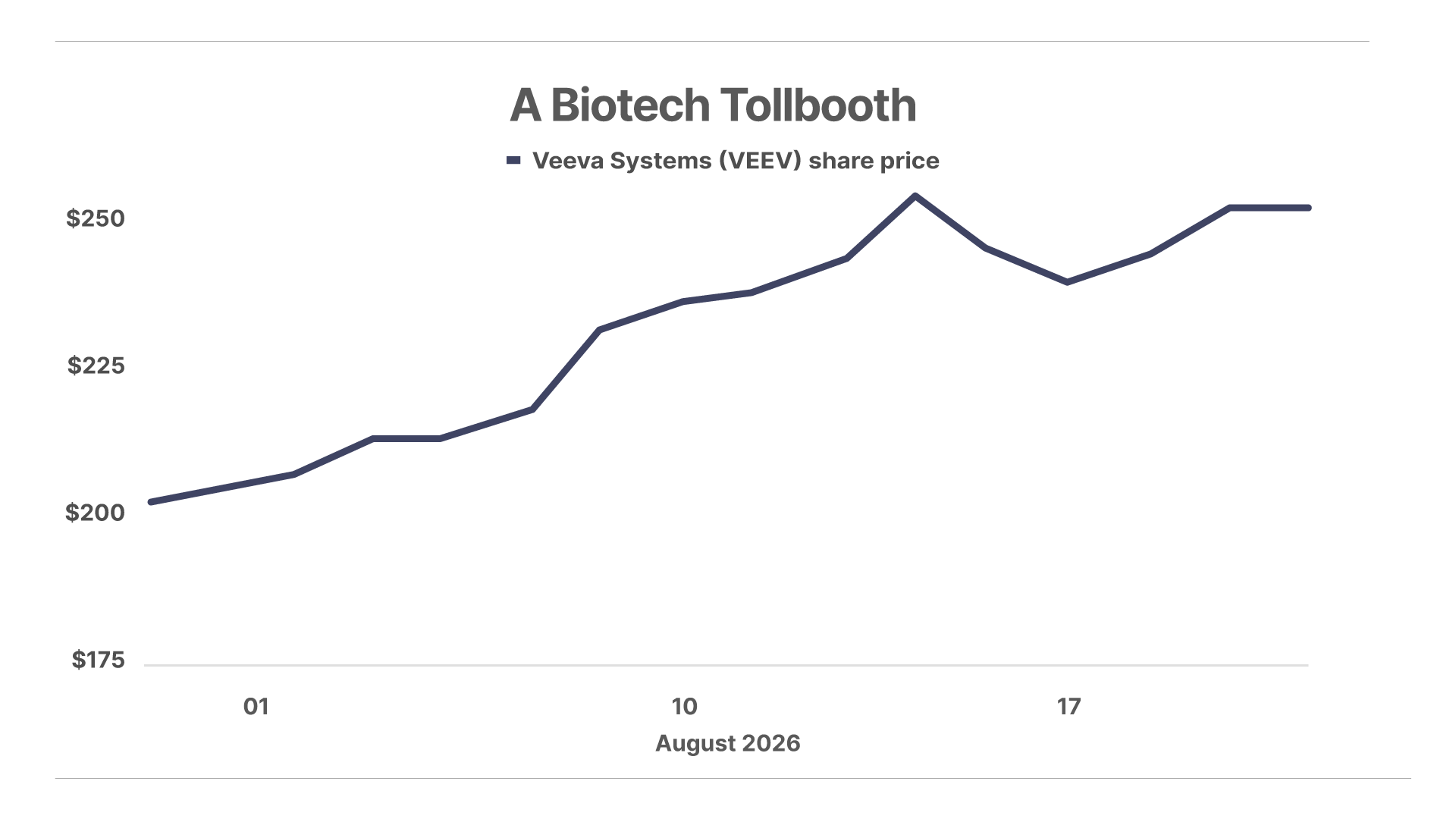
Biotech software leader Veeva Systems (VEEV) has seen its share price rise 24% since Porter recommended the company in the newly revamped Porter & Co. Biotechnology on August 1. His next biotech report reaches paid-up subscribers on September 5.
To become a paid-up subscriber and see what Porter will recommend next, click here.
“Same Thing As QE”
David G. writes:
Hey Porter,
Another great essay.
I read in the news this morning that the U.S. Treasury has begun buying back 10-year bonds to keep the interest on the 10-year bond down. It was 4.7% yesterday. That’s pretty close to your 5% “get out now” warning.
Isn’t this the same thing as QE for the long side of bonds?
In my honest opinion, I’m not sure that Secretary Bessent is really doing this solely for the interest rate. I personally think that he saw the handwriting on the wall similar to March 2023 when Signature and Silicon Valley collapsed. Liquidity then, and now, has all dried up.
“Stupid, Paper-Shuffling Rules”
Kraig F. writes:
Government regulators and stupidity certainly do rhyme. Why eliminate some of the rules passed under Dodd-Frank? It had many stupid, paper-shuffling rules (real estate appraisals come to mind), but the ones you mentioned are generally good guardrails.
As you point out, it will create winners and losers. I have been thinking of shorting Oracle for a while.
Your simple-to-understand analysis is much appreciated.